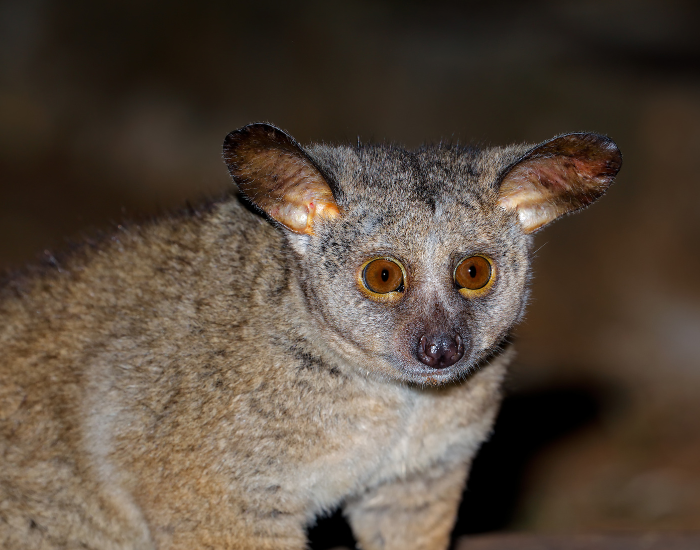
If the African night had an official mascot, it would undoubtedly be the bushbaby galago. When you think of African Animals, you probably think of cheetahs, or maybe servals. But these enchanting, diminutive primates, no bigger than a squirrel, are the undisputed champions of the nighttime canopy. They’re called “bush babies” because of their distinctive, loud, baby-like cries that echo through the forests and savannahs of sub-Saharan Africa.
Beyond the cute appearance and the heart-tugging calls, the bushbaby galago is a marvel of evolutionary engineering. Among bush baby species, there is remarkable diversity in form, habitat, and behavior, with each species, such as the Uluguru and Zanzibar bush babies, showcasing unique adaptations to their environments. Moreover, it’s a critical component of its ecosystem and an animal surrounded by fascinating facts and conservation complexities.
As a species, the Galagidae family, the collective name for all galago species, is one of the most successful groups of lower primates in Africa. But, how much do you really know about these agile, big-eyed acrobats?
We’re diving deep into the science, the stories, and the surprising facts that define the bushbaby galago. Therefore, get ready to have your understanding of these small primates completely transformed!
1. Are Galago and Bush Baby the Same? The Answer is Yes!
Let’s clear up the biggest question right out of the gate: Are galago and bush baby the same?
Absolutely. The names are interchangeable, but they have slightly different origins.
Bushbaby is the common, evocative name derived from their vocalizations. These famous, high-pitched baby-like cries or ‘weeps’ help them communicate, especially when startled or stressed.
Galago is the scientific genus name. Primatologists and researchers most often use this term. For example, the Senegal bushbaby, known scientifically as Galago senegalensis, is a well-known species within this genus.
So, whether you call them a bushbaby galago, a galago primate, or simply bush babies, you are referring to the same remarkable group of animals native to sub-Saharan Africa. They are also sometimes mistakenly referred to as “bush monkeys.” However, they are actually prosimians, an earlier branch of the primate family than true monkeys.

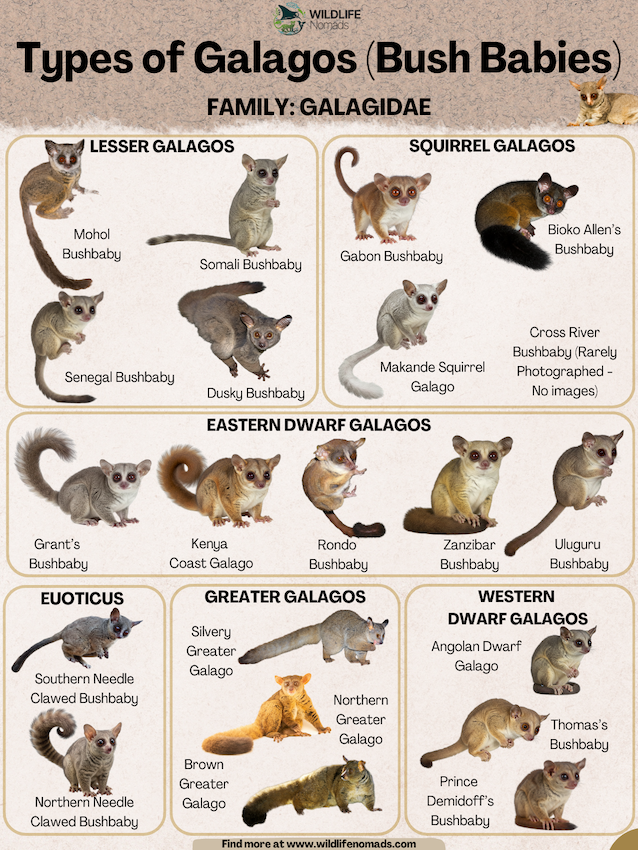
2. The Family is Vast: Over 20 Galago Species Exist
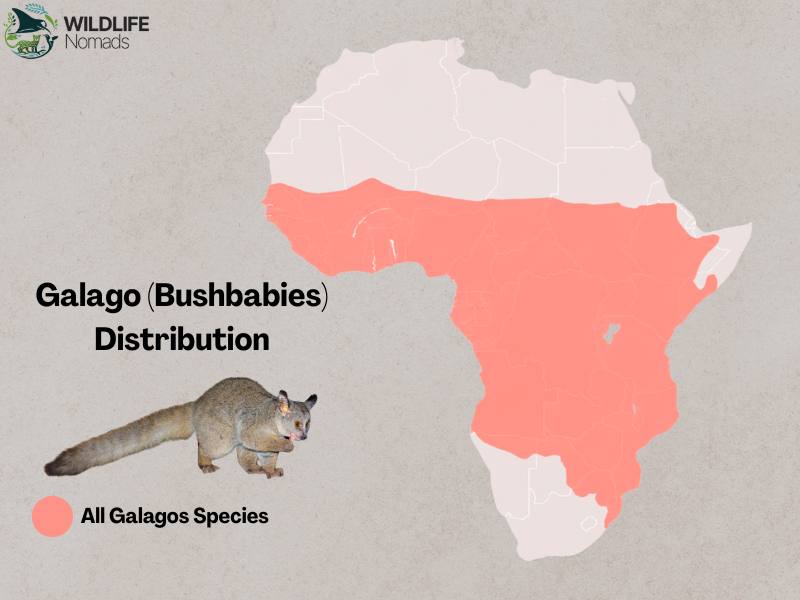
It’s easy to think of a bushbaby as just one animal. In reality, the family is massive and diverse. There are over 20 officially recognized galago species distributed across the continent, each showcasing incredible species diversity.
Notable species include:
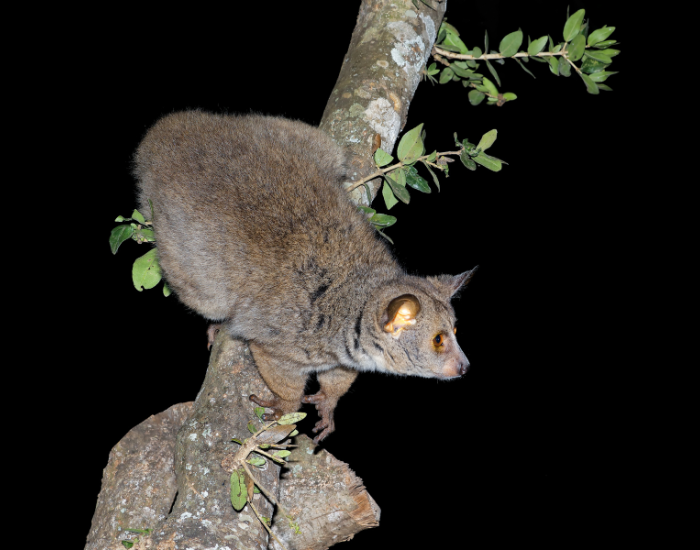
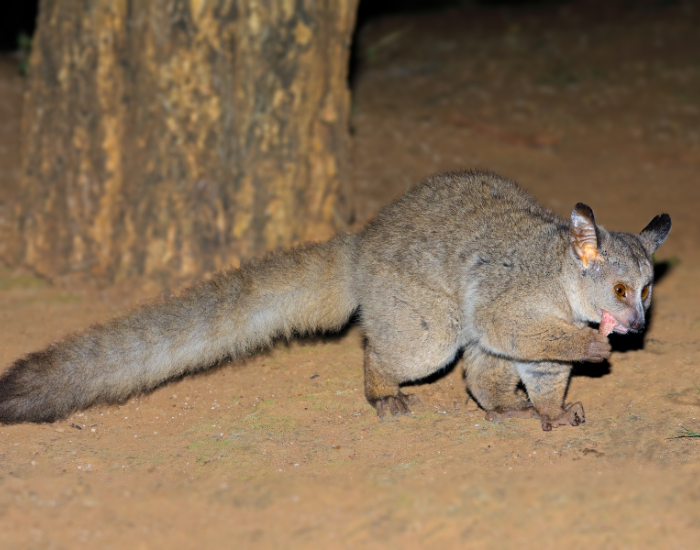
The Thick Tailed Greater Galago (Otolemur crassicaudatus) is one of the largest species, known for its very bushy tail that can be as long as its body length. It’s found in East Africa and Southern Africa.
The South African Lesser Galago (Galago moholi) is a much smaller, more common species found widely across southern parts of the continent. This lesser bushbaby is the type most commonly observed and studied. The galago moholi thrives in various habitat areas.
The Northern Greater Galago (Otolemur garnettii) is distinguished by its large size and powerful leaps, typically found in the equatorial forests of northern Tanzania and beyond.
Demidoff’s Dwarf Galago (Galagoides demidovii) is the smallest of the group, a true dwarf bushbaby weighing just 50-70 grams. Demidoff’s galago represents the mountain dwarf galago category.
Other species include Allen’s galago, the Somali bushbaby, spectacled lesser galago, and the lesser needle clawed galago, each adapted to different environments from West Africa to the Eastern Arc Mountains.
Most galago species are nocturnal and arboreal, with adaptations for leaping and living in trees. However, there is significant diversity in their size, behavior, and habitat preferences.
3. The Superpower is in the Legs: How Galagos Jump So High
If you’ve ever seen a bushbaby galago move, you know their most impressive trait is their ability to leap.
How do galagos jump so high?
Their secret lies in their incredible leg structure. They have disproportionately long, powerful hind legs and feet. These are specialized for vertical clinging and leaping (VCL).
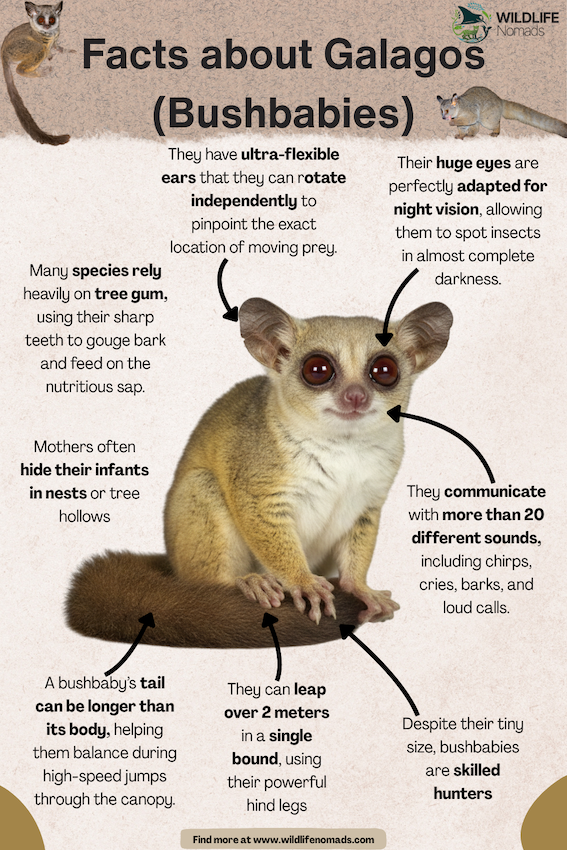
A study described their ability. They can jump up to 9 feet (nearly 3 meters) in a single bound. They essentially store elastic potential energy in their tendons and leg muscles before a jump, similar to how a spring is compressed. When they launch, this energy is released with explosive force. Consequently, this allows them to make multiple, rapid leaps through the darkness to avoid predators or catch insect prey. This makes them true acrobats of the forest.
4. They Mark Their Territory by… Urinating on Their Hands
This is perhaps the least “cute” of their characteristics. Nevertheless, it’s vital for their survival and social life. Bush babies are very good at olfactory communication. They use scent to navigate, warn others, and mark territory.
One of their primary methods is “urine washing” or “hand-washing.” The galago will urinate on its hands and feet. Then they spread the scent all over the branches they travel on. This creates a chemical trail that:
- Marks their path (allowing them to follow the trail home in the dark)
- Establishes dominance for dominant male individuals
- Aids in grip, providing a moist texture to help them cling to smooth surfaces
While we might find it odd, for a solitary forager navigating a dense, dark habitat, scent marking is the ultimate form of GPS and social messaging.
5. They Have ‘Delicate Ears’ That Can Be Folded Up
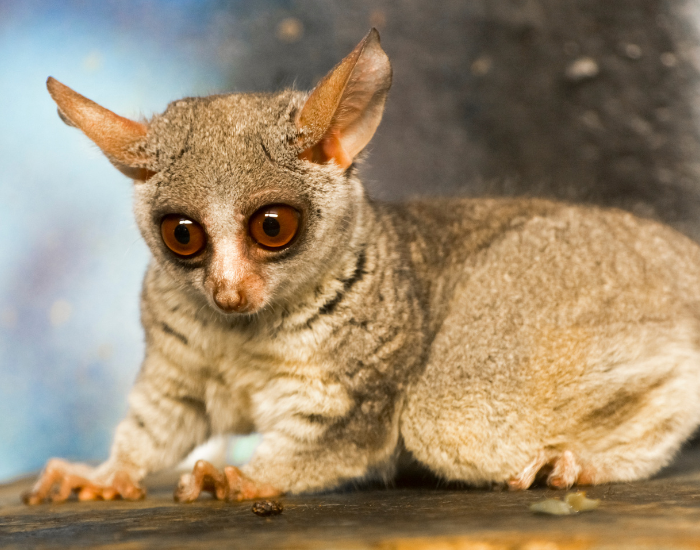
If you look closely at a bushbaby galago, you’ll notice their huge, mobile ears. These are far larger than what you’d expect for their body length. These aren’t just for show; they are incredible listening devices that provide good night vision support.
Their delicate ears can move independently of each other. As a result, the galago can pinpoint the exact location of a faint rustle, a calling partner, or, most importantly, the movement of insect prey.
But here’s the surprising part: when a galago is resting or hiding during the day, they have the ability to roll and fold their flexible, parchment-like ears flat against their head. This provides both protection from injury and helps to insulate them while they sleep in tree hollows or self-made nests. It’s a key behavioral adaptation for a nocturnal creature that relies on sound.
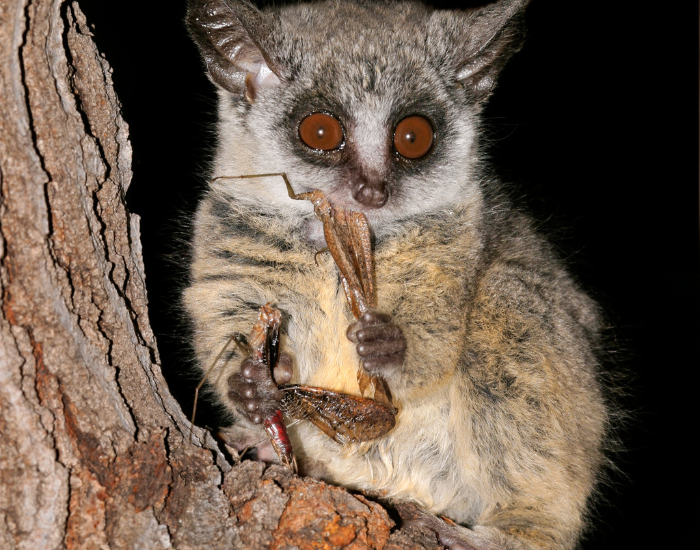
6. Conservation Status Varies, But Habitat Loss is the Main Threat
While the overall family of Galagidae is quite robust, their conservation status varies widely by species. Most are listed as Least Concern (LC) by the IUCN Red List. For example, the southern lesser galago is quite common and widespread across southern Africa.
However, localized threats and specific distributions mean some species are in trouble:
The Uluguru Bushbaby (Galago cocos): This species is found only in a specific forest area in Tanzania. It’s listed as Endangered due to rapid and severe habitat loss from agricultural expansion and logging. The name even suggests its location near the Uluguru Mountains.
The Zanzibar Galago (Galagoides zanzibaricus): Though listed as Near Threatened, its small range on Zanzibar makes it highly vulnerable to the loss of coastal forests. The zanzibar bushbaby faces ongoing threats.
The primary threat to virtually all galago populations is the destruction and fragmentation of their habitat areas. When their forest corridors are cut down, they lose access to food, safe tree hollows for sleeping, and mates. This highlights the critical need for continued primate conservation efforts focused on protecting diverse African forest ecosystems, particularly in equatorial Guinea and other vulnerable regions.
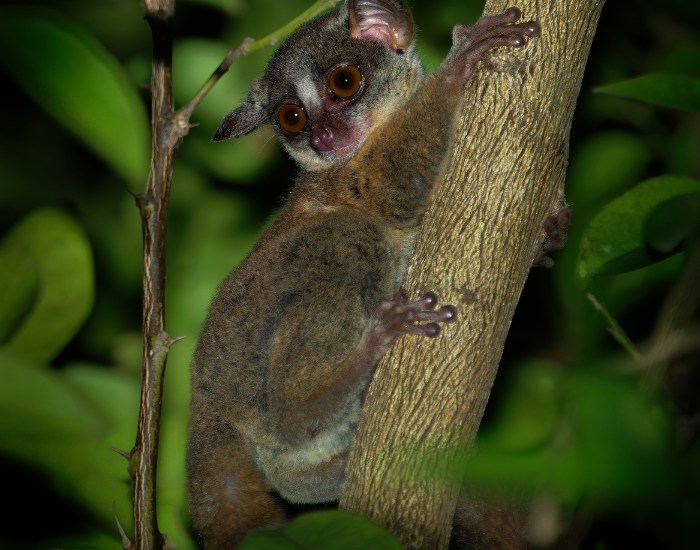
7. Galagos Are Not Monkeys, But Prosimians
A common question is: Are bush babies a type of monkey?
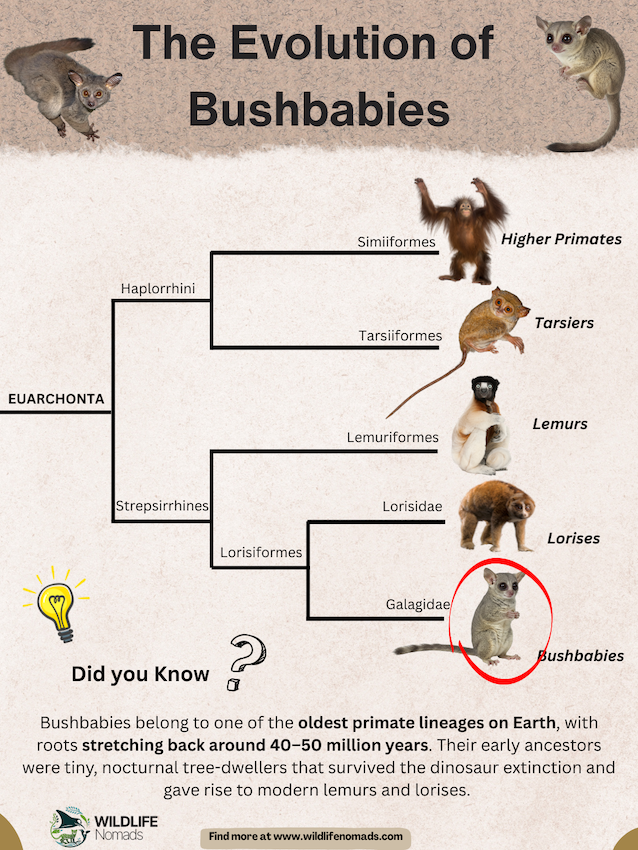
No, they are not. While they are both part of the primate family (they are nonhuman primates), galagos belong to a more evolutionarily ancient group called prosimians, or “pre-monkeys.” These are classified as small primates and lesser bushbabies in scientific terms.
Prosimians include the lemurs, lorises, and tarsiers, in addition to the galagos. Compared to “true” monkeys, prosimians generally have:
- A stronger reliance on the sense of smell (hence the urine-washing)
- A “wet nose” (rhinarium)
- Eyes that are larger and more directed sideways (though the galago’s forward-facing eyes are an exception)
- A simpler brain structure
Therefore, they are definitely part of the primate family. However, they are genetically and physically distinct from the bush monkeys or true bushbaby monkey species you might encounter.
8. They Are Omnivores and Excellent Insect Hunters
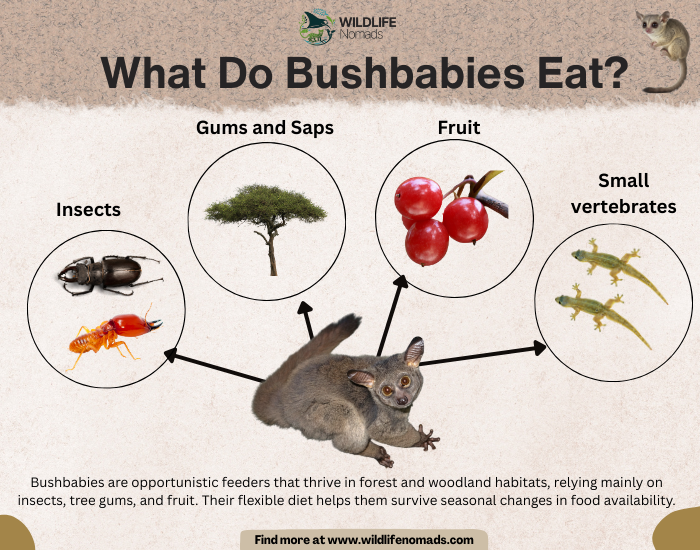
What does a bush baby eat?
Galagos are best described as opportunistic omnivores. This means their galago diet is adaptable to what is available. Nevertheless, they have a distinct preference for animal protein.
Insect Prey: Their primary food source. They are masters at using their acute hearing and powerful leaps to catch insects mid-air. This includes moths, beetles, and termites. Small animals occasionally supplement their diet.
Gums and Saps: Many species, especially the southern lesser galago, have specialized teeth. This “dental comb” helps them scrape tree gums and saps from acacia trees. These are critical sources of nutrition and water.
Fruit: They will eat soft fruits, berries, and seeds when available. This is especially true during the wet seasons and mating seasons.
Small Vertebrates: On rare occasions, a large galago, like the thick tailed bushbaby, may take a very small bird, lizard, or rodent.
This varied diet allows them to thrive across diverse landscapes. From the thickets of southern Africa to the acacia trees of the East Africa savannah, adult males and adult females find sufficient nutrition.
9. Their Social Lives Are Surprisingly Solitary
Despite the close, familiar name “bush baby,” many bushbaby galago species are primarily solitary foragers. The smaller species, in particular, prefer to hunt alone.
However, they do maintain a complex social structure:
Small Family Groups: While foraging is solitary, the animals often sleep together in small family groups during the day in a secure nest. They may construct nests in dense foliage or use a natural tree hollow. These groups typically consist of a mother and her offspring.
Dominance: In species that are slightly more social, like the larger Otolemur species, a dominant male may defend a territory. This territory encompasses the ranges of several breeding females.
Communication: They use their constant vocalizations, scent markings, and calls to maintain contact. In addition, they coordinate their movements without having to constantly stay together. The Senegal bush baby exhibits similar behaviors.
10. Mating is Timed to Resource Availability
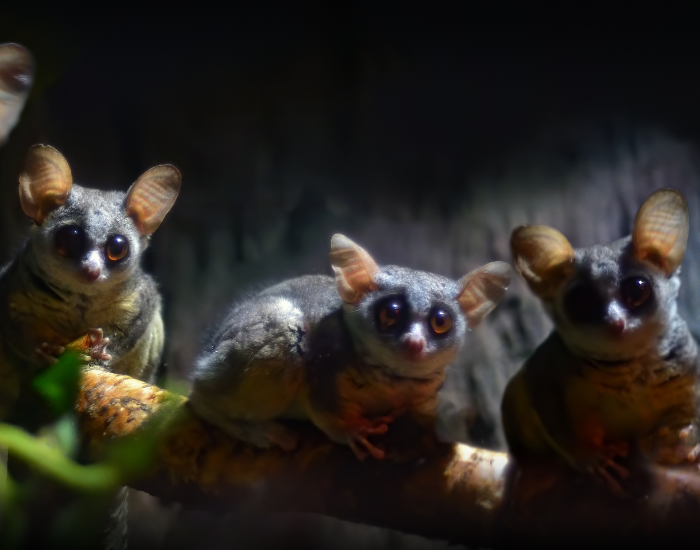
For most galago populations, the breeding cycle is highly seasonal. It’s adapted to maximize the chances of infant survival.
Mating seasons are usually timed so that young are born during the wet, resource-rich months. During this time, food, especially the crucial insect and fruit components of the galago diet, is most abundant.
Sexual Maturity: Females reach sexual maturity relatively quickly, often within their first year. However, they may not breed until they are slightly older.
Gestation: Gestation periods are short, about four months.
Offspring: They typically give birth to one or two offspring (often twins). These are initially unable to move independently, relying on the adult females to carry them or leave them clinging to a branch while they forage.
Life Span: The galago lifespan varies by species. However, they can live up to 10-15 years in the wild, and even longer in captivity. This indicates a slow, successful reproductive strategy.
11. The Complex Ethics: Can Galagos Be Pets?
This is perhaps the most critical question: Can galagos be pets?
The short, emphatic answer is NO. They should not be kept as pets.
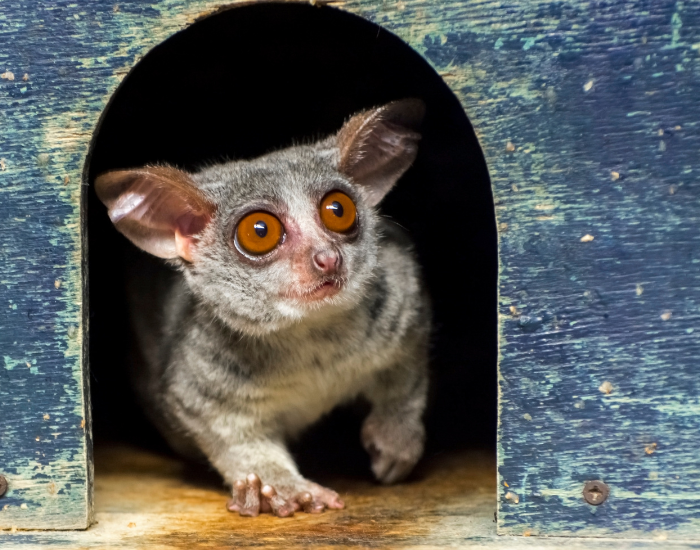
Although their cute appearance and small size may make them appealing, keeping a bushbaby animal as a domestic pet is detrimental to its welfare. Conservation groups and primatologists highly discourage this practice.
Nocturnal Nature: They are strictly nocturnal. They will be awake, active, and noisy all night. Furthermore, their owners will force them into an unnatural diurnal cycle, which is stressful and harmful.
The Smell Factor: The urine-washing behavior means they constantly mark their territory with a strong, musky smell. This is simply not compatible with a clean home environment.
Legal Complexity: Is it legal to own a bushbaby in the US? In many places, including the US, it is illegal without specific permits. Even where it is legal, responsible ownership requires expert care, a large, specialized enclosure, and a commitment to their complex needs.
In short, galagos make good pets only in the mind of someone who hasn’t researched the animal’s needs. Therefore, true appreciation means respecting them in their natural habitat.
12. They are Vital to the African Forest’s Health
Beyond being cute and acrobatic, bush babies play an indispensable ecological role.
Pest Control: Their relentless consumption of insect prey makes them natural pest controllers. Consequently, they keep insect populations balanced. They effectively catch insects throughout the night.
Pollinators/Seed Dispersers: When they consume fruits and gums, they help to spread the seeds and pollen of acacia trees and other flora throughout the forest. In this way, they effectively help the forest regenerate.
The density of galago populations means they are major contributors to the health of the entire ecosystem. The loss of these small animals would have a cascading negative effect on the flora and other fauna that rely on their services.
13. The “Night Monkeys” Can Sleep in the Same Spot for Years
As creatures of routine, galagos value security and familiarity. While they are capable of traversing large ranges at night, many populations show remarkable loyalty to their daytime sleeping quarters.
If an area is safe and undisturbed, a bushbaby galago may return to the same secure tree hollow, dense thicket, or abandoned nest to sleep. This can continue for months, or even years. They often construct nests in dense tangles of vines or forks of trees. This provides a safe, camouflaged haven against predators like owls and snakes during the day. This is why preserving habitat areas that contain old-growth trees and natural shelter is crucial for their long-term survival.
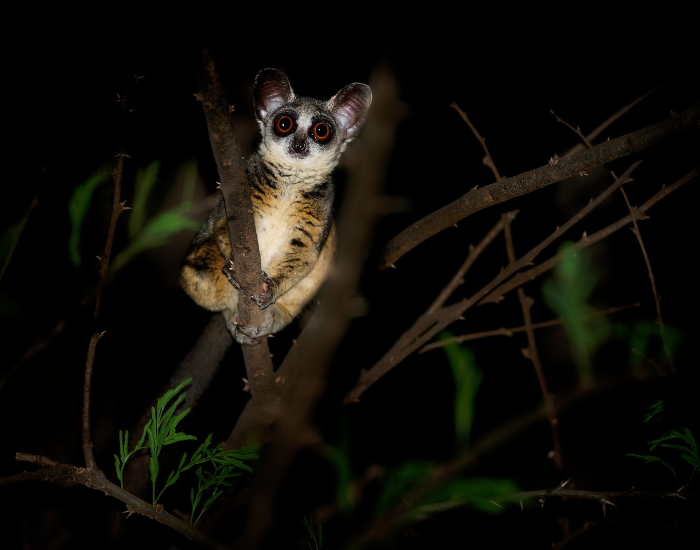
Who Hunts the Bushbaby? Natural Enemies and Predators
Life in the African night is full of challenges for bush babies. These agile primates, from the southern lesser galago to the thick tailed bushbaby, must constantly be on alert for natural enemies across sub-Saharan Africa.
Owls: These birds of prey are among the most formidable predators. With their silent flight and good night vision, these nocturnal hunters can spot and snatch bushbaby species as they leap between acacia trees or rest in tree hollows. Snakes, too, are a constant threat. Many species are adept climbers, able to infiltrate the very nests where bush babies seek refuge during the day.
Agile mammals like mongooses and genets prowl riverine forests and coastal forests, using their speed to catch unsuspecting bush babies. Even blue monkeys have been observed preying on bushbaby infants. In a remarkable display of intelligence, chimpanzees in certain regions hunt galagos using sharpened sticks.
As human settlements expand, domestic cats and dogs have become unexpected predators. This is especially true in areas where habitat loss has forced galago populations closer to villages. This overlap increases risks for species like the galago moholi, south African galago, and senegal bush baby, as well as the brown greater galago and dusky bushbaby.
The African Wildlife Foundation stresses the importance of preserving diverse habitats—acacia woodlands, riverine forests, and coastal thickets. When these environments are fragmented, bush babies lose not only their food sources and nesting sites but also their best defenses against predators.
FAQ: Answers to Your Top Bushbaby Questions
Yes, they are the same. “Bushbaby” is the common name for the Galagidae family, which are scientifically called “galagos.”
No, they should not be kept as pets. They are nocturnal, have specific dietary needs, and their natural behavior of urine-washing to mark territory makes them highly unsuitable for a domestic home.
No, they are prosimians (or “lower primates”), an older evolutionary branch than true monkeys.
No, galagos are not poisonous, venomous, or toxic to humans in any way. They are shy and generally harmless.
They are omnivorous, primarily consuming insects, tree gums, saps, and soft fruits. They are excellent hunters of insect prey.
Appreciating Africa’s Small Primate
The bushbaby galago, in all its varied forms, from the minuscule mountain dwarf galago to the robust thick tailed bushbaby, is a testament to the incredible adaptations of African wildlife. Their agility, sharp senses, and complex social structure have allowed them to thrive. They inhabit diverse areas ranging from dry savannah to humid coastal forests.
As we’ve explored, this galago bush dweller is not a pet, nor is it a monkey. It is a unique, irreplaceable galago primate whose survival hinges on our respect for its wild home. The threats of habitat loss are real. This is especially true for localized species like the Uluguru bushbaby and the spectacled galago.
To ensure future generations can hear the baby-like cries and witness the stunning acrobatics of these “night monkeys,” we must take action. Therefore, we must support organizations like the African Wildlife Foundation and prioritize sustainable land use practices.
Want to learn more about the incredible world of African primates and the several species that populate sub Saharan Africa? Support primate conservation efforts today.
Would you like to see a Galago in the Wild?
Here are six safari budget recommendations with trusted partners with a very high likelihood of seeing and bushbaby in the wild.
This blog is reader-supported. When you buy experiences through links listed on this site, we may earn an affiliate commission.