
Have you ever wondered what makes the gibbon primate one of nature’s most extraordinary creatures? These remarkable animals are often misunderstood, frequently confused with monkeys, sometime macaques, and sadly, many people don’t even know they exist. But here’s the thing – gibbons are absolutely fascinating, and once you learn about them, you’ll be amazed by their incredible abilities and unique characteristics.
Gibbons are truly special. They’re not just another monkey swinging through trees (spoiler alert: they’re not monkeys at all!). These lesser apes are evolutionary marvels that have adapted to life in the forest canopy in ways that will blow your mind.
Today, I’m sharing 12 incredible facts about the gibbon primate that will change how you think about these amazing animals. From their acrobatic abilities to their complex social lives, prepare to be amazed by what these creatures can do.
1. Gibbons Are Apes, Not Monkeys – Here’s Why This Matters
Let’s clear up the biggest misconception right away: gibbons are not monkeys. Sometimes, people mistakenly refer to them as “gibbons monkeys,” but this is incorrect, gibbons are apes, not monkeys. This is probably the most common question I encounter: “Is a gibbon a monkey or an ape?” The answer is definitively ape.
The gibbon primate belongs to the family Hylobatidae and is classified as a lesser ape or smaller ape. Compared to great apes and other apes, gibbons are smaller, more agile, and have unique adaptations for brachiation. Here’s what makes them different from monkeys:
- No tail: Unlike monkeys, gibbons have no tail whatsoever
- Upright posture: They walk upright on two legs when on the ground
- Larger brain: Relative to body size, gibbons have larger brains than monkeys
- Longer arms: Their arms are proportionally much longer than their legs
- Complex social behaviors: They exhibit more sophisticated social structures
The scientific name of gibbon varies by species, but they all belong to the family Hylobatidae, which is divided into four genera: Nomascus, Symphalangus, Hoolock, and Hylobates. So next time someone asks “is a gibbon classified as an ape?” you can confidently say yes – they’re our distant cousins in the primate family tree.

2. Gibbon Classification: The Family Tree of Nature’s Acrobats
When it comes to the gibbon family, things get fascinatingly complex! Gibbons are divided into four main genera, each with its own unique set of species and characteristics.
Here’s a quick tour of the gibbon family tree:
- Hylobates (Dwarf Gibbons): This genus is home to some of the most agile gibbons, including the well-known white handed gibbon (also called lar gibbon), agile gibbon, pileated gibbon, and the silvery gibbon. These species are often called “dwarf gibbons” due to their smaller size and are found throughout Southeast Asia’s forests.
- Hoolock: The hoolock gibbons are the only gibbons found outside Southeast Asia, ranging into northeastern India and Bangladesh. This group includes the eastern hoolock gibbon and the recently discovered skywalker hoolock gibbon, both of which are facing increasing threats from habitat loss.
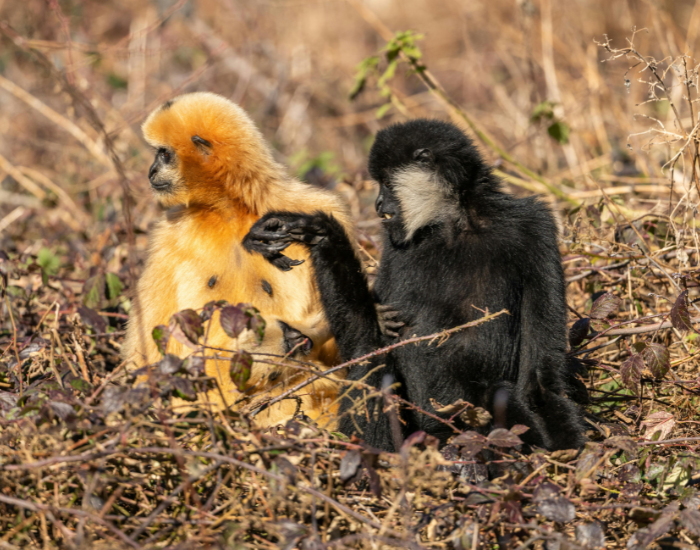
- Nomascus (Crested Gibbons): Known as the crested gibbons, this genus includes the northern white cheeked gibbon, southern white cheeked gibbon, and other white cheeked gibbon species. These gibbons are famous for their striking facial markings and haunting calls, but sadly, many are now critically endangered due to the illegal wildlife trade and shrinking forests.
- Symphalangus: This genus contains just one species, the siamang gibbon, the largest of all gibbons. Siamangs are easily recognized by their throat sacs, which they use to amplify their booming calls across the rainforest.
Each genus and species has adapted to its own unique corner of the forest, but all face similar threats.

3. There Are Over 20 Species of Gibbons (And They’re All Unique)
When people ask “how many gibbons are there?” or “how many species of gibbons exist?”, the answer might surprise you. There are over 20 recognized gibbon species, each with its own unique characteristics and habitat requirements.
Here are some of the most notable types of gibbons:
Northern White-Cheeked Gibbon (Nomascus leucogenys):
Found in Vietnam, Laos, and southern China, these gibbons are known for their distinctive white cheek patches and are critically endangered.
Lar Gibbon (Hylobates lar):
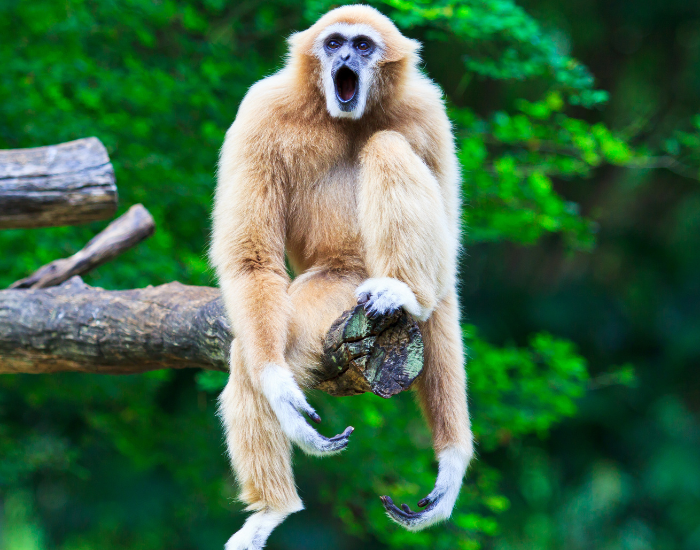
Also called the white-handed gibbon, these are among the most well-known gibbon species and are found in Thailand, Malaysia, and Myanmar. Lar gibbons are recognized for their two-tone coat and are endangered mammals.
White-Handed Gibbons:
These gibbons, also known as lar gibbons, are native to Southeast Asia and are famous for their brachiating locomotion and loud vocalizations. They are often seen in zoos worldwide.
Siamang (Symphalangus syndactylus):
The largest of all gibbon species, siamangs are found in Malaysia, Thailand, and Sumatra and are known for their inflatable throat sacs.
Hoolock Gibbons:
Including the eastern hoolock gibbon (Hoolock leuconedys), these are found in northeastern India and southern China.
Agile Gibbon (Hylobates agilis):
Found in Malaysia, Thailand, and Sumatra, these gibbons are known for their incredible speed and agility.
Bornean Agile Gibbon (Hylobates albibarbis):
Native to southern Borneo, this species of gibbon is also called the white-bearded gibbon and is endangered due to habitat loss.
Pileated Gibbon (Hylobates pileatus):
Found in Cambodia, Laos, and Thailand, these gibbons have distinctive cap-like crests.
Kloss’s Gibbon (Hylobates klossii):
Endemic to the Mentawai Islands in Indonesia, Kloss’s gibbon is known for its black fur and territorial calls, and is classified as endangered.
Southern Gibbon:
Refers to the Bornean white-bearded gibbon, found in southern Borneo, notable for its white beard and endangered status.
Bornean Gibbon:
This term often refers to several species endemic to Borneo, including the Bornean agile gibbon and the Bornean white-bearded gibbon, both facing threats from deforestation.
Eastern Gray Gibbon (Hylobates muelleri):
Endemic to Borneo, the eastern gray gibbon is critically endangered and recognized by its grayish fur.
Yellow Cheeked Gibbon (Nomascus gabriellae):
Also known as the southern yellow-cheeked crested gibbon, this species is found in Vietnam, Laos, and Cambodia, and is threatened by habitat destruction.
Yellow Cheeked:
This term refers to gibbons with distinctive yellow markings on their cheeks, such as the northern and southern yellow-cheeked crested gibbons.
Red Cheeked Gibbon:
Another name for the southern yellow-cheeked gibbon, highlighting its reddish facial markings and endangered status.
Eastern Black Crested Gibbons (Nomascus nasutus):
Critically endangered, these gibbons are found in a small region of northern Vietnam and southern China.
The diversity among gibbon types is remarkable, with each species adapted to specific forest environments and elevations. There are many species of gibbon, each with unique traits and conservation needs. Some gibbon species are closely related, especially those within the same genus, sharing similar physical features and behaviors. Unfortunately, many of these species are endangered due to habitat loss and human interference.

4. Where in the World? Gibbon Habitat and Distribution
Gibbons are true citizens of the treetops, thriving in the lush, green canopies of Southeast Asia’s tropical rainforests. Their range stretches across a patchwork of countries, each home to its own unique gibbon species.
You’ll find gibbons swinging through the forests of Indonesia, Malaysia, Thailand, Vietnam, Laos, Cambodia, and even into southern China and northeastern India. For example, the northern buffed cheeked gibbon makes its home in the forests of Vietnam, Laos, and Cambodia, while the southern white cheeked gibbon is found in the dense jungles of Laos and Vietnam. The Mentawai gibbon is a true island specialist, living only on the Mentawai Islands off the coast of Sumatra, Indonesia.
Some gibbons, like the hoolock gibbons, are found further north in the forests of northeastern India, Bangladesh, and Myanmar. In southern China, you can spot rare species such as the eastern black crested gibbon and the northern gray gibbon, both of which are now critically endangered. The javan gibbon is exclusive to the island of Java, while the bornean white bearded gibbon inhabits the rainforests of southern Borneo.
No matter where they live, all gibbons depend on healthy, unbroken stretches of tropical rainforest. Their survival is tightly linked to the fate of these forests, which are rapidly disappearing due to deforestation and habitat fragmentation. Protecting the unique habitats of the crested gibbon, black crested gibbon, and other species is essential if we want to ensure that gibbons continue to thrive in the wild.

5. Gibbons Are the Fastest Primates on Earth
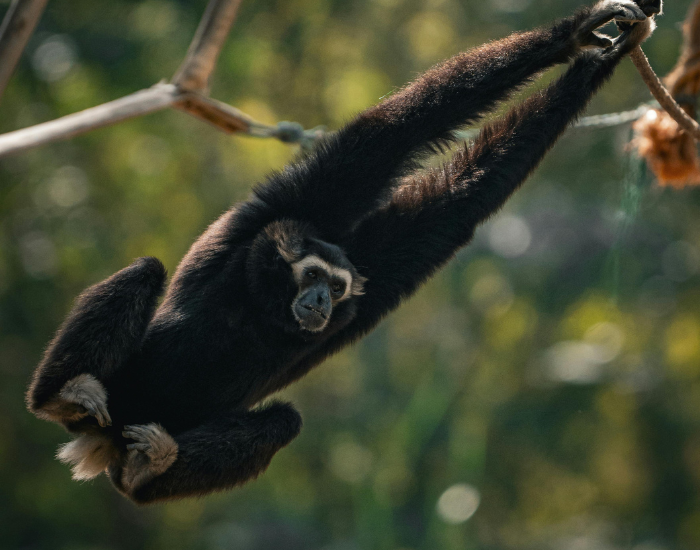
Here’s a fact that will amaze you: gibbons are the fastest primate in the world – at least when it comes to moving through trees. As arboreal apes, gibbons are specially adapted to life high in the forest canopy, and this adaptation is key to their remarkable speed. These incredible animals can swing through the forest canopy at speeds of up to 35 miles per hour (56 kilometers per hour).
Their speed comes from their unique form of locomotion called brachiation. This is essentially swinging from branch to branch using only their arms, and gibbons have perfected this art form over millions of years of evolution.
What makes them so fast?
- Incredibly long arms: A gibbon’s arm span can reach up to 6 feet, nearly twice their body height
- Specialized wrist joints: Their wrists can rotate almost 360 degrees, allowing for seamless branch-to-branch movement
- Lightweight bodies: Most gibbons weigh between 10-25 pounds, making them agile and quick
- Perfect balance: Their small heads and elongated limbs give them excellent balance while swinging
This incredible speed and agility help gibbons escape predators, find food across large territories, and navigate their complex forest homes with ease.
6. The Gibbon Primate Is NOT the Largest Primate (But They’re Still Impressive)
“Are gibbons the largest primates?” This is another common question, and the answer is no – far from it actually. Gibbons are among the smallest apes, which is why they’re called “lesser apes.”
Here’s how gibbons compare to other primates in size:
- Gibbons: 10-25 pounds (4.5-11 kg)
- Chimpanzees: 70-130 pounds (32-59 kg)
- Orangutans: 90-220 pounds (41-100 kg)
- Gorillas: 150-400 pounds (68-181 kg)
The largest gibbons are the siamang gibbons, which can weigh up to 29 pounds (13 kg) and are known for their shaggy fur and inflatable throat pouch used for loud vocalizations. Among gibbons, adult males are often slightly larger than females and may display more pronounced physical features, especially in species with sexual dimorphism. The smallest is the Kloss’s gibbon, weighing in at just 10-15 pounds (4.5-6.8 kg).
Gibbon skulls are notable for their short rostra, enlarged brain cases, and forward-facing orbits, distinguishing them from other primates and highlighting their close relation to great apes.
But don’t let their small size fool you – what gibbons lack in size, they make up for in agility, intelligence, and social complexity. Their compact size is actually an advantage in their arboreal lifestyle, allowing them to access thin branches and move through the canopy with unmatched grace.

7. Gibbons Are Generally Friendly, But Don’t Make Good Pets
People often ask “are gibbons friendly to humans?” and “are gibbon monkeys good pets?” Let me address both questions with some important context.
Gibbons can be relatively friendly toward humans in controlled settings like reputable sanctuaries or research facilities. They’re naturally curious and intelligent animals. However, this doesn’t mean they’re safe or appropriate as pets.
Here’s why gibbons are not good pets:
- They’re wild animals: Gibbons have complex social and environmental needs that can’t be met in a home setting
- They can be aggressive: While not typically aggressive toward humans, gibbons can become territorial and potentially dangerous
- It’s illegal: In most countries, keeping gibbons as pets is illegal due to CITES regulations
- They need specialized care: Their diet, social needs, and medical requirements are extremely complex
- They live 30-40 years: This is a massive, lifelong commitment that most people aren’t prepared for
Are gibbons aggressive towards humans? Generally no, but like any wild animal, they can become defensive if they feel threatened. Their powerful arms and sharp teeth can cause serious injury if they feel cornered or afraid.
The best way to appreciate these amazing animals is to support conservation efforts and visit them in their natural habitats or accredited facilities that prioritize their welfare.

8. Gibbon Intelligence Rivals That of Great Apes
How intelligent are gibbons? This question reveals one of the most underappreciated aspects of these remarkable animals. Gibbons are incredibly intelligent, showing problem-solving abilities, tool use, and complex social behaviors that rival those of great apes.
Evidence of gibbon intelligence includes:
- Tool use: Gibbons have been observed using tools to extract food from tree bark and crevices
- Problem-solving: They can navigate complex three-dimensional puzzles in their forest environment
- Social learning: Young gibbons learn complex behaviors by watching and imitating their parents
- Communication: They have sophisticated vocal communication systems with different calls for different situations
- Memory: Gibbons can remember the locations of fruit trees across their large territories and return to them at optimal times
Complex social behaviors also demonstrate their intelligence. Gibbons engage in cooperative parenting, territorial defense, and intricate mating rituals that require significant cognitive abilities.
Research has shown that gibbons can understand cause and effect, plan ahead for future events, and even show empathy toward other gibbons. This level of intelligence makes their conservation even more critical – we’re not just protecting animals, we’re protecting highly intelligent beings with rich emotional lives.

9. Gibbons Mate for Life (And They’re Amazing Parents)
Do gibbons mate for life? Yes, and their monogamous relationships are some of the most stable in the animal kingdom. This is one of the most beautiful aspects of gibbon behavior and sets them apart from many other primates.
Gibbon pair bonds are characterized by:
- Lifelong partnerships: Pairs typically stay together for their entire lives, which can span 30-40 years
- Cooperative parenting: Both parents actively care for their offspring
- Territorial cooperation: Pairs work together to defend their territory through coordinated vocal displays
- Shared responsibilities: Males and females share duties in finding food, protecting the family, and raising young
The gibbon family structure typically consists of a mated pair and their offspring. Gibbons usually live in small family groups, which include an adult male, an adult female, and their young. Young gibbons stay with their parents for several years, learning essential survival skills before eventually leaving to find their own mates.
Reproduction facts:
- Gibbons typically give birth to a single offspring every 2-3 years
- The female takes primary responsibility for caring for infants
- Young gibbons don’t reach sexual maturity until they’re 6-8 years old
- This slow reproductive rate makes gibbon populations vulnerable to decline
Their monogamous lifestyle and cooperative parenting make gibbons excellent examples of stable family structures in the animal kingdom.
10. Gibbon Populations Are Critically Endangered
How many gibbon monkeys are left in the world? Gibbons are endangered and are considered an endangered species, with many populations facing a critical risk of extinction. This is perhaps the most heartbreaking fact about gibbons. Many gibbon species are critically endangered, with some populations numbering in the hundreds.
Current population estimates:
- Hainan Gibbon: Fewer than 30 individuals remain (world’s rarest primate)
- Cao Vit Gibbon: Approximately 110 individuals
- Northern White-Cheeked Gibbon: Estimated 455-655 individuals
- Kloss’s Gibbon: Fewer than 40,000 individuals
How many wild gibbons are left? The total number of wild gibbons is alarmingly low, with several species on the brink of extinction in their natural habitats.
Why are gibbons going extinct? The primary threats include:
- Habitat loss: Deforestation for palm oil plantations, logging, and agriculture destroys the forest habitat that gibbons depend on for survival.
- Fragmentation: Remaining forests are broken into small, isolated patches
- Illegal wildlife trade: Gibbons are captured for the pet trade and traditional medicine
- Human encroachment: Expanding human settlements reduce available habitat
- Climate change: Changing weather patterns affect food availability

11. What Does a Gibbon Eat? Their Diet Is More Complex Than You Think
What do gibbons eat? Gibbons are primarily frugivorous, meaning they eat mostly fruit, but their diet is actually quite varied and sophisticated.
Primary gibbon diet components:
Fruits (60-80% of diet):
- Figs are their absolute favorite and most important food source
- Berries, drupes, and various tropical fruits
- They prefer ripe, sugary fruits that provide quick energy
Leaves and vegetation (15-25% of diet):
- Young leaves and shoots
- Flowers and buds
- Tree bark and sap (especially during fruit-scarce periods)
Protein sources (5-10% of diet):
- Insects and larvae
- Bird eggs (occasionally)
- Small invertebrates
Can gibbons eat meat?
While they occasionally consume insects and eggs, gibbons are not regular meat-eaters. Their digestive system is optimized for processing fruits and plant matter.
What is a gibbon’s favorite food?
Without question, figs are the preferred food of most gibbon species. These fruits are:
- Available year-round in tropical forests
- High in sugar and provide quick energy
- Easy to digest
- Found throughout their habitat range
Gibbons play a crucial role in forest ecosystems as seed dispersers. As they move through their territory eating fruits, they spread seeds across the forest, helping maintain plant diversity and forest regeneration.

12. Gibbon Vocalizations Are Among Nature’s Most Beautiful Sounds
One of the most spectacular aspects of gibbon behavior is their vocal communication. Gibbon primate calls are some of the most complex and beautiful sounds in the animal kingdom.
Types of gibbon vocalizations:
Great calls: These are elaborate vocal displays that can last 10-30 minutes and serve multiple purposes:
- Territorial announcements
- Pair bonding between mates
- Family coordination
- Communication across long distances
Duet calls: Mated pairs perform synchronized vocal duets that:
- Strengthen pair bonds
- Announce territory boundaries
- Coordinate family activities
- Demonstrate relationship status to other gibbons
Alarm calls: Quick, sharp calls that warn of:
- Predators (eagles, leopards, snakes)
- Territorial intruders
- Immediate dangers
Contact calls: Soft calls used for:
- Maintaining contact while foraging
- Coordinating movement through the forest
- Parent-offspring communication
Gibbons can project their calls up to 2 miles through dense forest, creating one of the most effective long-distance communication systems in the animal kingdom. Each species has a unique vocal signature, and individuals can be recognized by their distinct vocal patterns.
13. The Rarest Gibbon Species Will Break Your Heart
What is the rarest gibbon?
The Hainan gibbon (Nomascus hainanus) holds the tragic distinction of being the world’s rarest primate. With fewer than 30 individuals remaining in the wild, this species is on the brink of extinction. The Hainan black crested gibbon, another name for this species, is found only on Hainan Island and is classified as critically endangered due to its extremely limited population and habitat.
The Hainan gibbon story:
- Location: Found only on Hainan Island, China
- Population: Estimated 28-30 individuals in 2021
- Habitat: Tropical rainforest of Bawangling National Nature Reserve
- Decline: Population dropped from over 2,000 in the 1950s to fewer than 30 today
Other critically endangered gibbon species:
- Cao Vit Gibbon: ~110 individuals (Vietnam/China border)
- Kloss’s Gibbon: < 40,000 individuals (Indonesian islands)
- Northern White-Cheeked Gibbon: 455-655 individuals (Southeast Asia)
What makes these species so vulnerable?
- Small population sizes make them susceptible to genetic bottlenecks
- Limited habitat ranges offer no backup locations
- Slow reproductive rates mean populations recover slowly
- Human pressures continue to threaten remaining habitats

14. Gibbons Are Ecosystem Engineers
Here’s a fact that might surprise you: gibbon primates are ecosystem engineers, meaning they actively shape and maintain their forest environments in ways that benefit countless other species.
How gibbons engineer their ecosystems:
Seed dispersal: As gibbons move through their territories eating fruits, they:
- Spread seeds across large areas (up to 30 hectares per family group)
- Deposit seeds in optimal growing locations
- Help maintain plant genetic diversity
- Enable forest regeneration and expansion
Gibbons live in a variety of forest habitats, including scrub, semi-deciduous, and broadleaf forests. By dispersing seeds, they help maintain and regenerate these diverse forest habitats.
Canopy maintenance: Their movement through trees:
- Creates pathways for other arboreal animals
- Helps maintain branch connections between trees
- Influences forest structure and composition
Predator-prey dynamics: Gibbons serve as:
- Prey for large predators like clouded leopards and eagles
- Early warning systems for other forest animals through their alarm calls
- Indicators of forest health and ecosystem integrity
Forest connectivity: Their large territories:
- Require connected forest corridors
- Help maintain landscape-level forest connectivity
- Support other species that need large, undisturbed habitats
Research significance: Gibbons are considered indicator species, meaning their presence indicates a healthy forest ecosystem. Their absence often signals ecosystem degradation or collapse.
The loss of gibbon populations doesn’t just mean losing these incredible animals – it means losing a keystone species that helps maintain the health and diversity of entire forest ecosystems.
The Future of Gibbons Depends on Us
The gibbon primate represents one of nature’s most remarkable evolutionary achievements. These incredible animals – with their acrobatic abilities, complex social lives, and crucial ecological roles – deserve our attention, respect, and protection.
From their status as true apes (not monkeys) to their role as ecosystem engineers, gibbons continue to surprise and inspire researchers and conservationists worldwide. Their monogamous relationships, incredible intelligence, and beautiful vocalizations make them truly special members of our planet’s biodiversity.
But here’s the critical reality: many gibbon species are running out of time. With some populations numbering in the dozens rather than thousands, immediate action is needed to prevent extinctions that would be permanent and irreversible.
The 12 facts I’ve shared today represent just the beginning of what makes gibbons extraordinary. These animals have evolved over millions of years to become perfectly adapted to their forest homes, and they play irreplaceable roles in maintaining the health of some of the world’s most biodiverse ecosystems.
The gibbons are calling – literally and figuratively. Are you ready to answer?
Find a Gibbon and Amazing Experience
This blog is reader-supported. When you buy experiences through links listed on this site, we may earn an affiliate commission.