
Growing up, my world was shaped by wildlife documentaries. I would sit for hours watching Steve Irwin wrestle crocodiles, David Attenborough narrate the mysteries of the natural world, and of course, Jane Goodall as she quietly transformed our understanding of chimpanzees.
These figures were my earliest teachers, shaping my path into biology and conservation. The conservation community feels great sadness at the passing of Dr. Jane Goodall, whose legacy will be remembered for generations. While Attenborough gave voice to the planet and Irwin brought wild animals into our living rooms with fearless enthusiasm, Jane Goodall showed me the power of patience, compassion, and science. Her story has always felt especially personal, because it reminded me that one person with curiosity and courage can truly change the world and inspire countless people around the world.
Who was Jane Goodall?
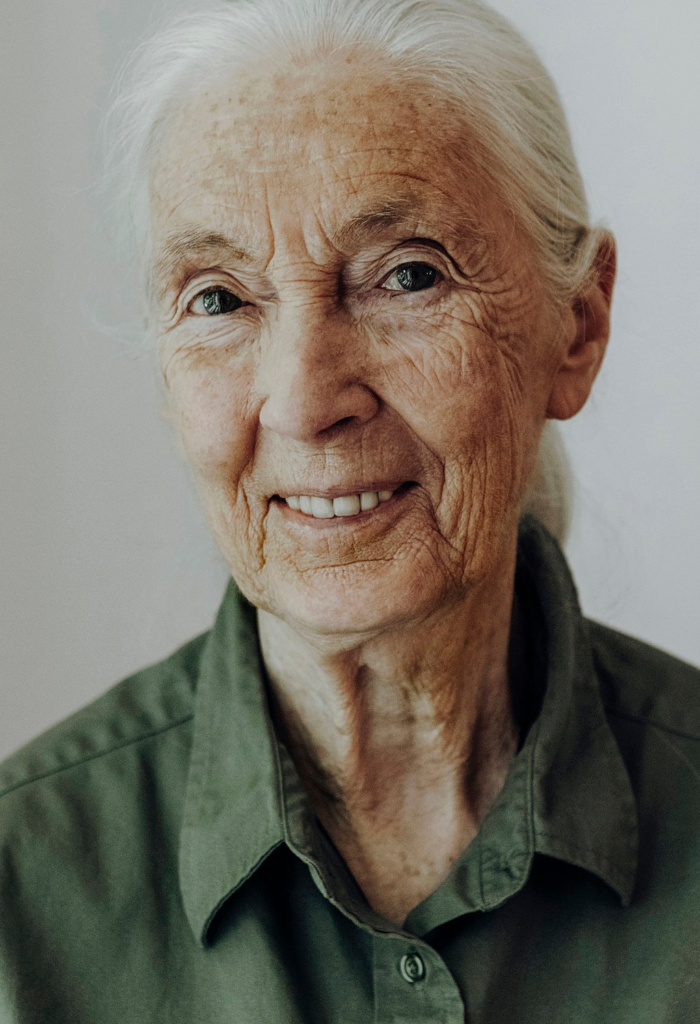
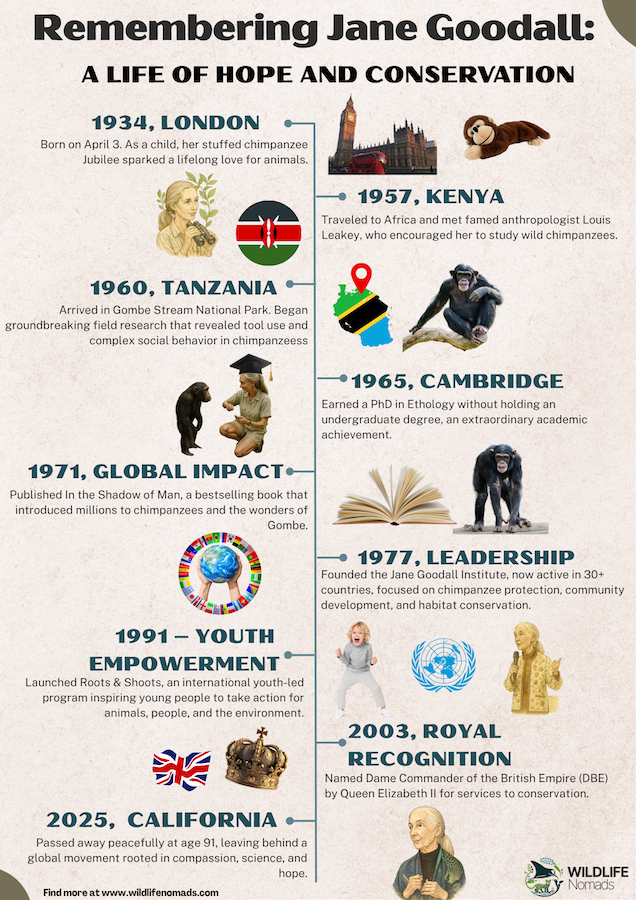
Dr. Valerie Jane Morris Goodall, better known as Jane Goodall DBE, changed the way we see the natural world. Born in London in 1934, she grew from a curious child who loved animals into a world-renowned ethologist, conservationist, and tireless advocate for wildlife.
Jane Goodall dedicated over six decades to studying wild chimpanzees in Tanzania. Her work revealed that these primates use tools, form complex social bonds, and experience emotions much like humans. Therefore, her discoveries forced scientists to reconsider the boundary between humans and other animals.
Jane Goodall died peacefully of natural causes at the age of 91, leaving behind a legacy that is both deeply personal and globally transformative. The Jane Goodall Institute continues her mission today. Operating in more than 30 countries, the organization protects chimpanzees, preserves habitat, and empowers young people and children through conservation programs.
Early Life: From Jubilee to Gombe
Jane’s love for animals began in childhood. Her mother gave her a stuffed chimpanzee named Jubilee, which sparked her lifelong fascination with primates. However, few imagined this young girl from England would revolutionize science.
As a young woman, Jane dreamed of studying animals in Africa. In 1957, she traveled to Kenya and met the renowned anthropologist Louis Leakey. Consequently, Leakey recognized her potential and selected her for an unprecedented mission: studying wild chimpanzees in their natural habitat.
Breaking Barriers in a Male-Dominated Field
Every women has gone through this. Trying to break a man domanted world. For jane it wa snot different.
Jane arrived in Gombe, Tanzania, in 1960 without formal scientific training. At that time, women rarely conducted field research alone. Nevertheless, her patience, observation skills, and revolutionary approach would prove more valuable than traditional credentials.
Louis Leakey supported Jane’s unconventional methods. In fact, he believed her lack of formal training was an advantage. She could observe chimpanzees without preconceived notions that limited other researchers.
Groundbreaking Chimpanzee Research at Gombe
Jane Goodall’s research at Gombe Stream National Park changed science forever. Her focus was to study chimpanzees in their natural habitat, closely observing their daily lives. Goodall’s discoveries about chimps’ behavior and social structure revolutionized scientific understanding, revealing behaviors that challenged everything scientists believed about primates and humans.
The Tool-Using Discovery That Changed Everything!
In 1960, Jane witnessed a chimpanzee named David Greybeard using a stick to fish termites from a mound. This observation shattered the scientific consensus that only humans used tools. As a result, researchers had to redefine what made humans unique.
National Geographic began documenting Jane’s work in the 1960s. Their photographer, Hugo van Lawick, captured stunning images of Jane with chimpanzees. These photographs brought her research to millions of people around the world.
Understanding Chimpanzee Behavior and Social Structure
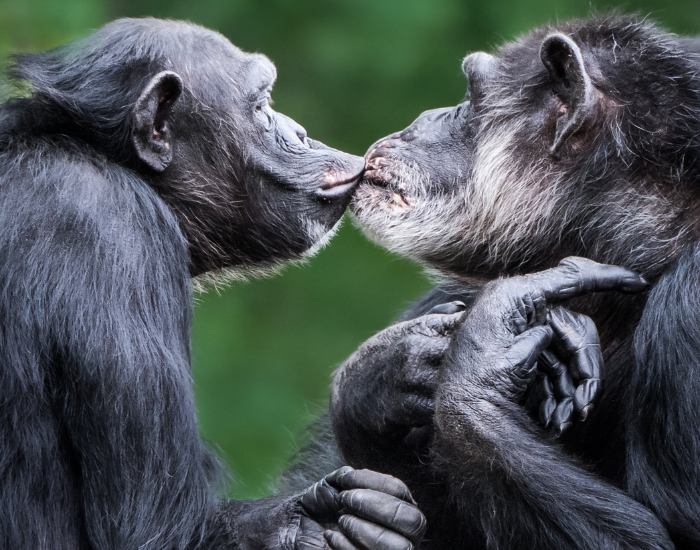
Jane’s patient observation revealed the complex social lives of chimpanzees. She documented their family bonds, hierarchies, and individual personalities. For example, she observed mothers teaching infants, friendships between males, and political alliances within groups.
Her research also revealed darker aspects of chimpanzee behavior. Jane documented aggression, territorial warfare between groups, and even infanticide. Therefore, her work showed that chimpanzees share both our capacity for compassion and violence.
Revolutionary Research Methods
Jane Goodall’s approach to studying chimpanzees was revolutionary. She gave each individual a name rather than a number. Scientists criticized this practice initially. However, naming helped Jane recognize individual personalities and track long-term relationships.
She spent years earning the trust of wild chimpanzees. This patience allowed her to observe natural behavior other researchers missed. Consequently, her methods became the gold standard for ethological research.
Academic Recognition and Scientific Contributions
Despite her lack of formal training, Jane Goodall earned a PhD from Cambridge University in 1965. Remarkably, she became one of only eight people ever admitted without an undergraduate degree. Her dissertation focused on chimpanzee behavior at Gombe.
Publications That Revolutionized Ethology
Jane Goodall published numerous scientific papers and books throughout her career. Her work appeared in leading journals and influenced generations of researchers. She wrote for both scientific audiences and the general public, making primatology accessible to everyone.
Her book “In the Shadow of Man” became an international bestseller. Published in 1971, it introduced millions to the chimpanzees of Gombe. The book combined scientific observation with compelling storytelling.
Long-Term Research at Gombe Stream
The Gombe chimpanzee study became the longest-running wildlife research project in history. Data collected over six decades provided unprecedented insights into primate behavior, genetics, and social dynamics.
Researchers continue studying the same chimpanzee families Jane first observed. This multi-generational data helps scientists understand learning, culture, and evolution in wild primates.
The Jane Goodall Institute: From Science to Action
Jane Goodall, the founder and organization’s founder of the Jane Goodall Institute, established it in 1977. The Jane Goodall Institute confirmed that its headquarters are located in Washington, DC. The organization transformed her scientific research into practical conservation action. Today, the Jane Goodall Institute operates worldwide, protecting chimpanzees and their habitat.
Protecting Chimpanzees and Their Habitat
The Jane Goodall Institute works to protect wild chimpanzee populations across Africa. Illegal trafficking, habitat loss, and disease threaten these primates. Therefore, the Institute fights to preserve forests and habitats in Tanzania, Uganda, Congo, and other countries. The Institute’s mission is to protect chimpanzees and their habitats through community-centered conservation programs, research, and advocacy.
The organization established sanctuaries for orphaned and rescued chimpanzees. These facilities provide care for animals that cannot return to the wild. Additionally, the sanctuaries educate visitors about conservation and help foster a connection to nature.

Community-Centered Conservation Programs
Jane Goodall understood that conservation must benefit local communities. Her Institute developed programs supporting sustainable livelihoods around protected areas. For example, communities receive support for education, healthcare, and economic development.
This approach recognizes that local people are essential partners in wildlife conservation. When communities benefit from protecting forests, they become powerful advocates for chimpanzees and other species.
Roots & Shoots: Empowering Young People
In 1991, Jane launched Jane Goodall’s Roots & Shoots, a youth-led environmental program rooted in her vision for empowering the next generation. The initiative empowers young people and children to become conservation leaders in their communities. Today, Roots & Shoots operates in more than 50 countries.
The program focuses on three interconnected goals: helping people, animals, and the environment. Young people design and implement projects addressing local challenges. Consequently, Roots & Shoots has inspired countless environmental advocates, including children, across the globe.
Global Advocacy and Environmental Protection
Jane Goodall became a tireless advocate for environmental protection and animal welfare. She is regarded as a hero to conservationists and scientists worldwide, inspiring future generations through her pioneering work. She served as a UN Messenger of Peace, speaking about conservation challenges worldwide. Her advocacy connected wildlife protection to climate change, human rights, and global well-being.
Speaking Truth to Power
Even into her 80s, Jane maintained a demanding travel schedule. Her speaking tour took her to universities, conferences, and community events around the world. Her message emphasized that every individual can make a difference through daily choices.
Jane met with political leaders, business executives, and community organizers. She advocated for policies protecting endangered species, preserving forests, and addressing climate change. Her gentle yet firm approach inspired action across sectors.
Connecting Conservation to Human Well-Being
Jane Goodall consistently linked wildlife conservation to human welfare. She explained that protecting forests benefits everyone through clean air, water, and climate stability. Therefore, saving chimpanzees means saving ourselves.
Her holistic approach to conservation influenced how organizations address environmental challenges. She demonstrated that successful conservation requires addressing poverty, education, and community development.
Awards, Recognition, and Honors
Jane Goodall received numerous awards recognizing her contributions to science and conservation. She was appointed Dame Commander of the British Empire in 2003. UNESCO named her a Goodwill Ambassador. She received the Kyoto Prize, the Benjamin Franklin Medal, and countless other honors.
However, Jane remained humble despite global recognition. She consistently credited the chimpanzees, local communities, and countless supporters who made her work possible.
Personal Philosophy: Hope and Action
Jane Goodall’s philosophy combined scientific rigor with profound hope. She believed that understanding leads to caring, and caring leads to action. This message resonated with millions of people worldwide.
The Power of Individual Action
Jane taught that every person’s choices matter. Simple actions like reducing consumption, supporting ethical businesses, and educating others create meaningful change. Therefore, she empowered individuals to see themselves as conservationists.
Her famous quote captures this philosophy: “You cannot get through a single day without having an impact on the world around you. What you do makes a difference, and you have to decide what kind of difference you want to make.”
Four Reasons for Hope
In her later years, Jane spoke about four reasons for hope despite environmental challenges:
First, young people’s energy and commitment inspire change. Second, the human brain’s ingenuity can solve problems we create. Third, nature’s resilience allows recovery when given a chance. Finally, the indomitable human spirit drives people to fight for what they believe in.
Scientific Legacy and Continuing Research
Jane Goodall’s research methods and discoveries continue influencing primatology, anthropology, and conservation biology. Her emphasis on long-term observation, individual recognition, and holistic ecosystem understanding shaped modern ethology. Through her groundbreaking studies, scientists were able to find new insights into primate behavior and conservation.
Researchers worldwide use techniques Jane pioneered at Gombe. Her work demonstrated that rigorous science and compassionate observation complement rather than contradict each other.
The Jane Goodall Institute’s Ongoing Mission
The Jane Goodall Institute remains at the forefront of chimpanzee conservation and community development. The organization continues expanding its reach, protecting more habitat, and empowering more communities.
Programs address threats including illegal wildlife trafficking, deforestation, and climate change. The Institute also develops innovative solutions using technology, community partnerships, and evidence-based strategies.
Frequently Asked Questions About Jane
Jane Goodall is most famous for her pioneering research on wild chimpanzees in Tanzania. She discovered that chimpanzees use tools, have complex social structures, and experience emotions similar to humans.
The Jane Goodall Institute protects chimpanzees, preserves forest habitat, supports local communities, and educates young people through programs like Roots & Shoots.
Jane arrived in Gombe, Tanzania, in 1960 to begin her groundbreaking chimpanzee research under the mentorship of Louis Leakey.
Yes. The Jane Goodall Institute is highly rated for transparency, impact, and effectiveness in conservation work and community development.
Her most important discoveries included chimpanzee tool use, complex social behaviors, mother-infant bonds, hunting behavior, and territorial warfare between groups.
Jane Goodall pioneered community-centered conservation that benefits both wildlife and people. She also empowered young people to become environmental leaders.
A Legacy That Continues
A couple of years ago, I read what may have been her last book, The book ofHope. What struck me most was how, despite the overwhelming challenges our world faces, Jane always remained an unwavering optimist. She reminded us that hope is not naive; it is necessary. Without it, there is no reason to act. With it, change becomes possible.
Jane Goodall’s life demonstrated that one person armed with curiosity, compassion, and determination can change the world. Her scientific discoveries transformed our understanding of primates and humanity itself. Her conservation work protected countless animals and empowered communities worldwide.
Jane Goodall’s life reminds us that science and empathy belong together. She taught us that conservation isn’t just about data, it’s about compassion, hope, and action.
Her Institute confirmed her peaceful passing in California while on a speaking tour, but her mission continues. The Jane Goodall Foundation and Institute remain central to global conservation, carrying forward her vision of a better world where humans and animals coexist in harmony.
Her story continues to inspire new generations, scientists, activists, and dreamers alike. In my own career, whether standing on a beach watching sea turtles hatch or hiking through rainforests to study rare birds, I’ve often thought of Jane’s words: “Only if we understand, will we care. Only if we care, will we help.”