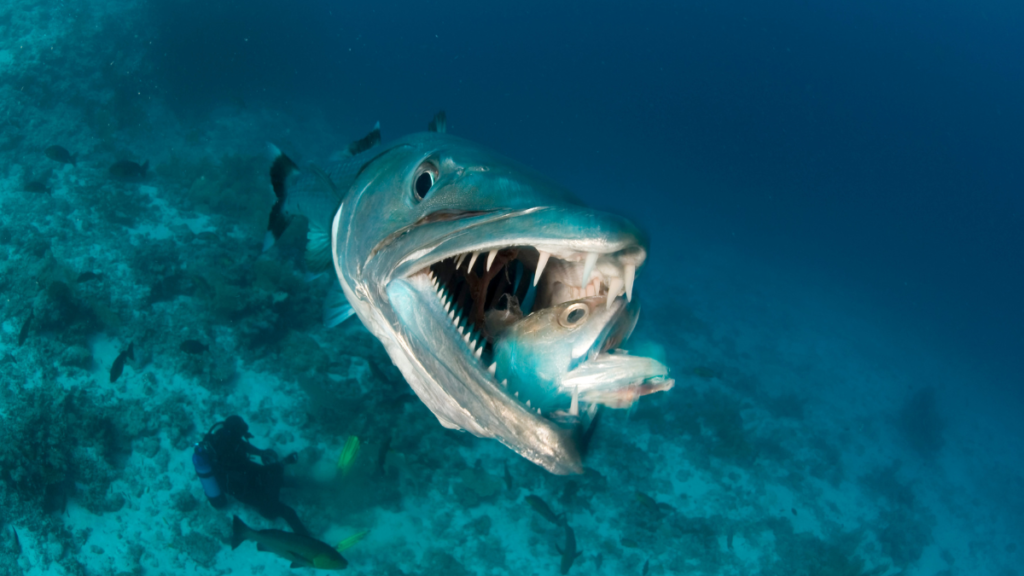
The first time a great barracuda shadowed me, I was hovering over a reef in the Caribbean Sea. It hung in the blue like a chrome torpedo, jaw cracked open, watching me. I have dived many times chasing strange animals. I have seen parrotfish, venomous puffer fish, reef sharks and other coral fish on the shallows. But honestly, et barracudas still make my pulse jump every single time.
Here is my honest confession, though. After all these years underwater, I still struggle to tell one barracuda from another. They share that same elongated, cylindrical body and that unmistakable underbite. So I finally built the field guide I always wanted to own.
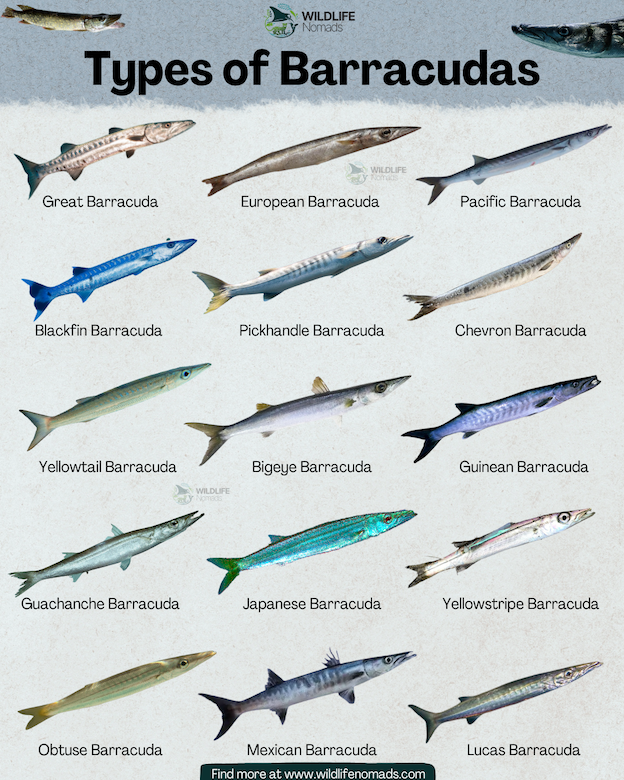
Barracudas live primarily in tropical and subtropical oceans, and most divers meet them eventually. These barracudas range from pocket-sized to genuinely enormous. Below are 14 barracudas you will actually encounter, plus the small clues that separate them. Learn these tells, and a confusing silver blur becomes a name you recognize.
The Anatomy That Defines All Barracudas
To tell these species apart, you first have to understand the basic blueprint that dictates how they hunt. Every barracudas belong to Sphyraena, the only genus in the family Sphyraenidae. The body of these fish is a long, cylindrical tube built for for a single purpose: the high-speed ambush. Barracudas are classic elongated fish, made to hang motionless and then explode forward.
If you look closely at a barracuda hanging in the current, you’ll notice its two dorsal fins that sit widely separated along the back. The anterior fin, a spinous dorsal fin, carries five spines. The posterior fin holds nine soft rays, and the anal fin beneath it mirrors those soft rays almost exactly. Small pelvic fins sit forward on the belly, while a deeply forked caudal fin powers the final sprint.
But it’s the business end that really defines them. The lower jaw juts past the upper jaw, and two rows of teeth line each side. The outer row grips struggling prey. The inner row, a set of small razor sharp teeth, does the slicing. Those needle like teeth and very sharp teeth let barracudas shear fish in a single clean cut.
Because they sit so high on the reef food chain, very few predators bother them once they reach maturity. They are patient, hyper-specialized hunters, and their physical tells are exactly what we use to spot different species underwater.

1. Great Barracuda (Sphyraena barracuda)
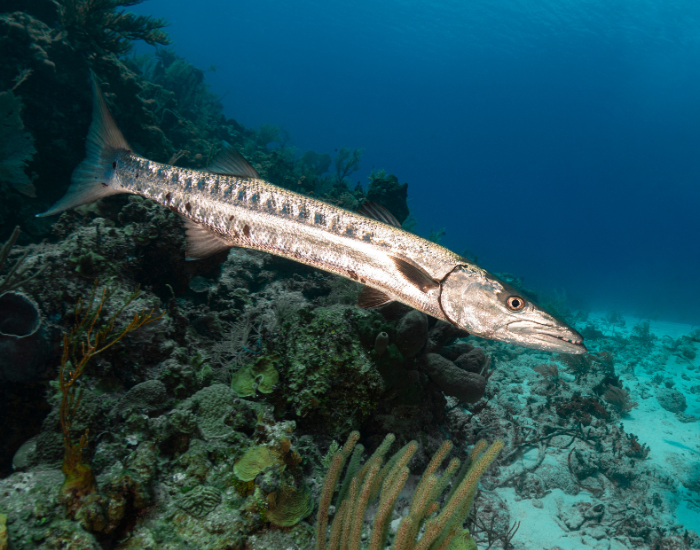
The great barracuda is the one everyone pictures. Sphyraena barracuda is the largest barracuda alive and the only truly circumglobal species. An adult great barracuda can reach 6.5 feet (2 m) and weigh up to 50 kg.
Coloration varies, but the back usually runs dark green over a white belly, scattered with a few dark spots near the tail. I have met them from North Carolina down through the warm western Atlantic Ocean. They patrol coral reefs and mangroves, then drift into the open ocean as mature specimens. During the mating season, adults push offshore to spawn. Most great barracuda I meet are simply curious, not aggressive. The largest barracuda I ever filmed clocked an estimated 36 mph and never even flinched at me. As an apex predator, the great barracuda anchors the reef food web from the top down.
2. European Barracuda (Sphyraena sphyraena)
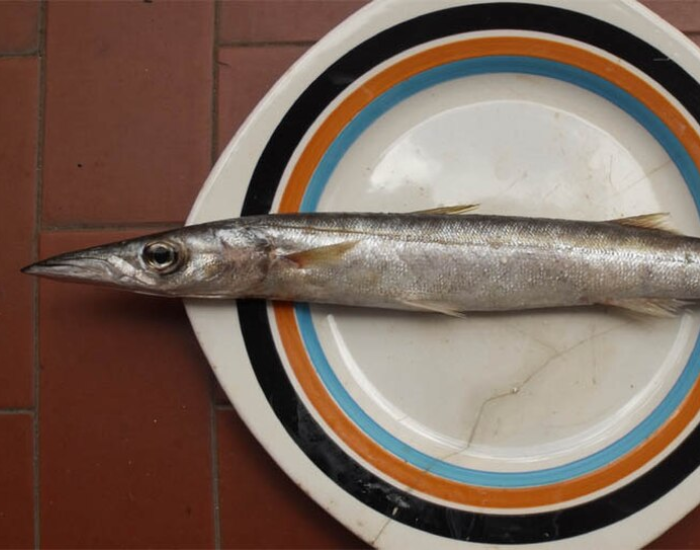
The European barracuda is the slim cousin of the Mediterranean and eastern Atlantic. It is a smaller species, silvery, with faint dark bars along the flanks. Mature specimens rarely pass 1 meter.
You will find it from the Bay of Biscay down to West Africa, with strays reaching the Red Sea. Genetic work places this European barracuda close to the great barracuda group. I have watched loose schools drift over Mediterranean seagrass beds at dusk, hunting anchovy.
3. Pacific Barracuda (Sphyraena argentea)
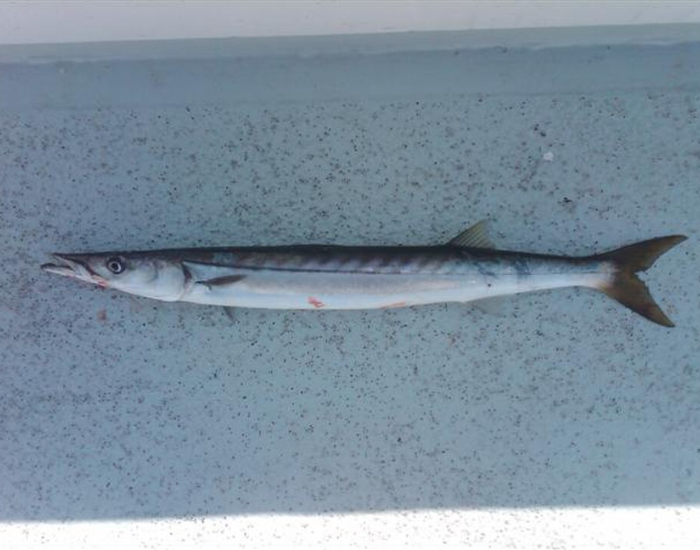
The Pacific barracuda, also called the California barracuda, owns the eastern Pacific Ocean. Its range stretches from Alaska down to Baja, though it loves cooler subtropical seas best. This is a lean, schooling fish prized by anglers along the West Coast.
Pacific barracudas gather in big silvery shoals near kelp edges. As a result, they have anchored a popular sport fishery for over a century. By contrast with tropical relatives, these barracudas tolerate genuinely chilly water.
4. Blackfin Barracuda (Sphyraena qenie)
The blackfin barracuda, sometimes called the chevron barracuda, is my favorite spectacle in the sea. It ranges from the Red Sea and East Africa across the Indo-Pacific to French Polynesia. Dark fins and bold chevron bars give it away instantly.
These barracudas form colossal, slow-turning schools over coral reefs down to 50 m. I once finned into the center of a barracuda tornado off Borneo. Hundreds of bodies spiraled around me, calm and unbothered, while I forgot to breathe.
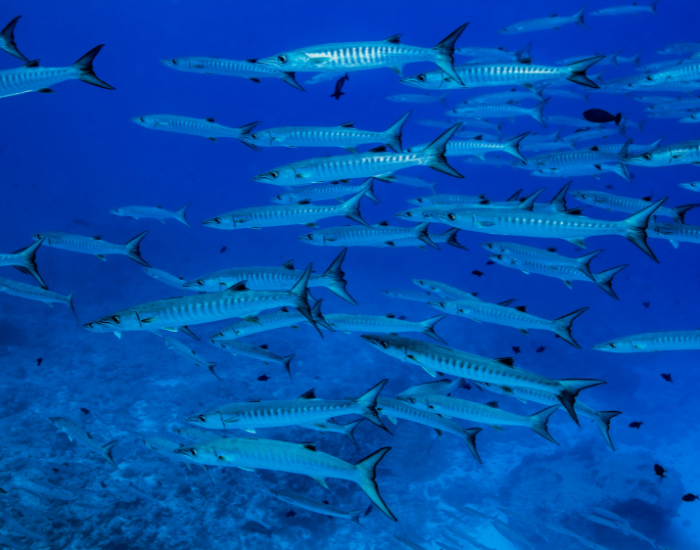
5. Pickhandle Barracuda (Sphyraena jello)
The pickhandle barracuda earns its name from the dark, tool-shaped bars cutting down its flanks. Older texts call it Commerson’s sea pike. This widespread Indo-Pacific species can stretch to 150 cm, making it one of the largest heavyweights in the genus.
Pickhandle barracudas haunt lagoons, estuaries, and deep reef slopes, tolerating murky water much better than their peers. If you are trying to identify one in the field, keep your eyes on the markings: its dark vertical bars fade out entirely below the lateral line, a key tell that separates it from its closest look-alike, the sawtooth barracuda.
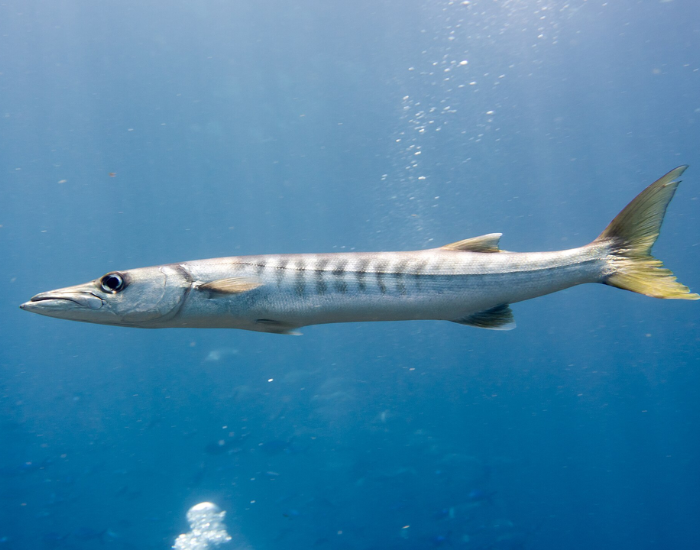
6. Sawtooth Barracuda (Sphyraena putnamae)
The sawtooth barracuda wears a tight, double row of chevron-shaped bars that look almost stitched onto its silver flanks. Because it shares Indo-Pacific reef drop-offs with both the pickhandle and the blackfin, underwater identification is notoriously difficult.
The trick to spotting a sawtooth is looking closely at the dark bars. Unlike the pickhandle, the sawtooth’s chevron markings cross completely over the lateral line, forming a distinct, continuous zig-zag pattern. These barracudas school tightly by day and scatter to hunt at dusk, favoring coastal reefs and outer lagoon walls where currents run strong.
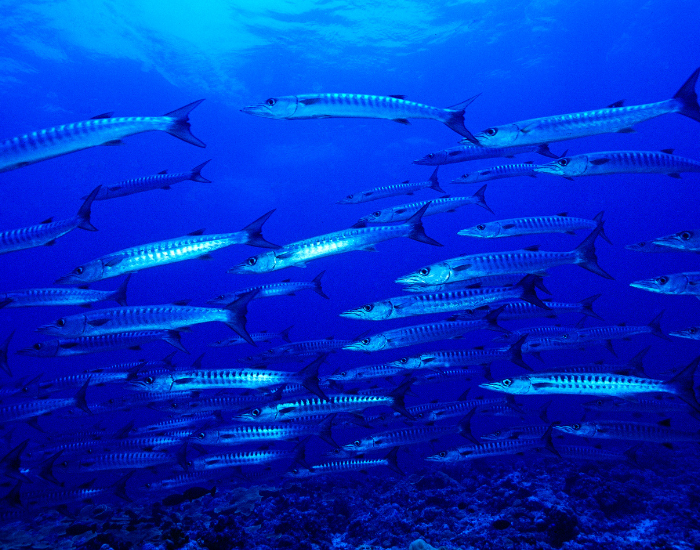
7. Yellowtail Barracuda (Sphyraena flavicauda)
The yellowtail barracuda is small, social, and easy to love. A bright yellow tail and a faint yellow stripe mark this species clearly. It rarely exceeds 40 cm, so it ranks among the smaller species you will meet.
This barracuda roams the Indo-Pacific and has slipped through Suez into the eastern Mediterranean. Yellowtail barracudas travel in dense daytime schools over reef flats. They feed on tiny baitfish, darting in quick coordinated rushes.
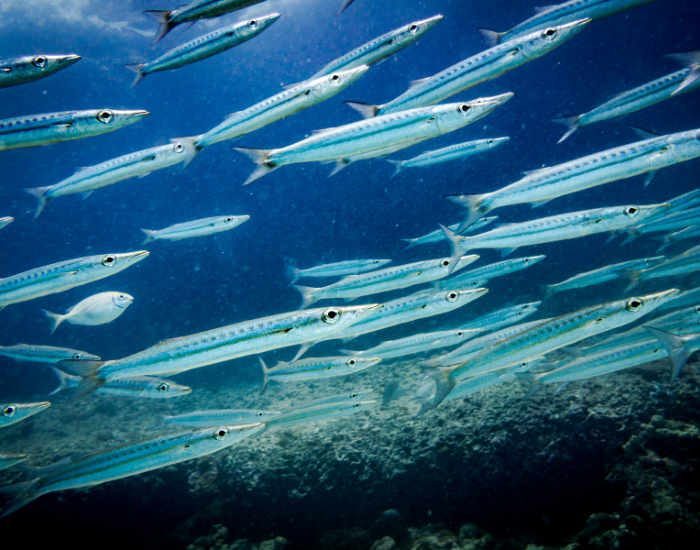
8. Bigeye Barracuda (Sphyraena forsteri)
The bigeye barracuda is named for an obviously large eye. It is a mid-sized Indo-Pacific species, common from the Red Sea to the central Pacific. Look for a small dark blotch above the pectoral fin.
Bigeye barracudas pack into stationary daytime schools near reef edges and drop-offs. At night, the school breaks apart to hunt. I find these barracudas among the most approachable for photography.
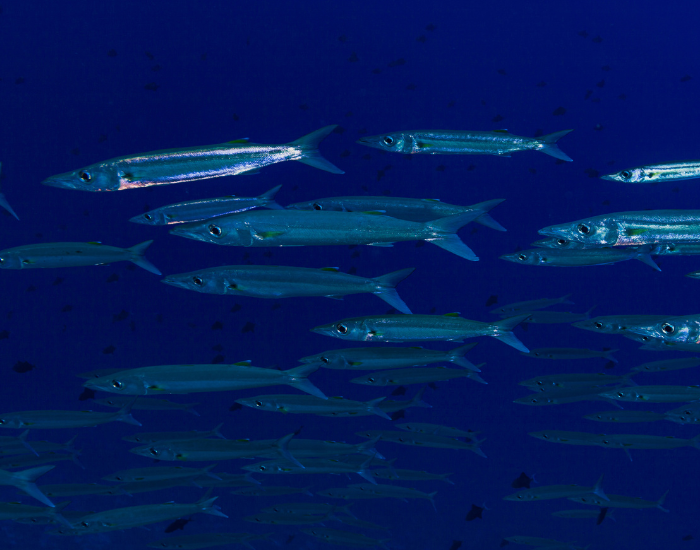
9. Guinean Barracuda (Sphyraena afra)
The Guinean barracuda dominates the tropical eastern Atlantic off West Africa. This is a heavy, powerful fish that can top 1.5 meters and rival smaller great barracudas in bulk. Anglers chase it hard along estuaries and surf zones.
Guinean barracudas push into brackish lagoons and river mouths to hunt mullet. Juveniles shelter in mangroves much like their Caribbean relatives. By contrast with reef-bound barracudas, this one thrives in turbid coastal water.
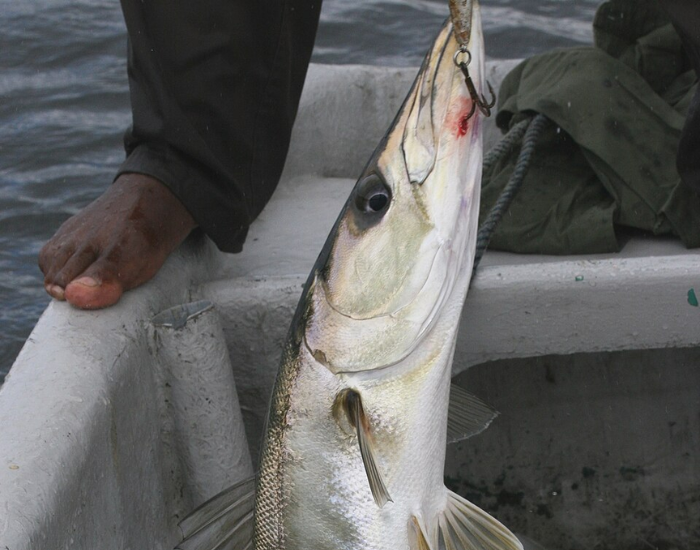
10. Guaguanche (Sphyraena guachancho)
The guaguanche is a slender barracuda of both Atlantic coasts. It lives along the western Atlantic Ocean and the eastern Atlantic, favoring muddy inshore bottoms. A faint golden lateral stripe separates it from look-alikes.
This is a smaller species, usually under 60 cm, that gathers over soft seagrass beds and estuaries. Guaguanche feed on shrimp and small fish near the bottom. Commercial nets along West Africa land them regularly.
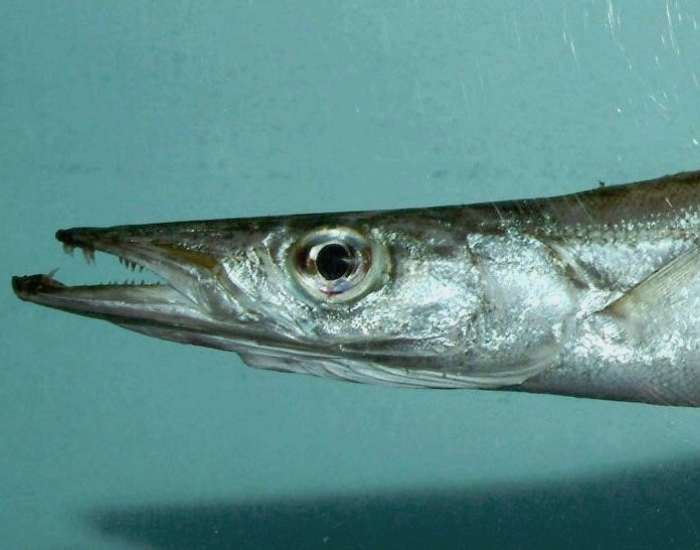
11. Japanese Barracuda (Sphyraena japonica)
The Japanese barracuda belongs to the cooler northwest Pacific. It ranges around Japan, Korea, and the East China Sea, tolerating temperate water comfortably. Local markets prize it as a food fish.
This species grows to roughly 35 cm and schools over coastal shelves. Japanese barracudas support a small but steady commercial fishery. Interestingly, these barracudas handle seasonal cold far better than tropical kin.
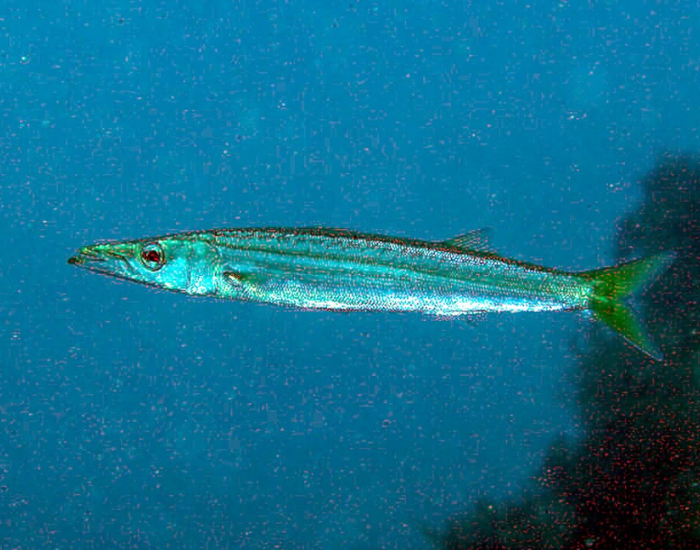
12. Yellowstripe Barracuda (Sphyraena chrysotaenia)
The yellowstripe barracuda is another compact, schooling Indo-Pacific fish. A clean yellow stripe runs the length of its silvery body. This species has also colonized the eastern Mediterranean through the Suez Canal.
Yellowstripe barracudas hug shallow coastal reefs and sandy flats. They feed actively by day on small baitfish. Many species in this group look near-identical, and the stripe is your best clue.
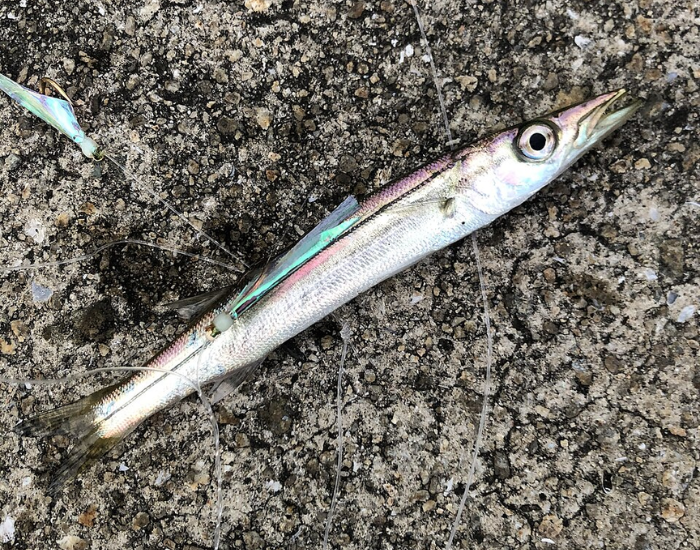
13. Obtuse Barracuda (Sphyraena obtusata)
The obtuse barracuda lends its name to an entire group of small relatives. It is a blunt-snouted Indo-Pacific species found from the Red Sea to Australia. Two faint yellow body stripes mark mature fish.
These barracudas form busy schools over inshore reefs and harbors. Obtuse barracudas feed on tiny fish and crustaceans near the surface. They tolerate slightly cloudy estuary water without complaint.
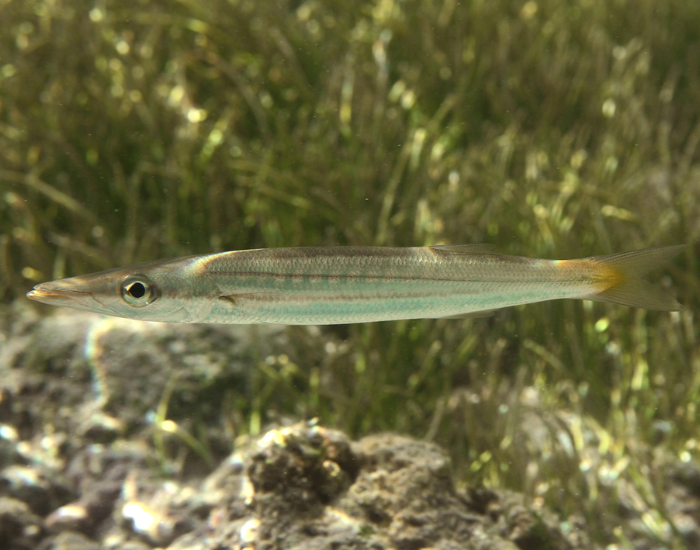
14. Mexican Barracuda (Sphyraena ensis)
The Mexican barracuda closes out the list in the eastern Pacific Ocean. Its range runs along tropical America, from the Gulf of California down to Peru. Coloration varies from silver to faintly barred.
This species grows to around 1 meter and frequents coastal reefs and bays. Mexican barracudas feed heavily on sardines and small jacks. Local fishers in tropical America catch these barracudas for both sport and the table.
Frequently Asked Questions
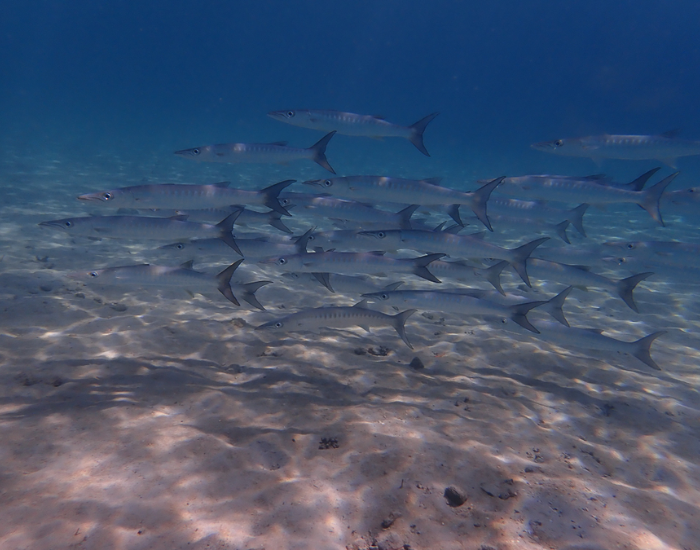
A barracuda is a long, predatory marine fish in the genus Sphyraena, the only genus in the family Sphyraenidae. Around 29 species of barracuda species exist worldwide as per 2026. Each shares an elongated, cylindrical body, two widely separated dorsal fins, and a jutting lower jaw full of sharp teeth. Barracudas live primarily in tropical and subtropical oceans.
Yes, a barracuda has scales. The body is covered in small, smooth cycloid scales that reduce drag during a high-speed strike. They feel slick rather than rough, which suits a fish that ambushes at up to 36 mph.
Mostly, no. Barracuda attacks on humans are genuinely rare, and such incidents are often preventable. Few fish would willingly attack humans this size. Documented fatalities trace back to isolated cases in 1947, 1957, and 1960. The bigger risk is dinner, because a large great barracuda can carry ciguatera fish poisoning.
Barracudas do. These fish strike at flashing, reflective movement because it mimics a fleeing baitfish. As a result, barracudas may mistake shiny objects for prey and bite a diver’s watch or jewelry. Wearing non-reflective gear prevents nearly all of these accidental encounters.
Few other predators challenge an adult great barracuda. Sharks, goliath grouper, and the occasional killer whale take the largest barracuda. Larger fish and seabirds pick off juveniles in seagrass beds and mangroves. Humans, through fishing pressure, remain the most significant threat of all.
Why Barracudas Are Worth a Second Look
Spend one slow afternoon comparing these 14 barracudas, and the silver blur finally resolves into individuals. The chevron bars, the yellow tail, the blunt snout — each detail names a barracuda species. As top predators, barracudas keep reef fish populations balanced and genetically healthy, which is reason enough to respect them. Once you know the field marks, telling barracudas apart stops feeling impossible.
Next time you dive a tropical reef, hang still and watch the barracudas watching you. Then tell me in the comments which barracudas you logged. If you love big ocean predators, my guides to whales and the strange animals of the deep sea are your next stop.
References:
Daly-Engel, T. S., Randall, J. E., & Bowen, B. W. (2012). Is the great barracuda (Sphyraena barracuda) a reef fish or a pelagic fish? The phylogeographic perspective. Marine Biology, 159(5), 975–985. https://doi.org/10.1007/s00227-012-1878-9
Friedman, M. A., Fernandez, M., Backer, L. C., Dickey, R. W., Bernstein, J., Schrank, K., Reich, A. (2017). An updated review of ciguatera fish poisoning: Clinical, epidemiological, environmental, and public health management. Marine Drugs, 15(3), 72. https://doi.org/10.3390/md15030072
O’Toole, A. C., Danylchuk, A. J., Goldberg, T. L., Suski, C. D., Philipp, D. P., Brooks, E., & Cooke, S. J. (2011). Spatial ecology and residency patterns of adult great barracuda (Sphyraena barracuda) in coastal waters of The Bahamas. Marine Biology, 158(10), 2227–2237. https://doi.org/10.1007/s00227-011-1728-1
O’Toole, A. C., Dechraoui Bottein, M. Y., Danylchuk, A. J., Ramsdell, J. S., & Cooke, S. J. (2012). Linking ciguatera poisoning to spatial ecology of fish: a novel approach to examining the distribution of biotoxin levels in the great barracuda by combining non-lethal blood sampling and biotelemetry. The Science of the total environment, 427-428, 98–105. https://doi.org/10.1016/j.scitotenv.2011.11.053
Santini, F., Carnevale, G., & Sorenson, L. (2015). First timetree of Sphyraenidae (Percomorpha) reveals a Middle Eocene crown age and an Oligo–Miocene radiation of barracudas. Italian Journal of Zoology, 82(1), 133–142. https://doi.org/10.1080/11250003.2014.962630
Kundu, S., Kim, H.-W., Lee, J., Chung, S., Lee, S. R., Gietbong, F. Z., Wibowo, A., & Kang, K. (2023). Mitogenomic architecture and phylogenetic relationship of European barracuda, Sphyraena sphyraena (Teleostei: Sphyraenidae), from the Atlantic Ocean. Fishes, 8(12), 573. https://doi.org/10.3390/fishes8120573