My first wild penguins were tiny. In 2019, a friend in Melbourne sent me to the St Kilda pier at dusk. Little penguins popped out of the water and waddled between the rocks as the city lights came on. African penguins are still on my list.
Africa’s penguin is bigger, louder and in far more trouble. It brays like a donkey, nests in old seabird droppings and lives on rocky coasts near Cape Town. In October 2024, it became the first penguin species ever listed as Critically Endangered.
Below are 12 facts about African penguins, from their pink eye patches to the court case fought over their fish. I also answer the questions people search most, including how many are left and where to see them.
🐧 How well do you know Africa’s only penguin?
Twelve questions on braying calls, guano burrows and starving moults. Read on, then test yourself at the end. Jump to the quiz ↓
1. The African Penguin Is the Only Penguin Species That Breeds in Africa
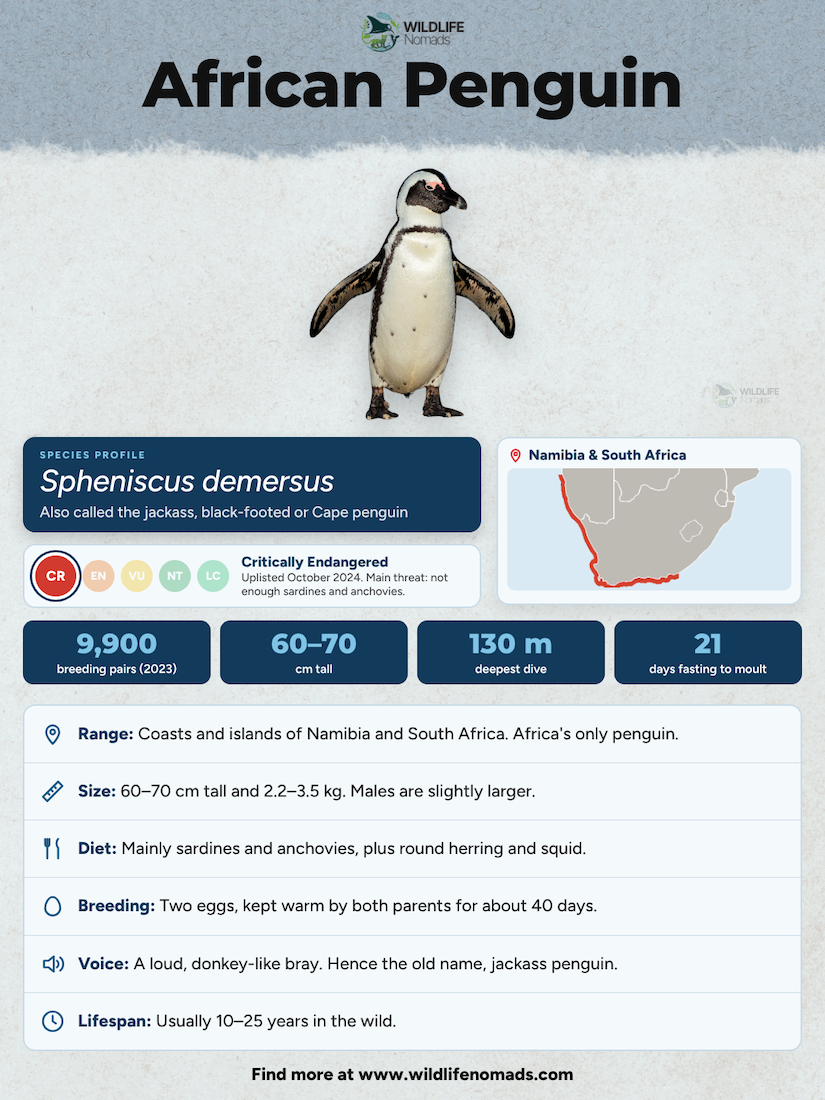
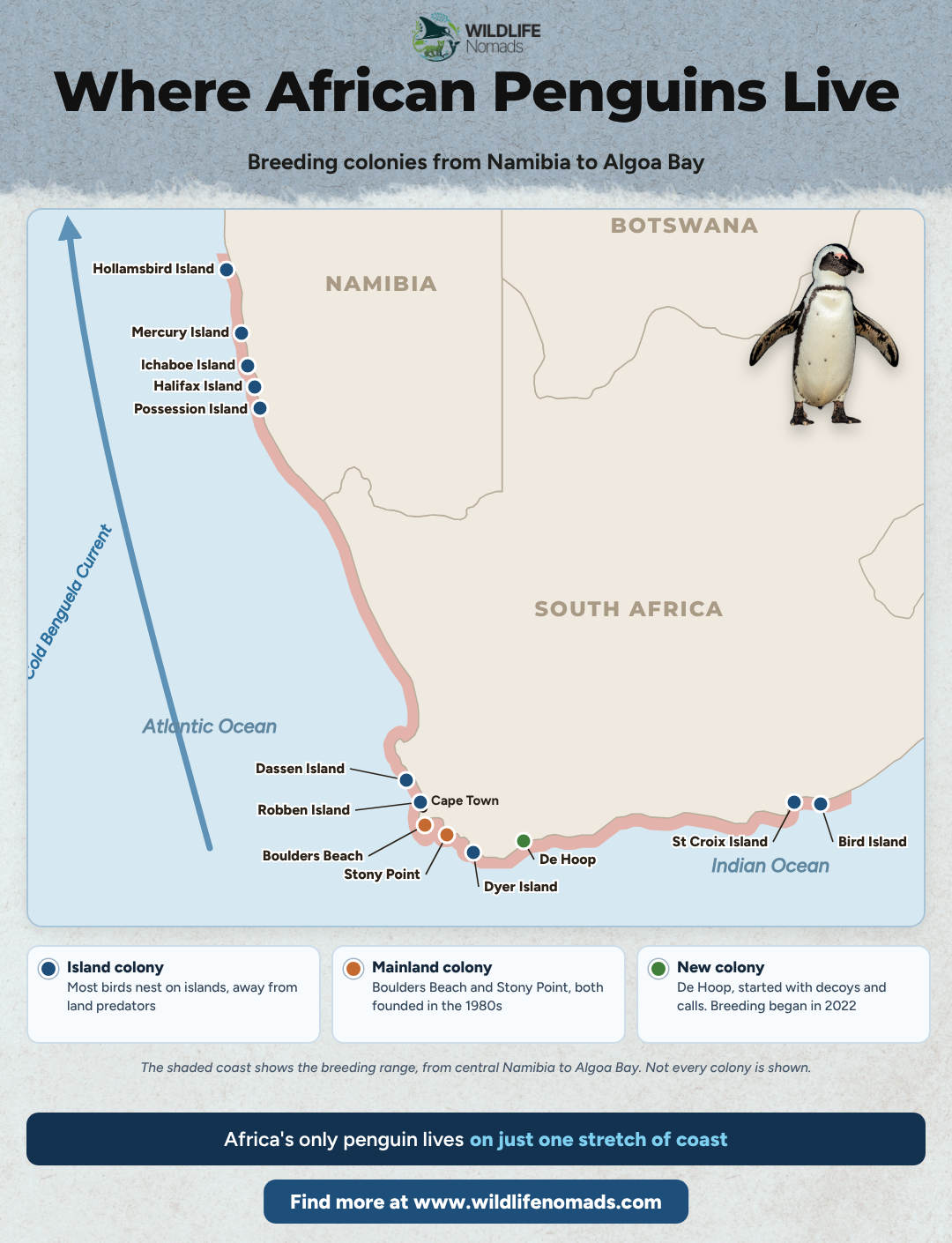
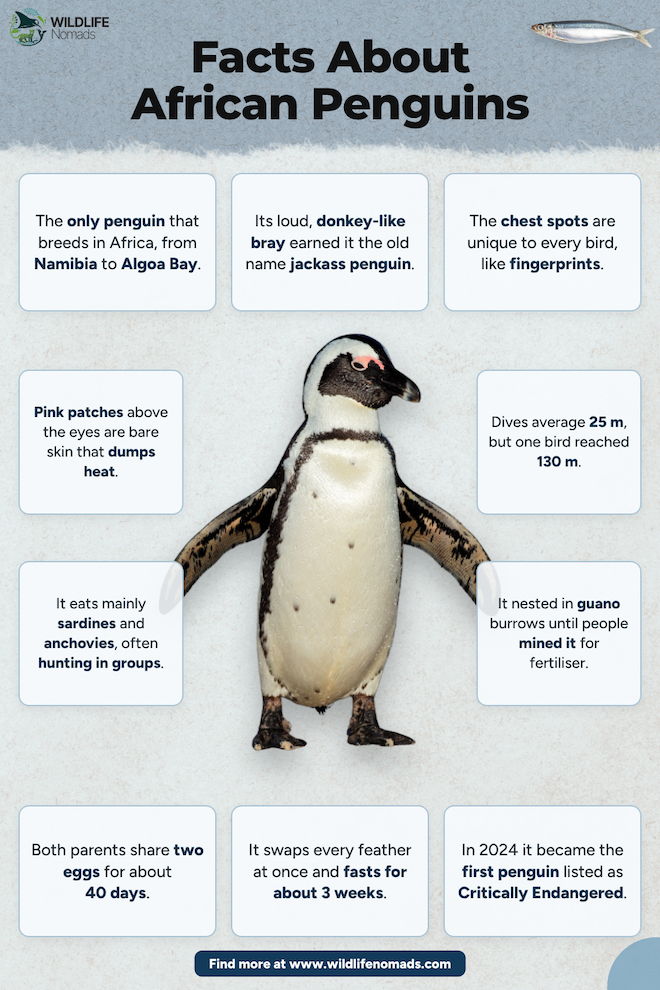
Penguins are not only polar birds. The African penguin (Spheniscus demersus) is the only penguin species that breeds on the African continent. It lives along the rocky coasts of southwestern Africa, from Namibia to Algoa Bay near Port Elizabeth, now Gqeberha.
Most colonies sit on offshore islands, including Dassen, Robben, Dyer, St Croix and Bird Island. Only a handful breed on the mainland. Boulders Beach in Simon’s Town and Stony Point in Betty’s Bay are the famous pair. A few birds founded both in the 1980s.
These are birds of temperate climates. The cold, nutrient-rich Benguela Current feeds their fish, while their nesting grounds can bake under a summer sun. That mix of cool water and hot land shapes almost everything about them.
Its closest relatives are the other banded penguins: the Humboldt, Magellanic and Galápagos penguins of South America. You can meet every one of them in our guide to the 18 species of penguins.
2. They Were Called Jackass Penguins for a Reason
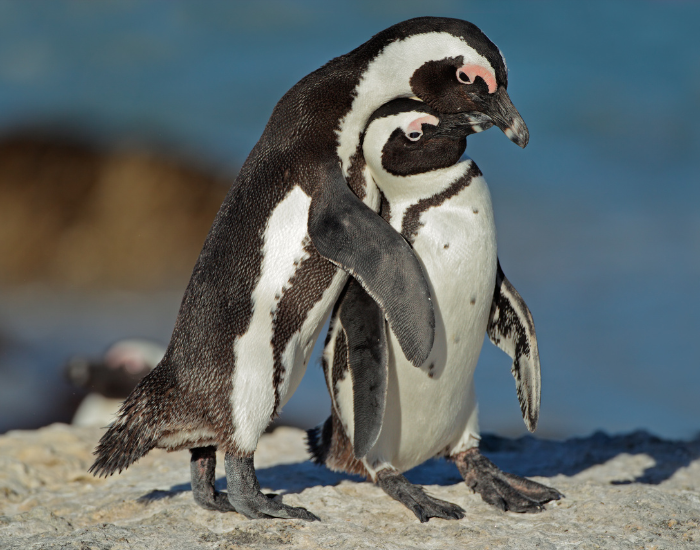
Stand near a penguin colony and you hear it long before you see it. The adults bray loudly, and the sound is remarkably close to a donkey. Sailors and naturalists called them jackass penguins long before the polite names took over.
Other names stuck too. Black-footed penguin describes the black legs and feet. Cape penguin and South African penguin point to the coast these birds call home.
The scientific name is more poetic. Spheniscus comes from the Greek for “wedge”, a nod to the streamlined body. Demersus is Latin for “plunging”, which suits a diving bird perfectly.
No two birds make quite the same sound, either. A 2015 study of a captive colony found individual cues in both contact calls and display songs. In a crowded, noisy colony, that vocal signature helps partners find each other.
3. Every African Penguin Wears a Unique Spot Pattern
Adults stand about 60 to 70 cm tall and weigh 2.2 to 3.5 kg. Males are slightly larger than females and have longer beaks. That puts them mid-table among penguins, above the little penguin and far below the emperor penguin.
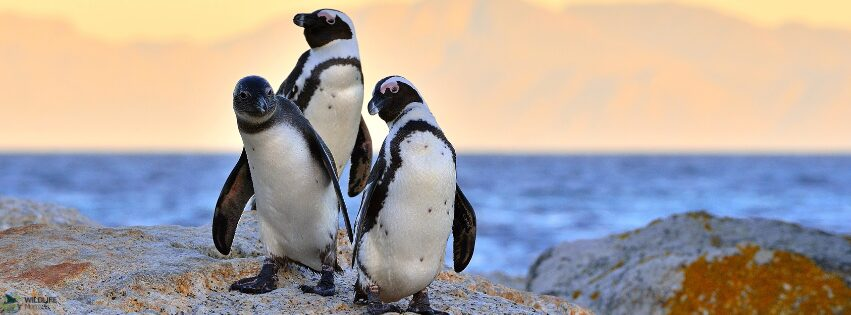
Look at the chest and you will see a single black stripe curving across the white. Magellanic penguins carry two bands, so that one stripe is a handy field mark. Below it sits a scatter of black spots, unique to each bird, much like human fingerprints.
The colours also work as camouflage. Black backs blend with dark water from above, while white undersides vanish against the bright surface from below. Biologists call this countershading.
Juveniles look different. They wear grey-blue to brownish feathers with no band and no spots. Full adult plumage arrives at around three years old.
4. Pink Eye Patches Work Like a Radiator
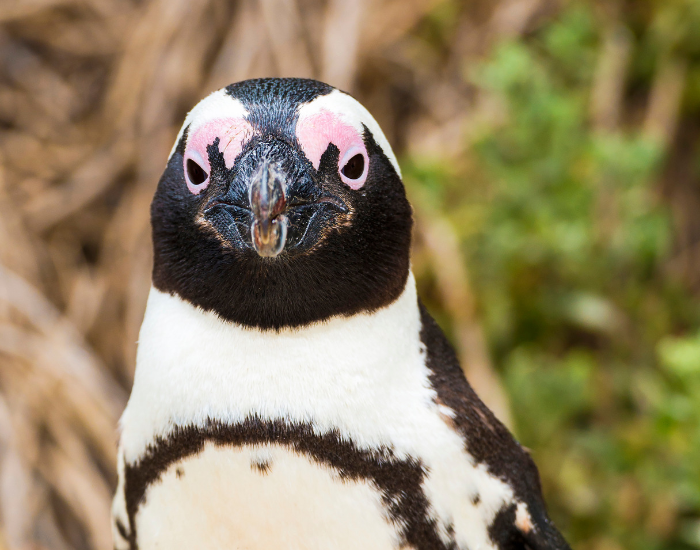
Those pink patches above the eyes are bare skin, not feathers. When a penguin overheats, more blood flows into that skin. Heat escapes into the surrounding air, and the patches turn a deeper pink.
Many sites call them sweat glands, but birds cannot sweat. The patches are simply a radiator in plain sight. On hot days, they also pant, hold their flippers away from the body and head back to sea.
Salt is the other challenge. They swallow seawater along with their prey. A gland above each eye filters excess salt from the blood, and the brine drips out through the nostrils. A quick head shake flicks it away.
5. African Penguins Swim at Up to 20 km/h
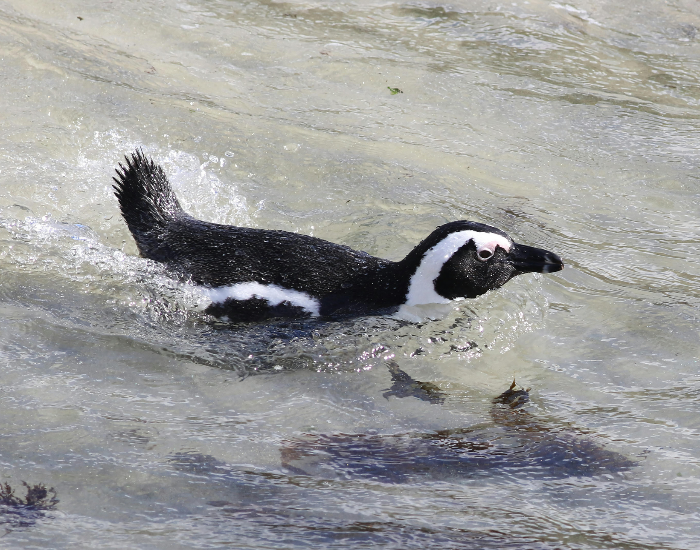
On land they waddle. Underwater they fly. Stiff, wedge-shaped flippers drive them forward, while heavy, solid bones help them stay down.
Cruising speed sits around 4 to 7 km/h, with bursts close to 20 km/h when chasing fish. That top speed is respectable, though nowhere near the fastest sea animals.
Most dives last only short periods. Foraging birds average about 25 m deep and 69 seconds per dive. The deepest recorded dive reached 130 m, and the longest lasted 275 seconds.
6. Sardines and Anchovies Decide Their Fate
The African penguin is a pursuit diver. Its diet centres on small schooling fish, especially sardines and anchovies. It also takes round herring, horse mackerel, squid and the odd crustacean.
Hunting is often a team effort. Groups of penguins herd fish into tight balls before picking them off. Researchers have found that birds feeding in groups catch more prey than lone hunters.
During the breeding season, parents forage within roughly 20 to 40 km of the colony. That short leash makes local fish stocks critical. When sardines shift away, parents hunt farther and chicks wait longer between meals. Want to see how one missing fish ripples outward? Try our food web game.
7. They Nest in Burrows Dug Into Old Guano
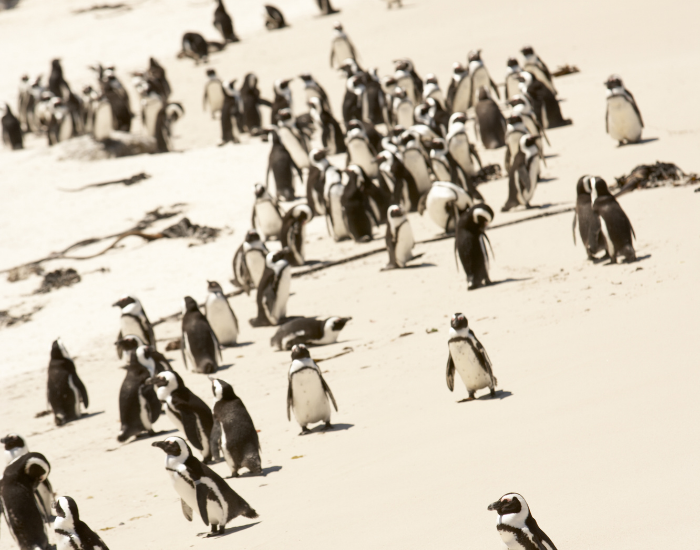
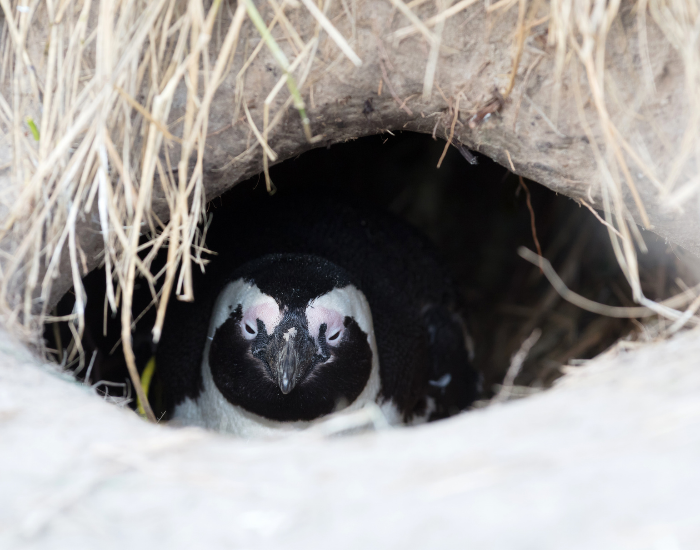
These penguins evolved to dig their nests in guano, the thick layer of seabird droppings built up on islands over centuries. A guano burrow stays cool and humid. It shields eggs from the sun and hides chicks from predators.
Then people mined it. Through the 1800s and 1900s, workers scraped the islands bare for fertiliser. Penguins lost their burrows and had to nest in the open, exposed to heat, storms and gulls.
Conservationists now install artificial nests in the colonies. Designs include plywood A-frames, cement and fibreglass shelters, and newer double-layered ceramic domes. A 2024 study across eight South African colonies found they raised breeding success by 16.5% overall. Still, no single design worked best everywhere.
8. Two Eggs, Shared Shifts and Chick Crèches
These birds breed in colonies and usually return to the same breeding grounds each year. Pairs often reunite with the same partner, though penguin “marriages” are not always for life. On Phillip Island, researchers counted nearly 250 divorces among about 1,000 little penguin pairs.
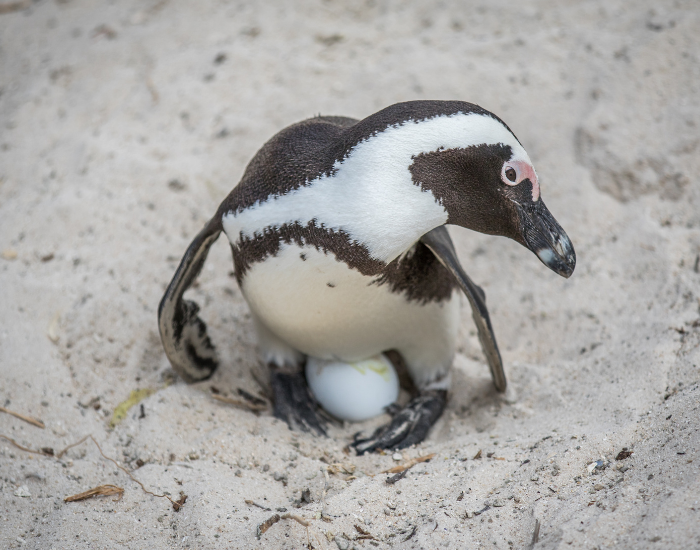
The breeding season is long, peaking from March to May in South Africa. A female lays two eggs, and both parents take turns incubating for about 38 to 41 days. Each shift lasts around two and a half days, depending on how fast the partner finds food.
After hatching, one parent guards the chicks while the other forages. At about a month old, chicks join crèches with other chicks, so both parents can hunt at sea. They fledge at 60 to 130 days, then spend one to two years at sea.
Most birds breed for the first time at four to six years old. People once took African penguin eggs as a delicacy, and collecting continued into the mid-20th century. Every egg taken was one less chick in a shrinking population.
9. They Starve Themselves Every Year to Grow New Feathers
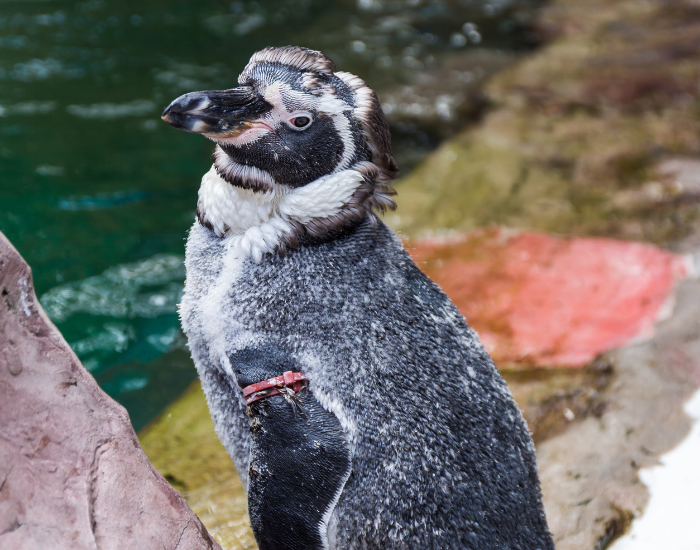
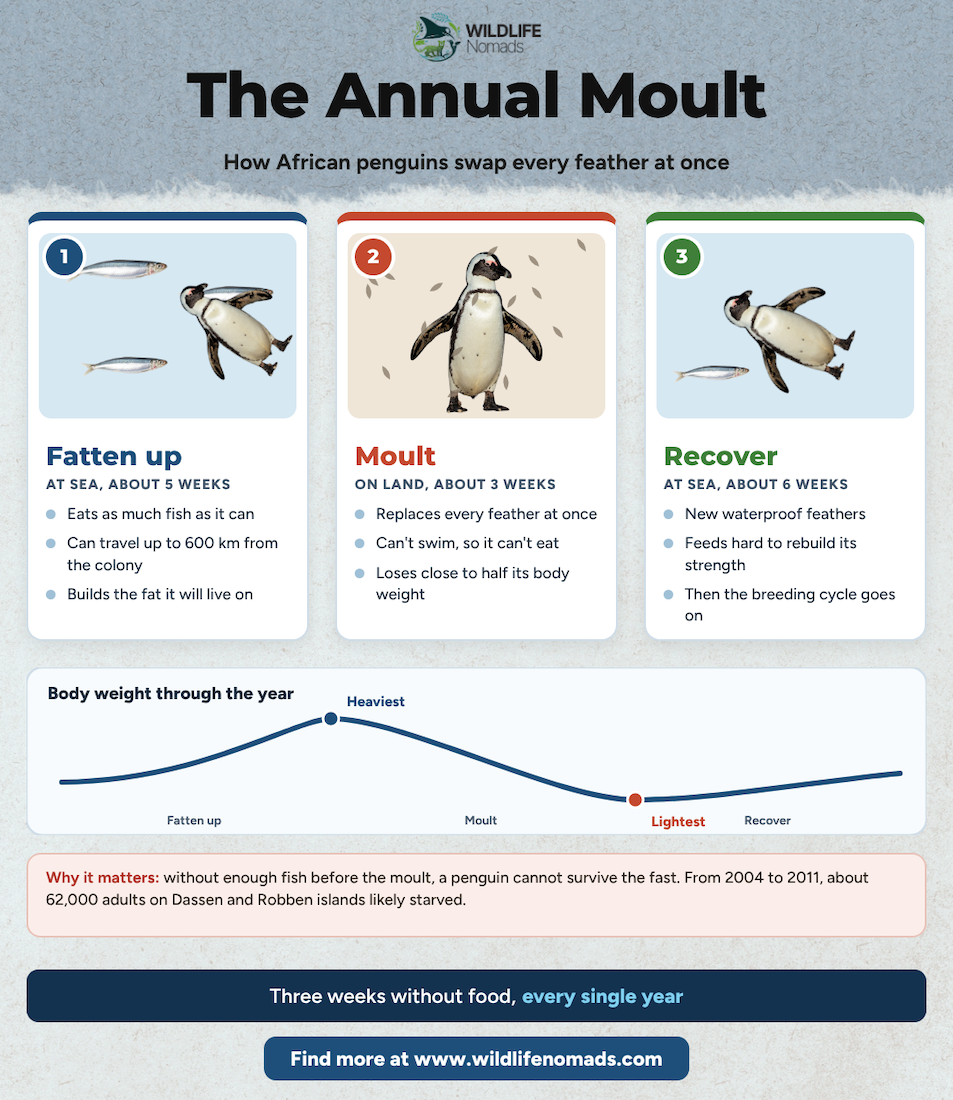
Once a year, every adult replaces all its feathers at once. This catastrophic moult lasts about 21 days, and the bird cannot swim or feed. Old feathers lose their waterproofing, so the new feathers must grow in before it returns to sea.
Preparation is intense. Penguins fatten for about five weeks first, ending up roughly 31% heavier than breeding adults. During the moult they lose close to half their body weight. Afterwards, they need about six weeks at sea to recover.
That fast is where food shortages turn deadly. A 2025 study estimated that about 62,000 breeding penguins on Dassen and Robben islands died between 2004 and 2011. Most likely starved, because sardine stocks stayed below 25% of their peak.
Moulting also costs chicks. Parents that must fatten up sometimes abandon their nests, leaving chicks behind. That is why rescue teams collect abandoned chicks every year.
10. The African Penguin Is Now Critically Endangered
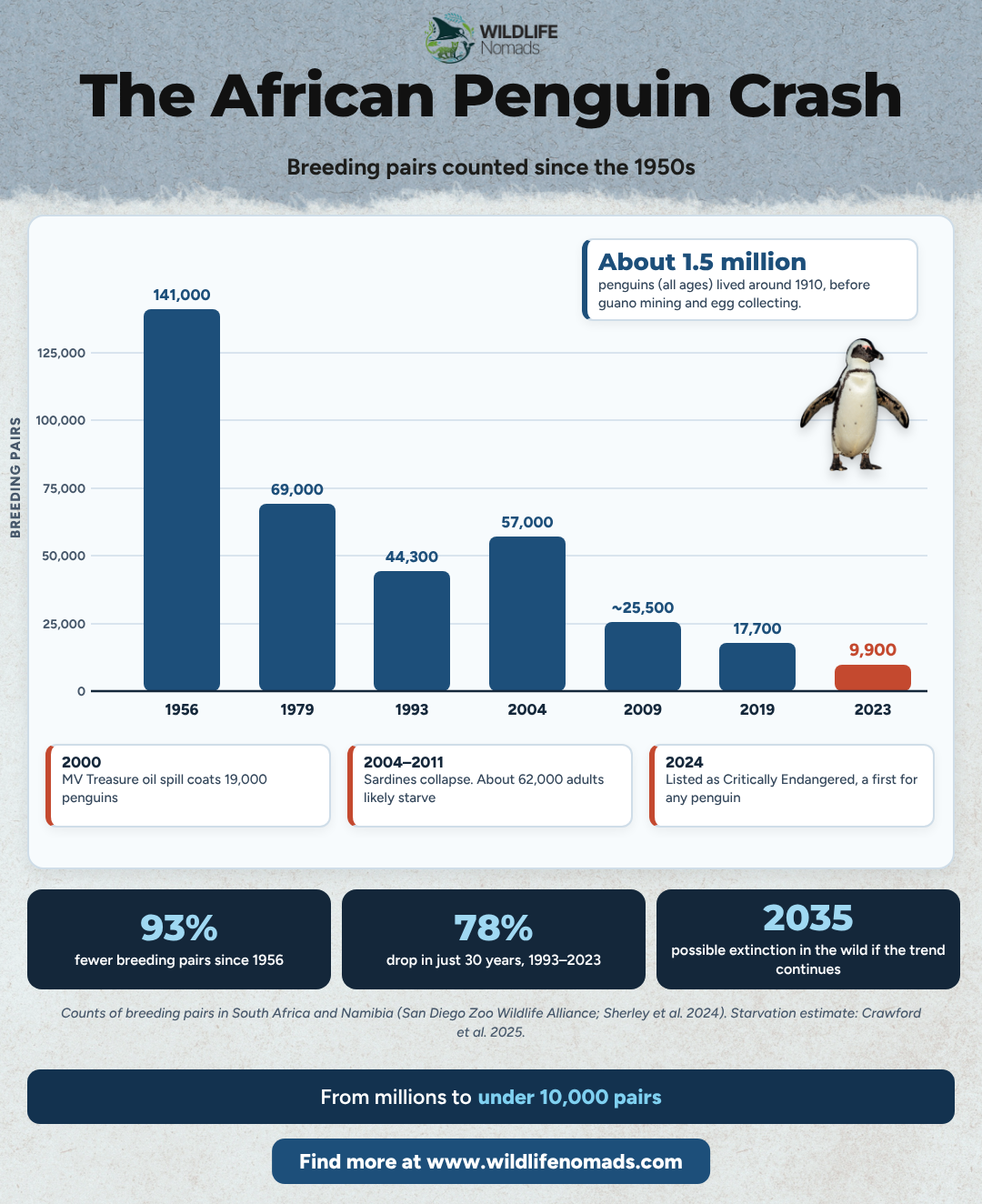
On 28 October 2024, the IUCN changed its conservation status from Endangered to Critically Endangered. It was the first penguin species ever placed in that category. The assessment counted about 9,900 breeding pairs in 2023, roughly 19,800 mature birds.
The fall has been steep. At the start of the 20th century, the species may have numbered 1.5 to 3 million birds. Dassen Island alone once held more than a million. BirdLife South Africa estimates the African penguin has lost 97% of its population.
Recent decades hit hardest. Breeding pairs fell from about 44,300 in 1993 to 9,900 in 2023, a 78% drop in 30 years. If that trend continues, scientists warn the species could vanish from the wild by 2035.
African penguin populations are far from the only ones in trouble. See where other species stand in our Endangered Animals Explorer, or read about almost extinct sea animals.
11. Oil, Predators and Even Bees Add to the Pressure
Hunger is the main driver, but the natural environment holds other dangers. In June 2000, the ore carrier MV Treasure sank between Robben and Dassen islands. Its oil coated about 19,000 African penguins.
What followed became one of the largest animal rescues ever attempted. Volunteers cleaned the oiled birds in Cape Town, and about 90% were released. Another 19,500 clean penguins were trucked roughly 800 km east to Port Elizabeth, out of the oil’s path.
Even so, about 2,000 adults died, along with thousands of chicks. Cleaned birds also raised fewer chicks in later years. Oil spills remain a constant risk on this busy shipping coast, alongside wider ocean pollution and underwater noise.
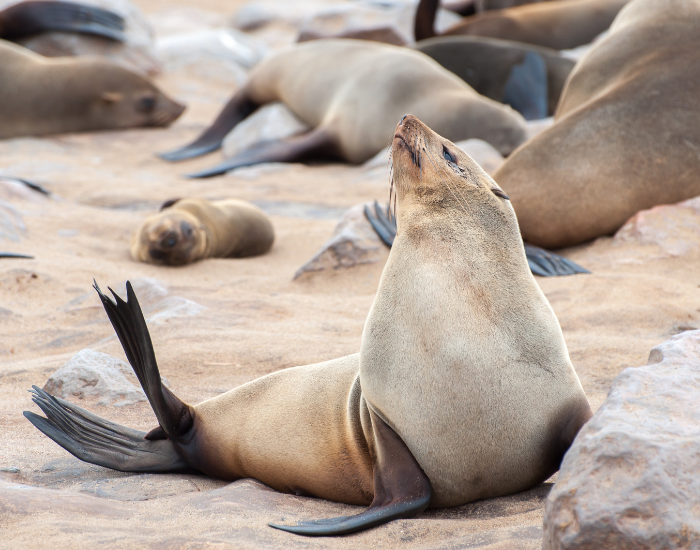
Natural predators take their share. At sea, Cape fur seals hunt penguins, especially around Dyer Island, and sharks take some too. On the islands, kelp gulls raid eggs and small chicks.
Mainland colonies face land predators: caracals, leopards, mongooses and domestic dogs. Cape clawless otters have also killed penguins near Simon’s Town. The strangest case came in 2021. A swarm of Cape honey bees stung 63 penguins to death at Boulders Beach.
Behind much of this sits climate change. Shifting conditions push sardines away from the western colonies. Heatwaves add stress for birds nesting in the open.
12. People Are Fighting Hard to Save Them
On 18 March 2025, South Africa’s High Court made a landmark settlement an order of court. It created ten-year no-take zones for sardine and anchovy purse-seine fishing. They surround six key colonies: Dassen, Robben, Stony Point, Dyer, St Croix and Bird Island.
Science backed that push. Earlier experimental closures improved chick survival and condition at some colonies. The effects were subtle, but real. You can read more about how marine protected areas work in our guide.
Juveniles add urgency. Satellite tracking showed young penguins follow cold, plankton-rich water that once meant plenty of fish. Off Namibia and western South Africa, those cues now lead them into depleted waters. Biologists call this an ecological trap.
On land, SANCCOB, the Southern African Foundation for the Conservation of Coastal Birds, has rescued seabirds since 1968. Its chick-rearing work focuses on releasing abandoned chicks back into the wild, nearly 8,000 so far.
BirdLife South Africa, CapeNature and SANCCOB also started a new colony at De Hoop Nature Reserve. Concrete decoys and speakers playing penguin calls lured birds ashore. In 2022, the first pair raised two chicks there.
There is good news from the Boulders Beach colony, too. SANParks counted 790 breeding pairs in its 2026 census, up from 698 in 2025. One good year is not a recovery, but it is a reason to keep going.
FAQs About African Penguins
The latest full count found about 9,900 breeding pairs in 2023, roughly 19,800 mature birds. Including young birds, the total was estimated at around 31,700. About 8,750 of those pairs breed in South Africa and about 1,200 in Namibia.
They are called jackass penguins because their loud, braying call sounds like a donkey. Both sexes bray, especially in the breeding colonies. Today, “African penguin” is the official common name.
Boulders Beach in Simon’s Town, near Cape Town, is the most accessible penguin colony. Boardwalks let you watch the birds closely without disturbing them. Stony Point in Betty’s Bay offers a quieter alternative, with a boardwalk through the colony.
They eat mainly sardines and anchovies. They also take round herring, horse mackerel and squid. Parents hunt at sea and bring partly digested fish back for their chicks.
Many wild birds live 10 to 15 years. Some reach their mid-twenties, and birds in zoos can live longer still. Survival depends heavily on food, especially in the weeks around the annual moult.
Watch From the Boardwalk
The African penguin shows how fast a common bird can become a rare one. Fewer than 10,000 pairs now carry a species that once numbered in the millions. Its future depends on fish, safe nests and people paying attention.
I still hope to hear that bray in person one day. If you get there first, here is how you can help.
- Choose sustainable seafood
Look for eco-labels such as the Marine Stewardship Council (MSC). Responsibly sourced fish leaves more prey for wildlife. - Visit responsibly
If you travel to South Africa or Namibia, stay on boardwalks and keep your distance from nests. - Donate or volunteer
SANCCOB and BirdLife South Africa rely on donations and volunteers for rescue and research. - Spread awareness
Share African penguin stories and images. Public pressure helped win the 2025 fishing closures. - Support policy
Back strong fisheries management and climate action. Groups such as WWF-South Africa campaign for both.
Want to Know More About Penguins?
Meet every species in our guide to the types of penguins. Then lighten the mood with these funny penguin facts. Planning a trip? Our guide to the best places to see wildlife in South Africa pairs well with a Boulders Beach visit.
Where to See African Penguins
This blog is reader-supported. When you buy experiences through links listed on this site, we may earn an affiliate commission.
References:
Crawford, R. J. M., Sherley, R. B., Shannon, L. J., McInnes, A. M., Carpenter-Kling, T., & Makhado, A. B. (2025). High adult mortality of African Penguins Spheniscus demersus in South Africa after 2004 was likely caused by starvation. Ostrich, 96(4), 216–224. https://doi.org/10.2989/00306525.2025.2568382
Favaro, L., Gamba, M., Alfieri, C., Pessani, D., & McElligott, A. G. (2015). Vocal individuality cues in the African penguin (Spheniscus demersus): A source-filter theory approach. Scientific Reports, 5, 17255. https://doi.org/10.1038/srep17255
Pichegru, L., Sherley, R. B., Malan, T., Barham, B. J., Ludynia, K., Geldenhuys, D., Amos, K., Barham, P. J., Drost, E., Hahndiek, V., Hufke, A., Hugo, C., Lawrence, C., McGeorge, C., McInnes, A. M., Makhado, A. B., Mashau, M., Milne, R., Purves, A., … Waller, L. (2024). Decades of artificial nests towards African penguin conservation: Have they made a difference? Ecological Solutions and Evidence, 5(4), e12388. https://doi.org/10.1002/2688-8319.12388
Sherley, R. B., Barham, B. J., Barham, P. J., Campbell, K. J., Crawford, R. J. M., Grigg, J., Horswill, C., McInnes, A., Morris, T. L., Pichegru, L., Steinfurth, A., Weller, F., Winker, H., & Votier, S. C. (2018). Bayesian inference reveals positive but subtle effects of experimental fishery closures on marine predator demographics. Proceedings of the Royal Society B, 285(1871), 20172443. https://doi.org/10.1098/rspb.2017.2443
Sherley, R. B., Ludynia, K., Dyer, B. M., Lamont, T., Makhado, A. B., Roux, J.-P., Scales, K. L., Underhill, L. G., & Votier, S. C. (2017). Metapopulation tracking juvenile penguins reveals an ecosystem-wide ecological trap. Current Biology, 27(4), 563–568. https://doi.org/10.1016/j.cub.2016.12.054
Sherley, R. B., Makhado, A. B., Crawford, R. J. M., Hagen, C., Kemper, J., Ludynia, K., Masotla, M. J., McInnes, A., Pichegru, L., Tom, D., Upfold, L., & Waller, L. J. (2024). The African Penguin Spheniscus demersus should be considered Critically Endangered. Ostrich, 95(3), 181–187. https://doi.org/10.2989/00306525.2024.2355618