

Few animals on the planet inspire the same universal love as the capybara. These chilled-out creatures have become internet darlings, often seen lounging in hot springs with monkeys on their backs or calmly munching grass while surrounded by chaos. Definetely one of the most iconic animals of Brazil. There are two species of capybaras: the greater capybara and the lesser capybara.
While the capybara is the largest rodent in the world, it’s important to note that the genus Hydrochoerus actually contains two extant species: the more widespread greater capybara and the smaller lesser capybara. The well-known capybara described in detail above is the greater capybara, formally known as Hydrochoerus hydrochaeris. The lesser capybara, a distinct species found mainly in northern regions like Panama and Colombia, is known scientifically as Hydrochoerus isthmius. Both belong to the family Caviidae, making them close relatives of the guinea pig.
So, Is a Capybara a Rodent?
Yes, capybaras are rodents, in fact, they hold the title for the largest rodent in the world. Scientifically known as Hydrochoerus hydrochaeris, capybaras belong to the order Rodentia, the same group that includes rats, mice, guinea pigs, and yes, even hamsters. Despite their unusual size (they can weigh up to 80 kg or 176 pounds), they’re 100% rodent.
Here are a few rodent-like features they share with other rodents:
- Continuously growing incisors
- Herbivorous diet
- Gnawing behavior. Their long, sharp teeth are essential for gnawing and maintaining their continuously growing incisors.
- High reproductive rates
Capybara pups reach sexual maturity at approximately 15 months of age.
So, to answer the question once and for all: Are capybaras considered rodents? Absolutely.

Where Do Capybaras Live?
Capybaras are native to Central and South America, thriving in countries like Pantanal in Brazil, Venezuela, Colombia, Argentina, and Uruguay. If you’re wondering where capybaras live, the answer is pretty straightforward: wherever there’s water. They thrive in grassy regions bordering rivers and densely forested areas, which provide both food and shelter.
These semi-aquatic mammals are always found near bodies of water such as lakes, swamps, marshes, and rivers. Their webbed feet and love of swimming make them uniquely adapted to aquatic life, and they often submerge themselves to escape predators or cool off. Capybaras frequently spend their time in shallow water to wallow and keep cool, particularly during the hottest parts of the day. Due to their dry skin, capybaras require access to water sources to maintain their health and well-being.

Here are 10 facts about capybaras:
1. Capybaras Are the Largest Rodents on Earth
If you ever imagined a guinea pig supersized to the extreme, you’d be picturing a capybara. Weighing more than a golden retriever and measuring up to four feet in length, the average weight of a capybara is around 110 pounds. They dwarf their rodent cousins. Their fur is typically light brown and characterized by shaggy hair, adding to their distinctive appearance.
Capybaras have slightly webbed feet that aid in swimming and escaping from predators. Additionally, they have small, hairless ears positioned high on their heads, allowing them to stay alert while most of their bodies are submerged in water. So if you’ve been asking, what is the largest rodent?, look no further.
2. They’re Surprisingly Good Swimmers
Don’t let their stocky build fool you. Capybaras are excellent swimmers and can hold their breath underwater for up to five minutes. Their partially webbed feet make them adept swimmers, allowing them to navigate through water with ease. Their eyes, ears, and nostrils are located high on their heads, similar to a hippo or crocodile, allowing them to stay underwater while keeping most of their body submerged.

3. They Love Company
Capybaras are incredibly social animals. In the wild, they typically reside in small groups consisting of around 10 individuals, though larger groups of up to 100 have been observed during dry seasons when water sources are scarce. These communities have complex social hierarchies and cooperative behaviors that help them thrive. Each group typically has a dominant male, several females, and subordinate males, all working together to ensure the group’s survival.
The social structure of these groups, including the roles of the dominant male, females, and subordinate males, is crucial for their psychological and physical well-being, as they rely on companionship and social structures to thrive.

4. Capybaras Communicate With an Entire Vocal Repertoire
You might not expect it, but these mellow mammals are actually quite vocal. Capybaras use a range of sounds to communicate, including:
- Barks
- Whistles
- Clicks
- Grunts
- Purrs
Each sound conveys different information, from alerting the group to danger to bonding between mothers and pups.

5. They’re Plant-Based
As strict herbivores, capybaras eat a variety of plants, including grasses, aquatic vegetation, fruit, and tree bark. Capybaras eat grass as a primary part of their diet. They even eat their own feces (called coprophagy) to obtain beneficial bacteria, which help their stomach break down the thick fiber present in their plant-based diet. This behavior helps them maximize nutrient absorption from hard-to-digest grasses. Nature is weird, but effective. As grass eaters, they chew food by grinding it back and forth, which helps them break down tough plant materials.

6. Capybara Lifespan Varies by Environment
In the wild, the capybara lifespan is usually around 8 to 12 years, though they tend to live longer in captivity, sometimes up to 15 years. Factors like predators, disease, and habitat degradation all affect longevity in the wild.
If you are interestd in how ling other animals, have a look at ourt article:

7. Capybaras Are Surprisingly Zen Around Other Animals
From monkeys to cats, birds to crocodiles, capybaras get along with just about everyone. However, they must remain vigilant as young capybaras are vulnerable to predators like black vultures, harpy eagles, and other birds of prey, and small cats. This non-aggressive nature makes them the ultimate chill companion in the animal kingdom. There’s a reason they’ve gone viral as the world’s most peaceful animals.

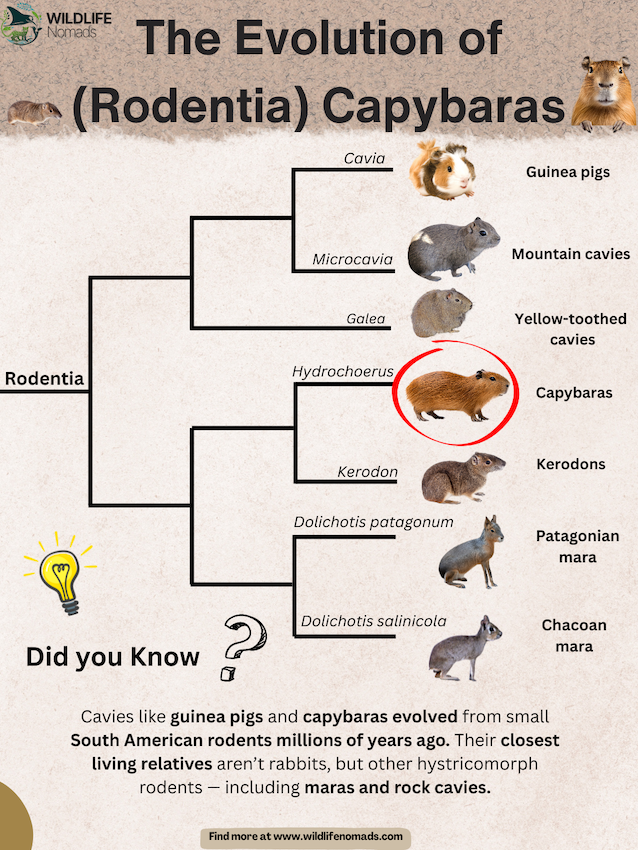
8. Capybaras Are Related to Guinea Pigs
It’s true! Despite their size, capybaras are closely related to guinea pigs and rock cavies. Both belong to the Caviidae family, though capybaras are in their own genus (Hydrochoerus). Capybaras are also distantly related to chinchillas and agoutis. So if you’re wondering, is a capybara a type of hamster? Not quite, but it is a cousin to your childhood pet guinea pig.
9. They’ve Adapted to Urban Life in Some Areas in South America
In parts of South America, especially Brazil, capybaras have become common sights in urban parks and even city streets. Their ability to adapt to human-modified environments is both impressive and a challenge for conservationists.

10. Rodent Capybaras Have Become Cultural Icons
From memes to merchandise, the capybara has become a symbol of peace, chill vibes, and low-key rebellion. They’re also featured in folklore, pop culture, and traditional indigenous stories throughout Latin America.
Conservation Status and Captivity: Challenges and Efforts
Capybaras are currently listed as “Least Concern” on the IUCN Red List of Threatened Species, but this doesn’t mean they are free from threats. Their populations are declining due to habitat destruction, illegal poaching, and the introduction of non-native species. Additionally, capybaras are sometimes utilized as a food source by local populations. These factors highlight the urgent need for conservation efforts to protect these unique creatures. Adult female capybaras typically produce one litter of young per year. The breeding habits of adult females include a gestation period and the vulnerability of newborn pups. The jaguar is the one main natural predator of adult capybaras. However, other large predators of adult capybaras include pumas and caimans (crocodilians). Young capybaras are also preyed upon by anacondas and forest foxes, in addition to the black vultures, harpy eagles, and small cats the article lists.
Conservationists are working hard to safeguard capybara habitats and reduce human-capybara conflicts. Initiatives include creating protected areas and launching education programs for local communities to raise awareness about the importance of capybaras in their ecosystems. For instance, the San Diego Zoo has a successful capybara breeding program and offers educational programs to inform the public about these fascinating animals and the need for their conservation. During the wet season, larger groups of capybaras form as food and water become more abundant, and breeding peaks. In contrast, during the dry season, capybaras adapt their diet by eating reeds, grains, melons, and squashes when fresh grasses and water plants are scarce.

What’s New in Capybara Science:
Urban Life & Human Impacts
In a study from Campo Grande, Brazil, researchers tracked nine capybara groups living entirely within the urban matrix to understand how city life changes their ecology. They found that these urban capybaras often have larger home ranges than their forest-dwelling counterparts, likely because fragmented green patches force individuals to roam farther for food and water.
Human presence also reshapes when and how capybaras move. On days with high foot traffic, these rodents shift more of their activity into the night, delaying their foraging and reducing use of open areas. In effect, capybaras adapt by becoming more nocturnal and selectively using habitat patches (grasslands, forest edges, water bodies) to minimize disturbance.
What Predators Teach Us About Capybara Behavior
A controlled experiment comparing capybara populations living in predator-rich and predator-free areas revealed fascinating behavioral flexibility. When exposed to predator cues (e.g. playbacks), capybaras rapidly increased vigilance levels, cut down on feeding time, and shifted group spacing to reduce individual risk.
Interestingly, the study also measured physiological stress markers (e.g. cortisol) and found that capybaras in predator-exposed areas showed elevated stress responses, suggesting that fear alone, even without direct predation, reshapes their behavioral budgets. This has big implications for rewilding, predator restoration, and how we manage landscapes where predators are lost or reintroduced.
Are Capybaras Rodents? Absolutely.
So, are capybaras rodents? Without a doubt. But they’re also so much more than that. These gentle giants break all the stereotypes associated with rodents. They’re calm, social, intelligent, and surprisingly relatable, maybe that’s why we love them so much.
Whether you came here wondering about the rodent capybara or just looking for a wholesome dose of animal facts, we hope you’ve learned something new about these aquatic-loving, social butterflies of the rodent world. Next time someone asks, “Are capybaras considered rodents?” you can hit them with the science and the fun facts.
Capybara Fact-Check: True or False? 🦫
Ten statements about the world’s chillest rodent — some true, some common myths. Answer each, then see your score.
Fact-check · True or False?
Find Capybaras in the Wild!
This blog is reader-supported. When you buy experiences through links listed on this site, we may earn an affiliate commission.