I visited the Natural History Museum in London earlier this year with a bucket list. Most of it was mammals. I wanted the saber-toothed cat and the giant ground sloth. Also I wanted the whole cast of Ice Age animals I had been drawing since childhood.
I got all of them. The prehistoric ground sloth is absurdly gigantic in person. The saber-tooth cat skull is smaller than every reconstruction suggests.
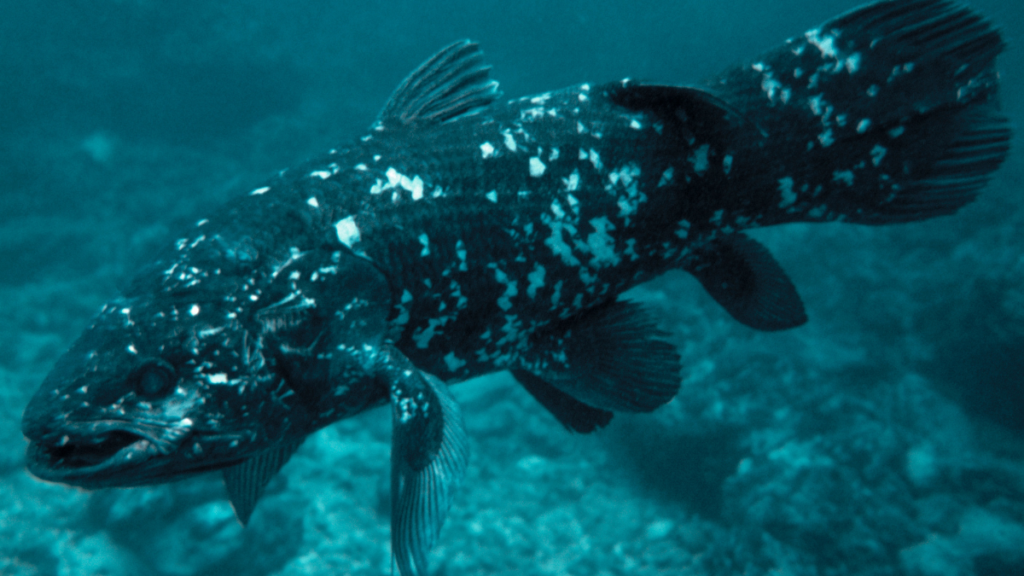
Then people file past the blue whale in the main hall, snap a photo, and keep walking. They do the same to a small, dark, heavy-looking fish nearby. That coelacanth specimen stopped me for twenty minutes.
Here is why. Scientists knew this animal only from stone. Every coelacanth on record sat in the fossil record, and the youngest fossils were roughly 66 million years old. Then a fisherman caught one alive.
Below are twelve facts about the coelacanth. We will cover its anatomy, its deep-sea habitat, its two living species, and the “living fossil” argument.
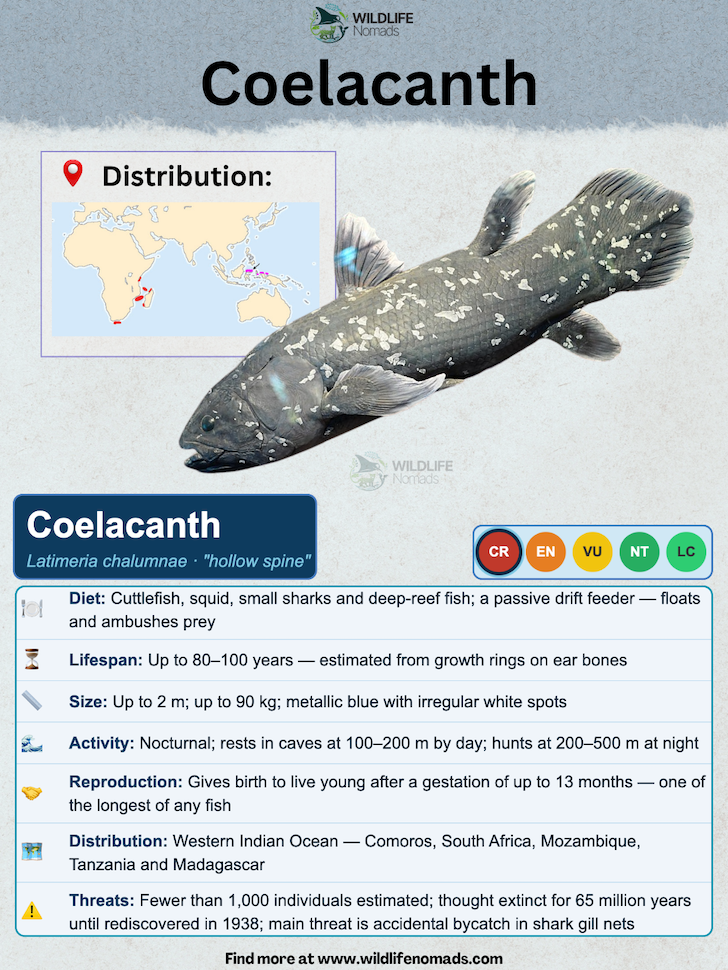
1. Scientists Declared the Coelacanth Extinct for 66 Million Years
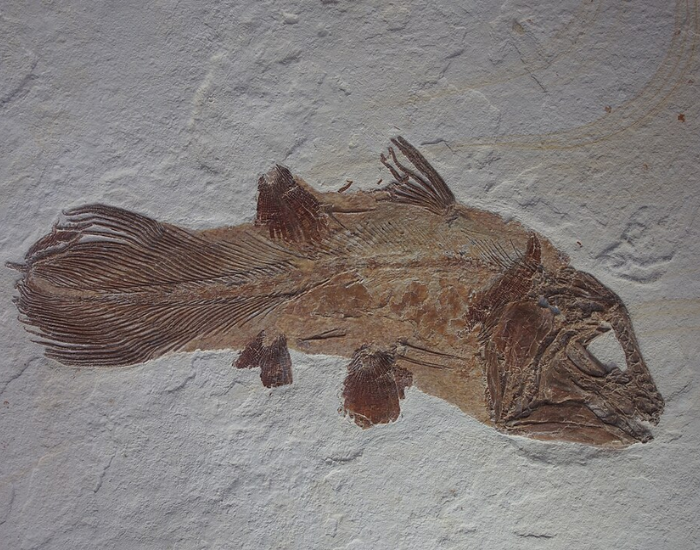
The fossil record for coelacanths stops abruptly at the end of the Cretaceous. For decades, that silence looked like extinction. Textbooks filed them alongside the dinosaurs and ammonites.
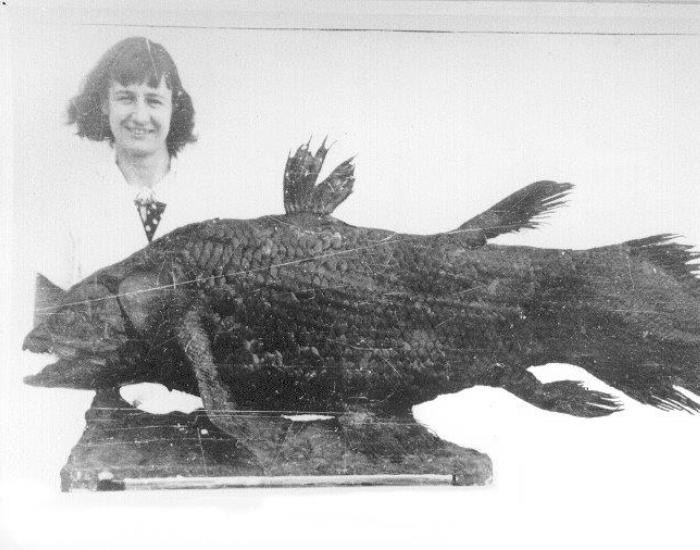
Then that silence broke. The first living coelacanth was discovered on December 22, 1938, off the coast of South Africa. A trawler hauled up a strange fish near the mouth of the Chalumna River. It was deep blue and roughly 1.5 metres long. Nobody aboard recognised it.
You will see the gap quoted as 66 million years and as 70 million years. Both numbers describe the same thing, the youngest fossil coelacanths before 1938. The difference simply reflects how you date those specimens.
2. A Museum Curator Named Marjorie Courtenay-Latimer Made the Call
Marjorie Courtenay-Latimer ran the small East London Museum on South Africa’s east coast. A local trawler captain called her whenever odd things came up in his nets. She went to the docks, saw the fish, and knew she had nothing like it. Marjorie Courtenay-Latimer identified the first living coelacanth ever recorded by science.
Preserving the whole animal was impossible, so she had it mounted and sketched. Ichthyologist J.L.B. Smith saw the drawings and recognised the lobed fins immediately. He named it Latimeria chalumnae in 1939, after her and after the river. The full scientific name reads Latimeria chalumnae Smith, 1939.
That naming still matters to me. A regional curator with no formal ichthyology training made the vertebrate discovery of the century. She managed it because she paid attention to a fin.
3. It Took Fourteen Years to Find the Second Specimen
Smith spent fourteen years distributing reward posters across the western Indian Ocean. The second coelacanth caught finally surfaced in the Comoros islands in 1952. Those islands turned out to be the stronghold of the West Indian Ocean coelacanth.
Comorian fishermen already knew the fish well. They called it gombessa and considered it useless. It was a bycatch nuisance that came up while they fished for oilfish at night.
National Geographic and everyone else framed 1938 as a discovery. The animal was never lost to the people living above it.
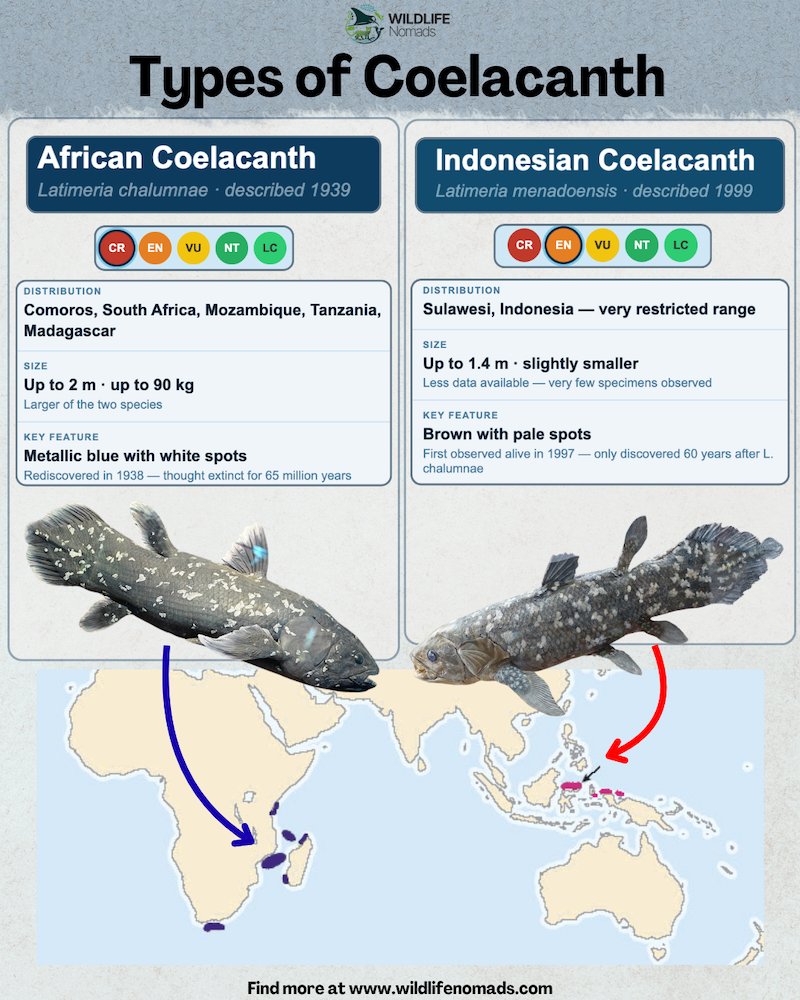
4. There Are Two Living Species, and One Was Found in a Fish Market
In September 1997, biologist Mark Erdmann spotted a coelacanth on a cart in Manado Tua, Sulawesi. He was on his honeymoon. He photographed it, then noticed the colour was wrong, brown, not the deep blue of the African fish.
A second fish caught in July 1998 confirmed his hunch. Researchers described the new species, Latimeria menadoensis, in 1999. Indonesians call it raja laut, “king of the sea.” Genetic work suggests the two extant coelacanth species split roughly 30–40 million years ago.
The IUCN treats them separately. Latimeria chalumnae is Critically Endangered. The Indonesian coelacanth is listed as Vulnerable, because so little is known about its range in Indonesian waters.
5. Their Paired Lobed Fins Move Like Limbs
Look at a coelacanth fin and you see muscle and bone. A normal fish has a thin fan of rays instead. That fleshy stalk places them with lungfish among the lobe-finned fishes. Ray-finned fishes account for almost every fish you have ever eaten.
Submersible footage shows something stranger. The paired fins move in a diagonal, alternating pattern, front-left with rear-right. That is exactly the gait a salamander uses to walk. The fish is not walking. It is sculling, and the coordination is inherited rather than invented.
That inheritance is the whole point. Coelacanths are closely related to lungfish and, more distantly, to tetrapods. This fish species is a strange cousin of every frog, bird, and human alive. Lungfish, however, sit closer to our own branch than coelacanths do.
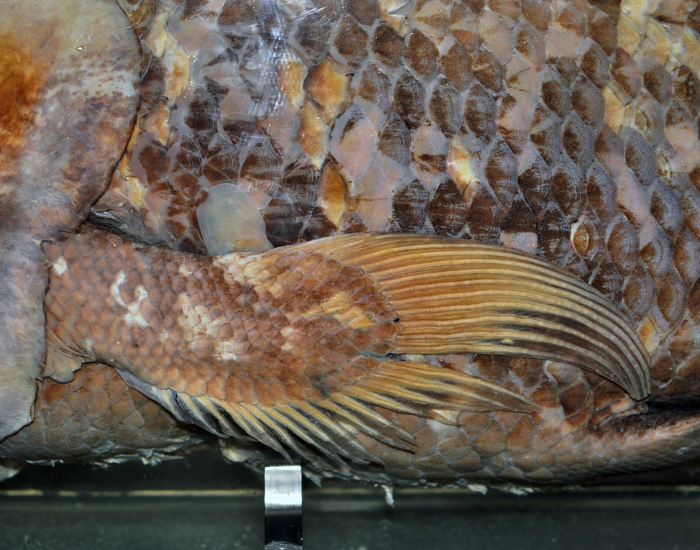
6. The Tail Has Three Lobes, Not Two
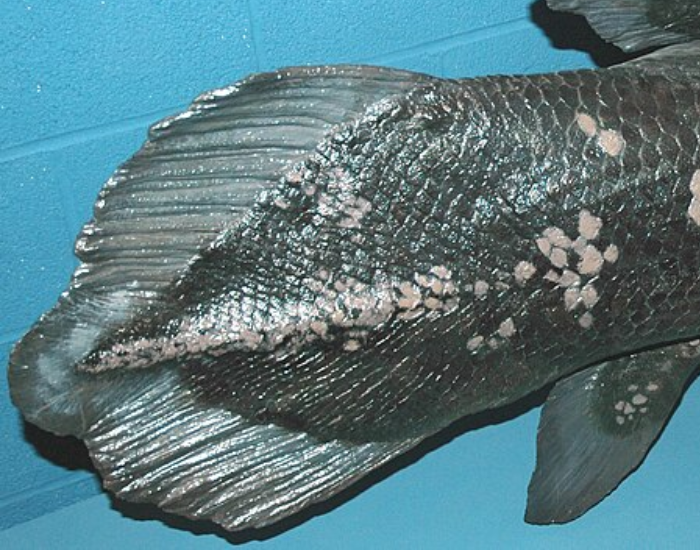
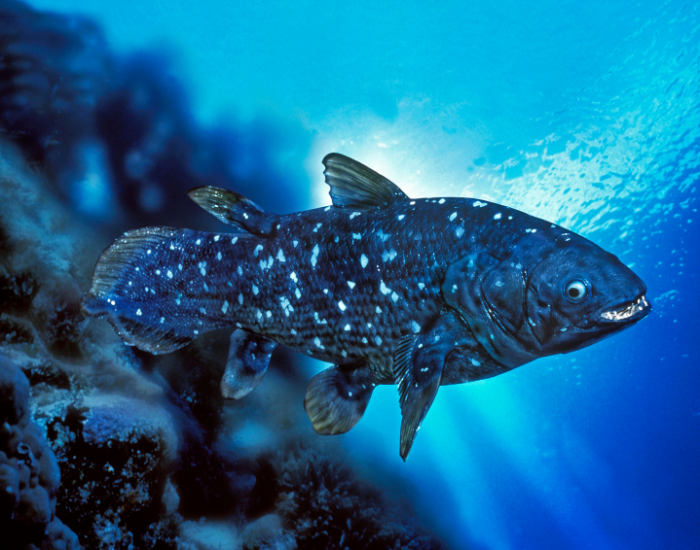
Most fish have a caudal fin with two lobes. The coelacanth has three. Two large lobes flank a small independent third lobe, which sticks out from the centre like a tuft.
The second dorsal fin and the anal fin are also lobed and mobile. Together they give the animal unusual fine control near the sea floor. Deep-water footage looks more helicopter than torpedo. They hover, tilt, and reverse in tight spaces with almost no forward momentum.
7. There Is a Hinge in the Skull
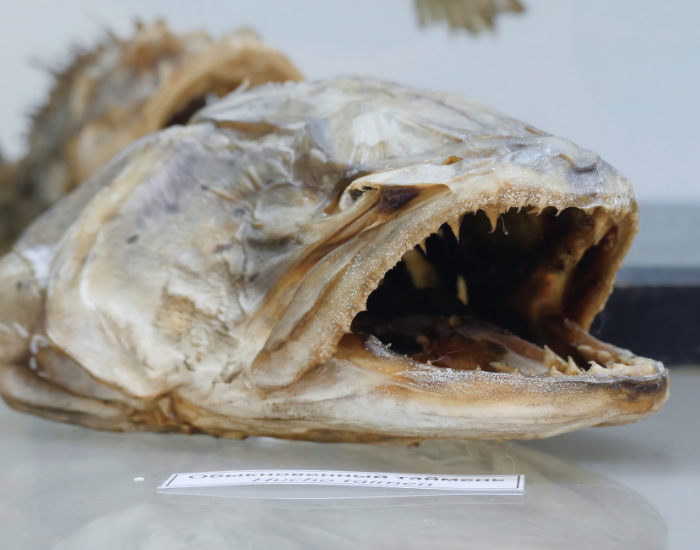
The coelacanth has an intracranial joint. That functional hinge splits the braincase in two and lets the front half swing upward. No other living vertebrate has one.
Coelacanths have a bony skull with an unusually wide mouth opening. Combine that hinge with mobile lower jaws and the gape turns enormous. The skull essentially unlatches, and suction pulls prey in before it registers the threat.
Divers have also filmed coelacanths doing headstands, snout-down against rock. They appear to be working prey out of crevices. Nobody has fully explained the behaviour yet.
8. A Rostral Organ Helps It Detect Prey in the Dark
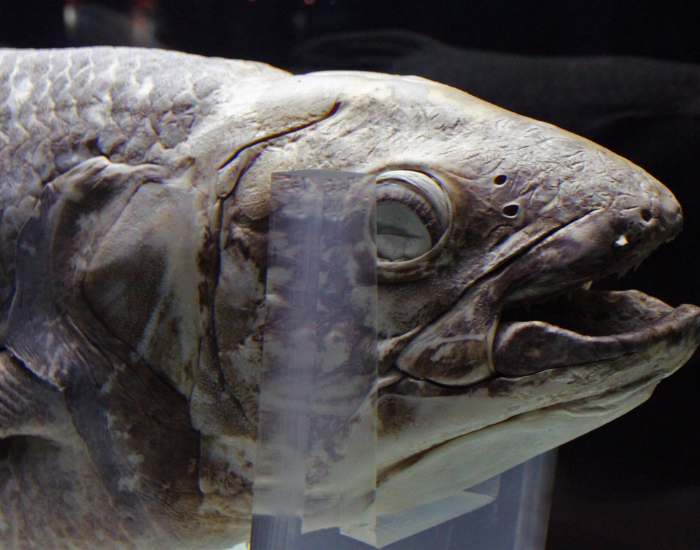
Inside the snout sits a jelly-filled cavity called the rostral organ. It detects weak electrical fields. That is useful when you hunt at 150 metres in near-total darkness.
Berquist and colleagues mapped the organ with MRI in 2015. They found low spatial resolution and a very short effective range. The strike fires when prey sits roughly 10 to 20 centimetres from the snout. It is not a long-range scanner, it is a trigger for the final snap.
9. It Has an Oil-Filled Tube Instead of a Backbone
Adult coelacanths never develop a bony vertebral column. They retain a notochord instead. That thick, hollow, oil-filled tube runs the length of the body. Your own embryo builds the same structure before a spine replaces it.
Their scales ooze mucus, and their tissues are loaded with oil and urea. That chemistry has a practical consequence, which I cover in the FAQ below.
10. It Is a Slow, Low-Energy Predator of Steep Rocky Slopes
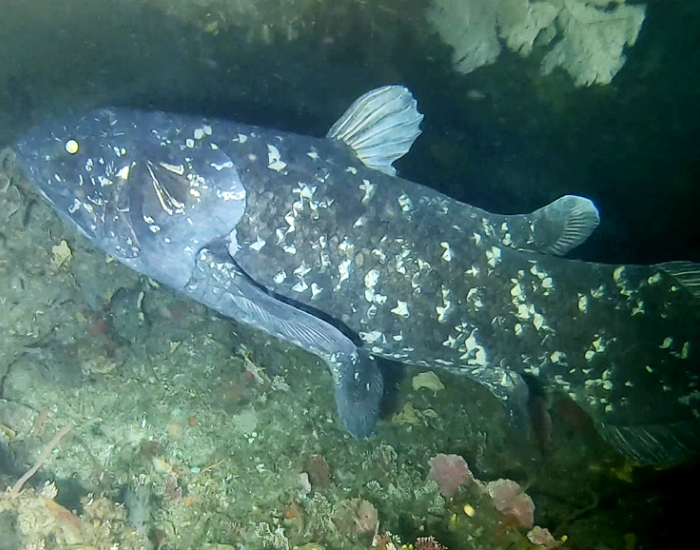
Coelacanths have a slow metabolism and rank as low-energy predators. They drift-feed, riding deep currents nose-down and barely swimming. The water delivers squid and fish to them. Warm shallow water suits them poorly, because they cannot pay the oxygen bill.
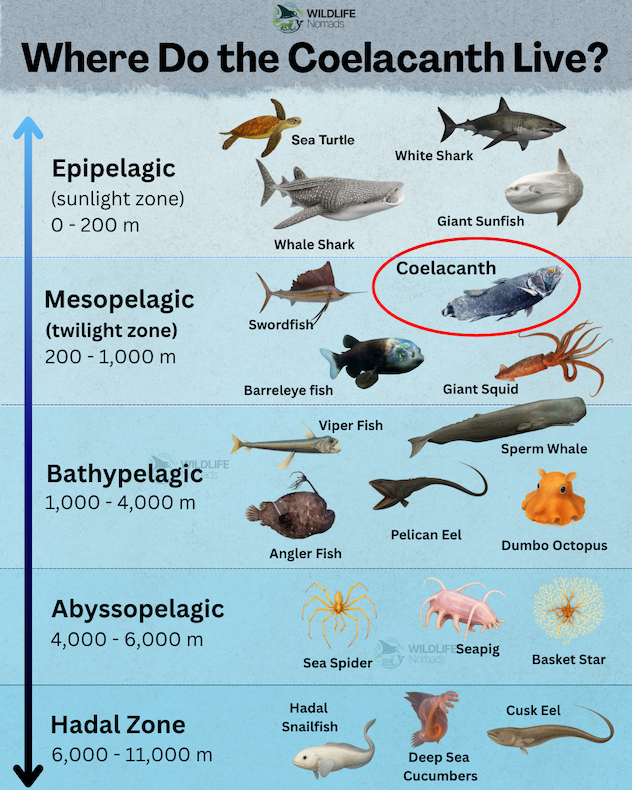
The natural habitat is consistent across both species. They favour deep-sea slopes with steep, rocky relief, submarine caves, and canyon walls. Most sightings fall between about 100 and 250 metres. Off the Comoros, they pack into volcanic lava caves by day and disperse at night to feed.
Coelacanths can reach up to 2 metres long and around 95 kilograms. In their natural environment, that bulk costs almost nothing. They hardly ever hurry.
You can meet the coelacanth just below 200 m in my deep sea dive.
DEPTH228
m Interactive · Deep Sea Dive Dive 228 m down to meet the coelacanth Scroll from the surface to the Mariana Trench and log 61 ocean animals on the way. →
11. They Give Birth to Live Young After a Five-Year Pregnancy
Coelacanths do not spawn eggs into the water. They give birth to live young. Pups arrive fully formed at roughly 35 centimetres, between three and thirty per litter.
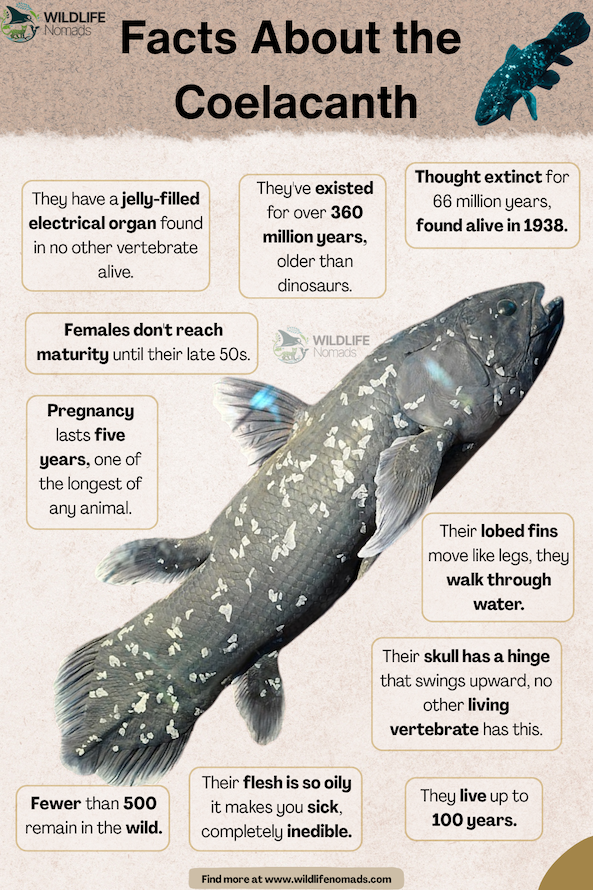
A 2021 study led by Kélig Mahé rewrote the timeline. The team counted fine growth marks on scales under polarised light. Their results put the lifespan near 100 years, sexual maturity around age 55, and gestation at about five years. Earlier estimates had claimed 20 years.
That biology is brutal for conservation. A century-long lifespan and a half-century wait for first reproduction leave no margin. Populations simply cannot absorb losses, which is why accidental capture hurts so much.
12. “Living Fossil” Is Only Half True
The term “living fossil” refers to organisms that have changed little since prehistoric times. Coelacanths are members of the class Actinistia, and they wear that label harder than almost anything alive.
Researchers have described more than 100 fossil species of coelacanth, though roughly 90 are currently considered valid. The oldest fossils dated so far reach back 420–410 million years, into the Devonian. Modern coelacanths are one small twig on that ancient lineage.
The genome supports part of the myth. The 2013 African coelacanth genome showed protein-coding genes evolving far slower than in other fish and tetrapods. Body shape has also changed remarkably little over the last few million years. That stability makes the group invaluable for reconstructing vertebrate evolutionary history.
A 2024 Nature Communications paper complicated the story. It described Ngamugawi wirngarri, a 380-million-year-old fossil from Western Australia. That team tied bursts of coelacanth evolution to tectonic activity, showing early innovation followed by a long slowdown. So the fish is mistakenly called unchanged. It changed hard, then stopped.
Frequently Asked Questions
Yes. Two coelacanth species survive today: Latimeria chalumnae in the West Indian Ocean and Latimeria menadoensis in Indonesian waters. technical divers took the first-ever in situ dive photos of an Indonesian coelacanth in North Maluku. Researchers detected the African species through environmental DNA the same year. Both remain rare, deep-dwelling, and legally protected.
Technically yes, practically no. Coelacanth flesh is saturated with oil, urea, and wax esters that humans cannot digest. Eating it causes severe diarrhoea, and Comorian fishermen have long regarded it as inedible. It is also protected under CITES Appendix I, so catching or trading one is illegal.
Yes, by a wide margin. Fossil coelacanths appear in Devonian rocks around 410 million years ago. The first dinosaurs show up roughly 230 million years ago. That gap explains why the coelacanth gets mistakenly called a “dinosaur fish.” It predates dinosaurs by about 180 million years.
They are not extinct, but extinction remains a real risk. The IUCN lists Latimeria chalumnae as Critically Endangered and Latimeria menadoensis as Vulnerable. A 21-year study estimated only 300–400 adults around Grande Comore. Accidental capture by deep-set fishing gear is the main threat, since a coelacanth cannot be released alive from those depths.
What the Coelacanth Actually Teaches Us
The lesson is not that a prehistoric fish survived. The lesson is that we declared a whole lineage extinct from missing fossils. We held that position for decades. We were wrong, because nobody had looked below 100 metres.
Want to keep going down that rabbit hole? I have written about the wider world of deep sea animals and about the barreleye fish, which has a transparent head. For a broader tour, start with my guide to the types of fishes.
Seen a coelacanth specimen in a museum somewhere? Tell me which one in the comments. I am building a list.
Coelacanth Challenge 🐟
Ten questions on the ocean’s most famous “living fossil” — first a fact-or-fiction round, then multiple choice. How many can you get?
References:
Amemiya, C. T., Alföldi, J., Lee, A. P., Fan, S., Philippe, H., MacCallum, I., … Lindblad-Toh, K. (2013). The African coelacanth genome provides insights into tetrapod evolution. Nature, 496(7445), 311–316. https://doi.org/10.1038/nature12027
Berquist, R. M., Galinsky, V. L., Kajiura, S. M., & Frank, L. R. (2015). The coelacanth rostral organ is a unique low-resolution electro-detector that facilitates the feeding strike. Scientific Reports, 5, 8962. https://doi.org/10.1038/srep08962
Chappuis, A., Kadarusman, Wong, M. Y. L., Handayani, T., Mambrasar, R., & Erdmann, M. V. (2025). First record of a living coelacanth from North Maluku, Indonesia. Scientific Reports, 15, 14074. https://doi.org/10.1038/s41598-025-90287-7
Clement, A. M., Cloutier, R., Lee, M. S. Y., King, B., Vanhaesebroucke, O., Bradshaw, C. J. A., Dutel, H., Trinajstic, K., & Long, J. A. (2024). A Late Devonian coelacanth reconfigures actinistian phylogeny, disparity, and evolutionary dynamics. Nature Communications, 15, 7529. https://doi.org/10.1038/s41467-024-51238-4
Mahé, K., Ernande, B., & Herbin, M. (2021). New scale analyses reveal centenarian African coelacanths. Current Biology, 31(16), 3621–3628. https://doi.org/10.1016/j.cub.2021.05.054
Oliver, J.-C., Shum, P., Mariani, S., Sink, K. J., Palmer, R., & Matcher, G. F. (2024). Enhancing African coelacanth monitoring using environmental DNA. Biology Letters, 20(10), 20240415. https://doi.org/10.1098/rsbl.2024.0415