
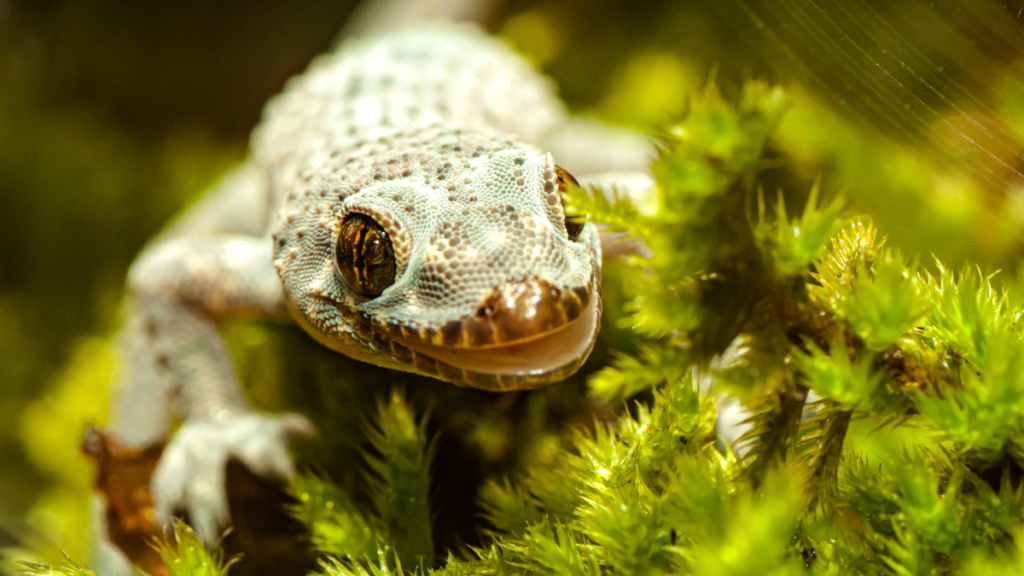
I spent three weeks in Turkey this year, and the guidebook moments delivered exactly what they promised. Hagia Sophia at opening hour. Balloons over Cappadocia at sunrise. Cave hotels carved into soft volcanic rock.
Then, on my last night in Istanbul, I sat on a rooftop in Sultanahmet and watched something better. A pale, blotchy lizard the length of my finger crept sideways across the plaster wall, stopped under a lamp, and swallowed a moth. I recognized it instantly. I had photographed the same animal on a hotel wall in Luxor, Egypt, two months earlier.
That was a Turkish gecko, and it might be the most-overlooked animal in the entire Mediterranean region. We fly across the world for cultural landmarks and walk straight past the wildlife living on them.
Here are 12 things I learned about this small, tough, surprisingly well-traveled reptile, including its real size, how to sex one, and why killing one is taboo in parts of the country I just left.
1. It Goes by Three Names, and “Turkish Gecko” Is the Oldest
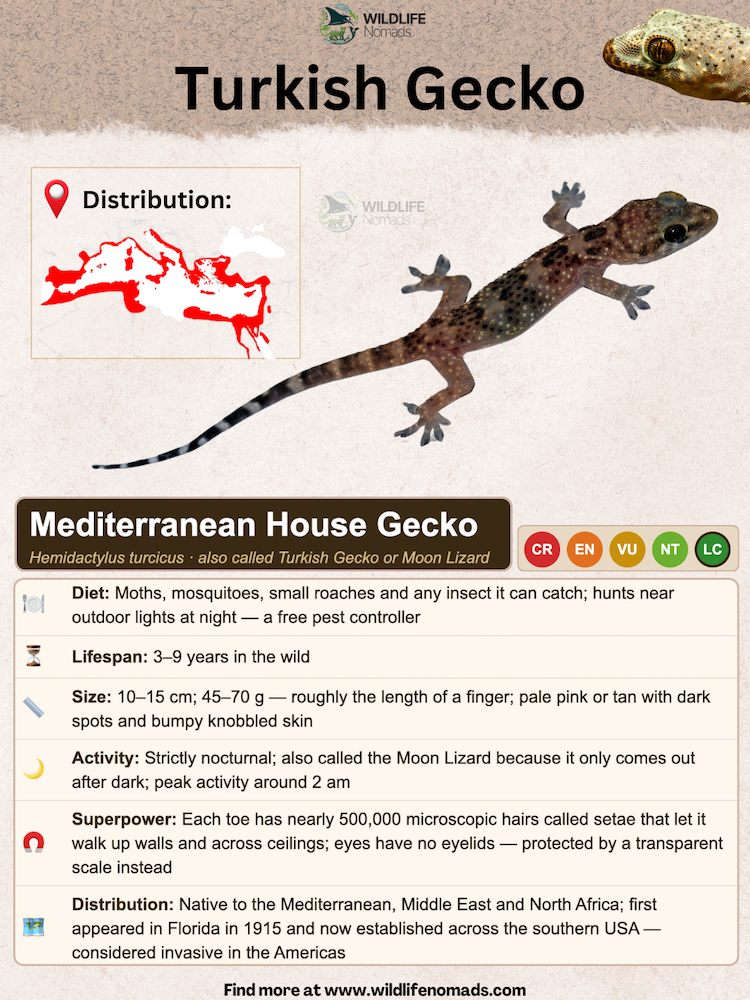
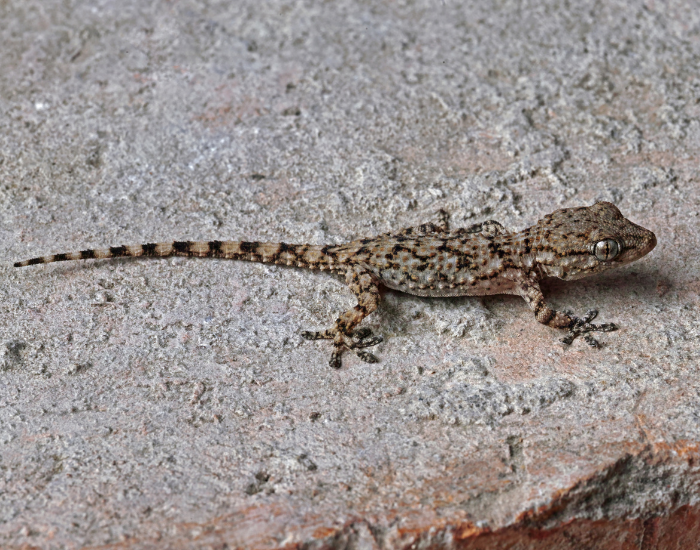
Carl Linnaeus described this animal in 1758 as Hemidactylus turcicus, literally, the half-toed lizard from Turkey. Most field guides now call it the Mediterranean house gecko, because “Turkish lizard” undersells a native range covering southern Europe, northern Africa and the Middle East.
The third name is my favorite. Locals across the Levant call it the moon lizard, or moon gecko, because it appears at dusk and vanishes by dawn. You will also hear “brown gecko” or brown gecko lizard used casually in the American South, though the colour is closer to pale pink than brown. This is an Old World species with a New World reputation problem.
2. Mediterranean House Gecko Size: 4 to 5 Inches, Tail Included
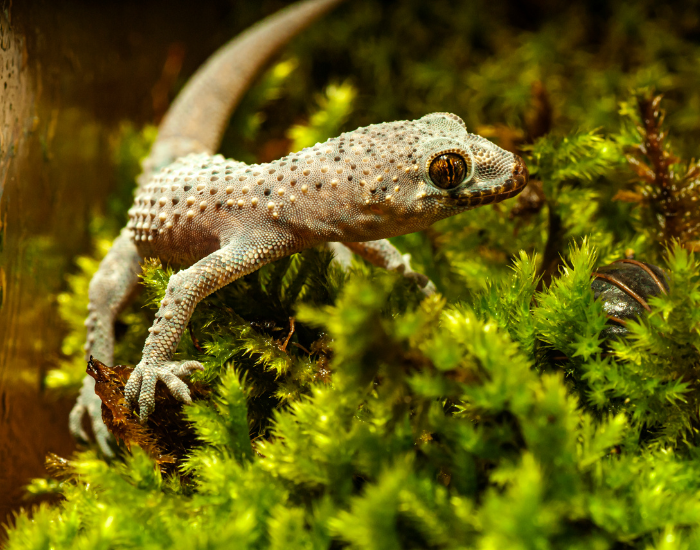
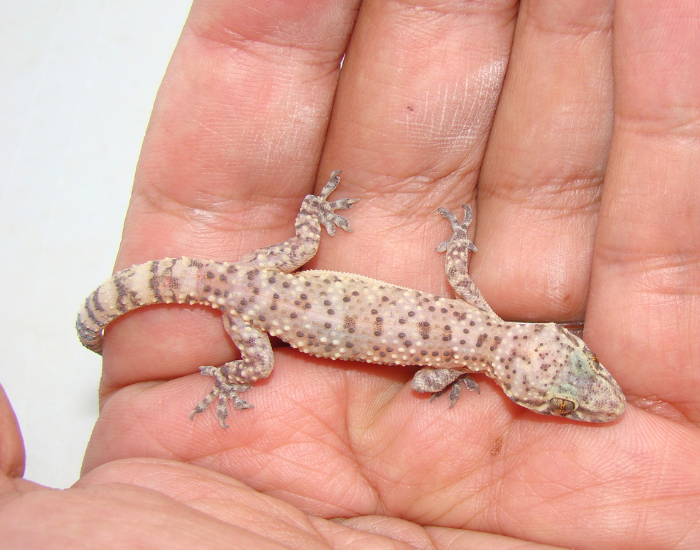
Adults reach 4 to 5 inches (10 to 13 cm) from snout to tail tip. That is the full size, not a juvenile stage, not a growth phase. Exceptional individuals push 15 cm, but I have never handled one that big.
Roughly half of that length is tail. The body of a large adult therefore sits in the hollow of your palm, weighing less than a slice of bread. People overestimate mediterranean house gecko size because a lizard sprinting across a wall looks far bigger than it is.
3. Those Large Eyes Lack Eyelids, So It Licks Them Clean
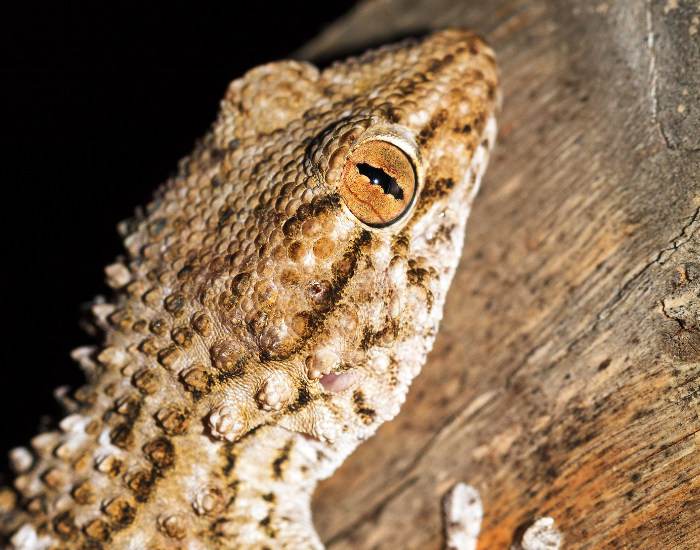
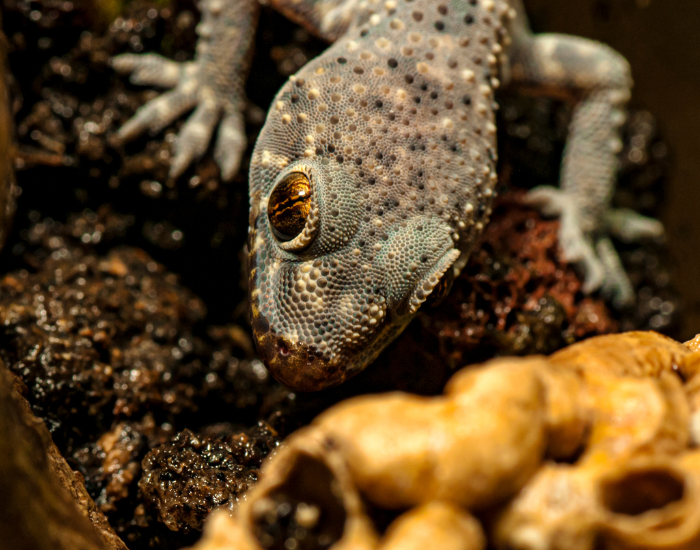
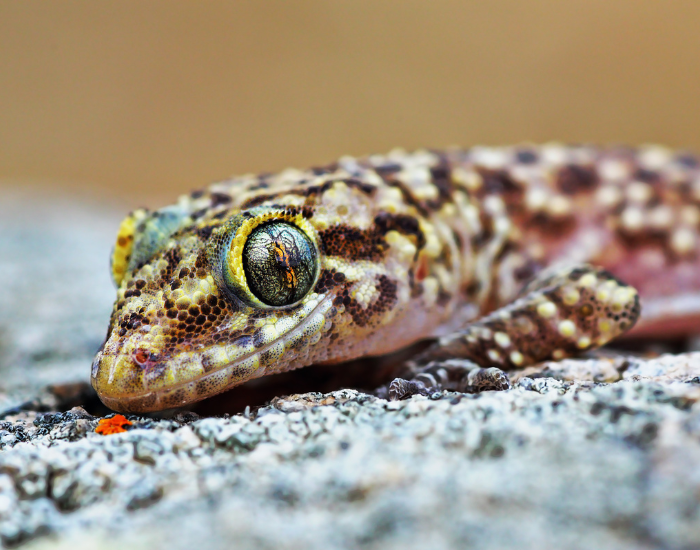
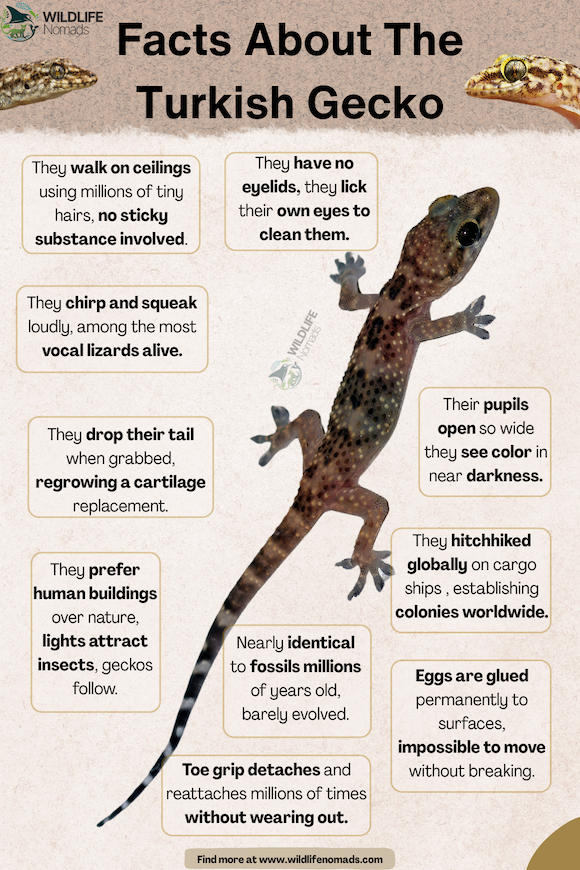
Get close with a headlamp and the eyes stop you cold. Turkish geckos have huge, dark eyes with vertical pupils that open into wide slits after dark, harvesting every available photon. Those large eyes lack eyelids entirely.
Instead of blinking, the gecko sweeps a broad tongue across each eye to clear dust. I watched one do this on a wall in Göreme, and it looked genuinely absurd. Lidless eyes and vertical pupils are the two fastest field marks separating this species from any native lizard in North America.
4. Sticky Toe Pads Let It Climb Walls Like Gravity Is Optional
The sticky toe pads are not sticky in the glue sense. Each toe carries rows of microscopic setae that exploit van der Waals forces, weak molecular attraction, multiplied across millions of contact points.
The result is a lizard that can climb walls, hang from ceilings and cross window glass. Interestingly, the system fails on one surface: Teflon. Photographs exist of a Mediterranean gecko skidding helplessly inside a non-stick frying pan, defeated by modern cookware.
5. Bumpy Skin Is the Easiest Field Mark
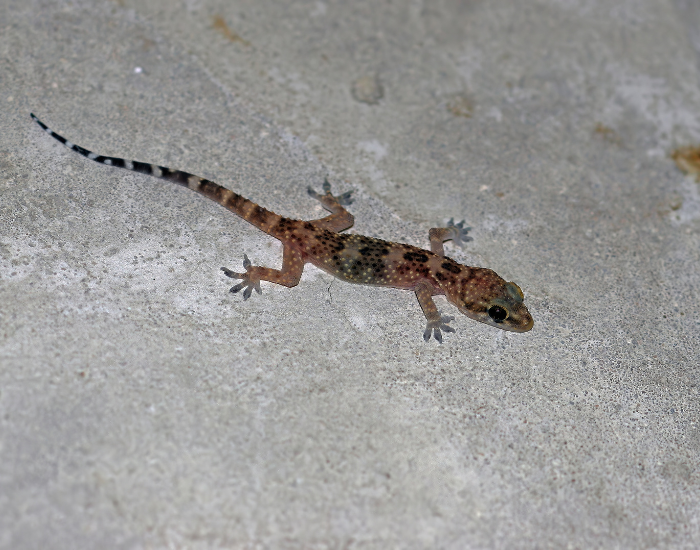
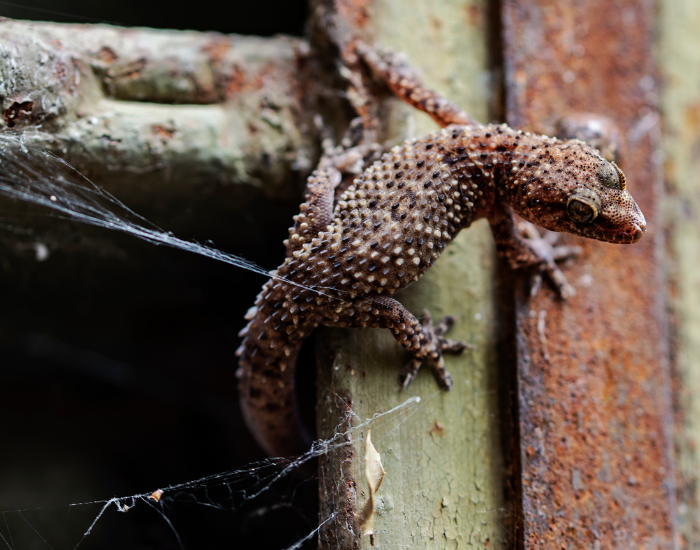
Run a light along the upper surface of the body and you will see raised, warty tubercles arranged in neat rows. That bumpy skin is diagnostic. The similar Indo-Pacific gecko (Hemidactylus garnotii) has smooth skin, so the two are easily distinguished once you know where to look.
Colour varies with light and mood. Most animals are generally light gray to translucent pink, with darker mottling scattered across the back and banded stripes on the tail of juveniles. The Texas Invasive Species Institute uses exactly this combination (bumpy skin, sticky toe pads, lidless eyes) as its identification shortcut for introduced geckos.
6. It Can Drop Its Tail Mid-Chase
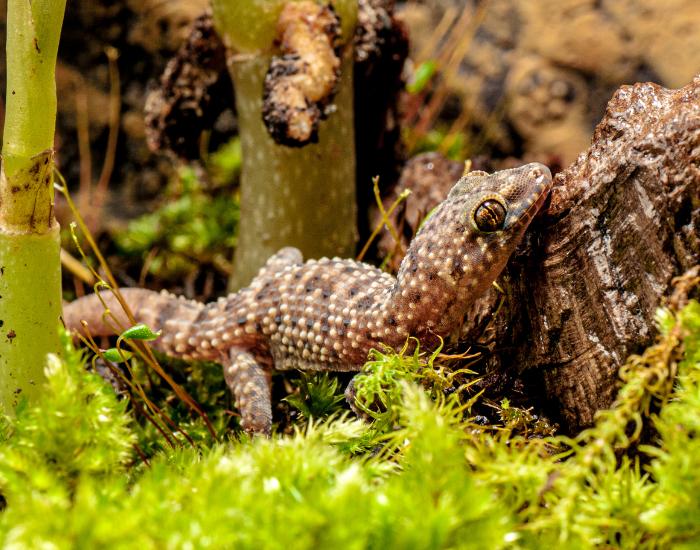
Grab one and you may end up holding a wriggling tail while the gecko escapes. Caudal autotomy is a defense mechanism, and the detached tail keeps twitching for up to a minute to hold a predator’s attention.
Regeneration follows, though it is neither fast nor free. Juveniles regrow roughly 85% of a lost tail within 30 days; adult males manage about 60%, and females closer to 40%. The replacement is cartilage rather than bone, and it never quite matches the original. This is one of many reasons I tell people to observe rather than handle, a lesson that applies to most of the pet reptiles people encounter in the wild.
7. Porch Lights Built This Predator a Free Buffet
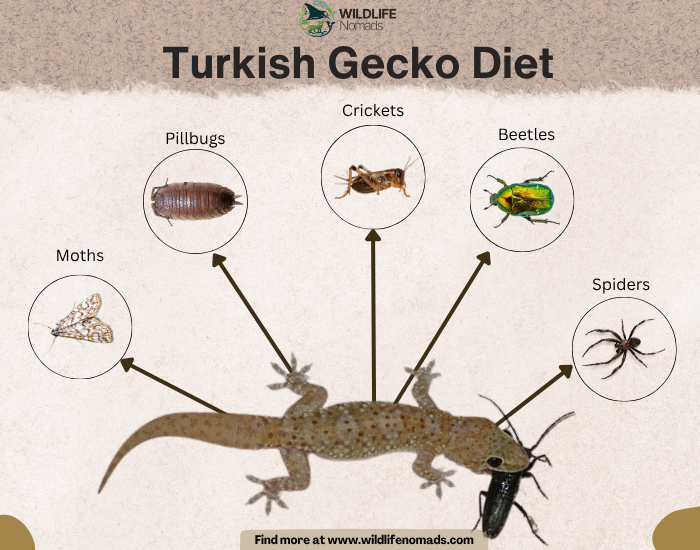
Turkish geckos are nocturnal insectivores, and they have made outdoor lights the centre of their world. Insects attracted to porch lights like moths, small roaches, crickets, beetles, spiders and other invertebrates — arrive in a steady stream, and the geckos simply wait.
There is real strategy here. Research on foraging success found that the bare walls around outside lights give geckos longer, cleaner strike distances than cluttered natural habitat. One study also documented them eavesdropping on male decorated crickets, intercepting the females drawn in by the call. That is not opportunism. That is exploitation of a food web humans accidentally built.
8. That High-Pitched Squeak Is a Territorial Message
Most lizards are silent. Geckos are not. recently wrote about how a Tokay gecko kept me awake in several Asian countries. Turkish geckos produce a distinctive high pitched squeak or chirp, easily mistaken for a bird until you spot the source clinging to a wall above you.
Males also produce rapid clicks, and dominant males use them to broadcast a territorial message to rivals. Adult males display real aggression toward other males, chasing, jaw-snapping, tail-wagging, and back-arching. Juveniles avoid adults for good reason, since adults will bite them. Females answer male clicks with short squeaks of their own, and the timing of that exchange decides whether mating happens.
Althoug no a turkish gecko, listen the chirping…” to “Although this video shows a different gecko species, you can hear a similar chirping call:
9. Two Eggs, Several Clutches, and Sperm Stored for Five Months
The breeding season runs from April to August each year. Females lay eggs from mid-May onward, and the average clutch size is two eggs — a fixed number, not a range. Across a single season, one female produces multiple clutches, with up to four recorded. Life history work in southern Texas first documented this pattern in the 1980s.
Eggs go into cracks and crevices around structures: wall voids, behind baseboards, under loose tree bark, in moist soil beneath planters. Several females often use the same site, a behaviour called communal nesting, and researchers have pulled 2 to 20 eggs from a single crevice. Gestation time is estimated at roughly 40 to 60 days, and geckos reach sexual maturity anywhere from four months to a year old.
The strangest detail comes last. Females store sperm in a funnel-shaped organ called the infundibulum for up to five months, fertilising eggs long after mating ends. One founding female can therefore start an entire population by herself.
10. The Mediterranean House Gecko Range Now Covers 22 U.S. States
The first American record came from Key West, Florida, in 1915, almost certainly a stowaway on a Mediterranean cargo ship. Since then, the mediterranean house gecko range has expanded across roughly 22 U.S. states.
The core is the southern United States: Texas, Louisiana, Alabama, Mississippi, Georgia, the Carolinas and, most densely, mediterranean house gecko Florida populations from the Keys northward. Scattered western records cover Arizona geckos, California, Nevada and New Mexico. More recent finds reach Tennessee, Kentucky, Missouri, Kansas, Maryland, Pennsylvania and Indiana.
Mexico tells the same story. Introduced populations exist in Tamaulipas, Veracruz, Tabasco, Campeche, Yucatán, Nuevo León and Durango, documented in regional herpetofauna volumes from Eco Herpetological Publishing. Cargo carried the first arrivals; the pet trade almost certainly spread the rest. That pattern mirrors what happened with the red-eared slider, another introduced species human transport carried worldwide.
11. Human Homes Are the Entire Strategy
This gecko is synanthropic, meaning it lives with us on purpose. Human development is its habitat: Turkish geckos concentrate in urban areas and suburban areas, on brick walls, stucco, garages, university campuses, cemeteries and human homes. Native forest, by contrast, holds almost none.
UTC news releases have followed a long-running gecko survey in Chattanooga, Tennessee, where researchers map sightings using GIS after two decades of reports. Buildings buffer the cold, so these geckos survive winters well north of where climate models once put them. That is precisely why several researchers call this the most successful species in an already successful genus, and one of the invasive species most likely to reach habitats no relative has touched.
Whether they harm native wildlife remains genuinely unresolved. They occupy niches native lizards and amphibians might otherwise use, and they consume shared insect prey. However, no study has yet demonstrated population-level damage to a native lizard. I think that honest uncertainty matters more than a confident headline.
12. In Turkey, Harming One Is Taboo
Here is the fact that reframed the whole trip for me. In Greece, Turkey and Cyprus, harming a Turkish gecko is taboo. People consider the animal benign, useful and welcome, and some households effectively keep them as free-roaming pests controllers.
Compare that with the Southern states, where the same species gets treated as a nuisance to spray. Same lizard, opposite cultural verdict. Ironically, the taboo produces better conservation outcomes than most formal policy, and researchers studying gecko folklore in southern Portugal reached a similar conclusion. Cultural tolerance is a conservation tool we systematically undervalue.
Turkish Gecko FAQ
Yes, and they are among the hardier beginner reptiles, though they are fast and dislike handling. Provide a minimum enclosure of 12″L x 12″W x 18″H, UVB lighting for 12 hours a day, and humidity averaging 60–80%. Feed juveniles daily and adults every other day, dusting insects with a mixture of calcium and multivitamins. Never take one from the wild — buy captive-bred, since wild-caught animals carry parasites and support a wildlife trade that harms native populations.
Look at the underside, just in front of the vent. Mature males show a short row of 4 to 10 preanal pores and two small post-cloacal bones creating a visible bulge at the tail base. Females lack both. Males also produce clicking calls, while females respond with shorter squeaks.
Rarely, and it barely registers. These geckos are not venomous or aggressive, and the Texas Invasive Species Institute notes their bite is weaker than a native anole’s. I have been bitten twice in the field and felt a pinch, nothing more. Wash your hands afterward, since reptiles can carry Salmonella.
Why This Small Lizard Deserves Your Attention
A turkish gecko on a hotel wall is not background scenery. It is a stowaway that has ridden human trade routes for over a century, tolerated cold it should not survive, and colonised two continents on a clutch size of two eggs.
I nearly missed it. Three weeks of mosques, cave churches and fairy chimneys, and my sharpest wildlife memory came from a lamp-lit wall at midnight. That is usually how it works.
So next time you are somewhere warm after dark, stand near an outdoor light and wait five minutes. Watch the wall, not the view. Tell me in the comments where you found your first mediterranean gecko, and if lizards are your thing, meet the basilisk that runs on water or the 15 types of skink next. If Egypt is on your list, my guide to Egyptian snakes covers the neighbours this gecko shares walls with.
Turkish Gecko Challenge 🦎
Ten questions on the Mediterranean’s most-overlooked lizard — first a fact-or-fiction round, then multiple choice. How many can you get?
References:
Altunışık, A. (2025). Age structure, growth, and survival rates of an insular population of Hemidactylus turcicus. Ecology and Evolution, 15(6), e71735. https://doi.org/10.1002/ece3.71735
Ceríaco, L. M. P., Marques, M. P., Madeira, N. C., Vila-Viçosa, C. M., & Mendes, P. (2011). Folklore and traditional ecological knowledge of geckos in Southern Portugal: Implications for conservation and science. Journal of Ethnobiology and Ethnomedicine, 7, 26. https://doi.org/10.1186/1746-4269-7-26
Dallas, J. W., Harris, A., Reinbolt, J., & Warne, R. W. (2022). Ecology of the synanthropic Mediterranean house gecko (Hemidactylus turcicus) at their northern invasion front. Urban Ecosystems, 25(1), 329–340. https://doi.org/10.1007/s11252-021-01136-0
Kanat, B., & Tok, C. V. (2015). Age structure of Hemidactylus turcicus (L., 1758) (Sauria: Gekkonidae) from southwestern Anatolia (Muğla, Turkey). Turkish Journal of Zoology, 39(3), 373–377. https://journals.tubitak.gov.tr/zoology/vol39/iss3/1/
Rose, F. L., & Barbour, C. D. (1968). Ecology and reproductive cycles of the introduced gecko, Hemidactylus turcicus, in the southern United States. The American Midland Naturalist, 79(1), 159–168. https://doi.org/10.2307/2423161
Stabler, L. B., Johnson, W. P., Locey, K. J., & Stone, P. A. (2012). A comparison of Mediterranean gecko (Hemidactylus turcicus) populations in two temperate zone urban habitats. Urban Ecosystems, 15(3), 655–666. https://doi.org/10.1007/s11252-011-0216-1
Weterings, R., & Vetter, K. C. (2018). Invasive house geckos (Hemidactylus spp.): Their current, potential and future distribution. Current Zoology, 64(5), 559–573. https://doi.org/10.1093/cz/zox052