There is something uniquely humbling about the poles. So vast and big. So white. An very, very cold. And still, animals you can find animals in some of the most extreme environment.
I recently focused on the little penguin and the tragic African penguin crisis, I’ve always been captivated by the sheer resilience of antarctic sea birds. How does an animal not just survive, but thrive, in a place where the wind literally tries to strip the skin from your face?
Enter the gentoo penguin. Known scientifically as Pygoscelis papua, this gentoo bird is a masterpiece of evolutionary engineering. Often overshadowed by the massive Emperor penguin, or the feisty Adélie, the gentoo penguin (or gen 2 penguin as I’ve heard a few travelers jokingly call them) is a species of extremes. They are the “sport cars” of the penguin world—built for speed, adorned with a prominent tail, and sporting bright orange beaks that stand out against the monochrome ice.
In this deep dive, we’re going to look at the gentoo penguin size, their strange social quirks, and the conservation challenges they face. Whether you call it a gentle penguin or a gentoo animal, by the end of this, you’ll see why they are one of my favorite subjects in polar biology.
1. They are the Third Largest Penguin Species
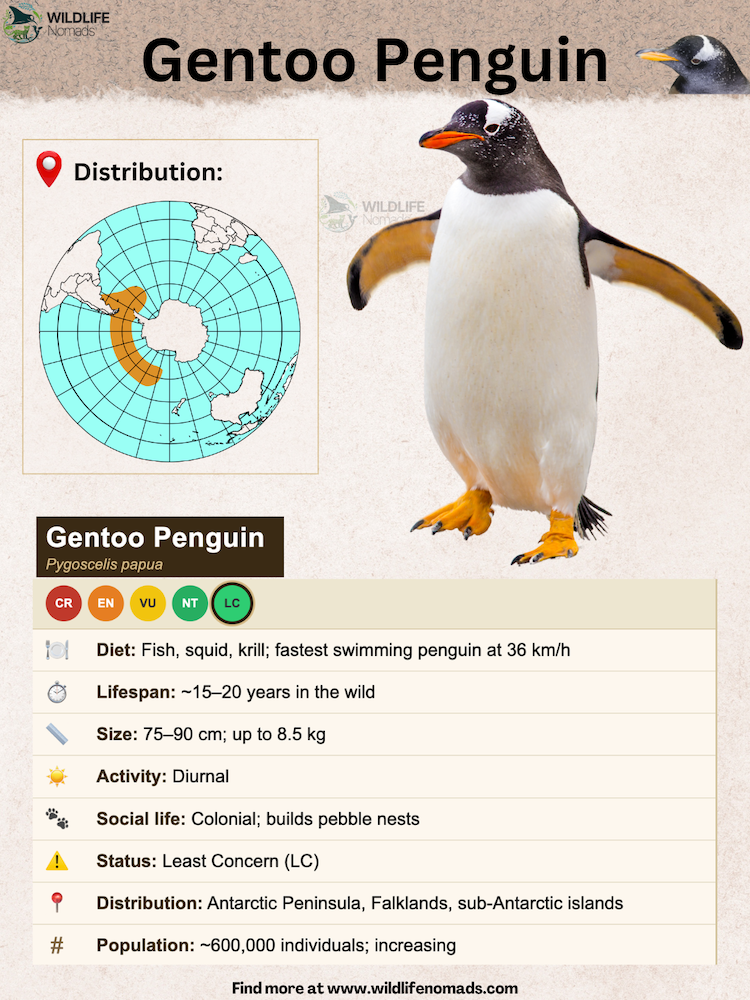
When you see a gentoo penguin in person, the first thing you notice is that they aren’t exactly “little.” In the hierarchy of penguin species, the gentoo penguin size puts them firmly in third place. They are smaller than the Emperor and King penguins, but they tower over most of their cousins.
An adult gentoo stands at a gentoo penguin height of about 75 to 90 cm (30 to 35 inches). Depending on the time of year—specifically if they’ve just finished a massive feeding binge before a molt—they can reach a maximum weight of around 8.5 kg (19 lbs). I often tell people that if you were to encounter one on a beach, they’d reach about mid-thigh on an average adult. They have a sturdy, athletic build that hints at their prowess in the water.

2. The Gentoo Penguin is the Fastest Swimming Penguin
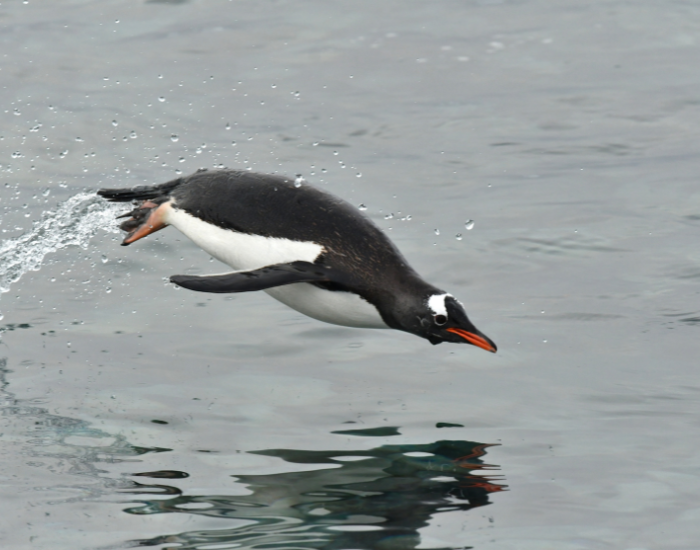
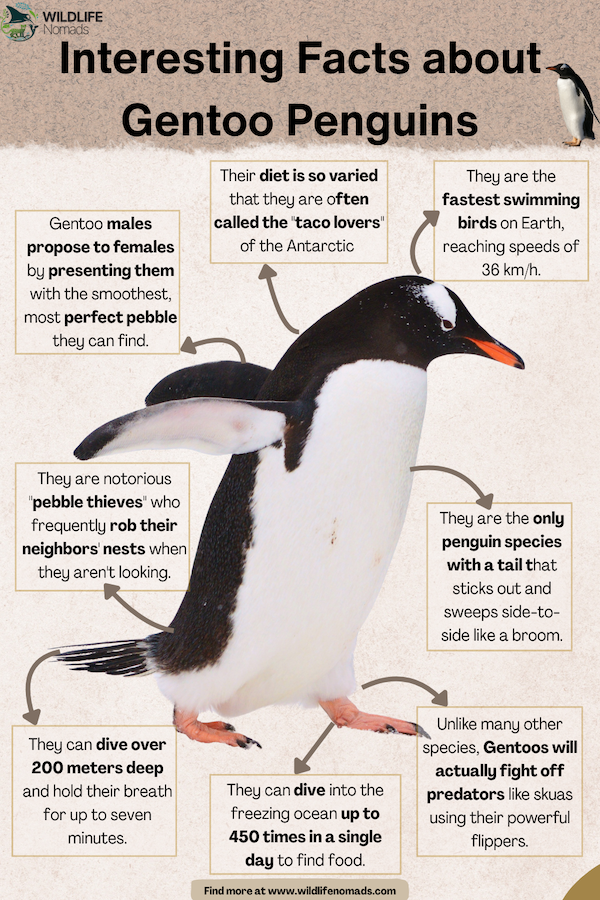
If there were an Olympic Games for antarctic wildlife, the gentoo penguin would take home the gold in every swimming sprint. These birds are the fastest swimming penguin on Earth, capable of reaching speeds up to 36 km/h (22 mph).
To put that in perspective, that is roughly four times faster than the fastest human swimmer. They achieve this through a combination of highly specialized webbed feet, a torpedo-shaped body, and powerful flippers. When I’ve watched them from a boat near the Antarctic Peninsula, they don’t just swim; they “porpoise.” They leap out of the water to take quick breaths while maintaining incredible forward momentum. It’s a survival mechanism that helps them evade leopard seals and killer whales.
3. Their Scientific Name comes from thei Tail! (Pygoscelis Papua)
The gentoo penguin scientific name is Pygoscelis papua. The genus name Pygoscelis actually means “brush-tailed,” which is a reference to their most prominent tail. Unlike many other penguins that have short, stubby tails, Gentoos have long tail feathers that sweep behind them as they waddle on land.
Interestingly, recent studies in polar biology suggest that the “Gentoo” we know might actually be four distinct species. Genetic research shows significant differences between populations in the Falkland Islands, South Georgia, and the Kerguelen Islands.
4. They Have a Very Specific “Look”
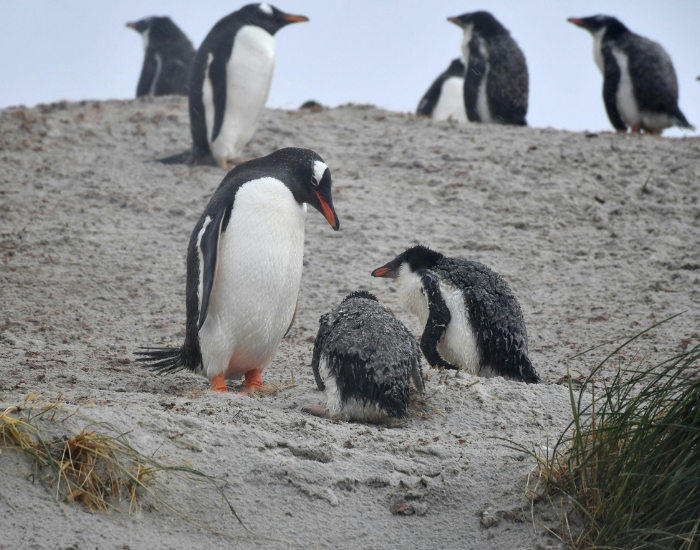
What does a gentoo penguin look like? If you are looking at a crowd of penguins on a rocky beach, look for the “bonnet.” They have a very distinct wide white stripe that runs across the top of their head, from one eye to the other.
Their bright orange beaks (or more accurately, a reddish-orange) are another dead giveaway. They also have flashy orange-pink webbed feet. Combined with their white feathers on the belly and old feathers that turn a brownish hue before the annual molt, they are quite the dandy of the subantarctic islands.
5. Gentoo Penguins Live in the Southern Hemisphere
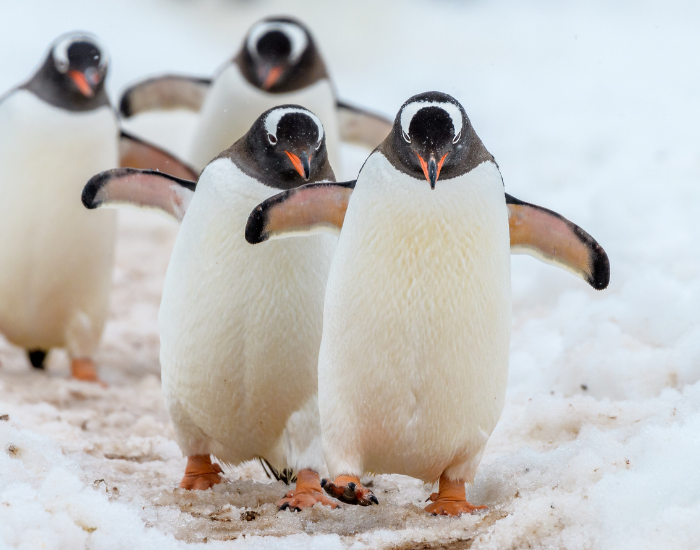
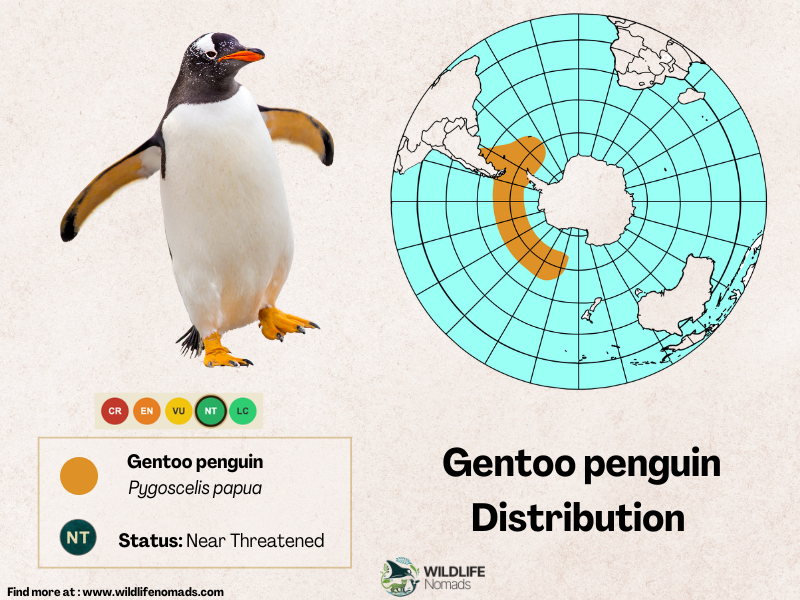
While people often confuse the Arctic and Antarctic, remember this: there are no penguins in the Arctic. The gentoo penguin location is strictly in the Southern Hemisphere.
They have a circumpolar distribution, meaning they are found all around the southern pole. You can find massive breeding colonies on the Antarctic Peninsula, but they also frequent many sub antarctic islands like the Falkland Islands, South Georgia, and King George Island. They prefer areas that are partially ice-free, often choosing rocky beaches or tufts of grass over solid ice sheets.
6. They Are Professional Stone Thieves
One of the most hilarious (and slightly dramatic) gentoo penguins facts involves their nesting habits. Gentoos don’t use twigs or grass; they use small stones. A male will scout the beach for the perfect pebble and present it to a female as a “gift.”
However, because the “perfect” stone is a hot commodity, gentoo penguins are notorious for egg collecting… or rather, stone stealing. If a neighbor turns their back, a Gentoo will quickly waddle over, snatch a stone from their nest, and bring it back to their own. This leads to constant squabbles and a very noisy breeding season. It’s a reminder that even in the harshest environments, social politics are alive and well.
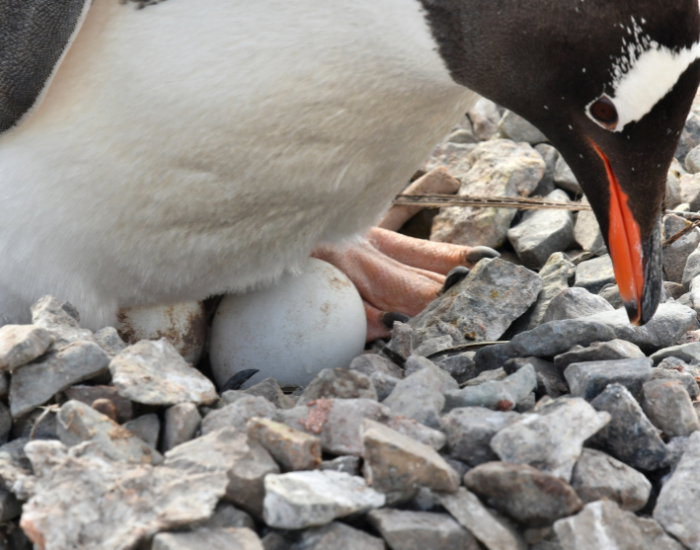
7. They Usually Lay Two Eggs
While some penguins only raise one chick, female gentoo penguins typically lay two eggs in a nest made of those stolen stones. Both parents share the responsibility of incubation, which lasts about 34 to 36 days.
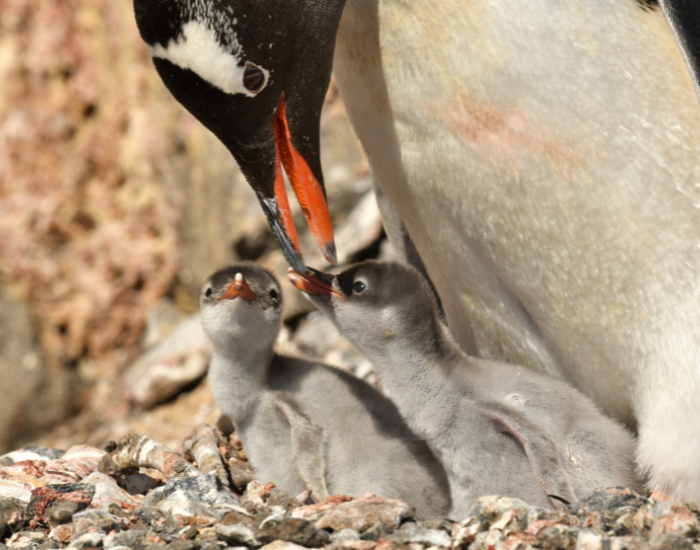
Once the eggs hatch, the parents take turns going to sea to hunt for fish, squid, and crustaceans. Usually, two chicks are raised, although in years where food is scarce, only the stronger of the two may survive. This is a tough reality of antarctic wildlife, but it ensures that at least one healthy individual makes it to the fledging period.
8. Their Diet is Quite Diverse
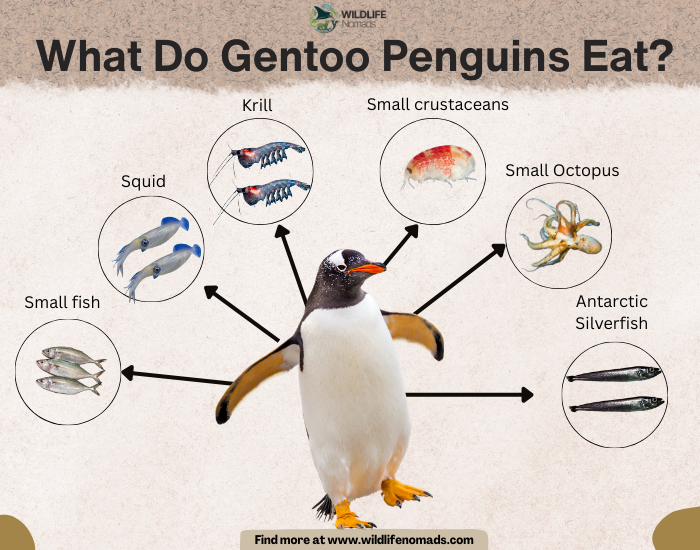
The gentoos diet is highly opportunistic. Unlike some specialized feeders, they are happy to eat whatever the ocean provides. Their primary prey includes:
- Fish (specifically Nototheniids)
- Crustaceans (Krill is a staple near the Antarctic)
- Squid
They are capable of deep dives reaching up to 200 meters (650 feet) in search of food. They can dive hundreds of times a day to satisfy their hunger and feed their growing gentoo chicks. This flexibility in diet is one reason why their total breeding population has remained relatively stable compared to other marine threatened species.
9. Are Gentoo Penguins Endangered?
Currently, the IUCN Red List classifies them as Least Concern, though they were previously listed as Near Threatened.
While the global total breeding population is estimated at around 387,000 pairs, we can’t get complacent. Climate change is causing sea level rises and shifts in prey availability. Some populations on the sub antarctic islands are declining, while others on the Antarctic Peninsula are actually expanding south as the ice melts. They are a “sentinel species”—their health tells us exactly what is happening to the southern oceans.
10. They Face Formidable Predators
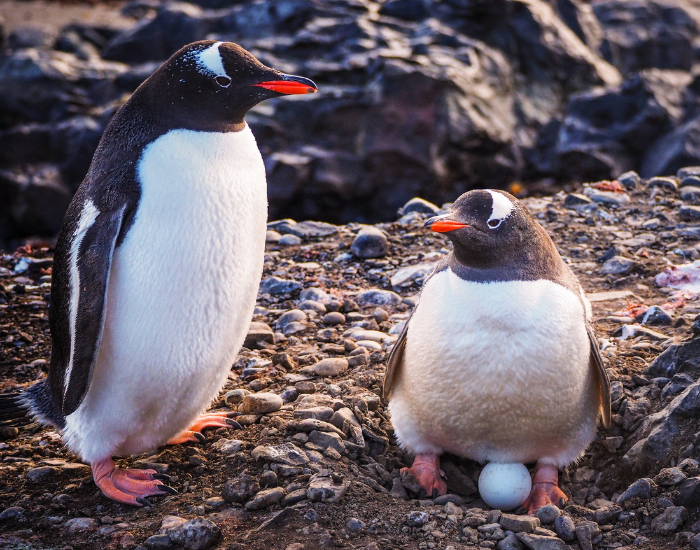
Life as a gentoo penguin isn’t all pebble-gifting and swimming. They are a key part of the food web. In the water, their main predators are leopard seals, killer whales (orcas), and southern sea lions.
On land, the eggs and other chicks are at risk from other types birds like skuas and giant petrels. I’ve seen skuas patrol breeding colonies with surgical precision, waiting for a single moment of parental inattention. It’s a high-stakes game of survival that underscores the importance of large colonies for protection.

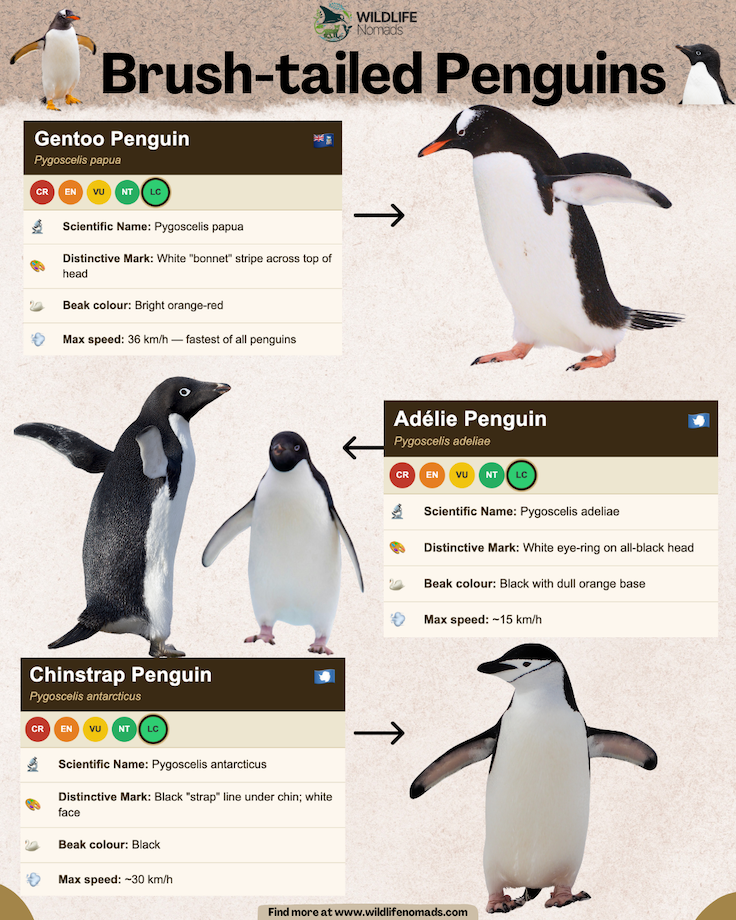
Comparison: Gentoo vs. Other Antarctic Penguins
| Feature | Gentoo Penguin | Adélie Penguin | Chinstrap Penguin |
| Scientific Name | Pygoscelis papua | Pygoscelis adeliae | Pygoscelis antarcticus |
| Distinctive Mark | White “bonnet” stripe | White eye-ring | Black “strap” under chin |
| Beak Color | Bright Orange/Red | Black/Dull Orange | Black |
| Max Speed | 36 km/h (Fastest) | 15 km/h | 30 km/h |
FAQ: Common Questions About the Gentoo Penguin
They breed on the Antarctic Peninsula and across subantarctic islands, including the Falkland Islands, South Georgia, King George Island, and the Kerguelen Islands.
Their diet consists mainly of fish (especially rockcod and Patagonian species), squid, and crustaceans such as krill. Their diet varies significantly by location and season.
Adults stand between 75 and 90 cm (30–35 inches) tall, making them the third largest penguin species on Earth.
Yes. They hold the record as the fastest swimming penguin—and the fastest swimming bird—on Earth, reaching burst speeds of up to 36 km/h (22 mph).
Approximately 774,000 adult gentoo penguins (around 387,000 breeding pairs) exist worldwide. The IUCN currently classifies them as Least Concern, though some regional populations are declining.
The Future for Our Tuxedoed Friends
Writing about the gentoo penguin reminds me of why I became a biologist. There is a profound beauty in an animal that looks like it’s wearing a tuxedo but behaves like a high-speed submarine and a petty jewel thief simultaneously.
The antarctic sea birds and the inhabitants of the frozen south are facing a changing world. While the Gentoo is currently holding its own, we must continue to support conservation status monitoring and marine protected areas. If we lose the “fastest swimmers” of the ocean, we lose a vital piece of the planetary puzzle.
If you found this deep dive fascinating, check out my other guides on antarctic animals or learn about the world of apex predators to see how these penguins fit into the grander scheme of life!
Where to See Gentoo Penguins in the Wild?
Here is a list of 6 wildlife safari tours to the Falkland island where you can see Penguins, including gentoo penguins in the wild. As a biologist, I only recommend tours that follow strict ethical guidelines to ensure we don’t disturb wildlife. These are the three tours/ partners I trust most based on their conservation records:
This blog is reader-supported. When you buy experiences through links listed on this site, we may earn an affiliate commission.
References:
Clausen, A. P., & Pütz, K. (2003). Recent trends in diet composition and productivity of gentoo, Magellanic and rockhopper penguins in the Falkland Islands. Aquatic Conservation: Marine and Freshwater Ecosystems, 13(S1), S23–S40. https://doi.org/10.1002/aqc.476
Forcada, J., & Trathan, P. N. (2009). Penguin responses to climate change in the Southern Ocean. Global Change Biology, 15(7), 1618–1630. https://doi.org/10.1111/j.1365-2486.2009.01909.x
Hao, Z., Yin, B., Prapamonthon, P., & Yang, G. (2023). Hydrodynamic performance of a penguin wing: Effect of feathering and flapping. Physics of Fluids, 35(6), Article 061907. https://doi.org/10.1063/5.0147776
Levy, H., Clucas, G. V., Rogers, A. D., Leaché, A. D., Ciborowski, K. L., Polito, M. J., Lynch, H. J., Dunn, M. J., & Hart, T. (2016). Population structure and phylogeography of the Gentoo Penguin (Pygoscelis papua) across the Scotia Arc. Ecology and Evolution, 6(6), 1834–1853. https://doi.org/10.1002/ece3.1929
Vianna, J. A., Fernandes, F. A. N., Frugone, M. J., Figueiro, H. V., Pertierra, L. R., Noll, D., … & Poulin, E. (2020). Genome‐wide analyses reveal drivers of penguin diversification. Proceedings of the National Academy of Sciences, 117(36), 22303–22310. https://doi.org/10.1073/pnas.2006659117
Trathan, P. N., García-Borboroglu, P., Boersma, D., Bost, C.-A., Crawford, R. J. M., Crossin, G. T., Cuthbert, R. J., Dann, P., Davis, L. S., Angel, A. P., Barbosa, A., Bininda-Emonds, O. R. P., Chiaradia, A., Colyn, R., Culik, B. M., Dell’Omo, G., Dierkes, H., Ellison, P. J., Garcia, N., … Seddon, P. J. (2014). Pollution, habitat loss, fishing, and climate change as critical threats to penguins. Conservation Biology, 29(1), 31–41. https://doi.org/10.1111/cobi.12349