
Caribou Migration
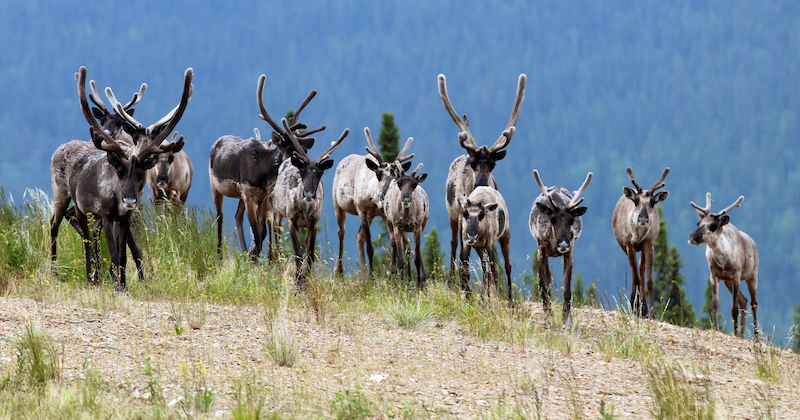
The longest round trip walked by any animal,
and the herds are disappearing.
The caribou migration is the longest round trip walked by any land animal, and it is vanishing while we watch. Arctic herds have fallen from roughly 5.5 million animals to 1.88 million in about thirty years. One Canadian herd that once numbered over half a million was down to 3,609 in 2025.
Why do caribou walk that far?
Three reasons, and the third explains why they can never simply settle.
The coast is a safer nursery
Cows head for open coastal tundra that greens up early and holds far fewer wolves and bears than the forest they wintered in. Newborns get a few weeks of rich forage and low risk, which is most of what decides whether they survive their first year.
July is unliveable inland
Mosquitoes and warble flies swarm the interior in summer. Harassed animals stop feeding, and in a growing season only eight weeks long that costs them dearly, so the herds climb onto windy ridges and coastal strips where moving air keeps the insects down.
Lichen grows back slowly
Winter food is almost entirely lichen, and caribou are the only large mammals that can digest it. Lichen takes decades to recover once grazed out, so a herd that stayed in one place would eat itself into famine. Constant movement is the only way the system works.
The map below puts the whole caribou migration on one canvas, drawn looking straight down on the North Pole, because this animal lives on both sides of the Arctic and no ordinary map can hold Alaska and Lapland at once. Press play to run a year. The circles show the major herds drawn to scale, with a faint outer ring marking each one’s recorded peak — the gap between ring and circle is the story.
The caribou migration, month by month
Timings shift with snow and thaw, but the order never changes.
Digging for lichen
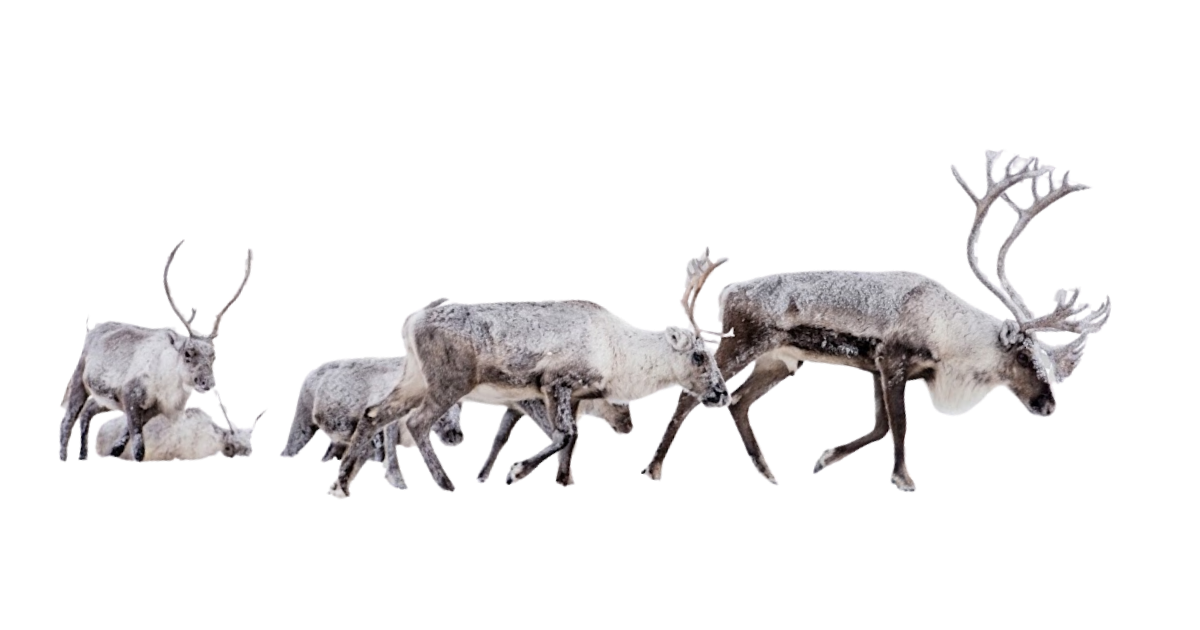
The herd spreads through spruce forest and mountain valleys, digging craters in the snow to reach lichen underneath. Snow depth decides how hard the winter is, although the newer danger is rain that freezes into a lid the animals cannot break.
North, with the pregnant cows in front
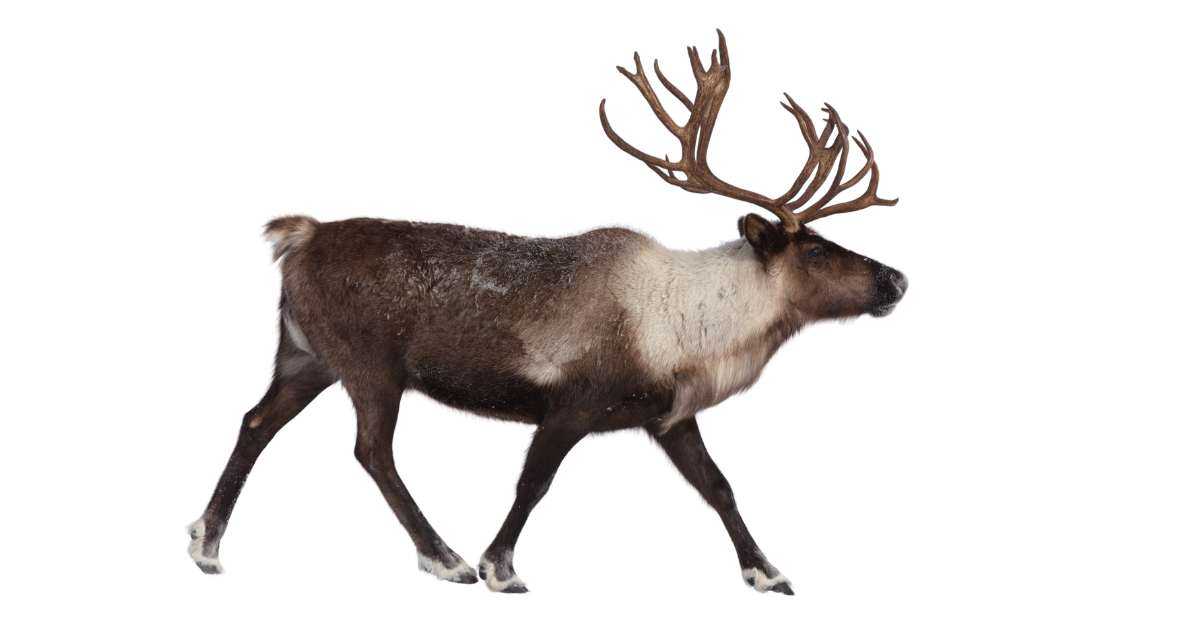
Pregnant females leave first and travel hardest, sometimes crossing rivers still choked with ice. Arriving late at the calving grounds costs a calf its best weeks, so the cost of waiting is higher than the risk of going early.
A caribou can swim a river in spate with a calf beside it. Getting there on time matters more.
Calving, then the insects
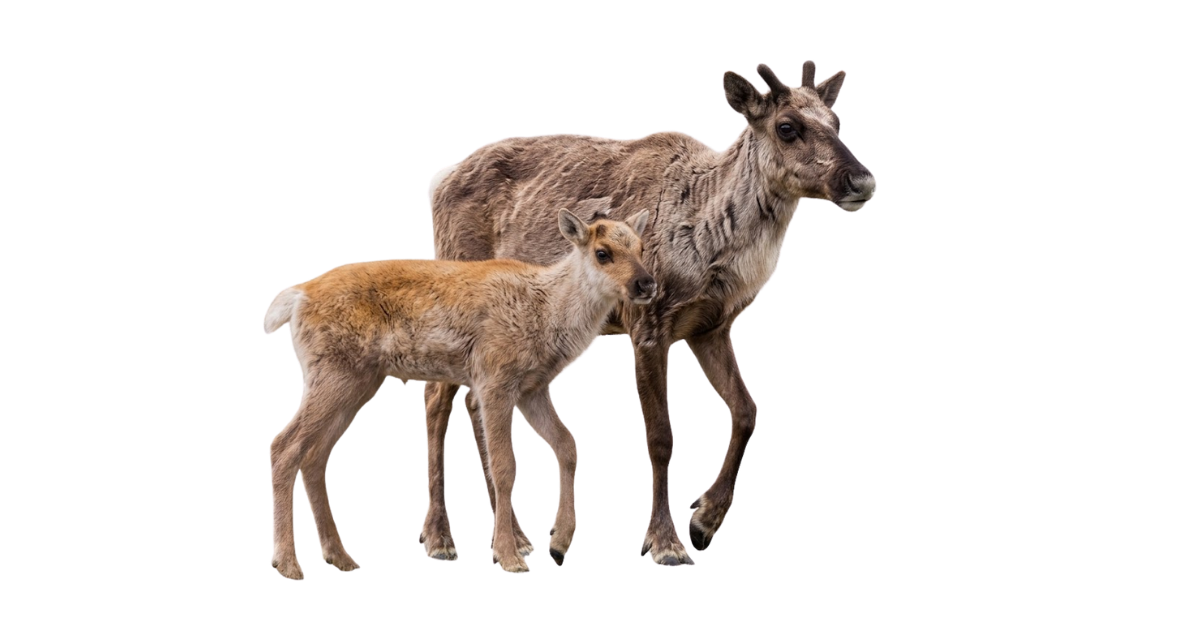
Nearly every calf on the coastal plain arrives inside a fortnight in early June. Swamping predators all at once works better than spreading births across the summer, and a calf is standing within an hour and running with the herd inside a day.
Then the flies arrive. By July the herds have gathered into enormous aggregations and pushed onto windy ground.
Fattening, then the rut
Willow leaves and mushrooms go down fast as the herd works back towards the treeline. October brings the rut, and bulls that spent all summer building antlers and body mass burn through both in a few weeks.
Afterwards the bulls drop their antlers. Cows keep theirs right through winter, which is how you can tell that every reindeer pulling a sleigh at Christmas is female.
Caribou or reindeer? One caribou migration, two ways of living it
They are one species, Rangifer tarandus. North America says caribou and means wild animals; Eurasia says reindeer, and almost every reindeer in Europe belongs to somebody.
In Sweden that ownership is Sámi, and it is not a small operation. Around 4,600 reindeer owners work roughly 220,000 animals across 51 herding districts, and the reindeer husbandry area covers close to 40% of the country. There are no fences across most of it. An animal grazing alone on a fell in February looks entirely wild and is not.
What matters for this map is that both groups migrate. Herded reindeer move between inland winter forest and mountain summer pasture on a seasonal round that mirrors the wild one almost exactly — the difference is that people decide when.
The two reindeer I met in Abisko
In the first week of February 2018 I went to Kiruna and Abisko, in the far north of Swedish Lapland, to see the northern lights. We stayed four days in Abisko, and on one of them we went walking in the reserve. At some point I got separated from my friend and found myself alone in the snow.
Two reindeer were standing there. No fence, no herder, nobody else in sight. I could not photograph them, because it was cold enough that taking my hands out of my gloves to work a camera was genuinely a bad idea, and I was not equipped for that kind of cold back then. So I just stood and watched, and then they moved off.
I assumed they were semi-domesticated, and that turns out to be right. Reindeer in that part of Norrbotten belong to Sámi herding districts that cover enormous areas without fencing them. What I could not have known standing there is that those same animals migrate — in February they were on winter grazing, and by May they would be moving up towards the mountains.
It is the only time I have seen this species outside a zoo, and I have thought about it more than a four-day trip to see the aurora would normally warrant.
What is happening to the herds
The caribou migration is being counted as it shrinks. The overall picture comes from the 2024 Arctic Report Card, which tracked 13 migratory tundra herds from 1970 onward. Together they have fallen by about 65%, from roughly 5.5 million animals to 1.88 million, with the steepest declines in the last two decades (Gunn et al., 2024).
Individual herds tell it more sharply. The Western Arctic herd in Alaska peaked at 490,000 in 2003 and now stands near 121,000. Porcupine, the herd on this map, was counted at 143,000 in July 2025, down from 218,000 in 2017. Worst of all is Bathurst in the Northwest Territories: over half a million animals in the 1980s, 6,851 in 2022, and 3,609 in 2025.
Several forces stack up. Warmer summers cut feeding time because insect harassment lasts longer; rain falling on snow freezes into ice that seals the lichen away; and mines, roads and railways carve up ranges that need to stay continuous. Meanwhile the calving grounds of the Porcupine herd sit inside the coastal plain of the Arctic National Wildlife Refuge, which has been fought over for oil leasing for forty years and remains contested.
Common questions
Why are caribou herds declining?
Several pressures at once, and climate change runs through most of them. Warmer summers mean longer insect seasons, so harassed caribou run instead of eating. Rain now falls on Arctic snow more often, then freezes into a crust that locks lichen away and starves animals standing above their food. Mines and roads fragment ranges that need to stay continuous. Across 13 monitored tundra herds the total has dropped roughly 65% since the 1990s.
What is the largest caribou herd in the world?
The Taimyr herd in the Russian Arctic remains the largest, according to the 2024 Arctic Report Card. In North America the picture has changed recently: the Western Arctic herd was long Alaska’s biggest at 490,000 animals in 2003, but after falling to about 121,000 it has been overtaken by the Porcupine herd at 143,000. Several herds that once exceeded half a million, including Bathurst and George River, are now counted in the thousands.
Is a caribou bigger than a moose?
No, and the gap is wide. Moose are the largest deer alive, with bulls commonly 380 to 700 kilograms and shoulder heights around two metres. Caribou bulls typically weigh 110 to 210 kilograms, so a big moose can outweigh a big caribou three or four times over. Caribou instead have antlers on both sexes, which no other deer manages.
How far do caribou migrate in a year?
The Porcupine and Bathurst herds share the record for the longest annual round-trip migration of any land animal at 1,350 kilometres, measured as a straight line between the far ends of the journey (Joly et al., 2019). Following the ground they actually walk, an individual covers several times that, and estimates of the total commonly run past 3,000 kilometres a year.
References
- Gunn, A., Russell, D., Joly, K., Manzo, L., Pellissey, J., Tulagak, J., & Whiting, A. V. (2024). Migratory tundra caribou in a warmer climate. In Arctic Report Card 2024. NOAA. https://doi.org/10.25923/qn4a-td90
- Joly, K., Gurarie, E., Sorum, M. S., Kaczensky, P., Cameron, M. D., Jakes, A. F., Borg, B. L., Nandintsetseg, D., Hopcraft, J. G. C., Buuveibaatar, B., Jones, P. F., Mueller, T., Walzer, C., Olson, K. A., Payne, J. C., Yadamsuren, A., & Hebblewhite, M. (2019). Longest terrestrial migrations and movements around the world. Scientific Reports, 9, 15333. https://doi.org/10.1038/s41598-019-51884-5
- Government of the Northwest Territories. (2025). 2025 population survey results released for the Bathurst and Bluenose-East barren-ground caribou herds. Environment and Climate Change, GNWT.
Routes on the map are corridors averaged from collar data, not the path of any individual animal. Herd circles are drawn to scale from the most recent published counts. Figures checked September 2026.



