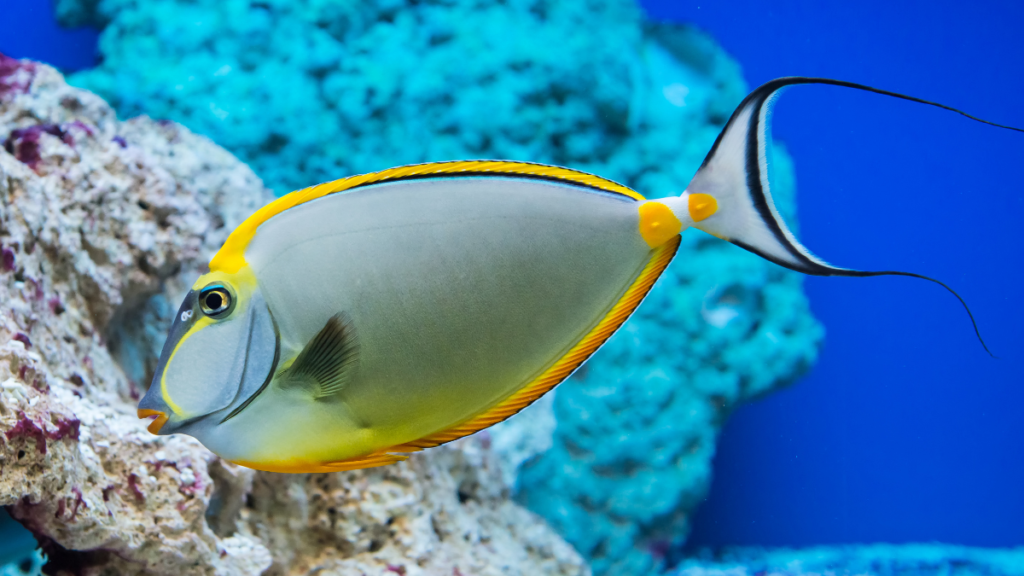
I am writing this from the Red Sea, three straight days into diving and snorkelling its reefs. Few places on Earth come close for coral fish. I had been distracted by a school of big black fish and a few sombre wrasses when a slim shape slid past the coral. It was an Elegant Unicornfish (Naso elegans), swimming shy near the reef. That was my first one, ever. The unicorn fish is a creature I had read about for years, yet seeing it move rewired how I think about reef grazers.
These animals are close cousins of the surgeonfish and the bright tangs you know from aquariums, but they live very different lives out on the reefs. In this guide I walk you through 12 standout species, what their horns and blades actually do, and where I have met them face to face. Expect biology, behavior, and field notes, not a textbook. By the end you will learn to spot one and read its strange anatomy on sight.
What Is a Unicorn Fish?
Unicorn fish belong to the genus Naso, a tight branch of the family Acanthuridae, the surgeonfish family that also gives us the colorful reef tangs. The genus Naso holds about 19 species, and only nine or ten carry the horn-like protrusion that earns the group its name. That horn is what most people picture: a blunt projection that develops on the forehead and points forward as the fish swims. The genus splits into two subgenera, separated by the keels on the caudal peduncle near the tail.
Here is the part most divers miss. Every unicornfish, horned or not, carries a pair of bony plates on each side of the caudal peduncle. These are the blades, fixed scalpel sharp blades that sit just before the tails. Surgeonfish and most tangs hide a single retractable blade; these reef tangs trade that retractable blade for permanent keeled plates, used for self defense and squabbles. Most species are diurnal, active by day and tucked into reef shelter at night, which is a good example of how their daily rhythm follows the algae and plankton they chase.
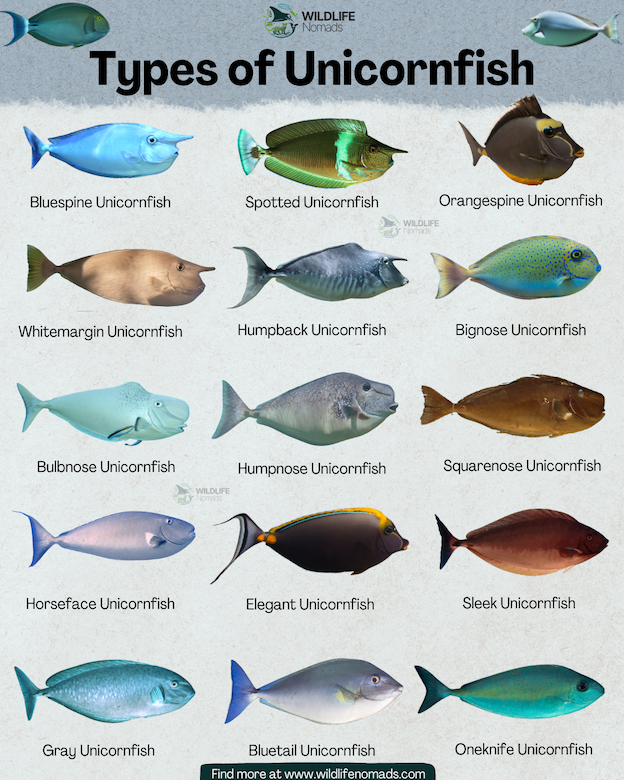
The 12 Species, One by One
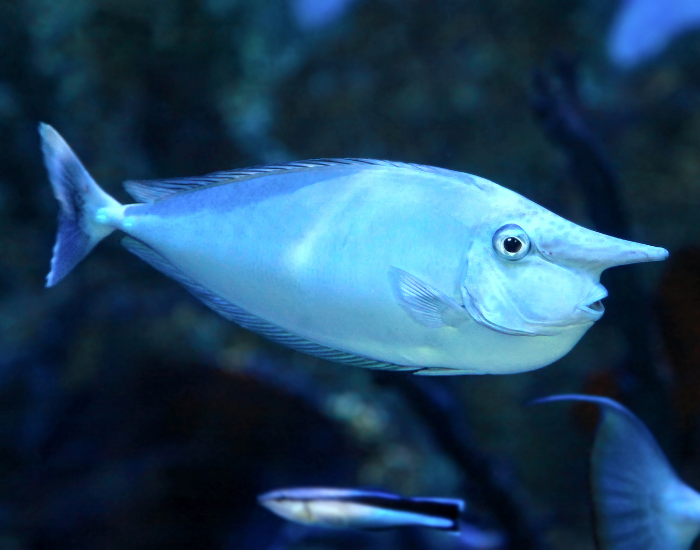
1. Bluespine Unicornfish (Naso unicornis)
This is the textbook unicorn horn fish, and the species that anchors the whole genus Naso. The bluespine unicornfish grows large, up to about 70 cm, with a tall horn protruding from the brow and two electric-blue blades flanking its tail. It is a heavyweight grazer of brown seaweed, and on the Great Barrier Reef it is nearly the only fish that reliably eats tough Sargassum.
That makes Naso unicornis a keystone browser whose feeding shapes coral health across countless Indo-Pacific reefs. I have watched them work a reef edge like methodical farmers, cropping algae no other animals will touch.
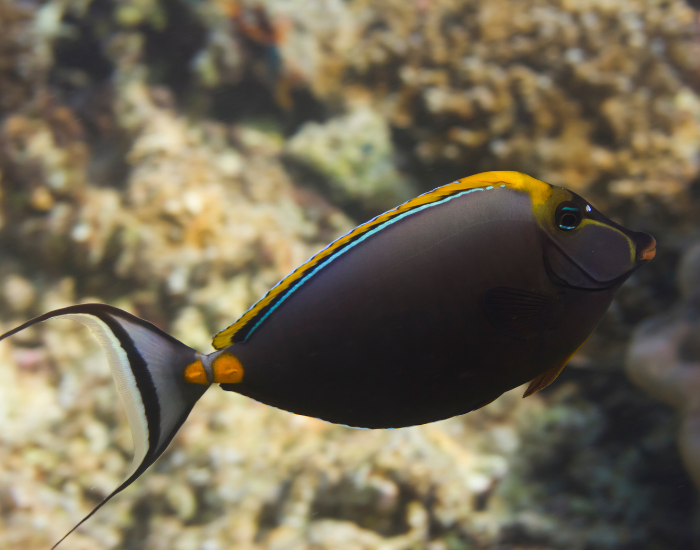
2. Elegant Unicornfish (Naso elegans)
My Red Sea fish. The Elegant Unicornfish has no horn at all, just a steep rounded brow, but it wears the prettiest livery among these tangs: a slate frame trimmed with yellow and a black, orange-margined mask around the eyes. It is the Indian Ocean and Red Sea counterpart of the orangespine.
It grazes leafy seaweed over shallow, sunlit corals where that growth thrives. Mine kept a shy slot between coral heads, darting out to feed and back to shelter.
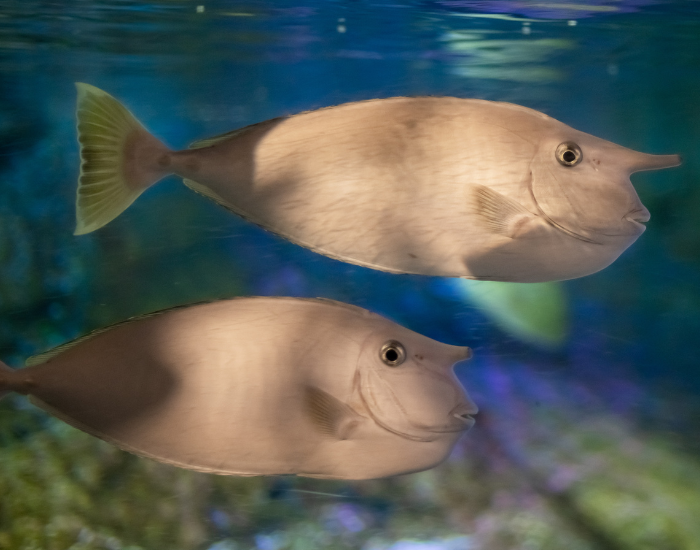
3. Whitemargin Unicornfish (Naso annulatus)
If size impresses you, Naso annulatus is the giant. The whitemargin unicornfish can grow to a full metre, the largest in the family by length. Adults develop a tapering horn that can extend past the mouth. Juveniles look plain by contrast and school in open water, picking off drifting prey.
As they grow, the frame lengthens and the horn appears, a slow piece of development you can almost read like rings. They range widely across tropical seas and reefs, often well down the slope at real depths.
4. Spotted Unicornfish (Naso brevirostris)
The spotted unicornfish is a shapeshifter in diet. Larvae eat plankton out in the blue, juveniles settle and graze benthic algae on the reef, then adults rise back into mid-water to hunt gelatinous prey like salps.
Its horn is tall and forward-pointing, sometimes past the snout, yet the mouth stays tucked beneath it. A study of its visual system found the eyes finish most of their growth right at the larval-to-juvenile switch, matching that dramatic shift in feeding.
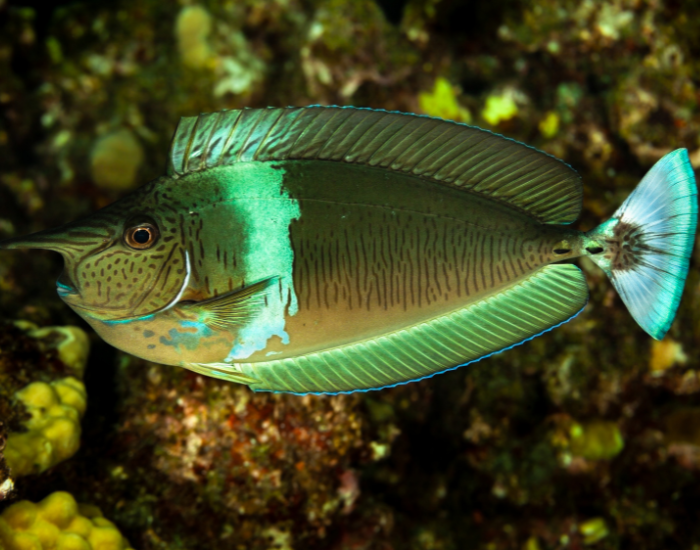
5. Orangespine Unicornfish (Naso lituratus)
Hornless but unmistakable, the orangespine unicornfish wears two bright orange blades at the base of its tail like warning flags. People often call it the “naso tang” in the aquarium trade, and it is one of the most recognizable tangs on Pacific reefs. It browses leafy brown seaweed across shallow corals. Reproductive work on this species and the bluespine found moderate lifespans, roughly 14 years here, useful numbers for managing reef fisheries.
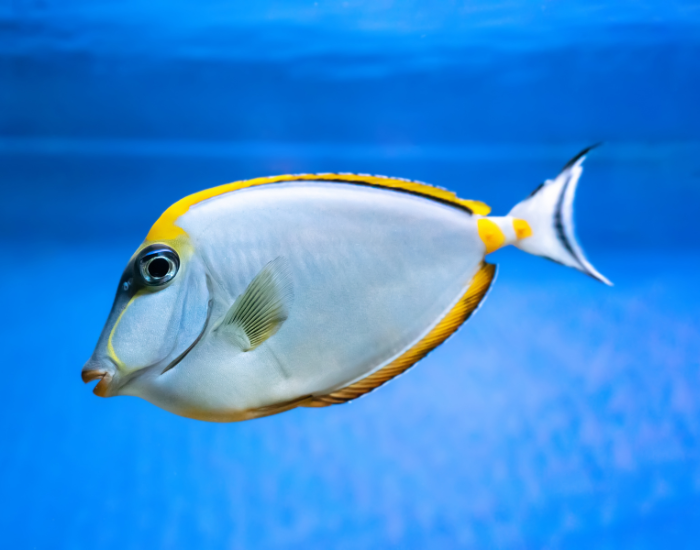
6. Sleek Unicornfish (Naso hexacanthus)
True to its name, the sleek unicornfish is a streamlined, hornless torpedo. It leaves the reef floor to hang in midwater in large aggregations, sometimes hundreds strong, filtering zooplankton from the current. Watch a group long enough and you will see them flush from dull grey to deep blue in seconds, a color change that ripples through the school. Among open-water tangs this is the classic look. They keep near steep drop-offs and shoot back to the reef when predators pass.
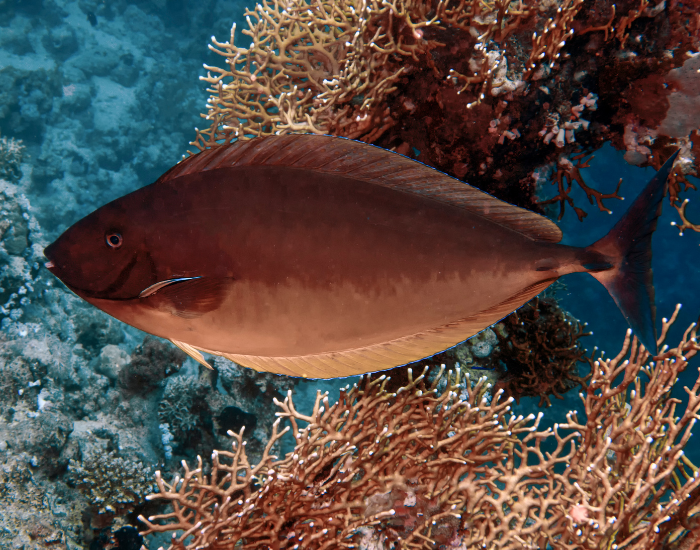
7. Vlaming’s Unicornfish (Naso vlamingii)
Vlaming’s unicornfish has no spike, just a bulging snout above the lips. What it lacks up front it makes up for in display. Males light up with electric-blue lines and a flushed face when courting females in the evening, then drop it within seconds. Researchers documented dominant males flashing these signals at smaller males too, evidence the snout works as a social billboard. It is a midwater planktivore found across the Indo-Pacific, commonly over outer reef slopes and deeper reefs.
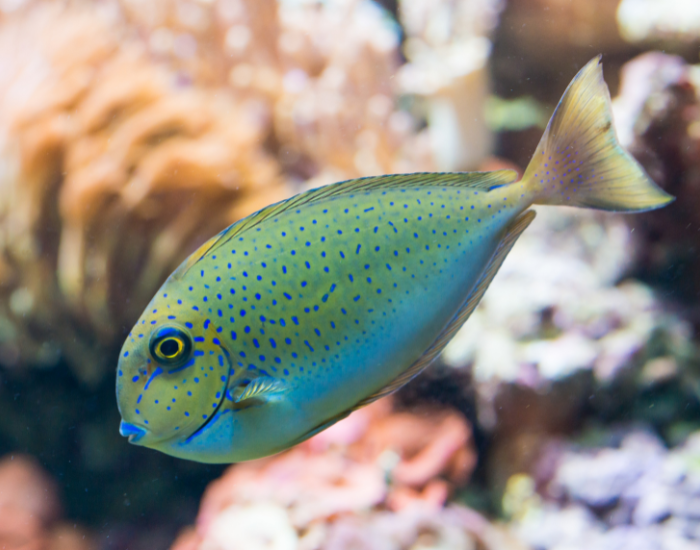
8. Humpback Unicornfish (Naso brachycentron)
The humpback unicornfish is one of the strangest in the group. Big males develop both a forward horn and a steep humped back, giving a profile unlike any other reef fish. It is among the bigger tangs, reaching well over half a metre. Sightings are uncommon, which makes each one a small event. It grazes seaweed but ranges deep and wide across remote reefs, so most divers go years without a clear look.
9. Humpnose Unicornfish (Naso tuberosus)
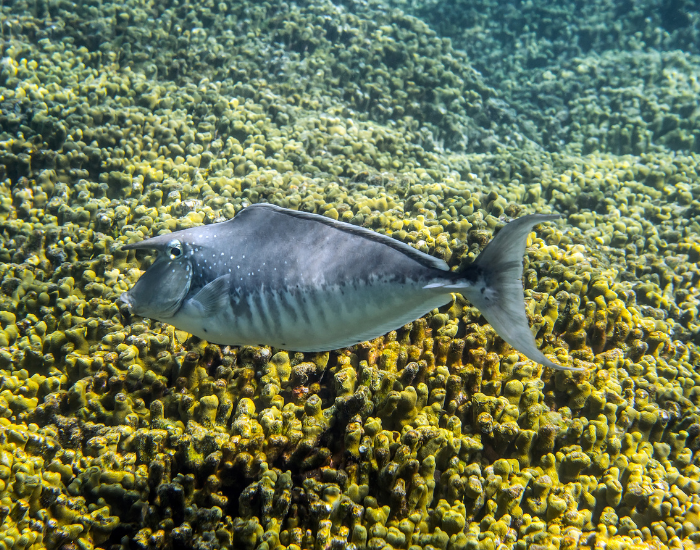
Easy to confuse with its cousins, the humpnose unicornfish carries a bulbous, rounded bump rather than a true horn. It is a robust, deep-bodied grazer of the Indo-Pacific that favors clear seaward reefs with current. Adults can grow past 60 cm. The species keeps to a smaller range than the wide-ranging planktivores, sticking to specific reef zones where its favored algae and turf grow thick.
10. Slender Unicornfish (Naso lopezi)
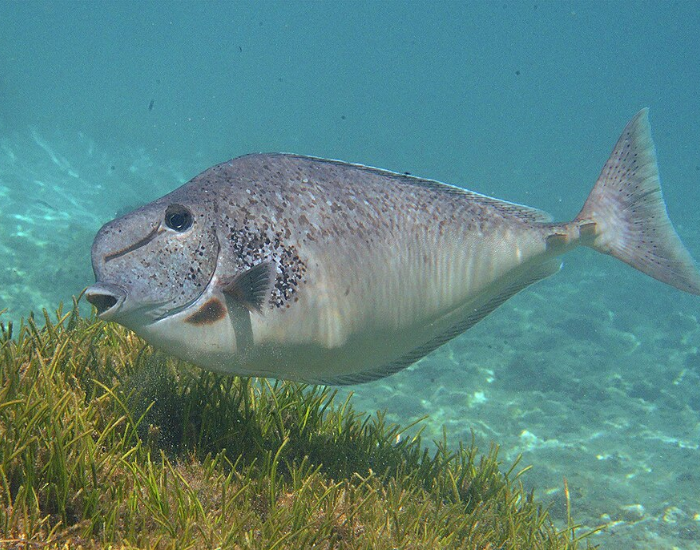
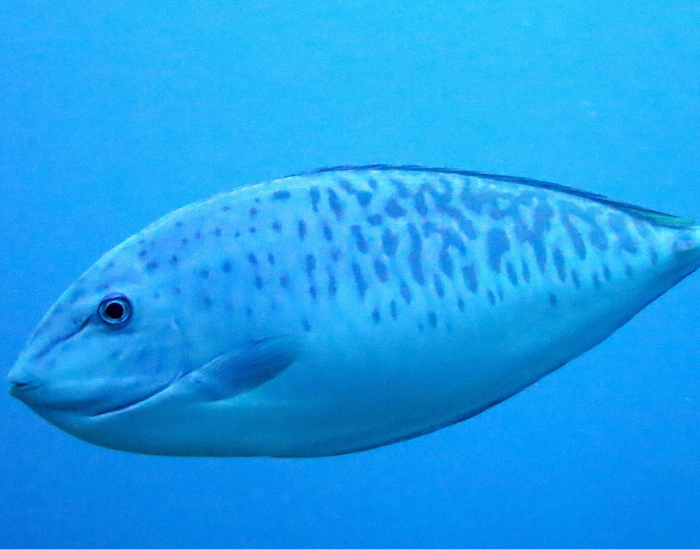
The slender unicornfish breaks the mold: no horn, no bump, just a clean, elongate body built for open water. It forms large midwater groups along deep reef slopes and edges, feeding almost entirely on drifting prey. Its pale, silvery look and forked tail can fool you into thinking it is some other fish entirely until you spot the telltale caudal blades. It is classified firmly within Naso despite looking nothing like the horned classics.
11. Oneknife Unicornfish (Naso thynnoides)
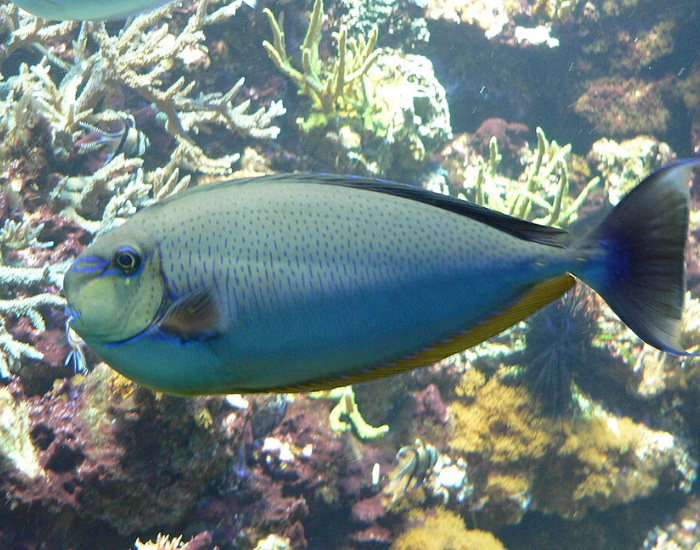
A small, schooling planktivore, the oneknife unicornfish takes its name from a single keel on each side of the tail, placing it in the second subgenus. It is one of the more abundant unicornfish in parts of the western Pacific, where it gathers in fast-moving groups over the reef and its corals. Tuna-like in shape, it feeds on drifting prey and rarely sits still for a close photo.
12. Gray Unicornfish (Naso caesius)
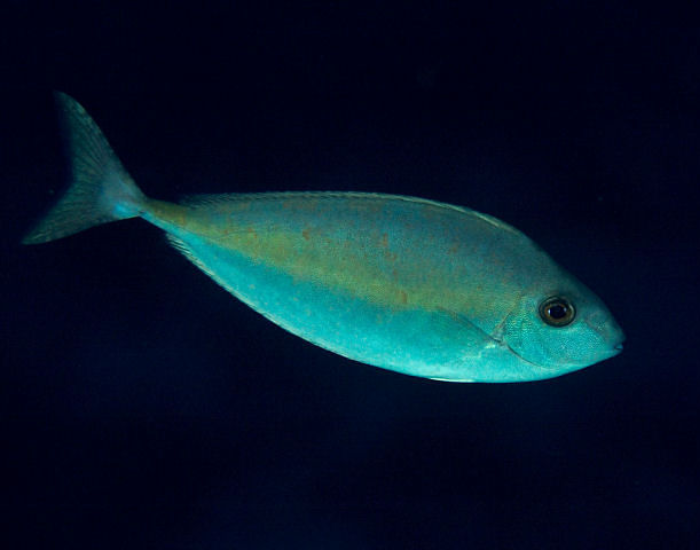
Plain at a glance, the gray unicornfish is a hornless, slate-colored planktivore closely related to the sleek species and often mixed into the same schools. It hovers in midwater off reef drop-offs, picking zooplankton from the current, and can flush brighter during social moments. Divers overlook it constantly because it reads as background grey until the light catches a shimmer along its body.
Bonus: Two More Worth Knowing
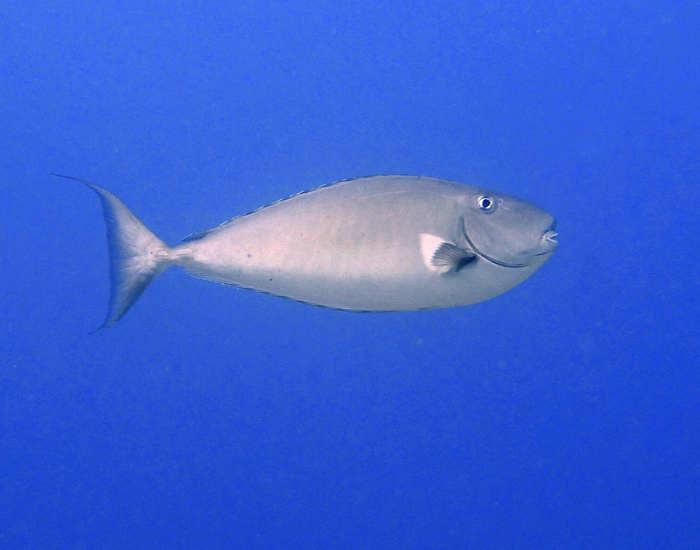
The blackspine unicornfish (Naso minor) is a deep-water specialist, a modest planktivore with dark tail spines that haunts reef slopes below typical dive depths. The horseface unicornfish (Naso fageni) is a large, heavy-headed grazer whose long, sloping forehead earns the name; it stays uncommon and patchy across its range, a reminder that even within one genus the variety runs deep.
How to Read One in the Water
After enough dives you stop relying on the horn. It helps, but it appears on fewer than half the species and changes with age and sex. I read the tail first. Find the colored blades at the base, and you have a unicornfish, full stop. Bright orange means orangespine; electric blue points to bluespine. From there, shape tells you the rest: a deep grazer hugging the corals versus a sleek planktivore hanging in open water. These tangs and their grazing habits make them the clean-up crew of healthy coral reefs.
The horns themselves are not weapons. Evidence suggests they signal male quality, and males can flush them to compete, so the structure is best considered courtship gear, not combat gear. The blades and the slashing tails do the fighting. Together they make this one of the most quietly fascinating animals on any reef.
Frequently Asked Questions
A unicorn fish is a reef-dwelling member of the genus Naso, part of the surgeonfish family Acanthuridae. The common name comes from the horn that develops on the forehead of some species. Not every species has one. All of them carry sharp, fixed blades on the tail base for self defense, which truly sets the group apart.
It depends on the species. Many of these tangs are herbivores that graze algae and seaweed off the corals, and their grazing helps keep coral reefs healthy. Others, like the sleek and spotted species, are diurnal planktivores feeding on plankton in midwater. Some switch diet as they grow, starting on plankton, moving to seaweed, then back as adults. The result is a group that touches nearly every part of the reef food web.
Unicornfish live in warm tropical and subtropical waters across the Indo-Pacific, from the Red Sea to the central ocean reefs. Most prefer coral reefs and rocky areas, sheltering in reef structure, though some range down to roughly 700 feet. Shallow, sunlit zones suit the algae-grazers; planktivores favor deeper outer slopes.
Yes. Most species, including the bluespine, are assessed and listed as Least Concern on the IUCN Red List. That status is reassuring, but it does not mean unprotected. As a key reef grazer, the bluespine unicornfish matters far beyond its own numbers, so heavy local fishing can still ripple out and damage the whole reef. Protecting these fish helps protect the reefs and corals they keep clean.
They Are More Than Their Horns
Strip away the horn, the part that gets all the attention, and the real story is ecological. Unicornfish help maintain reef biodiversity by controlling the algae that would otherwise smother corals, and their waste feeds nutrients back into the system. They are broadcast spawners, releasing eggs and sperm into open water, and they school to graze safely under the eyes of predators.
Watching that Elegant Unicornfish slip past the coral, I was not thinking about a mythical horn. I was watching one quiet life keep its place in a working reef, the same role these tangs play in every warm sea on the planet. Go find your own, whether on a reef or in the pages of our guides to coral fishes, parrotfish, or the wider world of finfish. Then tell me in the comments which one you saw first.
References:
Arai, H., & Satoh, T. (2007). Prominent ornaments and rapid color change: Use of horns as a social and reproductive signal in unicornfish (Acanthuridae: Naso). Ichthyological Research, 54(1), 49–54. https://doi.org/10.1007/s10228-006-0373-z
Taylor, B. M., Rhodes, K. L., Marshell, A., & McIlwain, J. L. (2014). Age-based demographic and reproductive assessment of orangespine Naso lituratus and bluespine Naso unicornis unicornfishes. Journal of Fish Biology, 85(3), 901–916. https://doi.org/10.1111/jfb.12479
Carlson, P. M., Bargmann, F., & Marshall, N. J. (2019). Visual system development of the spotted unicornfish, Naso brevirostris (Acanthuridae). Journal of Experimental Biology, 222(24), jeb209916. https://doi.org/10.1242/jeb.209916
Puk, L. D., Ferse, S. C. A., & Wild, C. (2016). Patterns and trends in coral reef macroalgae browsing: A review of browsing herbivorous fishes of the Indo-Pacific. Reviews in Fish Biology and Fisheries, 26(1), 53–70. https://doi.org/10.1007/s11160-015-9412-z
Marshell, A., & Mumby, P. J. (2015). The role of surgeonfish (Acanthuridae) in maintaining algal turf biomass on coral reefs. Journal of Experimental Marine Biology and Ecology, 473, 152–160. https://doi.org/10.1016/j.jembe.2015.09.002
Eble, J. A., Bowen, B. W., & Bernardi, G. (2011). Phylogeography of the unicornfishes (Acanthuridae: Naso): Genetic diversity and biogeography across the Indo-Pacific. Marine Ecology Progress Series, 428, 245–258. https://doi.org/10.3354/meps09083
Hoey, A. S., & Bellwood, D. R. (2009). Limited functional redundancy in a high diversity system: Single species dominates key ecological process on coral reefs. Ecosystems, 12(8), 1316–1328. https://doi.org/10.1007/s10021-009-9291-z