When I visited Baja in 2019, I’ll never forget the sun and the warm. I was there during a billfish competition, not as a competitor, but as a recent graduate biologist. Over a lukewarm beer, a veteran U.S. sailor named Dave described a world of granders and gladiators. He spoke of blue marlin leaping clear of the Pacific, of black marlin peeling line off a reel faster than the eye could follow.
As a scientist, I look for data first. However, as a human, I felt the conflict Dave lived every day. He loved these fish, yet his sport relied on catching them. Several marlin species are highly vulnerable, especially in the overfished pockets of the Pacific and Atlantic oceans. In the Caribbean region, Japanese and Cuban fishermen have historically caught over a thousand tons of blue marlin annually, highlighting the significant commercial fishing pressure on the species.
This is one of the most biologically extraordinary predators on our planet. Marlin are also known as ‘ocean gar’, ‘ocean guard’, and in some regions, ‘Cuban black marlin’. Here are 12 facts that prove exactly that.

1. There Are Four Recognised Marlin Species
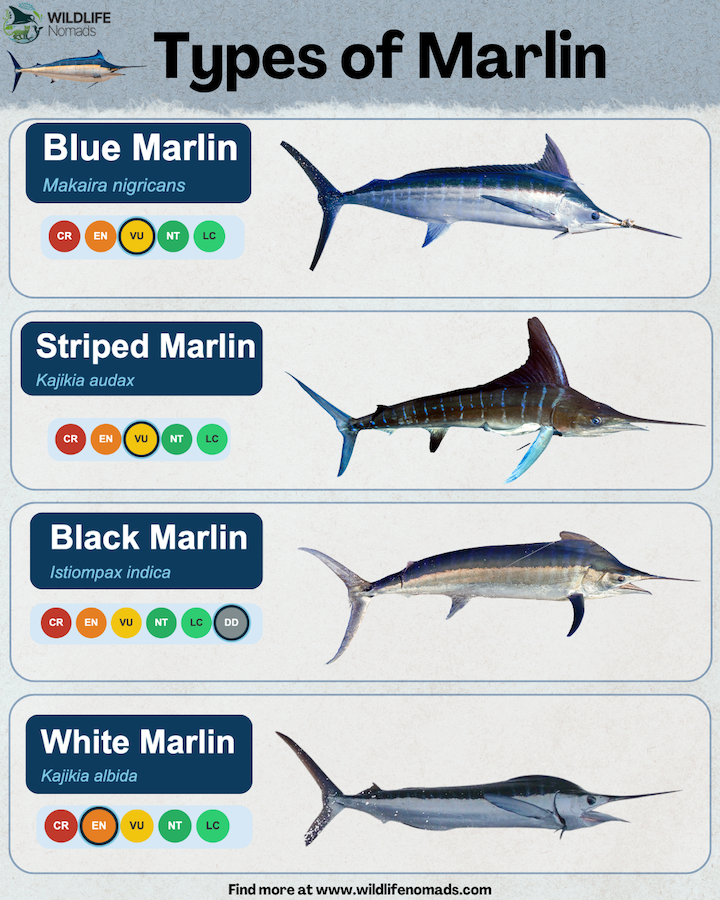
Scientists currently recognise four valid marlin species within the billfish family Istiophoridae. Each occupies a distinct ecological niche across the world’s warm ocean basins.
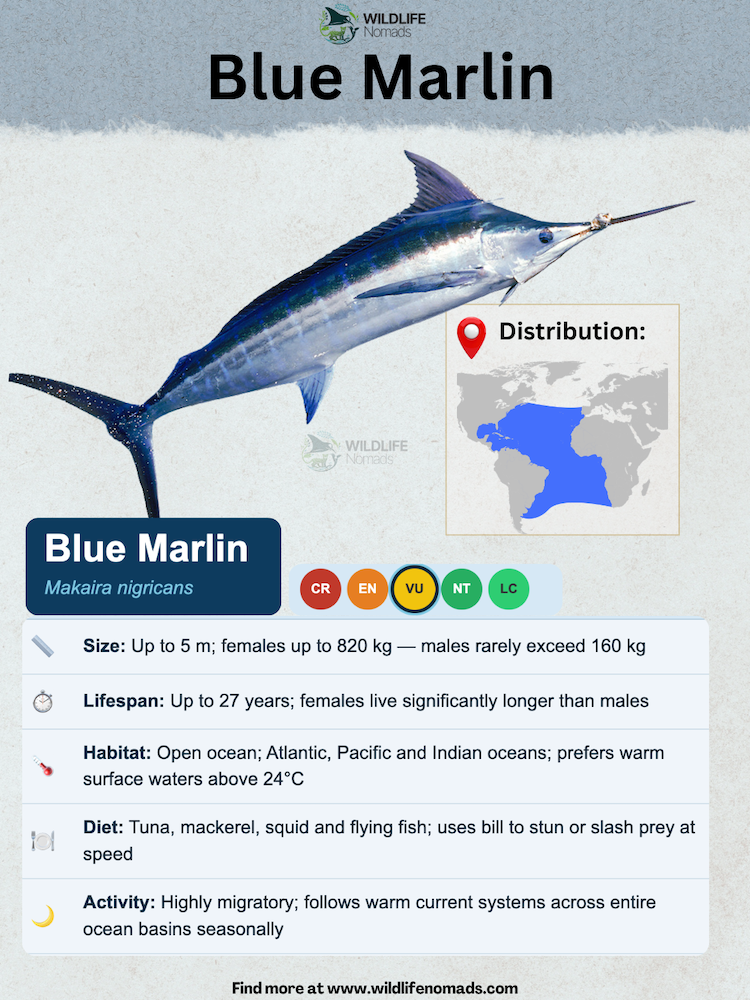
- Blue marlin (Makaira nigricans) — found in the Atlantic, Pacific, and Indian oceans. The Atlantic blue marlin is listed as Vulnerable by the IUCN.
- Black marlin (Istiompax indica) — the largest marlin species, inhabiting the tropical and subtropical Pacific and Indian oceans.
- Striped marlin (Kajikia audax) — a slightly smaller, highly migratory species found across the Indo-Pacific.
- White marlin (Kajikia albida) — the smallest of the four, limited to the Atlantic Ocean and Caribbean region.
Note: While this post focuses on the four primary marlins, the broader billfish family (Istiophoridae) actually contains 11 species. This includes various spearfish and the iconic sailfish. Taxonomic debate continues regarding certain subspecies, but the four listed above are the “True Marlins” recognized by major authorities like the IGFA.
2. The Speed Claims Are Wildly Exaggerated
Popular media often claims black marlin reach 129 km/h (80 mph). In reality, this figure came from a single fishing reel observation, not a controlled scientific measurement. A 2016 peer-reviewed study used muscle contraction timing to estimate a theoretical maximum burst speed of around 36 km/h (22 mph) for billfish.
That said, these are still among the fastest fish in the open sea. They are powerful swimmers capable of covering enormous distances with ease. Blue marlin are fast and powerful swimmers that prefer bluewater environments, where they use their speed and strength to pursue schooling surface fish. The ocean is dense and drag increases exponentially with speed, which sets hard physical limits on how fast any fish can actually travel.
3. They Have a Built-In “Brain Heater”
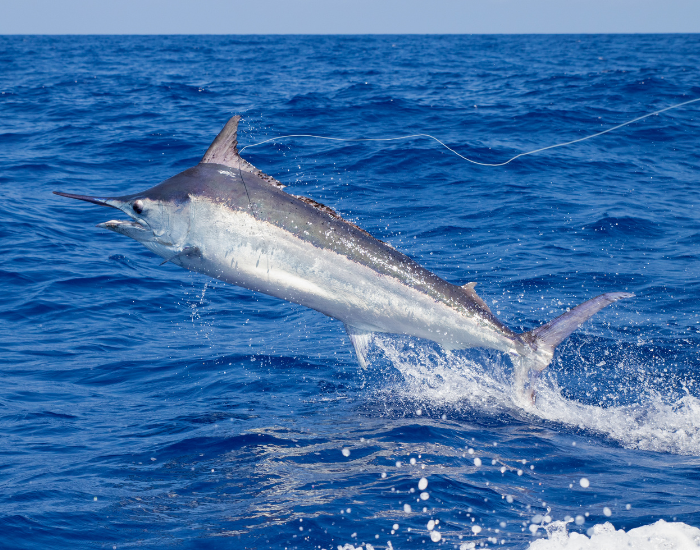
Marlin belong to a rare group, less than 1% of fish species, that exhibit regional endothermy. They maintain a “heater organ” near the eyes and brain. This organ keeps neural tissue warm even when the fish dives into cold, deep waters to hunt.
In addition, this warm-blooded adaptation gives them a massive neurological advantage. Their visual processing and reaction times remain sharp at depth. Therefore, they can detect and pursue prey far more effectively than their cold-blooded targets.
4. The Bill Is a Club, Not a Spear
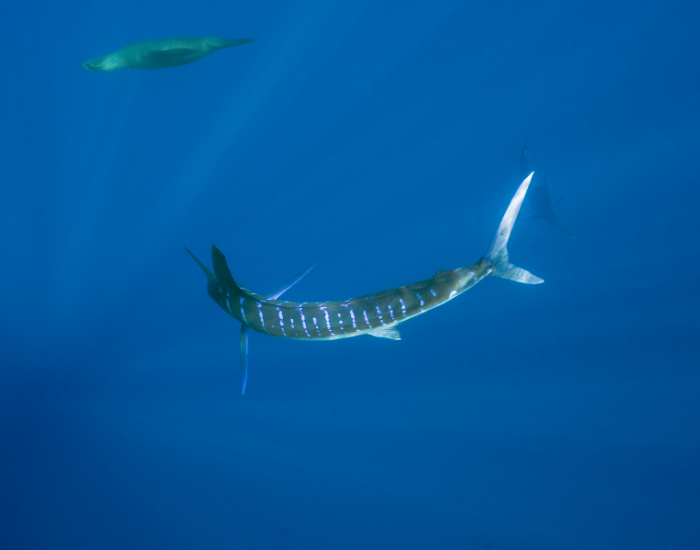
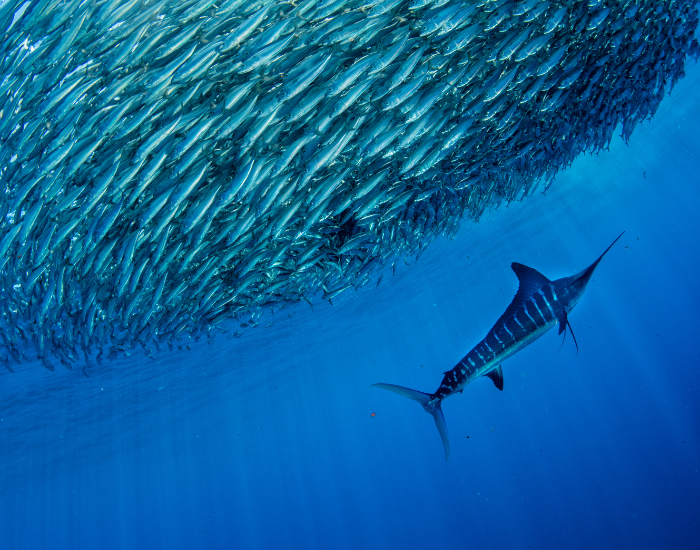
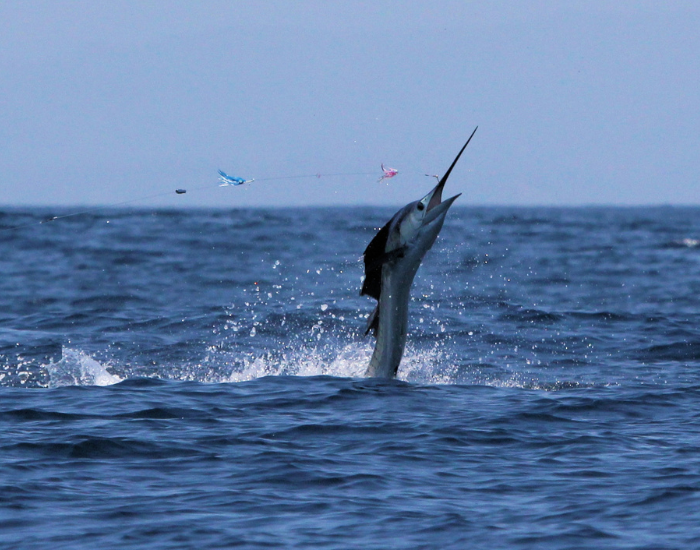
This is one of the most common marlin misconceptions. The long rostrum, that pointed upper jaw — is not used to spear prey like a shish kebab. Instead, marlins slash laterally through schools of tuna, mackerel, or squid with fast, powerful sideways strikes.
The goal is to stun or injure prey, not impale it. For example, a marlin will charge a baitball at speed and swing its bill through the school. It then circles back to consume the stunned fish. If a marlin breaks its bill, it can still survive, though hunting efficiency drops significantly.
5. They Change Colour Like a Living Neon Sign
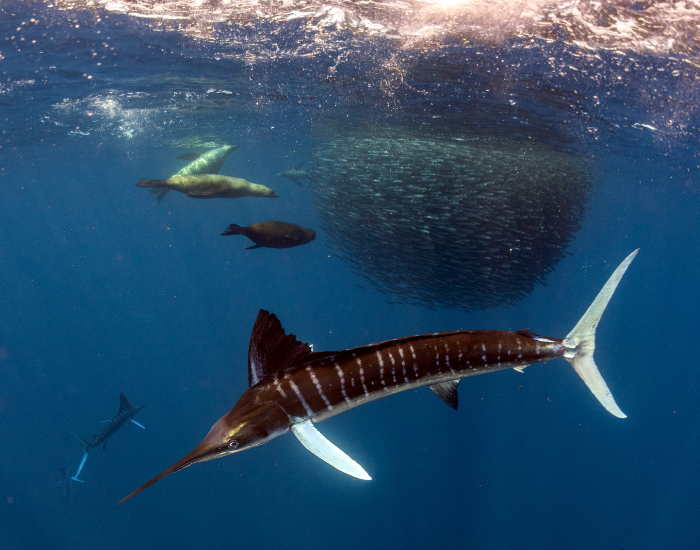
So, what colour is a marlin? Colour depends entirely on its mood. At rest, the typical marlin displays a blue-black dorsal surface fading to a silvery white belly. The dorsal surface is often a deep, dark blue, and some individuals may have darker spots along their back. Juvenile blue marlin larvae can be identified by two iridescent blue patches on their head, a distinctive feature at this early life stage.
These flashing vertical stripes serve two purposes. They likely confuse prey during an attack. They may also act as communication signals to other marlin in the vicinity. Once the fish dies, the colours fade rapidly to a dull grey, which is why a pescado marlin at market looks so different from the live animal.
6. The Females Are the Giants — “Granders” Are Always Female
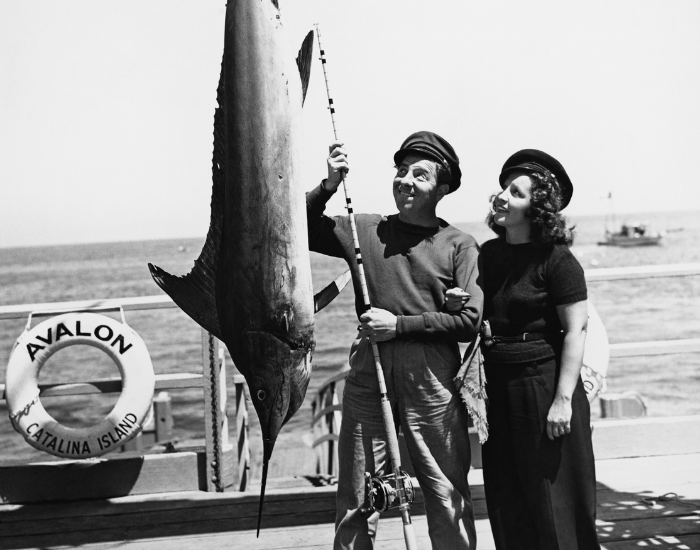
Marlin show extreme sexual dimorphism. Male blue marlin rarely exceed 300 pounds. However, females can weigh up to four times more. Female blue marlin are significantly larger in body size than males, with notable differences in weight and length at various life stages. A “grander”, a marlin exceeding 1,000 pounds, is, without exception, a female.
The Pacific blue marlin world record, caught off Kona, Hawaii in 1982, stands at 1,376 pounds. The black marlin all-tackle record is even larger: 1,560 pounds, landed off Cabo Blanco, Peru, in 1953. Blue marlin are the largest of the billfish, growing to 14 feet long and weighing up to a ton. Both blue marlin and black marlin can exceed 14–16 feet in length and 1,000–2,000 pounds. Females grow larger because they need the extra mass to produce and carry millions of eggs.
7. Some Fins Can Fold Away for Speed — But Not the Black Marlin’s
Blue and striped marlin have grooves along their bodies where they tuck their pectoral fins flush against the skin at high speed. It is the biological equivalent of an aircraft retracting its landing gear. This dramatically reduces drag and allows for faster bursts. Marlin also have a prominent anal fin and a large, forked caudal fin (tail), both of which contribute to their hydrodynamic efficiency and swimming speed. In juvenile marlin, the first dorsal fin is proportionally larger, gradually reducing in size as the fish matures.
The black marlin, however, is the exception. Its pectoral fins are rigid and cannot fold flat against the body. This is actually the most reliable field identification feature for the species. Anglers and biologists use this rigid fin trait to distinguish black marlin from blue marlin at a glance.
8. They Are Highly Migratory Fish Crossing Entire Ocean Basins
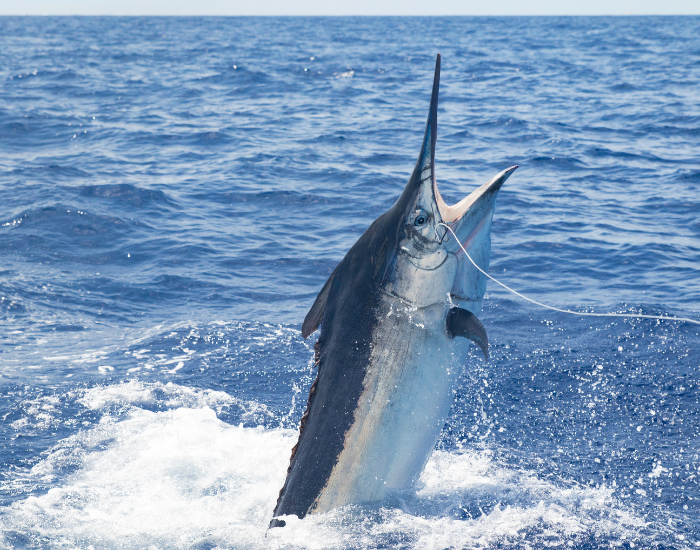
Marlin are among the most wide-ranging highly migratory fish on the planet. Tracking studies from The Billfish Foundation have recorded individual marlin covering more than 9,000 miles across open ocean basins. They follow warm currents and thermal boundaries, moving wherever baitfish concentrate. Blue marlin are found primarily in the temperate and tropical regions of the Atlantic Ocean, with their migration patterns influenced by water temperatures. They prefer warm waters above the thermocline, often expanding their range into temperate waters during warmer months.
The Atlantic blue marlin ranges across both the Atlantic and occasionally into the Indian and Pacific oceans. The striped marlin is common across Pacific and Indian oceans. In addition, the black marlin is found throughout tropical and subtropical waters offshore from Australia, Hawaii, Costa Rica, Panama, and the Pacific islands. None of these fish respect national borders, which makes international conservation agreements essential.
9. Their Eyes Are Built for the Open Sea
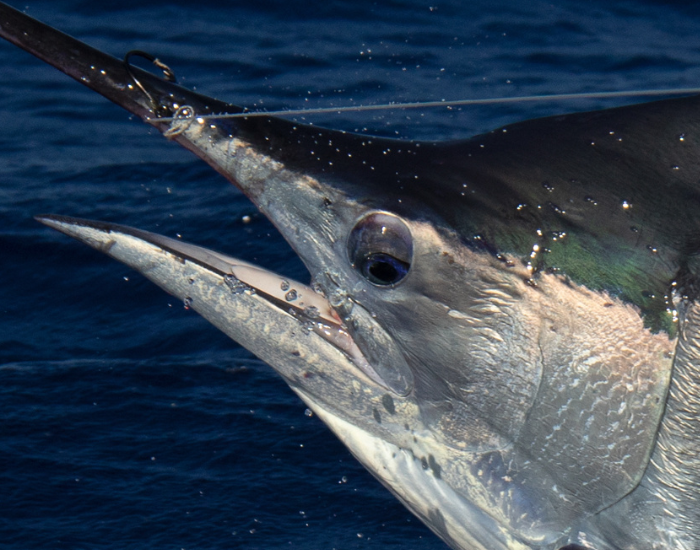
Marlin spend time near the surface but regularly dive into deep waters to hunt. Therefore, their eyes have evolved for high contrast sensitivity across a wide range of light conditions. They can likely detect ultraviolet wavelengths, helping them spot the shimmer of prey scales against bright surface light.
This visual acuity makes them devastatingly effective predators. A blue marlin can detect and intercept a school of tuna from a significant distance, even in the complex light conditions of open sea waters offshore.
10. The Atlantic Blue Marlin Is Officially Vulnerable
The Atlantic blue marlin (Makaira nigricans) is listed as Vulnerable on the IUCN Red List. Its conservation status reflects decades of pressure from both commercial longline fishing bycatch and sport fishing. Blue marlin are also targeted by commercial fishermen, contributing to their threatened status as recognized by the IUCN due to overfishing. The species reproduces relatively slowly compared to other fish, and populations in the South Atlantic and North-western Pacific remain unpredictable.
However, conservation efforts have shown results. Catch-and-release practices, promoted by organisations like The Billfish Foundation, have helped reduce mortality. The survival rate of released blue marlin can be low if the fish is badly injured during capture, highlighting the importance of best practices to improve post-release survival. The Billfish Conservation Act of 2012 in the United States also outlawed the commercial sale of billfish, offering important protections. Nevertheless, gradual reducing of fishing pressure globally remains the critical challenge.
11. A Baby Marlin Starts Smaller Than a Grain of Rice
Female marlin produce millions of eggs during spawning season. Black marlin, for example, spawn between September and November near the Great Barrier Reef, the only confirmed breeding ground for the species. The fertilised eggs are tiny, and the larvae that hatch are similarly minuscule.
In addition, a baby marlin grows at a staggering rate during its first year. If it survives the gauntlet of large pelagic sharks and other predators, it can reach several feet in length within twelve months. This rapid growth rate is essential: in the open sea, if you are not yet a predator, you are absolutely the prey.
Blue marlin larvae and juveniles can be affected by a variety of parasites, including spiny-headed worms and tissue flukes, which can impact their health and survival.
12. They Have Been Inspiring Humans for Centuries
Marlin hold a special place in human culture, particularly among sport fishermen and coastal communities across the Pacific islands and Caribbean region. Blue marlin are highly prized as an important game fish and are greatly coveted by sportsfishers and trophy hunters. Ernest Hemingway’s The Old Man and the Sea features a marlin as its central subject, a testament to the awe these fish inspire. In some countries, the marlin is a national fish and a key species driving recreational fishery economies.
For example, destinations like Cabo San Lucas, Kona Hawaii, and Cairns, Australia have built entire tourism industries around marlin fishing. The fish generates significant value — both economically and ecologically, as an apex predator regulating prey fish populations across the ocean.

Frequently Asked Questions
A marlin is a large, fast-swimming billfish in the family Istiophoridae. It is characterised by a long, rounded upper jaw (bill), a high dorsal fin, and a streamlined cylindrical body. There are four widely recognised marlin species: blue, black, striped, and white marlin.
Most marlin have a deep blue-black back fading to a silvery white belly, sometimes with pale vertical stripes. They have a long pointed bill, a tall first dorsal fin, and a large forked tail. Marlin also possess a prominent anal fin and a powerful caudal fin, both contributing to their streamlined body size and swimming ability. The black marlin is notably darker and heavier-bodied, while the white marlin is the smallest of the four species.
Marlin are apex predators. They eat tuna, mackerel, squid, flying fish, and occasionally smaller billfish. They use their bill to slash through schools of baitfish, stunning prey before consuming it. Some black marlin have even been found with juvenile sharks in their stomachs.
Not intentionally. However, due to their size, speed, and the force of a jumping fish, marlin can injure anglers. A hooked marlin leaping into a boat has caused serious injuries. Treat these fish with great respect — both in the water and at the gunwale.
References:
Collette, B. B., Di Natale, A., Fox, W., Graves, J., Juan Jorda, M., Pohlot, B., & Schratwieser, J. (2022). Makaira nigricans. The IUCN Red List of Threatened Species 2022: e.T170314A46936155. https://dx.doi.org/10.2305/IUCN.UK.2022-1.RLTS.T170314A46936155.en
Domenici, P., Wilson, A. D., Kurvers, R. H., Marras, S., Herbert-Read, J. E., Steffensen, J. F., Krause, S., Viblanc, P. E., Couillaud, P., & Krause, J. (2014). How sailfish use their bills to capture schooling prey. Proceedings. Biological sciences, 281(1784), 20140444. https://doi.org/10.1098/rspb.2014.0444
Svendsen, M. B., Domenici, P., Marras, S., Krause, J., Boswell, K. M., Rodriguez-Pinto, I., Wilson, A. D., Kurvers, R. H., Viblanc, P. E., Finger, J. S., & Steffensen, J. F. (2016). Maximum swimming speeds of sailfish and three other large marine predatory fish species based on muscle contraction time and stride length: a myth revisited. Biology open, 5(10), 1415–1419. https://doi.org/10.1242/bio.019919
Rowland, L. A., Bal, N. C., & Periasamy, M. (2015). The role of skeletal-muscle-based thermogenic mechanisms in vertebrate endothermy. Biological reviews of the Cambridge Philosophical Society, 90(4), 1279–1297. https://doi.org/10.1111/brv.12157
Shimose, T., Yokawa, K., Saito, H., & Tachihara, K. (2008). Seasonal occurrence and feeding habits of black marlin, Istiompax indica, around Yonaguni Island, southwestern Japan. Ichthyological Research, 55(1), 90–94. https://doi.org/10.1007/s10228-007-0004-3
Prince, E. D., Snodgrass, D., Orbesen, E. S., Hoolihan, J. P., Serafy, J. E., & Schratwieser, J. E. (2007). Circle hooks, ‘J’ hooks and drop-back time: A hook performance study of the south Florida recreational live-bait fishery for sailfish, Istiophorus platypterus. Fisheries Management and Ecology, 14(2), 173–182. https://doi.org/10.1111/j.1365-2400.2007.00539.x