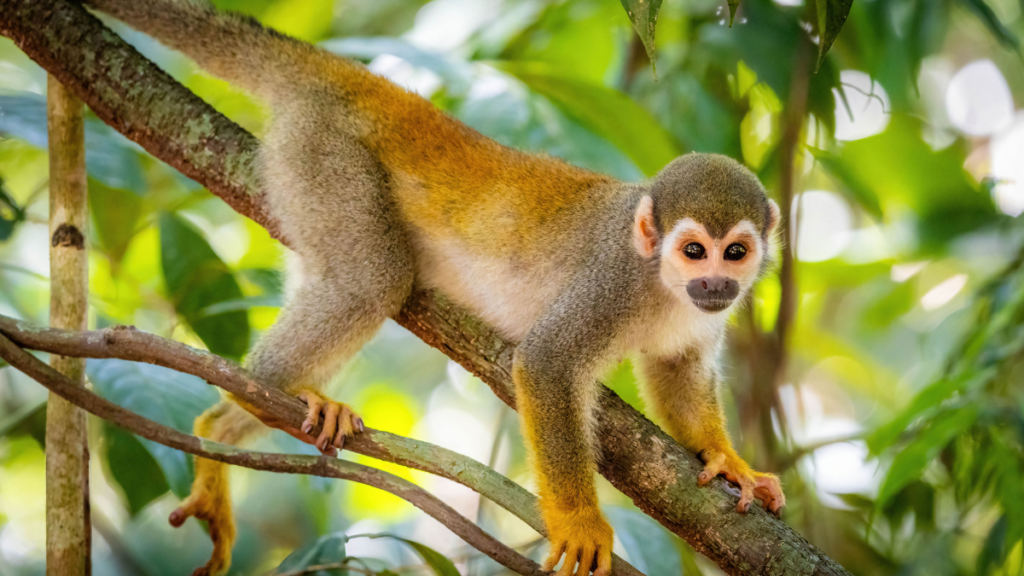
A few years back, one of our Wildlife Nomads team members, Jackie, texted me from Costa Rica in a total frenzy. She was standing in Manuel Antonio National Park, watching a river of tiny golden bodies pour through the canopy. “Cesar, what ARE these?” Squirrel monkeys. Dozens of them, moving like one organism.
Squirrel monkeys still stop me cold. They weigh less than a can of soda, yet they carry the biggest brain, pound for pound, of any primate on Earth. In this piece I’ll walk you through what makes these little New World monkeys so remarkable, the biology, the behavior, the conservation fights, and the honest answer to whether you should ever keep one.
By the end, you’ll understand squirrel monkeys the way a field biologist does. Not as cute internet clips, but as one of the most socially sophisticated small primates alive. Let’s get into it.
1. A Squirrel Monkey Is a Tiny New World Primate
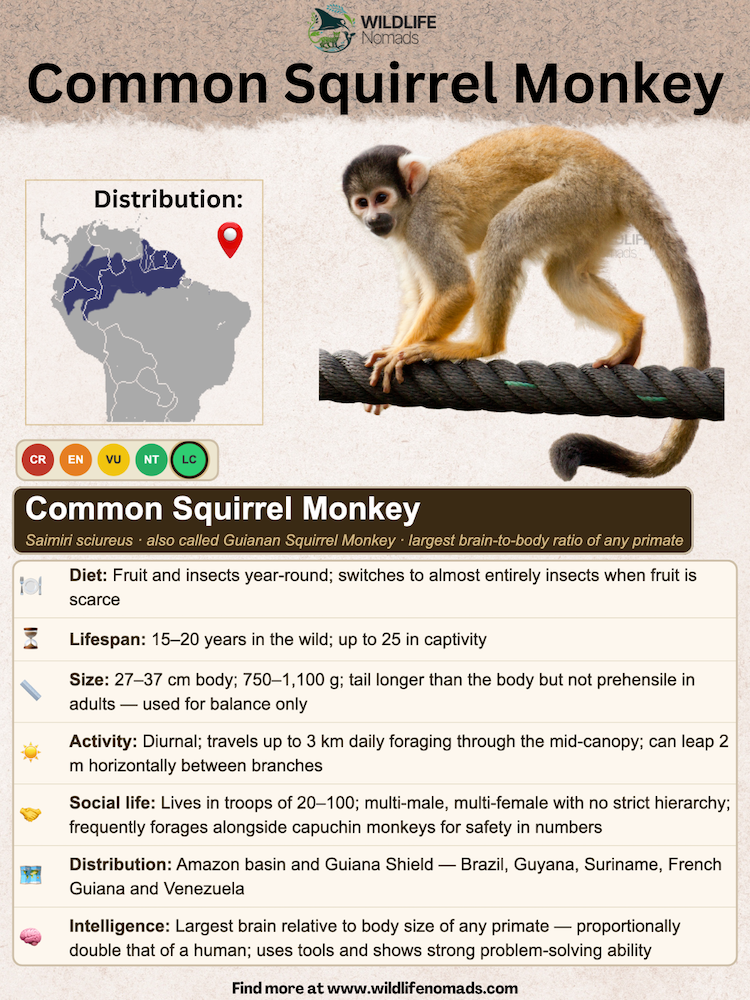
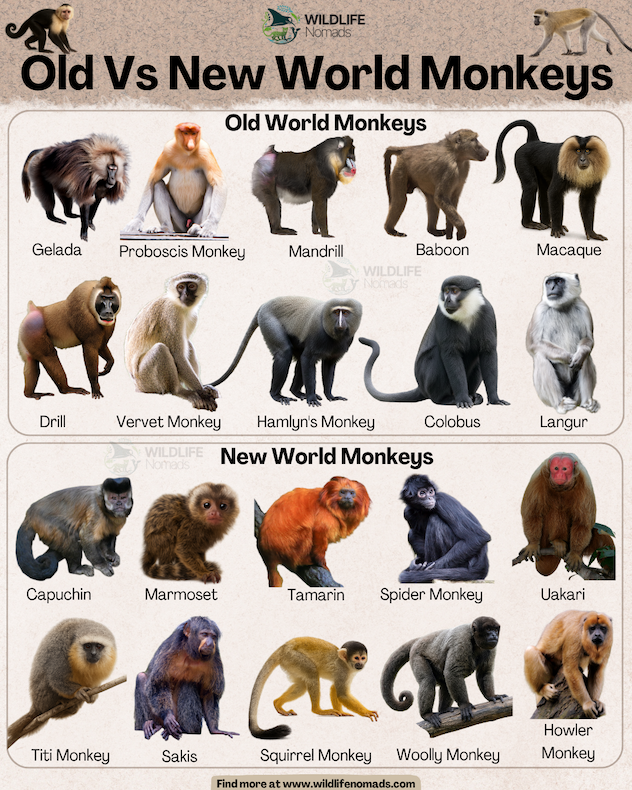
Squirrel monkeys are small New World monkeys of the genus Saimiri, native to Central and South America. Their range runs from Costa Rica down through the Amazon basin. As neotropical primates, they share those forests with dozens of other primate species.
The name is refreshingly literal. Early naturalists watched them dart along branches with long, bushy tails and thought “squirrel.” That agility is real, and I’ll come back to it. For now, picture a primate the size of a squirrel that thinks like something much larger.
For years, taxonomists recognized only two species and lumped everything else together. Today most experts count at least five species, and several classifications push that number to seven. Getting the species right actually matters enormously for conservation, as you’ll see.
2. They Have the Biggest Brain, Relative to Body, of Any Primate
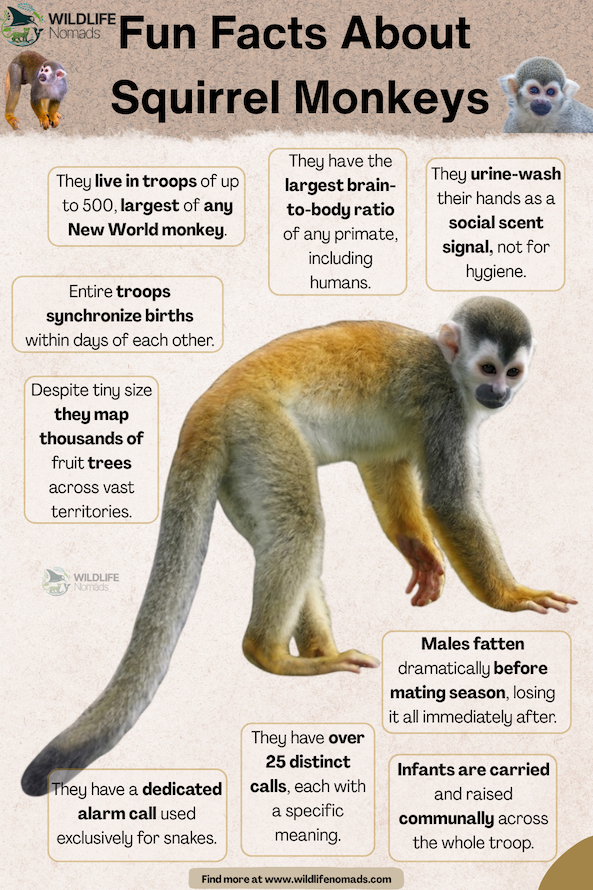
Here’s the fact that always lands hardest over coffee. Squirrel monkeys have the largest brain-to-body mass ratio of all primates, roughly 1:17. For comparison, our own human ratio sits near 1:35.
Now, a big ratio doesn’t mean they out-think us. Their brains are absolutely small. However, packing that much neural tissue into such a tiny frame hints at serious cognitive demands. A crowded social life and a tricky foraging puzzle both reward brainpower.
That’s exactly why squirrel monkeys became so common in medical research and behavioral studies. Their mix of small size and complex cognition made them, for better and worse, a fixture in labs studying learning and neuroscience for decades.
3. They Live in Some of the Largest Troops in the Primate World
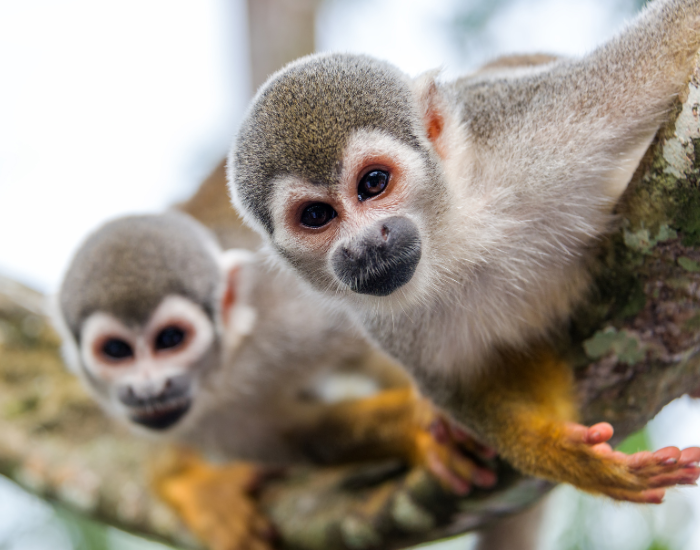
Jackie’s “river of monkeys” wasn’t an exaggeration. Squirrel monkeys form large groups, mixed-sex troops that range from around 25 members to as many as 500. Few primates tolerate crowds like that.
These aren’t chaotic mobs, though. Within a troop you’ll often find smaller cliques, and a big troop frequently splits into two groups as it feeds. Females with young cluster in one, while males drift loosely nearby. Watching two groups merge and split across a morning is like reading a live map of primate social evolution.
Big groups buy safety. More eyes spot a harpy eagle or a prowling jaguar before it strikes. For an animal this small, numbers are the first line of defense.
4. They “Talk” With 25 to 30 Distinct Calls
Coordinating hundreds of animals in dense forest takes serious communication. Squirrel monkeys use a vocal repertoire of roughly 25 to 30 calls, peeps, chucks, twitters, barks, and screams. Each carries a different message.
Some calls keep the troop spaced correctly as it feeds. Others are sharp warning sounds that name the threat, signaling whether danger comes from the ground or the sky. Mothers and infants keep in near-constant vocal contact, which is how a baby never loses the group in thick cover.
5. Urine Washing Is the Weirdest Habit You’ll Ever Love
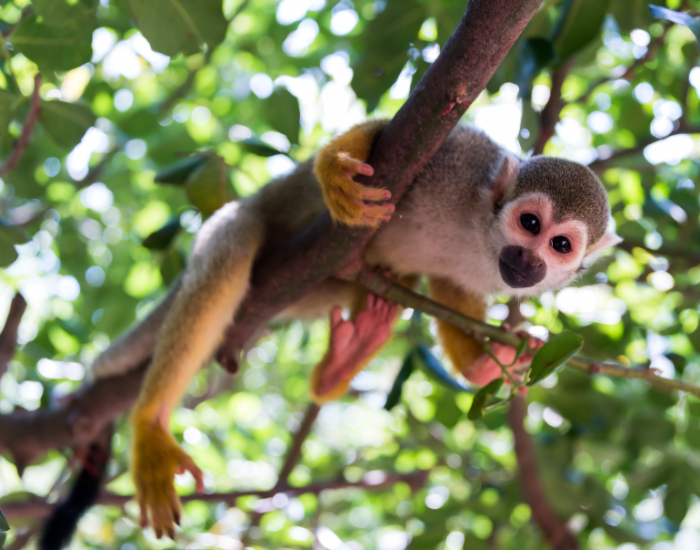
This one makes people wince, and I get it. Squirrel monkeys practice a behavior called urine washing. They urinate on their hands, then rub it across the soles of their feet.
It sounds gross, but it’s brilliant multitasking. The scent helps with marking territory and advertising reproductive status, so troop members constantly broadcast who they are. It may also help them display dominance during tense social moments.
There’s a practical bonus, too. In the sweltering tropics, that damp film aids evaporative cooling, and it gives their grip a little extra traction on smooth branches. One strange habit, several problems solved.
6. Where Squirrel Monkeys Live Shapes Everything About Them
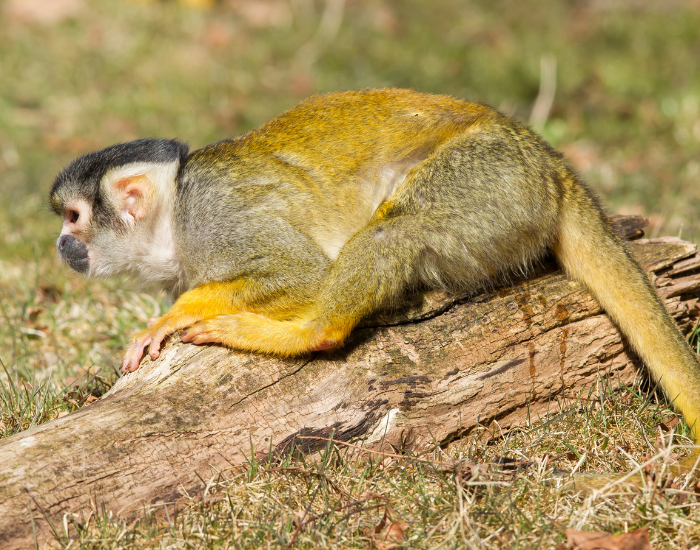
Squirrel monkeys live in warm, wet, green places across Central America and South America. They inhabit tropical forests, mangroves, swamp forests, and the floodplain forests that flank Amazon rivers. Humidity and heat suit them perfectly.
Crucially, they favor the edges. Squirrel monkeys thrive in secondary and disturbed forests, and they cluster near rivers where fruiting trees and insect life explode. A typical troop patrols a home range of roughly 150 to 250 hectares.
That flexibility is a double-edged sword. It helps them persist where fussier primates vanish. Yet it also pulls them straight into the path of expanding farms and roads, which is where the trouble starts.
7. They Eat Fruit, Bugs, and Whatever Else Works
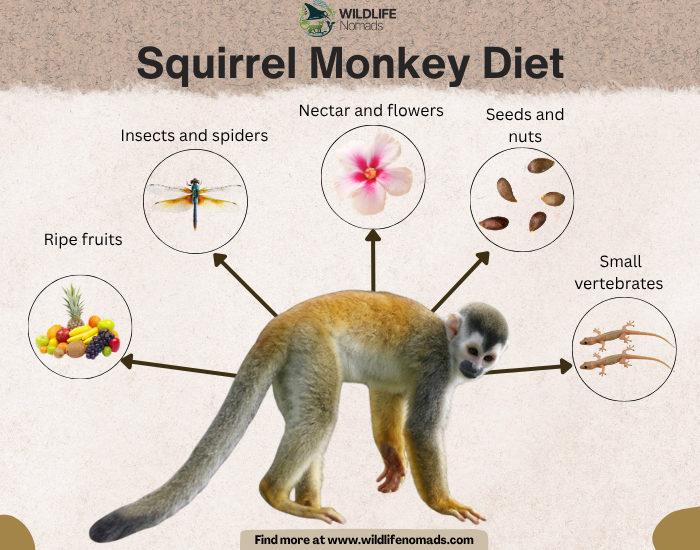
Squirrel monkeys are frugivores and insectivores, that’s the technical way of saying fruit and insects run the menu. They prefer small, soft, berry-like fruits under a centimeter wide. Alongside that, they hunt insects relentlessly.
They’ll happily improvise, too. On lean days they take seeds, leaves, and tree gum, and some populations raid nests for bird eggs, or snap up other small birds outright. Squirrel monkeys spend over half of every single day foraging for food.
Interestingly, they often forage right alongside capuchin monkeys. The larger capuchins flush insects as they crash through the canopy, and the squirrel monkeys cash in. It’s a loose partnership I never tire of watching.
8. Their Small Bodies Are Built for the Canopy
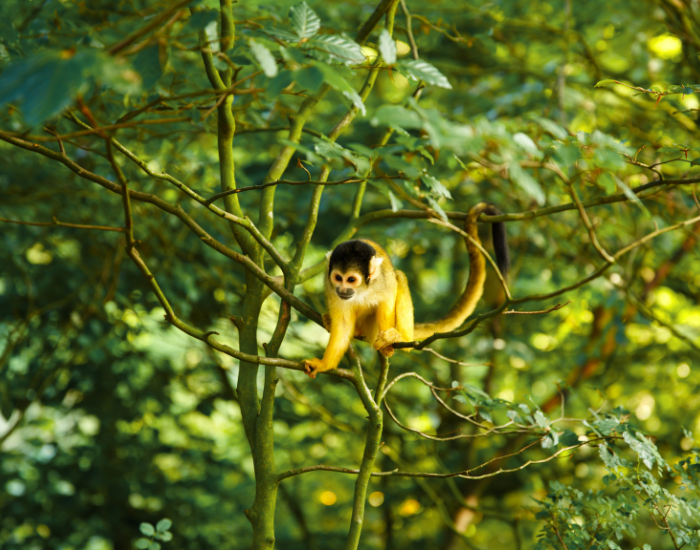
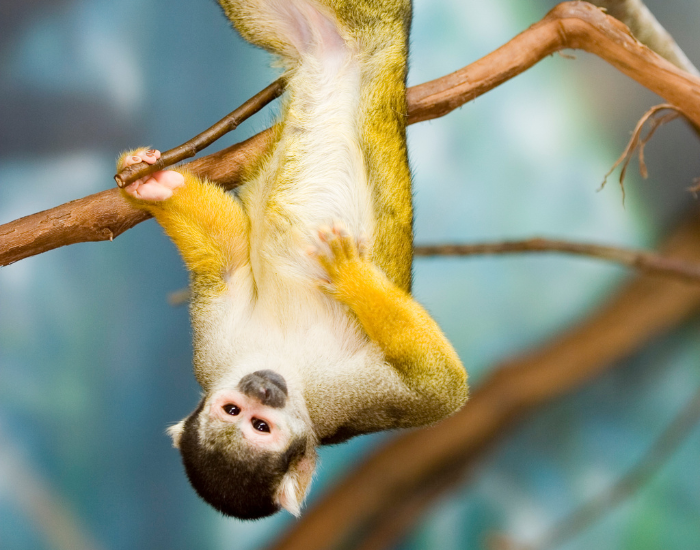
Let’s talk anatomy. A squirrel monkey’s body runs about 25 to 35 cm long, with a tail that’s actually longer, roughly 35 to 42 cm. That tail is non-prehensile, so it works as a balance pole rather than a fifth hand.
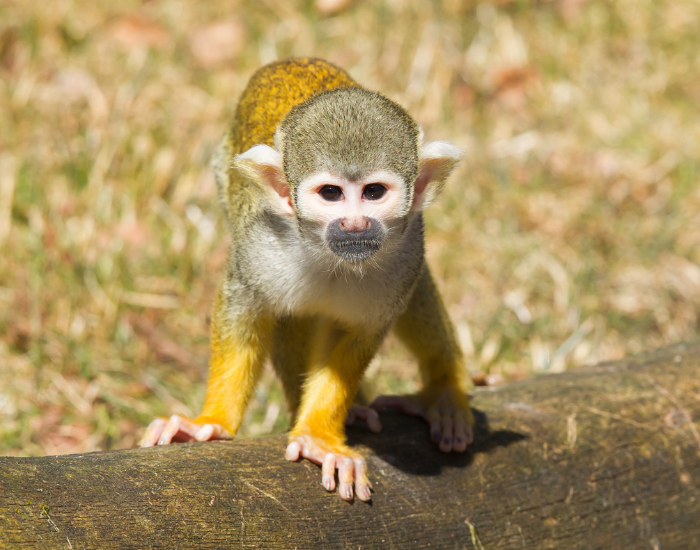
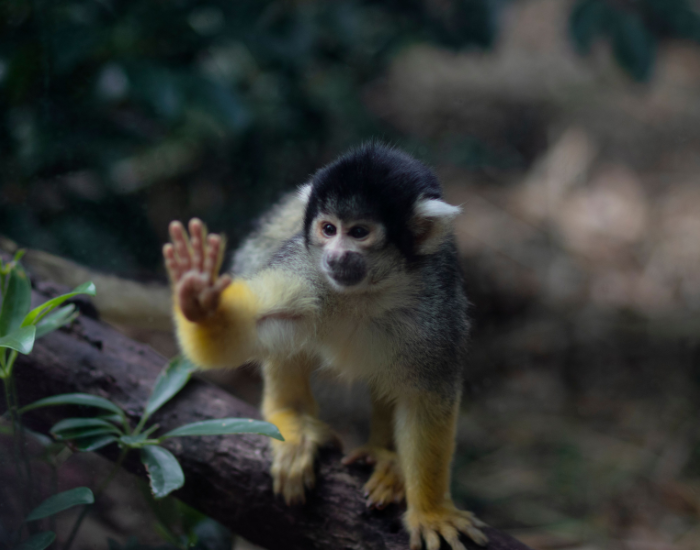
Male squirrel monkeys weigh between 750 and 1,100 grams, while female squirrel monkeys stay lighter at 500 to 750 grams. They’re agile and mainly quadrupedal, sprinting along branches with that squirrel-like ease. Short, close fur covers them in black and yellow-orange tones, with orange fur along the limbs and paler yellow fur on the underside.
Then there’s the face. A crisp mask of white fur rings each eye, framed by darker markings, which is why some people call them “death’s head” monkeys. In person, catching the light, they’re anything but grim.
9. Breeding Runs on the Rhythm of the Rains
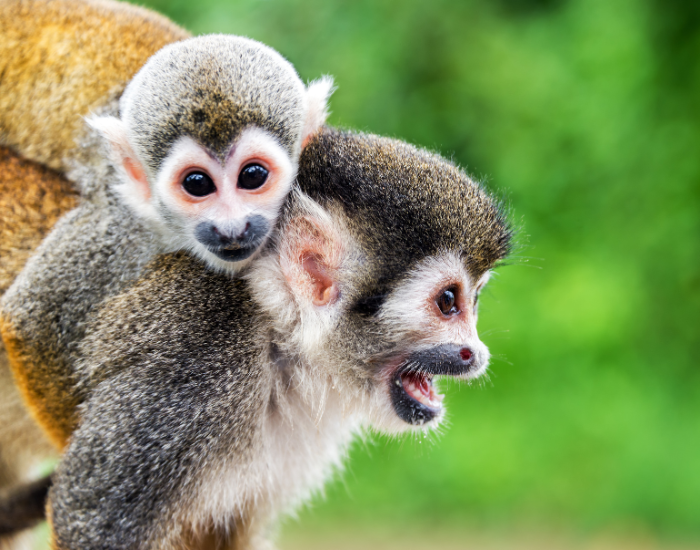
Squirrel monkey reproduction is tightly tied to the seasons. Females carry their young through a gestation period of 150 to 170 days and give birth during the rainy season, when fruit and insects peak. Newborns get weaned somewhere between 4 and 18 months.
The males put on a strange show first. Before the breeding season, sexually mature males pack on up to 20% of their body weight, bulking into a “fatted” condition that signals fitness. This burst of seasonal sexual dimorphism decides who mates and who waits.
One rare surprise closes this out. Squirrel monkeys rarely bear twins (roughly 1 in 150 pregnancies for cptive individuals) since raising two at once in the wild is a heavy ask.
10. Their Mating Patterns Turn the Troop Upside Down
The breeding season rewires squirrel monkey society for a few frantic weeks. Their mating patterns are seasonal and competitive, packed into the short window before the rains. Once females reach sexual maturity, they favor the largest, fattest males.
Female squirrel monkeys hold real power here. They choose, and the fatted males compete for that attention through size and display rather than outright violence. As a result, the biggest sexually mature males father most of the next generation.
By contrast, the rest of the year looks calm and cooperative. This seasonal switch between mellow and manic is one of the strangest rhythms I’ve watched in any primate.
11. Seven Species, Very Different Fates
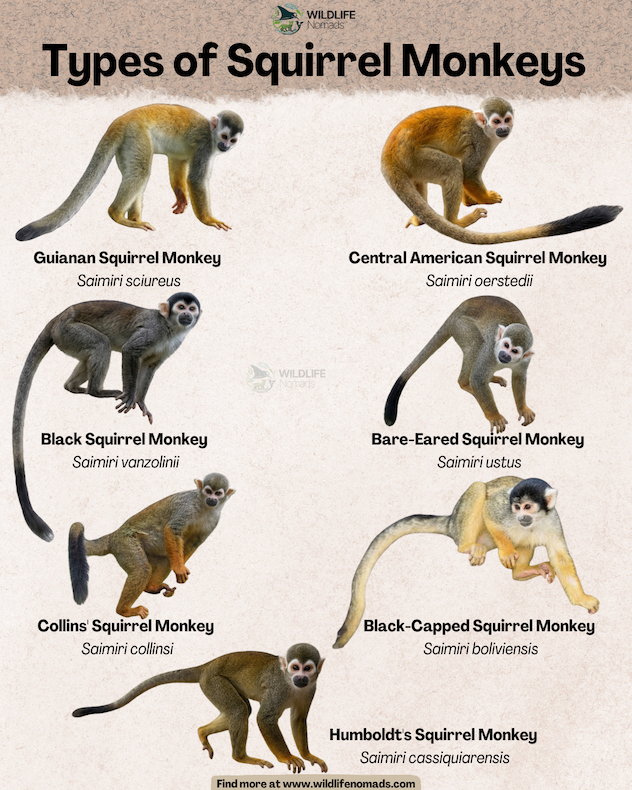
This is where being precise about squirrel monkey species stops being trivia. Recent morphological and mitochondrial phylogenetics revealed that the Amazon River itself splits eastern populations into two species — Saimiri sciureus and Saimiri collinsi. Rivers, it turns out, write the rules here.
Their conservation statuses diverge sharply. The Bolivian squirrel monkey and Collins’ squirrel monkey are both listed as least concern. The golden-backed squirrel monkey sits at near threatened, while the black-headed squirrel monkey and the black-crowned Central American squirrel monkey are both endangered. The bare-eared squirrel monkey and several other subspecies round out this surprisingly complicated family, and researchers still debate how to classify other squirrel monkeys within it.
Saimiri oerstedii, the only Central American squirrel monkey species, is exactly the one Jackie photographed in Costa Rica. Habitat loss, forest fragmentation, and the pet trade drove its squirrel monkey populations down by roughly 60% in under 30 years. Costa Rica’s shift toward conservation and ecotourism is a big reason those Manuel Antonio troops still exist.
12. They Quietly Shape How We Study Rainforests
Squirrel monkeys punch far above their weight in science. Because they’re abundant, wide-ranging, and sensitive to disturbance, researchers use them in ecological models that predict how whole forests respond to logging and climate change. Small primates like these make excellent early-warning indicators.
Their value goes beyond ecology. Decades of medical research relied on squirrel monkeys precisely because their biology sits close to ours. That history is ethically complicated, and it’s one more reason I’d rather see these animals thriving in the wild than living behind glass.
Frequently Asked Questions
No, and I say that as someone who adores them. Squirrel monkeys are wild, intensely social animals that need enormous troops, complex forest, and constant stimulation to stay healthy. In captivity they grow stressed, aggressive, and prone to disease. The pet trade has also gutted wild populations, so buying one directly harms the species.
In the exotic pet market, squirrel monkeys often sell for roughly $4,000 to $10,000, before permits, enclosures, and lifelong vet care. Beyond the cost, private ownership is illegal or tightly restricted in many places. The ethical answer is simpler: no price is worth removing one from the wild.
The name comes from behavior, not biology. Early observers watched these small primates dash along branches with long, bushy tails, moving exactly like tree squirrels. The resemblance stuck, even though squirrel monkeys are true primates related to capuchins.
First, they have the largest brain-to-body ratio of any primate. Second, they live in troops of up to 500. Third, they practice urine washing to mark territory and cool down. Fourth, males fatten up before the breeding season. Fifth, the Amazon River separates some species entirely.
Squirrel monkeys live across Central America and South America, from Costa Rica through the Amazon basin, in countries like Brazil, Peru, and French Guiana. They favor tropical forests, mangroves, and floodplain forests, usually near water.
Why These Tiny Monkeys Matter
Squirrel monkeys prove that intelligence and social complexity don’t require a large body — just a demanding world and the brainpower to navigate it. Their giant brains, sprawling troops, and river-drawn species boundaries make them one of the most quietly fascinating small primates alive.
So here’s my ask. If you find yourself in Costa Rica, Peru, or anywhere their forests still stand, go watch a wild troop move through the canopy. Skip the pet listings and the roadside photo ops entirely. Then come back and tell me what you saw in the comments — and if you loved this, dive into our full guide to the monkeys of Costa Rica next.
Squirrel Monkeys: Fact or Fiction? 🐒
Twelve statements about the Amazon’s tiny brainiac — six true, six myths. Can you tell them apart?
Fact or Fiction?
Find Incredible Experiences with Squirrel Monkeys!
This blog is reader-supported. When you buy experiences through links listed on this site, we may earn an affiliate commission.
References:
Blair, M. E., & Melnick, D. J. (2012). Scale-dependent effects of a heterogeneous landscape on genetic differentiation in the Central American squirrel monkey (Saimiri oerstedii). PLoS ONE, 7(8), e43027. https://www.ncbi.nlm.nih.gov/pmc/articles/PMC3419685/
Chiou, K. L., Pozzi, L., Lynch Alfaro, J. W., & Di Fiore, A. (2011). Pleistocene diversification of living squirrel monkeys (Saimiri spp.) inferred from complete mitochondrial genome sequences. Molecular Phylogenetics and Evolution, 59(3), 736–745. https://www.sciencedirect.com/science/article/abs/pii/S1055790311001643
Cropp, S., & Boinski, S. (2000). The Central American squirrel monkey (Saimiri oerstedii): Introduced hybrid or endemic species? Molecular Phylogenetics and Evolution, 16(3), 350–365. https://pubmed.ncbi.nlm.nih.gov/10991789/
Mercês, M. P., Lynch Alfaro, J. W., Ferreira, W. A. S., Harada, M. L., & Silva Júnior, J. S. (2015). Morphology and mitochondrial phylogenetics reveal that the Amazon River separates two eastern squirrel monkey species: Saimiri sciureus and S. collinsi. Molecular Phylogenetics and Evolution, 82, 426–435. https://pubmed.ncbi.nlm.nih.gov/25451802/
Smith, R. L., et al., (1980). Urine as a communicator in a New World primate, Saimiri sciureus. Animal Learning & Behavior. https://link.springer.com/article/10.3758/BF03199636