
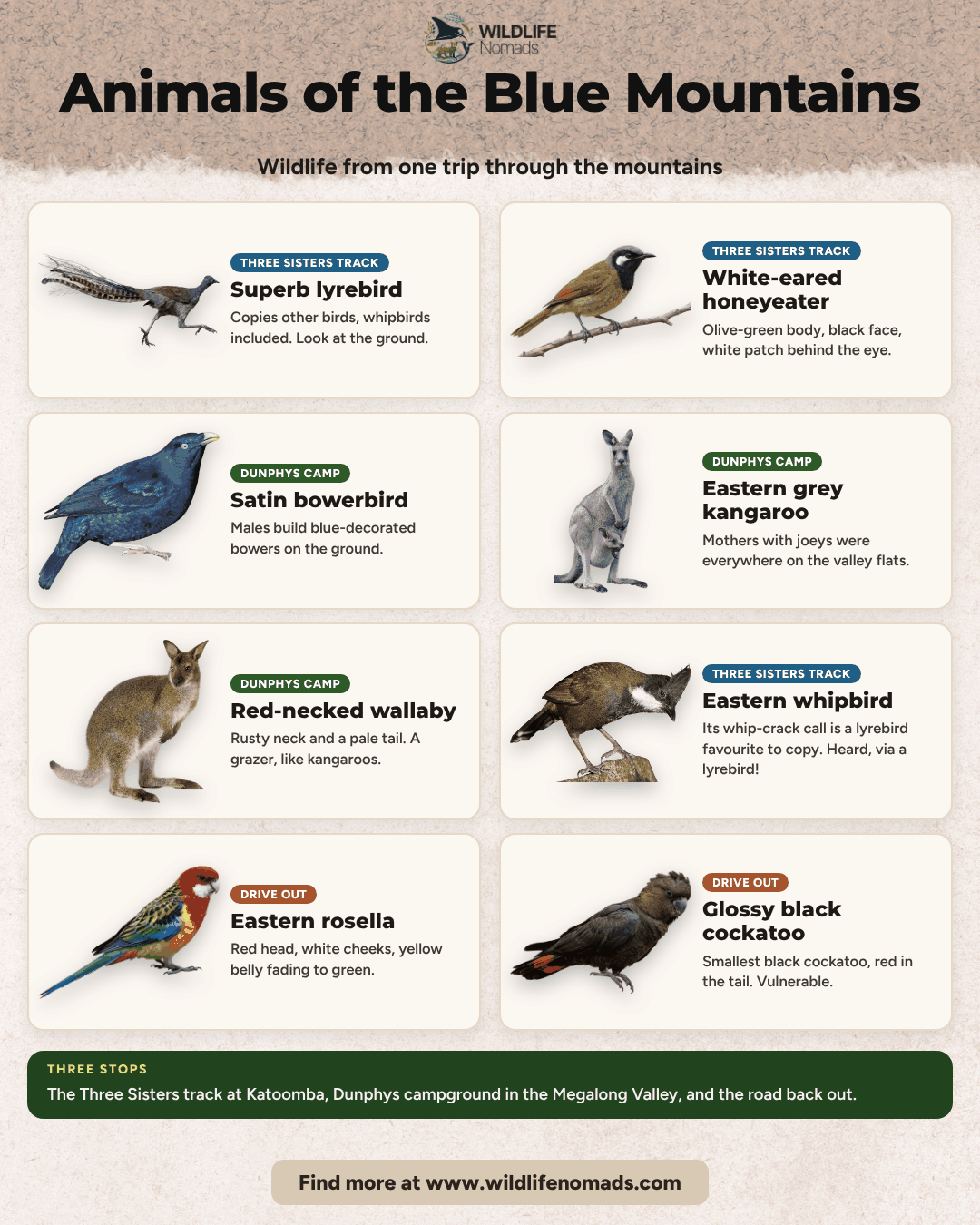
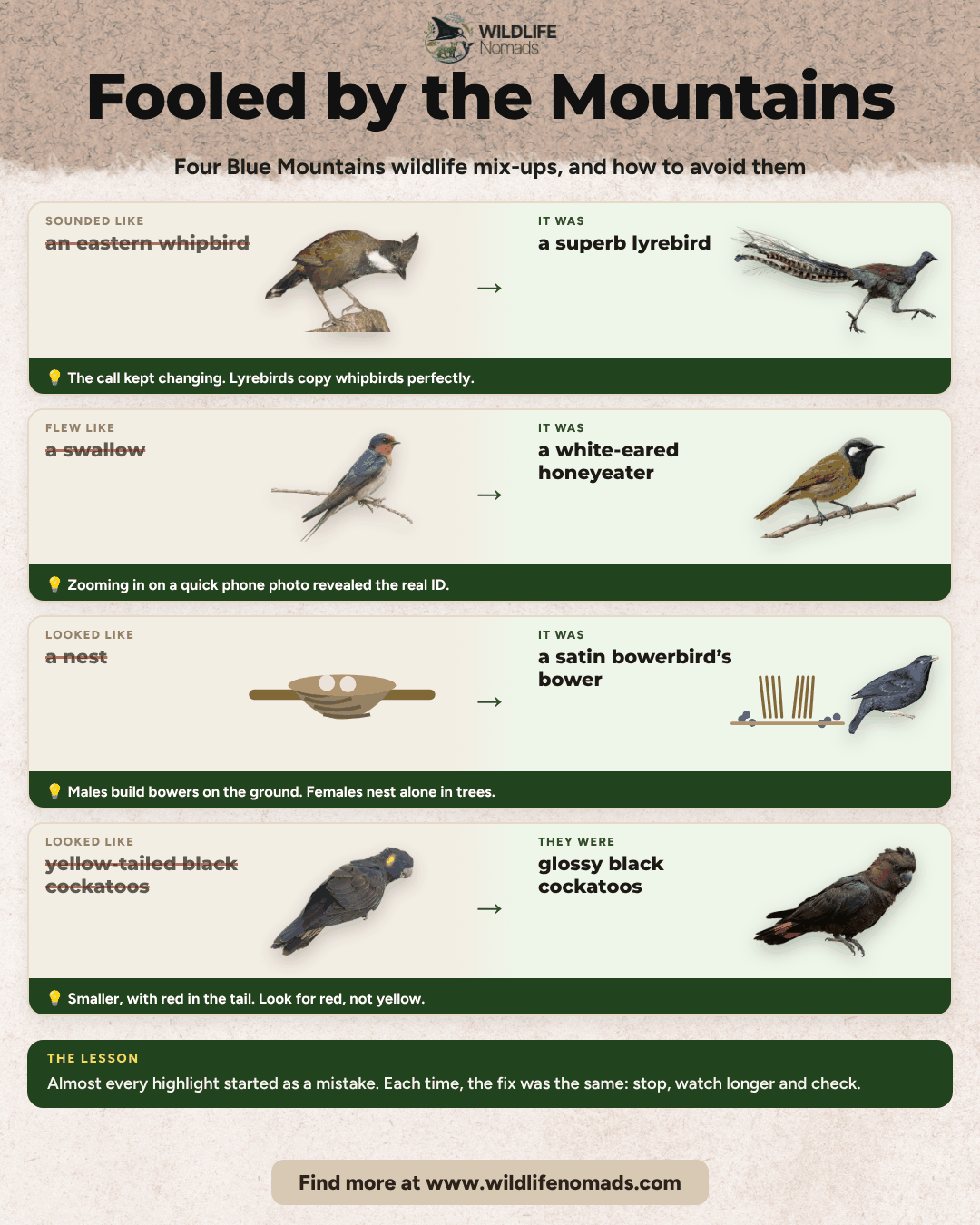
This was my third trip to the Blue Mountains, and they surprised once more. A lyrebird sounded like a whipbird. A honeyeater flew like a swallow. A bowerbird’s display looked like a nest. Two black birds hid a flash of red.
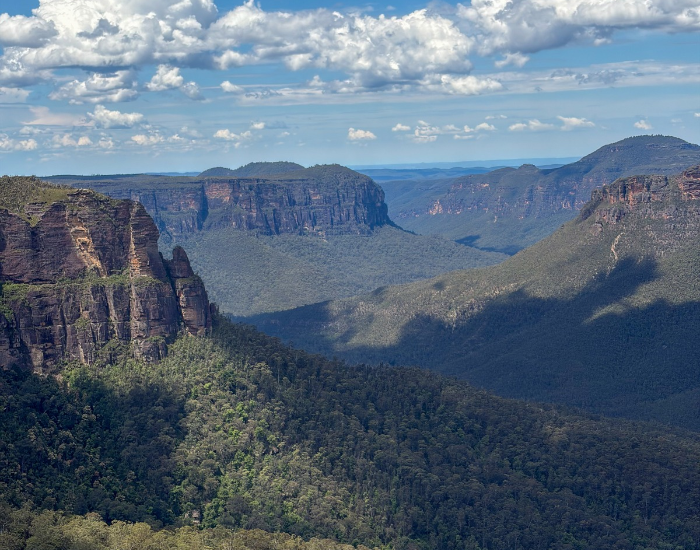
We left Sydney on the next leg of our Australia lap and spent four nights in the Blue Mountains. The first night was at a quiet camp near Katoomba, close to the Three Sisters. The next three were at Dunphys campground, deep in the Megalong Valley.
These are my notes on Blue Mountains wildlife from that stretch. They include every mistake I made along the way, because each one taught me something.
A Lyrebird That Sounded Like Everyone Else
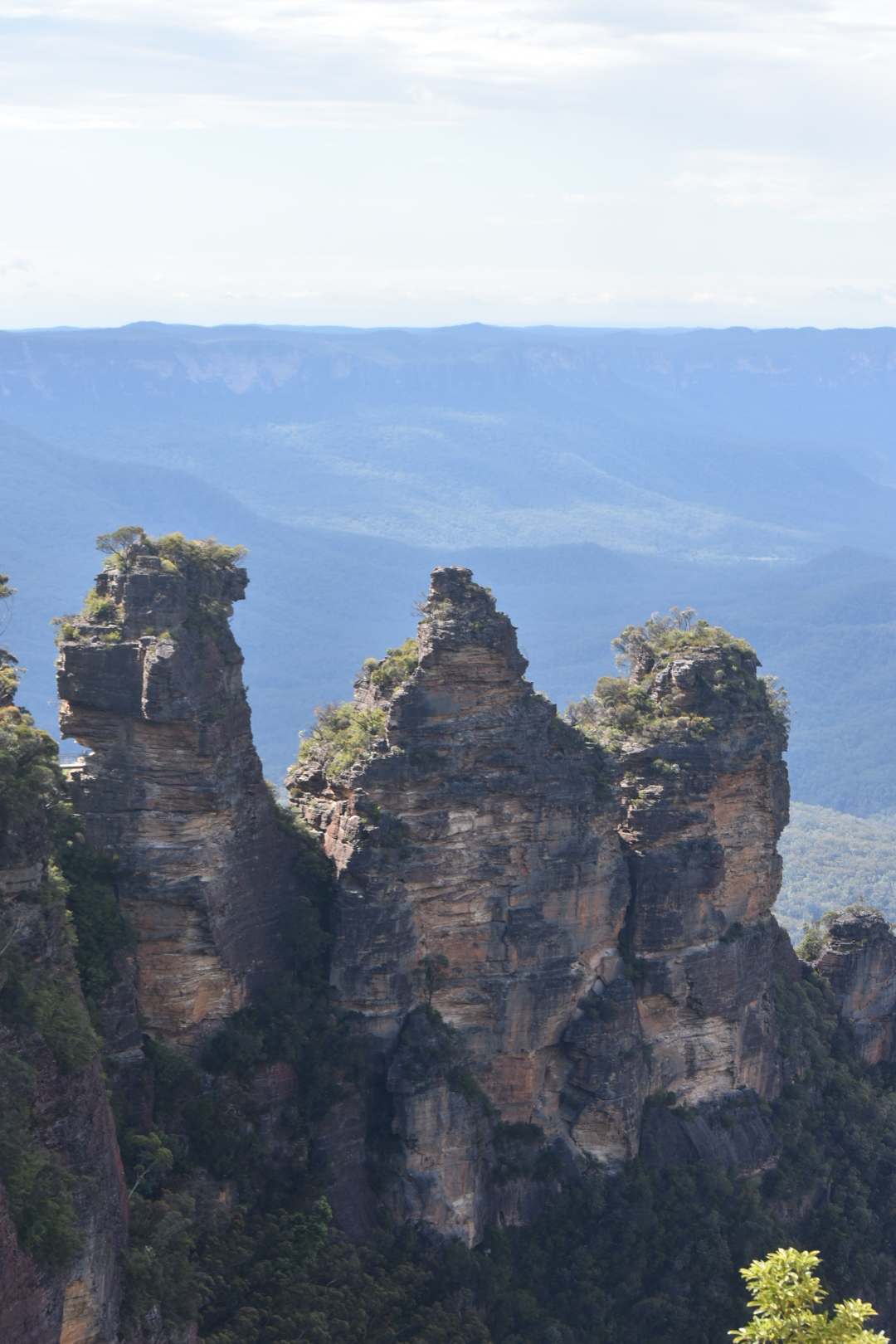
On the Three Sisters walking track, a couple of people had stopped to stare into the scrub. Honestly, I would have walked straight past. The bush was full of calls, and none of them sounded like one bird.
Then I saw what they saw: a superb lyrebird (Menura novaehollandiae). It was my second wild lyrebird of the lap. The first one turned up at Gloucester River, during my failed platypus search at Barrington Tops. This time, only by standing still and watching closely could I make out the long tail.
It was loud. Really loud. It ran through an eastern whipbird’s whip-crack, then a string of birds I couldn’t name. You would never guess a single bird made all of it.
That is the whole trick of lyrebird song. Superb lyrebirds copy other species so accurately that even the original birds can’t always tell the difference. Whipbirds are one of their favourite models.
The Blue Mountains are also a lyrebird research site. In the Jamison Valley, below the cliffs near Katoomba, researchers recorded nesting females mimicking other birds too. So the famous mimicry isn’t only a male show.
My tip: if a whipbird keeps changing its mind, stop. Look at the ground, not the trees.
Not a Swallow
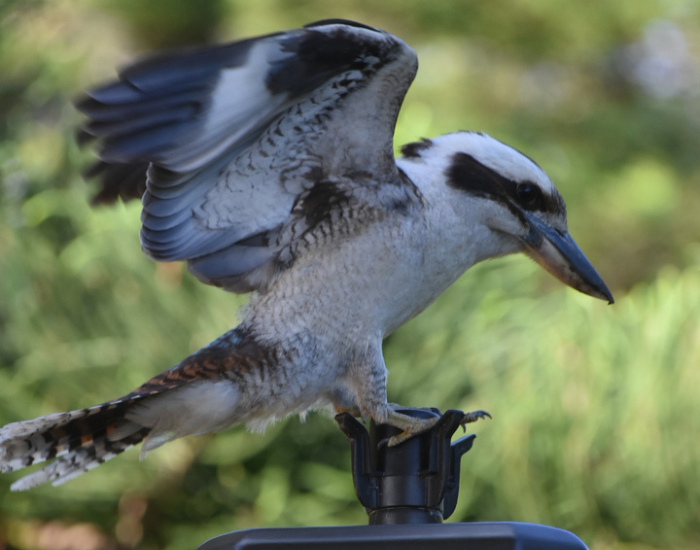
On the same track, a small bird flew past and I grabbed a quick phone photo. The way it flew made me think it was a swallow. I didn’t think about it again that day.
Later I zoomed in and uploaded the photo to iNaturalist. It wasn’t a swallow at all. It was a white-eared honeyeater (Nesoptilotis leucotis), a brand-new species for my lap list.
Up close, it’s hard to mistake. Adults have an olive-green body, a black face and throat, and a clean white patch behind the eye. They like eucalypt forest with a thick shrub layer.
Honeyeaters have followed me around this whole trip, from the blue-faced honeyeater at our first stop onwards. This one taught me a simple lesson. A bad phone photo is still data, so take it anyway.
Kangaroo Flats at Dunphys
Dunphys campground sits at the end of the Megalong Valley road, in Blue Mountains National Park. To get there, you drive through private farmland first. Kangaroos and wallabies lined the whole way in.
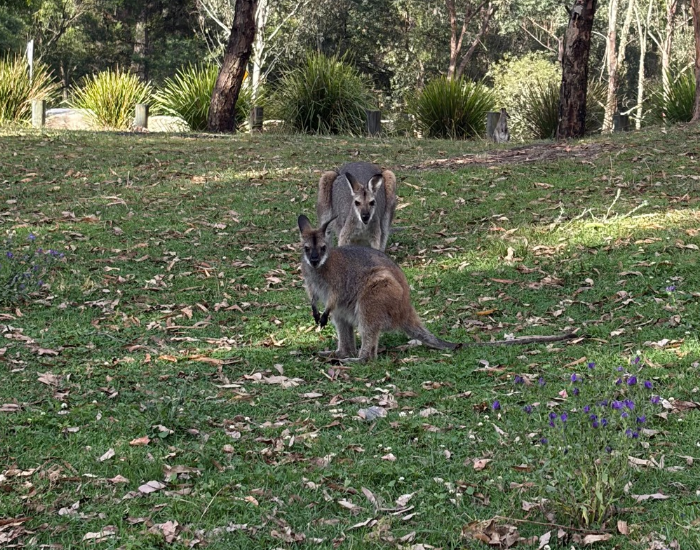
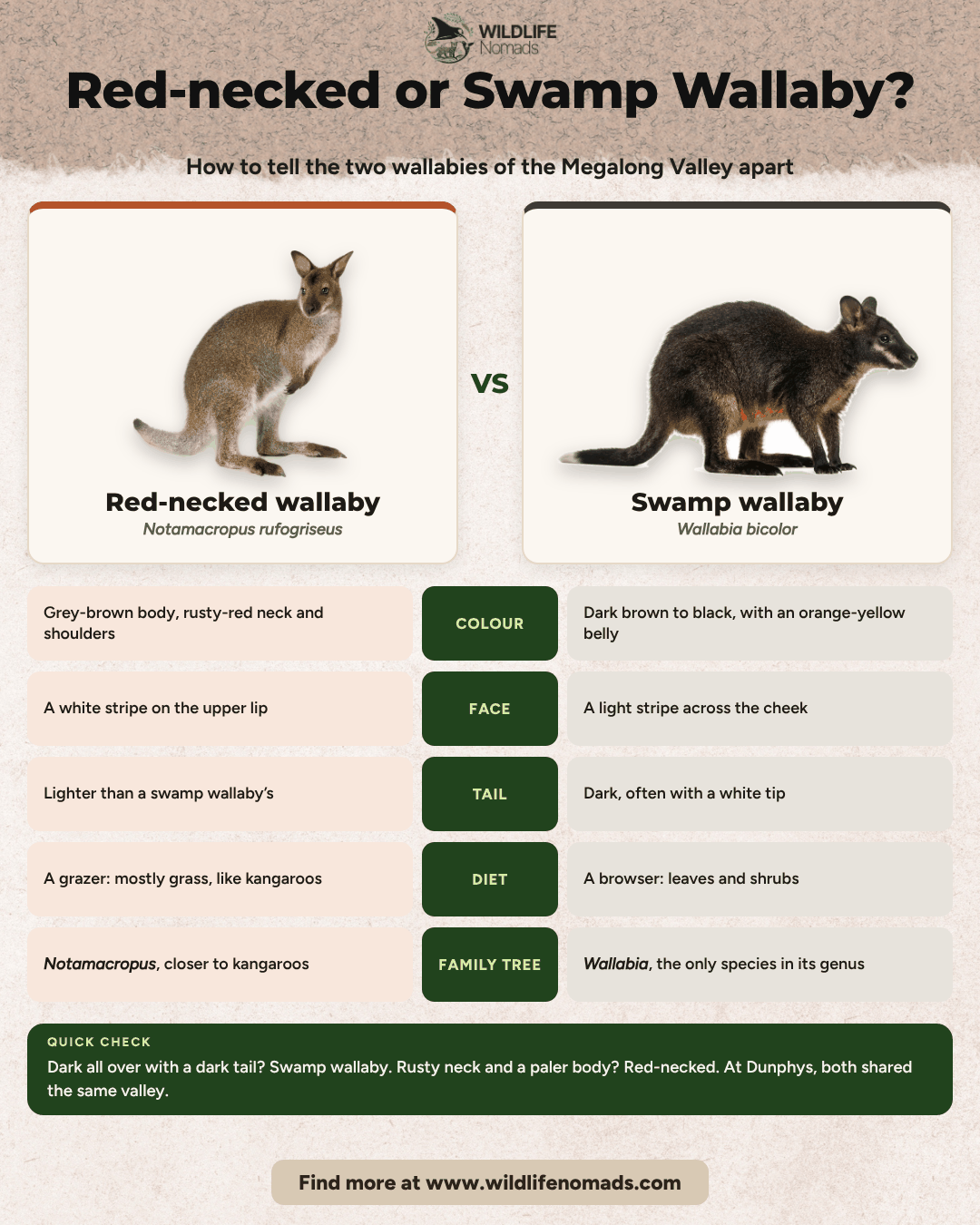
We’ve camped with plenty of kangaroos on this trip, and plenty of wallabies at places like Gloucester. Dunphys was the first camp where I saw so many of both together. Eastern grey kangaroos were everywhere, especially mothers with joeys. Swamp wallabies and red-necked wallabies moved among them.
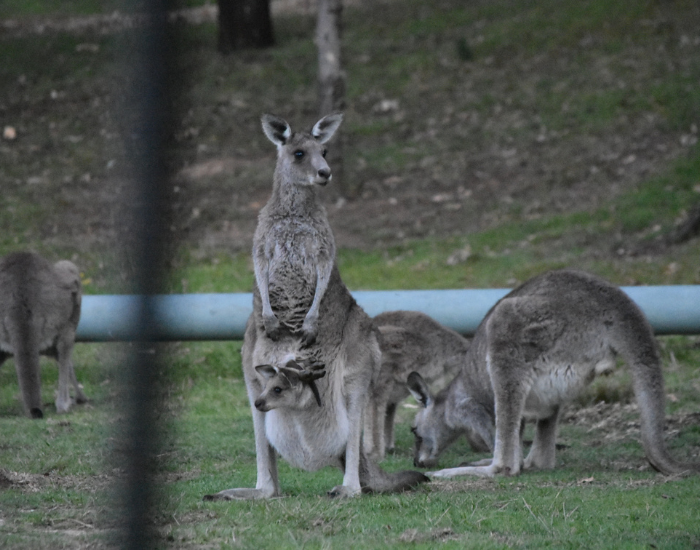
It looks like one big mob, but these animals live quite different lives. Red-necked wallabies (Notamacropus rufogriseus) are mainly grazers, like kangaroos. Swamp wallabies (Wallabia bicolor) are browsers, with teeth suited to leaves and shrubs.
Swamp wallabies even sit in their own genus. In fact, red-necked wallabies are closer relatives of kangaroos than of swamp wallabies. Different diets are one reason so many of them can share the same valley.
To tell the two wallabies apart, check the colour. Red-necked wallabies have a rusty neck and a pale tail. Swamp wallabies are much darker overall, with a dark tail.
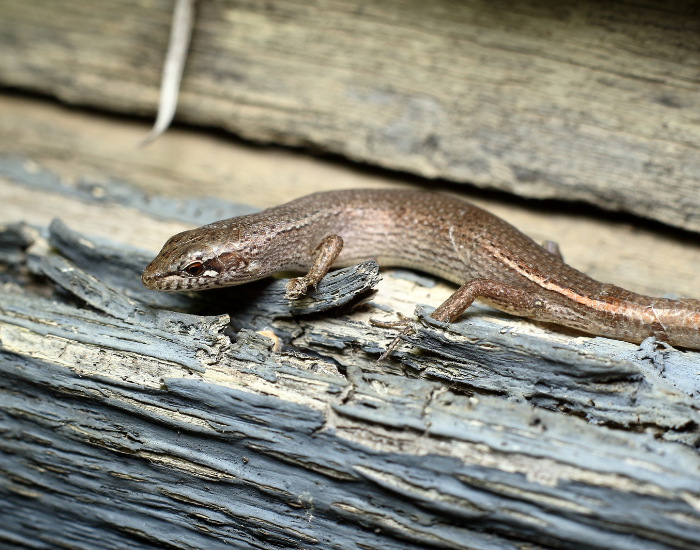
A short trail to a lookout starts right next to the campground. On it, we found a garden skink (Lampropholis guichenoti). It’s one of the most common lizards in south-eastern Australia, yet it was a new species for my lap list.
Sulphur-crested cockatoos and magpies called around us the whole way. And there were spiders everywhere.
The Blue Things by the Bush
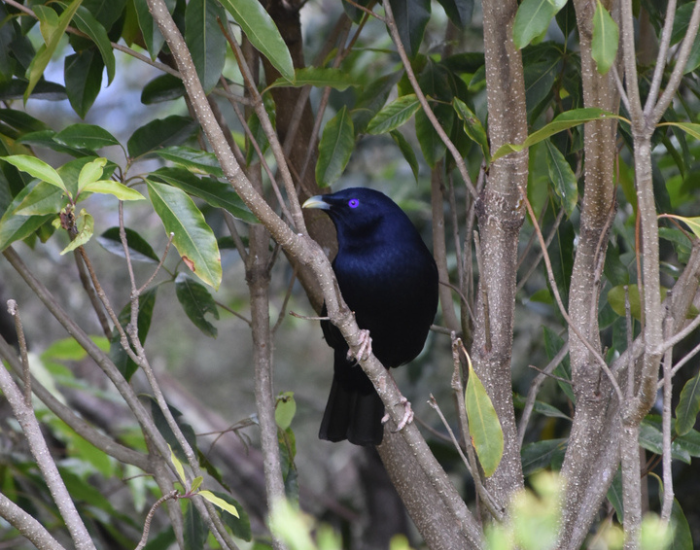
We always try to pick a campsite that faces the bush. At Dunphys, that paid off. A satin bowerbird (Ptilonorhynchus violaceus) visited every day and came very close to camp. It gave me my best satin bowerbird photo so far.
On our last day, I finally worked out where it kept going. Close to our site, a patch of ground was full of small blue objects. My first thought was that I’d found its nest.
However, bowerbirds don’t work that way. It was a bower, not a nest. Male satin bowerbirds build an avenue of twigs on the ground. Then they decorate it, mostly with blue things: feathers, flowers, bottle tops, even drinking straws.
The bower is a stage for courtship. When a female visits, the male struts, bows and quivers his wings while he calls. If she’s impressed, they mate in the avenue. Then she leaves and builds a real nest on her own, in a tree or bush.
The timing fits, too. Satin bowerbirds breed from about September to February, so late November is prime bower season.
One more twist catches many people out. Adult males are glossy blue-black, but they take about seven years to get that plumage. Until then, young males look green like the females. The bird at our camp was glossy blue-black, so he was a fully adult male. He was very likely the owner of that bower.
Two Black Birds and a Flash of Red
On the drive out, a pair of eastern rosellas (Platycercus eximius) flew across the road. They’re an easy bird to name: red head, white cheeks, and a yellow belly that turns green towards the tail.
Then two black birds flew over. Most black cockatoos I see are yellow-tailed black cockatoos. But I caught a spot of red, so I stopped the car in the middle of the road to look.
They were glossy black cockatoos (Calyptorhynchus lathami). They were clearly smaller than the yellow-tailed blacks I know. One had yellow on its face. Sadly, I couldn’t get a photo.
Size and red are the giveaways. Glossies are the smallest of Australia’s black cockatoos, at about 48 cm long. Males have plain bright red tail panels. Females show yellow patches on the head and neck, with barred orange-red tails.
So the yellow face I saw points to a female. Be careful, though. Yellow-tailed black cockatoos have a yellow cheek patch too. Red in the tail tells you more than yellow on the face.
Glossies are also extremely fussy eaters. They feed almost entirely on she-oak seeds, cracking the woody cones with that heavy bill. Clearing of she-oak woodland has hit them hard in many areas.
This was the highlight of the whole camp. The south-eastern glossy black cockatoo is listed as Vulnerable under national law since 2022, and in NSW since 2023. You can see more species in the same position in our endangered animals explorer.
FAQs About Blue Mountains Wildlife
Superb lyrebirds live in the wet forests and gullies of Blue Mountains National Park. I saw one beside the Three Sisters walking track near Katoomba. Listen for loud, fast-changing birdsong coming from the ground, often including whipbird calls.
No. The male builds the bower on the ground and decorates it with blue objects to attract females. After mating, the female builds a separate nest in a tree or bush and raises the chicks alone.
The south-eastern glossy black cockatoo is listed as Vulnerable under national law and in NSW. It depends almost entirely on she-oak seeds, so loss of she-oak woodland is a major threat.
Slow Down and Look Again
Three visits in, the Blue Mountains still taught me something new. Almost every highlight started as a mistake: the wrong bird, the wrong sound, the wrong idea of a nest. Each time, the fix was the same. I stopped, watched longer and checked.
If you visit, walk the Three Sisters track slowly and listen. Pick a campsite that faces the bush. And keep your eyes on the sky as you drive out. You can follow the rest of the trip as it happens, or see the best places to spot wildlife in Sydney, where this leg began.
References:
Australian Museum. (n.d.). Satin Bowerbird. https://australian.museum/learn/animals/birds/satin-bowerbird/
BirdLife Australia. (n.d.). Glossy Black-Cockatoo. https://birdlife.org.au/bird-profile/glossy-black-cockatoo
Dalziell, A. H., & Welbergen, J. A. (2016). Elaborate mimetic vocal displays by female superb lyrebirds. Frontiers in Ecology and Evolution, 4, 34. https://doi.org/10.3389/fevo.2016.00034
NSW Threatened Species Scientific Committee. (2023). Calyptorhynchus lathami lathami (South-eastern Glossy Black-Cockatoo): Vulnerable species listing, final determination. NSW Government.
Sprent, J. A., & McArthur, C. (2002). Diet and diet selection of two species in the macropodid browser–grazer continuum: Do they eat what they ‘should’? Australian Journal of Zoology, 50(2), 183–192. https://doi.org/10.1071/ZO01043