
Wildlife Nomads · Play · Deforestation Lab
What Is Deforestation? Clear a Rainforest and See What Happens
Deforestation is the clearing of forest to use the land for something else, such as farms, mines or towns. Clear a tropical rainforest patch by patch and watch the animals, carbon, rain and soil respond. Then sort the causes, explore the numbers and match animals to their forests.
By Cesar Medina, conservation biologist · 6 interactive stops

What is deforestation?
Deforestation is the clearing of forest so the land can be used for something else. Most often, that means cattle pasture, crops or plantations. Mines, roads and towns also replace forest.
Forests cover about 4.14 billion hectares, or 32% of the world’s land. They hold much of the planet’s land wildlife. They also store carbon, recycle water and protect soil.
When people cut the trees and change the land use, those services disappear too. Try it yourself in the Deforestation Lab above.
Deforestation is one form of habitat loss. For the bigger picture across all ecosystems, read my guide to habitat destruction.
Deforestation, forest degradation and tree cover loss
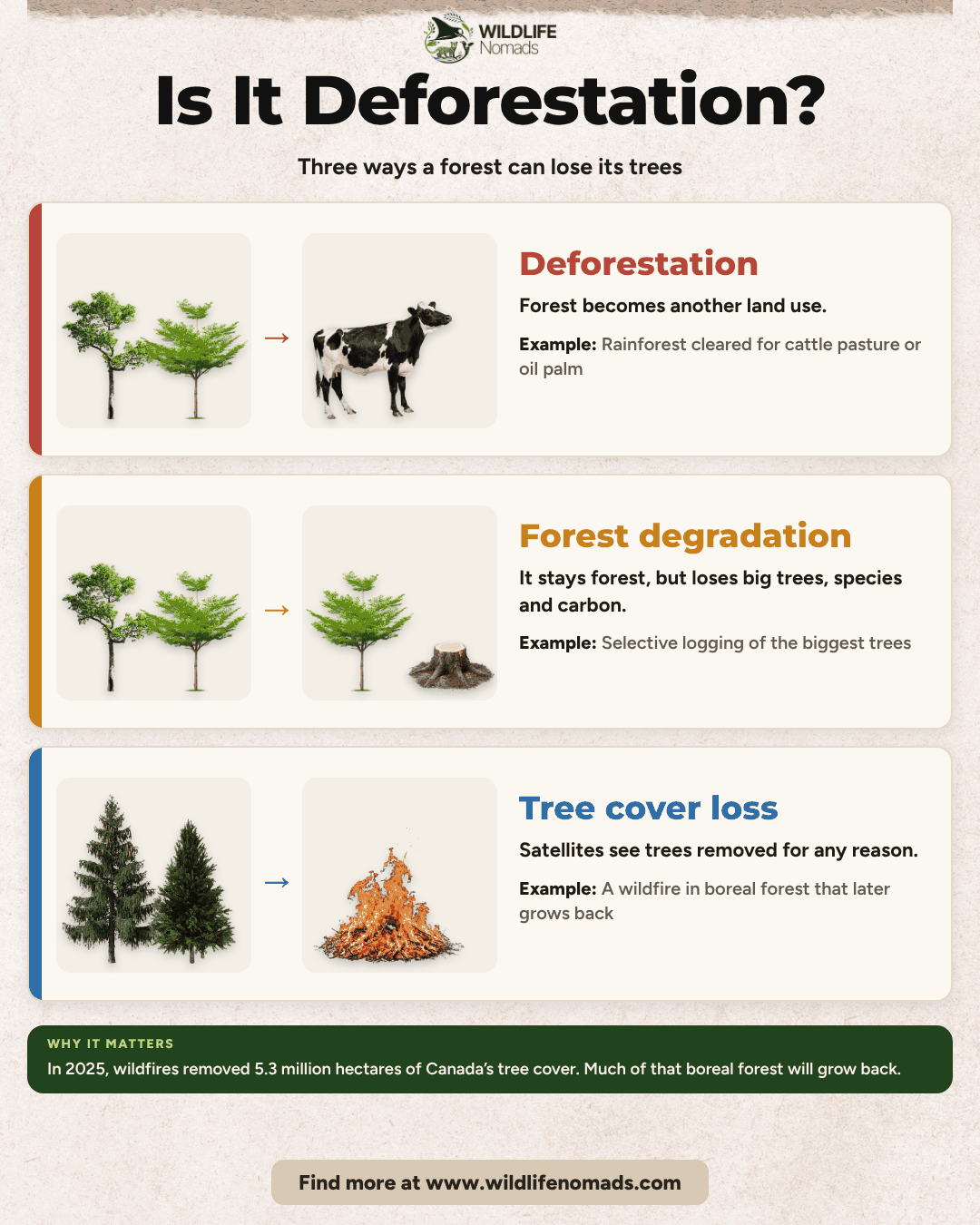
News stories often mix up these terms. Scientists use each one for a different kind of change.
| Term | What it means | Example |
|---|---|---|
| Deforestation | Forest becomes another land use. | Rainforest cleared for cattle pasture or oil palm |
| Forest degradation | The land stays forest, but it loses trees, species or carbon. | Selective logging of the biggest trees |
| Tree cover loss | Satellites detect trees removed for any reason. | Wildfire in boreal forest, or a timber harvest that is replanted |
The difference matters. In 2025, Canada lost 5.3 million hectares of tree cover to wildfires. Much of that burned boreal forest will grow back, so it is tree cover loss rather than deforestation.
What causes deforestation?
A major 2022 study found that agriculture drove 90 to 99% of tropical deforestation from 2011 to 2015. Surprisingly, only 45 to 65% of that land became productive farmland within a few years.
The biggest driver in the Amazon. Ranchers clear forest and sow grass for beef cattle.
Soy fields have spread across cleared land in South America. Much of it feeds livestock.
Indonesia and Malaysia grow most of the world’s oil palm, often on former lowland rainforest.
Industrial and illegal logging degrade forests. Their roads open the way for clearing, hunting and fire.
People burn land to clear it, and drought helps fires spread. Fire caused 42% of global tree cover loss in 2025.
Mines, dams, roads and urban development clear smaller areas but push into new frontiers.
I have seen this first-hand. From a scooter in Sumatra, the oil palm plantations were easy to spot. Natural forest is layered and full of life. A plantation is neat rows of a single tree.
Australia is no exception. Driving between two campgrounds in Barrington Tops, I crossed about an hour and a half of cleared cattle country. In Queensland, about 86% of clearing in 2023–24 was for pasture.
Many everyday commodities produced on cleared land end up in our homes. These include beef, soy, palm oil, timber and paper products.
Where is deforestation happening?
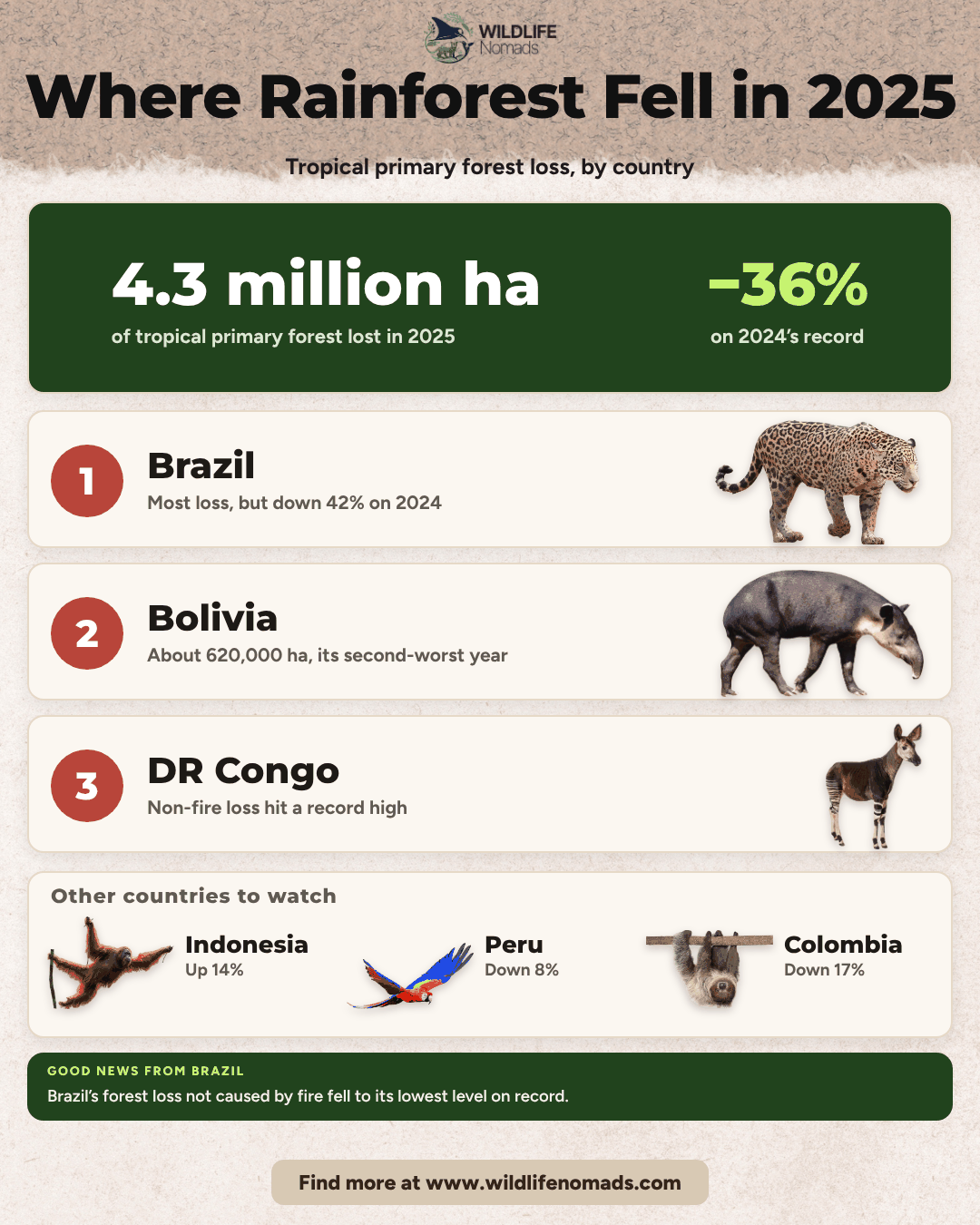
Most deforestation today happens in tropical forests. In 2025, the tropics lost 4.3 million hectares of primary forest. That was 36% less than the record, fire-fuelled loss of 2024.
- South America: Brazil still lost the most tropical primary forest, but its loss fell 42% from 2024. Bolivia ranked second, with about 620,000 hectares.
- Central Africa: the Democratic Republic of the Congo had the third-highest loss.
- Southeast Asia: Indonesia’s loss rose 14%, though it stayed below its mid-2010s highs.
Temperate countries cleared much of their forest long ago. Western Europe lost most of its original forest centuries before satellites existed. Today, Europe is gaining naturally regenerating forest.
Effects of deforestation
Climate change and carbon emissions
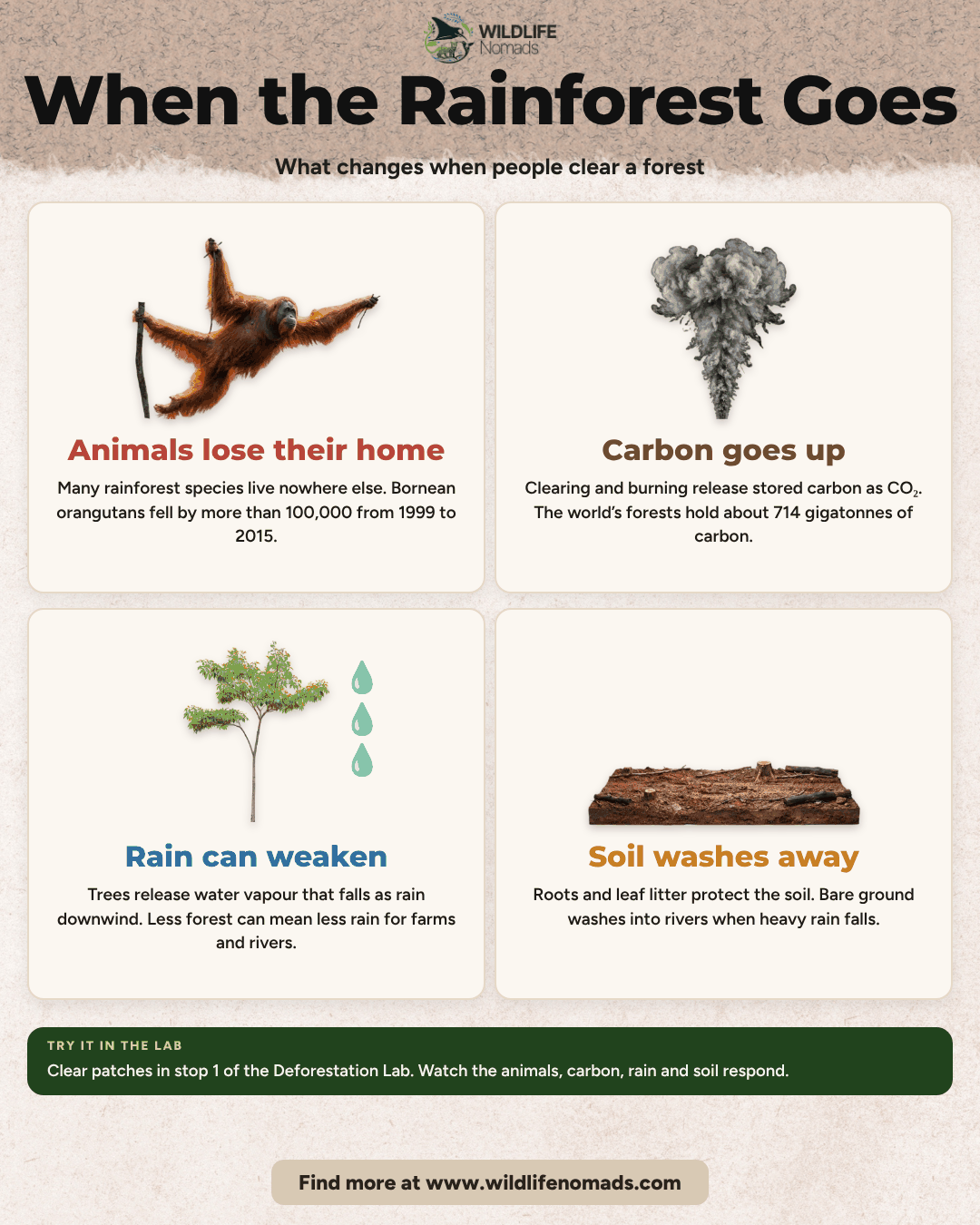
Forests store about 714 gigatonnes of carbon, according to the FAO. Growing trees sequester carbon dioxide from the air, and forest soils store carbon too.
When people clear or burn forests, much of that stored carbon returns to the air as carbon dioxide. Burning fossil fuels is the largest source of greenhouse gases. Deforestation and other land use change add more on top.
The water cycle
Trees pull water from the soil and release it as vapour through their leaves. That atmospheric moisture forms clouds and falls again as rain, often far downwind.
In the Amazon rainforest, this recycling helps carry rain deep into the continent. Clear enough forest, and the rain that farms and rivers rely on can weaken.
Soil erosion
Roots hold soil in place, and leaf litter protects it from heavy rain. Once the trees go, bare soil washes into rivers more easily. Deforested areas often lose the soil’s ability to hold water and nutrients.
Biodiversity loss
Tropical rainforests hold a huge share of the world’s land species. When forest falls, many species lose their only suitable habitat.
A 2018 study found that global demand for natural resources eliminated more than 100,000 Bornean orangutans. Explore more rainforest animals and why biodiversity matters.
Zoonotic diseases
Forest loss can also change disease risk. In New York state, researchers found more infected tick nymphs in small forest fragments than in larger ones. That raised the local risk of Lyme disease.
Is deforestation getting better or worse?
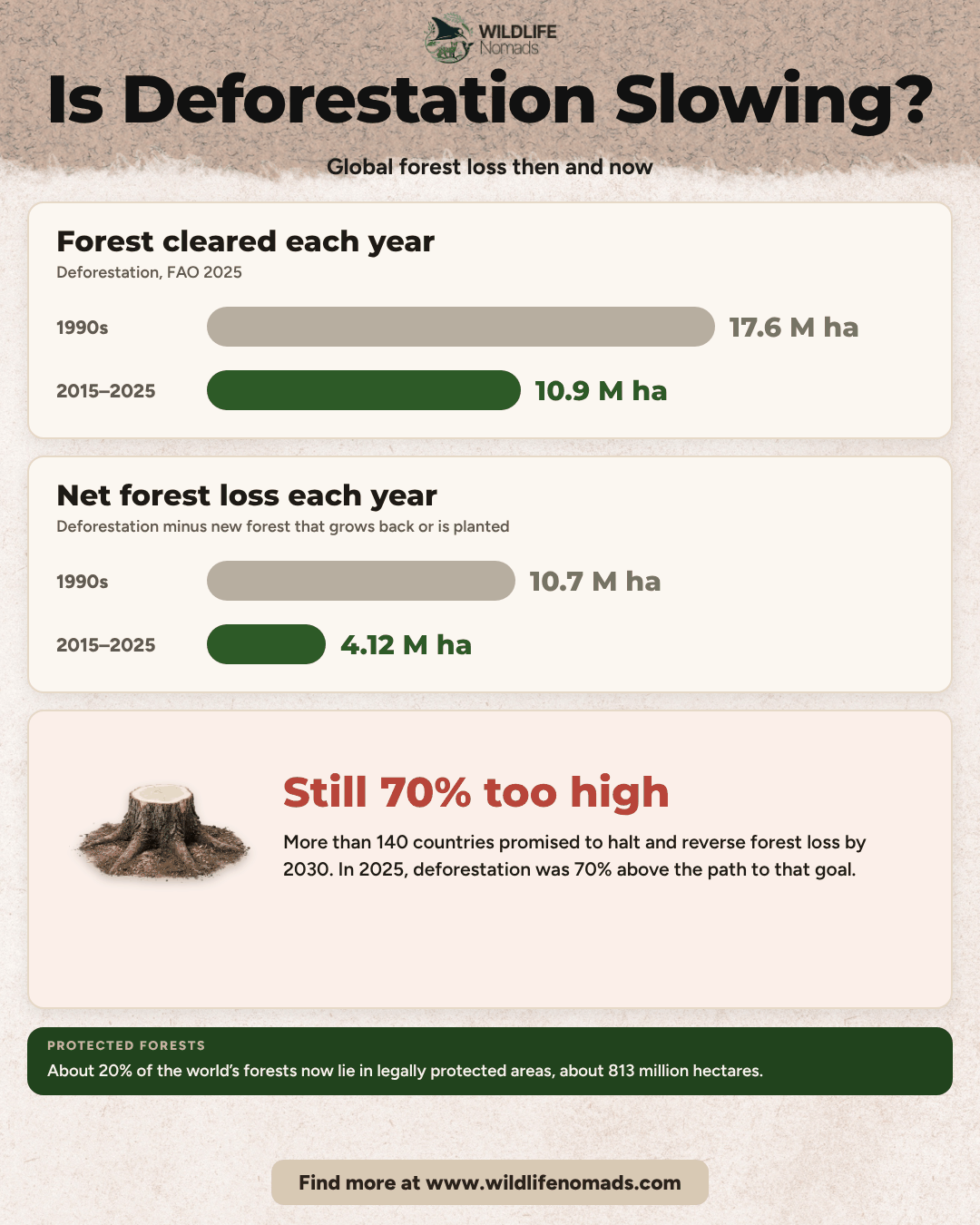
Global deforestation rates are falling. The FAO estimates deforestation reached 17.6 million hectares a year in the 1990s. In 2015–2025, it slowed to 10.9 million hectares a year.
Net forest loss fell even faster, from 10.7 to 4.12 million hectares a year. Net loss subtracts new forest that grows back or is planted.
But deforestation continues. More than 140 countries pledged to halt and reverse forest loss by 2030. In 2025, deforestation was still 70% higher than the path needed to meet that goal.
How can we stop deforestation?
- Protect forests: about 20% of the world’s forests now lie in legally protected areas.
- Choose certified products: look for the Forest Stewardship Council (FSC) label on wood and paper products.
- Cut demand: eating less beef and buying certified palm oil and soy reduce pressure on forests.
- Restore forests: replanting trees helps, but old-growth forests hold more carbon and species than young ones.
- Stop illegal logging: enforcement and satellite monitoring help catch illegal clearing early.
See how human choices add up in my Ecological Footprint Calculator. Then explore life from floor to canopy in Rainforest Layers.
Try it: clear four patches in stop 1, then replant them. Notice how slowly the animals return.
Free mini guide
Take the forest story with you
All four infographics in one printable PDF: what counts as deforestation, what we lose, where forests fell in 2025 and whether it is slowing, plus a quick quiz.
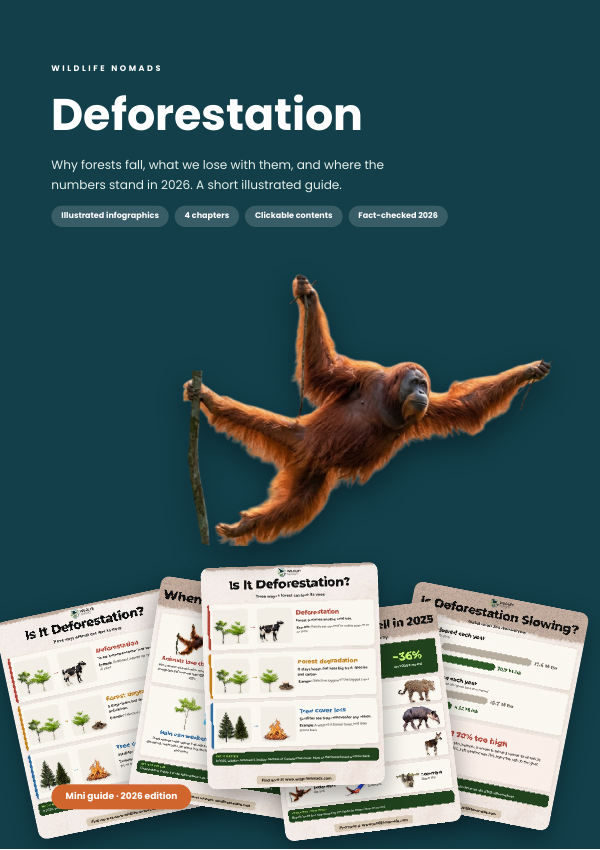 Free PDF · 14 pagesDeforestation Mini GuideOrangutans, jaguars, carbon and the 2025 numbers, ready to print for home or class.Download free →
Deforestation FAQ
Deforestation is the clearing of forest so the land can be used for something else. That usually means cattle pasture, crops or plantations, but also mines, roads and towns.
Agriculture drove 90 to 99% of tropical deforestation from 2011 to 2015. Cattle ranching, soy and palm oil lead the list. Logging, fire, mining and urban development add to the pressure.
Forests store carbon in trees and soil. Clearing and burning them releases that carbon as carbon dioxide, a greenhouse gas. Fewer trees also absorb less carbon dioxide in future.
The FAO estimates that 10.9 million hectares of forest were deforested each year from 2015 to 2025. In 2025 alone, the tropics lost 4.3 million hectares of primary forest.
Deforestation turns forest into another land use, such as farmland. Forest degradation leaves the land as forest but damages it, for example through selective logging.
Protecting forests, enforcing laws against illegal logging and restoring cleared land all help. Buying FSC-certified wood and paper and eating less beef also reduce the pressure.
References
Allan, B. F., Keesing, F., & Ostfeld, R. S. (2003). Effect of forest fragmentation on Lyme disease risk. Conservation Biology, 17(1), 267–272. https://doi.org/10.1046/j.1523-1739.2003.01260.x
Food and Agriculture Organization of the United Nations. (2025, October 21). Global deforestation slows, but forests remain under pressure, FAO report shows [Global Forest Resources Assessment 2025]. https://www.fao.org/newsroom/detail/global-deforestation-slows–but-forests-remain-under-pressure–fao-report-shows/en
Jong, H. N. (2026, April 29). Tropical forest loss falls in 2025, but world still off track on deforestation goals. Mongabay. https://news.mongabay.com/2026/04/tropical-forest-loss-falls-in-2025-but-world-still-off-track-on-deforestation-goals/
Pendrill, F., Gardner, T. A., Meyfroidt, P., Persson, U. M., Adams, J., Azevedo, T., Bastos Lima, M. G., Baumann, M., Curtis, P. G., De Sy, V., Garrett, R., Godar, J., Goldman, E. D., Hansen, M. C., Heilmayr, R., Herold, M., Kuemmerle, T., Lathuillière, M. J., Ribeiro, V., … West, C. (2022). Disentangling the numbers behind agriculture-driven tropical deforestation. Science, 377(6611), eabm9267. https://doi.org/10.1126/science.abm9267
Queensland Government. (n.d.). 2023–24 SLATS report: Key findings. https://www.qld.gov.au/environment/land/management/mapping/statewide-monitoring/slats/slats-reports/2023-24-slats-report/key-findings
Voigt, M., Wich, S. A., Ancrenaz, M., Meijaard, E., Abram, N., Banes, G. L., et al. (2018). Global demand for natural resources eliminated more than 100,000 Bornean orangutans. Current Biology, 28(5), 761–769.e5. https://doi.org/10.1016/j.cub.2018.01.053
World Resources Institute. (2026, April 29). Tropical rainforest loss slowed in 2025, but fire is a growing threat to forests worldwide. Global Forest Review. https://africa.wri.org/insights/tropical-rainforest-loss-slowed-2025-fire-growing-threat-forests-worldwide



