
Wildlife Nomads · Play · Nitrogen Cycle Lab
What Is the Nitrogen Cycle? Follow One Atom From Air to Soil and Back
The nitrogen cycle is the path nitrogen takes between the air, soil, water and living things. Follow one nitrogen atom through bacteria, plants and a cow. Break the triple bond, staff the microbe crew and flood a river with fertiliser.
By Cesar Medina, conservation biologist · 6 interactive stops
What is the nitrogen cycle?
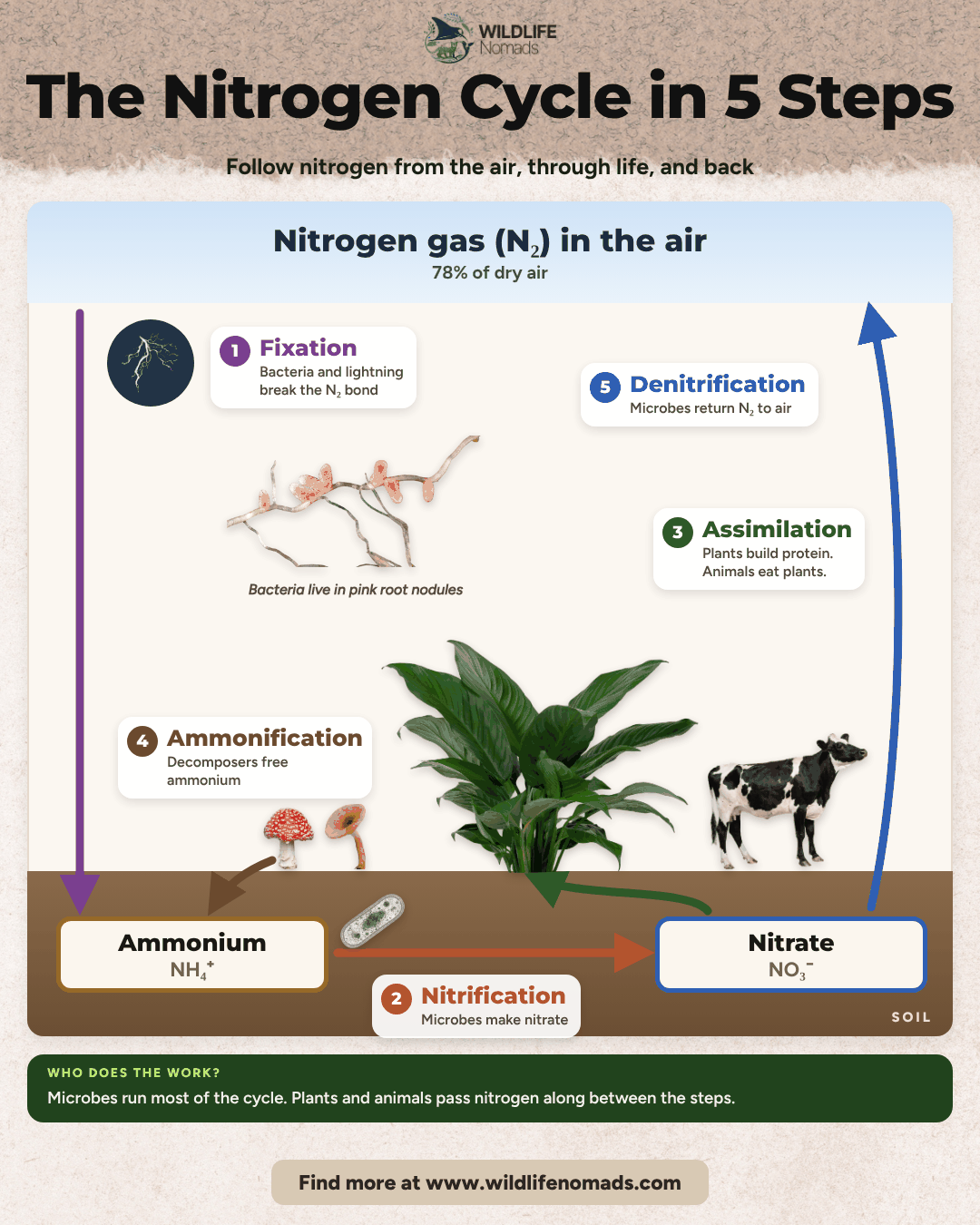
The nitrogen cycle is the movement of nitrogen between the air, soil, water and living organisms. First, microbes turn nitrogen gas into forms plants can use. Then plants and animals pass it along. Finally, other microbes turn it back into gas.
Nitrogen exists in many chemical forms. For example, it floats in the air as nitrogen gas (N₂). In soil water, it dissolves as ammonium and nitrate. Inside every cell, it also forms part of amino acids and nucleic acids.
The cycle of nitrogen links all these forms, because each step changes nitrogen from one form to another. Most steps depend on bacteria, archaea and fungi. So you can follow a single atom through them in the Nitrogen Cycle Lab above.
Why living things need nitrogen
Living organisms build proteins from amino acids, and every amino acid contains nitrogen atoms. DNA and RNA, the nucleic acids, contain nitrogen too. In addition, plants need it for chlorophyll, the green pigment that captures sunlight.
Nitrogen makes up about 3% of the human body by mass. However, you get all of it from food. That is because animals cannot use atmospheric nitrogen, and neither can plants.
As a result, life faces a strange problem. The air holds a vast supply of gaseous nitrogen. Still, nitrogen availability limits plant production in many natural ecosystems. In other words, life is surrounded by nitrogen it cannot touch.
Why most organisms cannot use nitrogen gas
Two nitrogen atoms in N₂ share a triple bond. In fact, it is one of the strongest chemical bonds in nature. So breaking it takes a lot of energy.
Only a few routes can do it. For instance, some bacteria and archaea break it with an enzyme. Lightning, on the other hand, breaks it with heat. Meanwhile, factories use high temperature, high pressure and natural gas. Hot engines and power plants also do it by accident.
Once broken, the nitrogen becomes reactive nitrogen. Scientists also call it fixed nitrogen, bioavailable nitrogen or biologically available nitrogen. In short, these names all mean the same thing: a usable form.
The 5 main steps of the nitrogen cycle
Textbooks usually split the nitrogen cycle into five steps. In real ecosystems, however, all five run at once, in different places.
| Step | What happens | Who does it |
|---|---|---|
| 1. Nitrogen fixation | N₂ gas becomes ammonia (NH₃), which forms ammonium (NH₄⁺) in soil water. | Nitrogen-fixing bacteria such as Rhizobium and cyanobacteria; also lightning and factories |
| 2. Nitrification | Ammonium becomes nitrite (NO₂⁻), then nitrate (NO₃⁻). | Ammonia-oxidizing bacteria and archaea, then nitrite-oxidizing bacteria |
| 3. Assimilation | Roots take up ammonium and nitrate. Plants then build amino acids, proteins and DNA. | Plants, algae and many microbes |
| 4. Ammonification | Dead organisms and waste release ammonium again. | Decomposer bacteria and fungi |
| 5. Denitrification | Nitrate becomes nitrogen gas, with some nitrous oxide (N₂O), and returns to the air. | Denitrifying bacteria in low-oxygen soil and water |
Animals join the cycle at step 3, when they eat plants or other animals and reuse the organic nitrogen. Later, their urine, dung and bodies feed step 4.
Nitrogen fixation: how nitrogen enters the living world
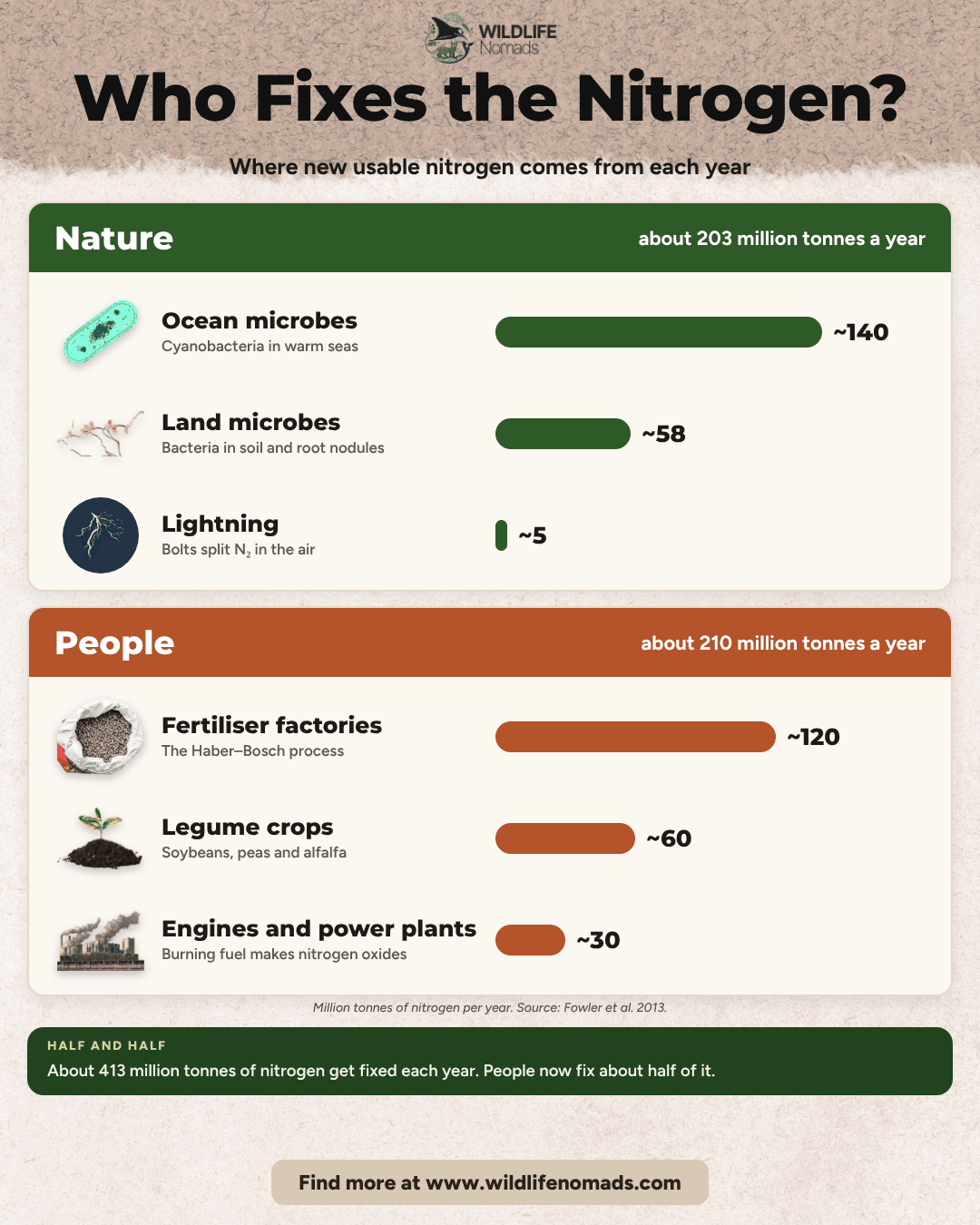
Nitrogen fixation is the process that turns N₂ gas into ammonia. This is mainly how nitrogen enters food webs. Three very different routes do it.
Bacteria and archaea use the enzyme nitrogenase. Most nitrogen fixation in nature happens this way, on land and at sea.
A bolt splits N₂ in the air. The atoms then form nitrogen oxides and nitric acid, which rain carries down.
Factories make ammonia from air and natural gas at about 400–500 °C. Most of it becomes fertiliser.
Nitrogen-fixing bacteria and legume plants
Some nitrogen-fixing bacteria live free in soil, while others live inside plants. For example, Rhizobium and its relatives partner with legumes such as beans, peas, clover and acacias.
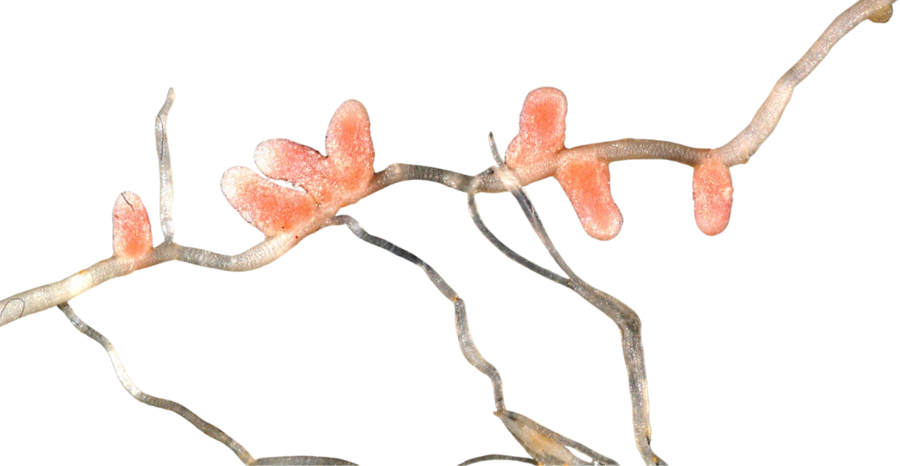
The bacteria live inside small lumps on the roots called nodules. If you cut a healthy nodule open, it looks pink. That colour comes from leghemoglobin, a protein that keeps oxygen low around nitrogenase. Oxygen damages the enzyme.
The deal works both ways. In return for sugars from the plant, the bacteria pay in fixed nitrogen. That is why farmers rotate crops with legumes.
Why fixing nitrogen is so expensive
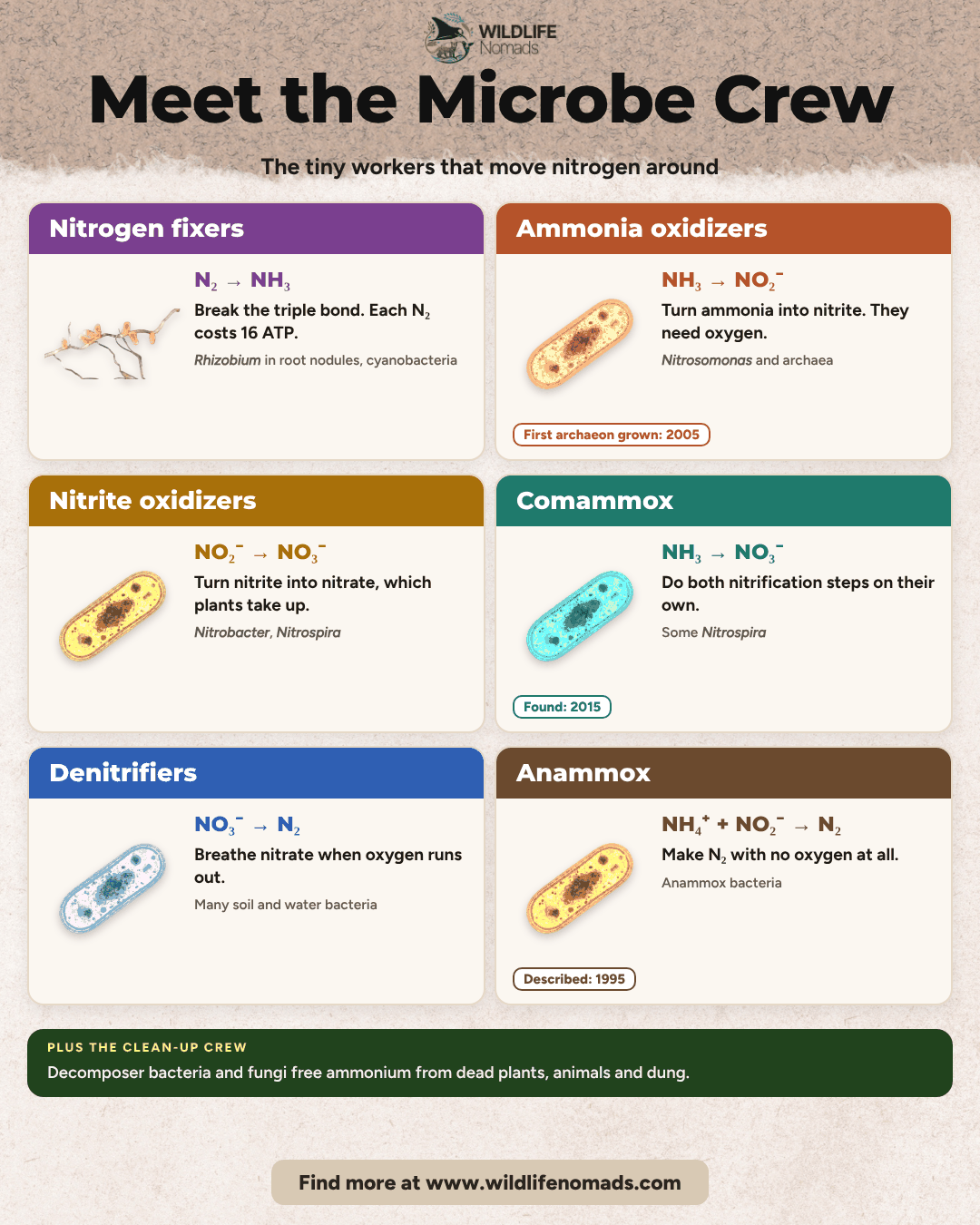
Unlike a factory, nitrogenase works at normal temperatures. Instead, it pays with energy. Each N₂ molecule costs the cell 16 ATP, its energy currency. Therefore, many bacteria switch fixation off when easier nitrogen sources are around.
Nitrification: from ammonia to nitrate
Nitrification turns ammonium into nitrate in two steps. Microbes use it as an energy source, much as we use food. Because both steps need oxygen, they happen in well-aired soil and water.
Step one is ammonia oxidation. Ammonia-oxidizing bacteria, such as Nitrosomonas, and ammonia-oxidizing archaea convert ammonia into nitrite. In the bacteria, the enzyme ammonia monooxygenase first turns ammonia into hydroxylamine. Then hydroxylamine oxidoreductase helps finish the job.
Step two is nitrite oxidation. Nitrite-oxidizing bacteria, such as Nitrobacter and Nitrospira, turn nitrite into nitrate. As a result, nitrite rarely builds up, because these bacteria use it quickly.
A 2015 surprise: two research teams found Nitrospira bacteria that run both steps alone. Scientists call this complete nitrification, or comammox.
Ammonia-oxidizing archaea were a surprise too. Researchers first grew one in the lab in 2005. Since then, scientists have learned these microbes are very common in the oceans and in soils.
Denitrification, anammox and DNRA: how nitrogen leaves
Nitrogen returns to the air mainly through denitrification. Denitrifying bacteria live in waterlogged soils, sediments and low-oxygen water. When oxygen runs out, they breathe nitrate instead.
In this way, nitrate becomes their electron acceptor, the job oxygen does for us. This nitrate reduction runs through several gases and ends with dinitrogen gas. Along the way, some nitrous oxide escapes.
Anaerobic ammonium oxidation (anammox)
Anammox bacteria join ammonium and nitrite and make N₂ gas. Moreover, they need no oxygen at all. Scientists first spotted the process in a Dutch wastewater reactor in the 1990s.
Today, anammox plays a big role in wastewater treatment. It also removes a large share of fixed nitrogen from the oceans.
Dissimilatory nitrate reduction to ammonium (DNRA)
Some microbes take a different path. Rather than making gas, they turn nitrate back into ammonium. This dissimilatory nitrate reduction therefore keeps the nitrogen in the soil or sediment.
For these reasons, biologists now picture a microbial nitrogen-cycling network rather than a neat circle. Different microorganisms compete for the same nitrogen compounds.
The marine nitrogen cycle and aquatic ecosystems
The oceans run their own nitrogen cycle. In warm surface waters, cyanobacteria such as Trichodesmium fix nitrogen. Meanwhile, ammonia-oxidizing archaea are abundant in the deep ocean.
In many coastal seas, nitrogen is the nutrient in shortest supply. In many freshwater lakes, by contrast, phosphorus often plays that role. Even so, both matter in most aquatic systems.
Low-oxygen zones in the ocean are hotspots for nitrogen loss through denitrification and anammox. Healthy kelp forests and mangroves also take up nitrogen from coastal water.
Nitrogen in rocks
Textbooks long said almost all nitrogen came from the air. Rocks, however, tell a different story. Many sedimentary and metamorphic rocks hold nitrogen, and weathering releases it into soils.
In northern California, for example, forests on nitrogen-rich bedrock stored more nitrogen and carbon than forests on nitrogen-poor rock. Later work showed rock nitrogen sources are widespread across Earth’s surface.
How humans changed the global nitrogen cycle
People now fix about as much nitrogen as all natural biological fixation on land and in the oceans. In fact, global estimates put human fixation at about 210 million tonnes a year.
Haber–Bosch fertiliser is the largest human source. It also helps feed nearly half of the world’s people.
Soybeans, peas and alfalfa carry nitrogen-fixing bacteria. Farmers grow them on huge areas.
Burning coal, oil and natural gas creates nitrogen oxides. These cause air pollution, smog and acid rain.
Too much nitrogen: algal blooms and dead zones
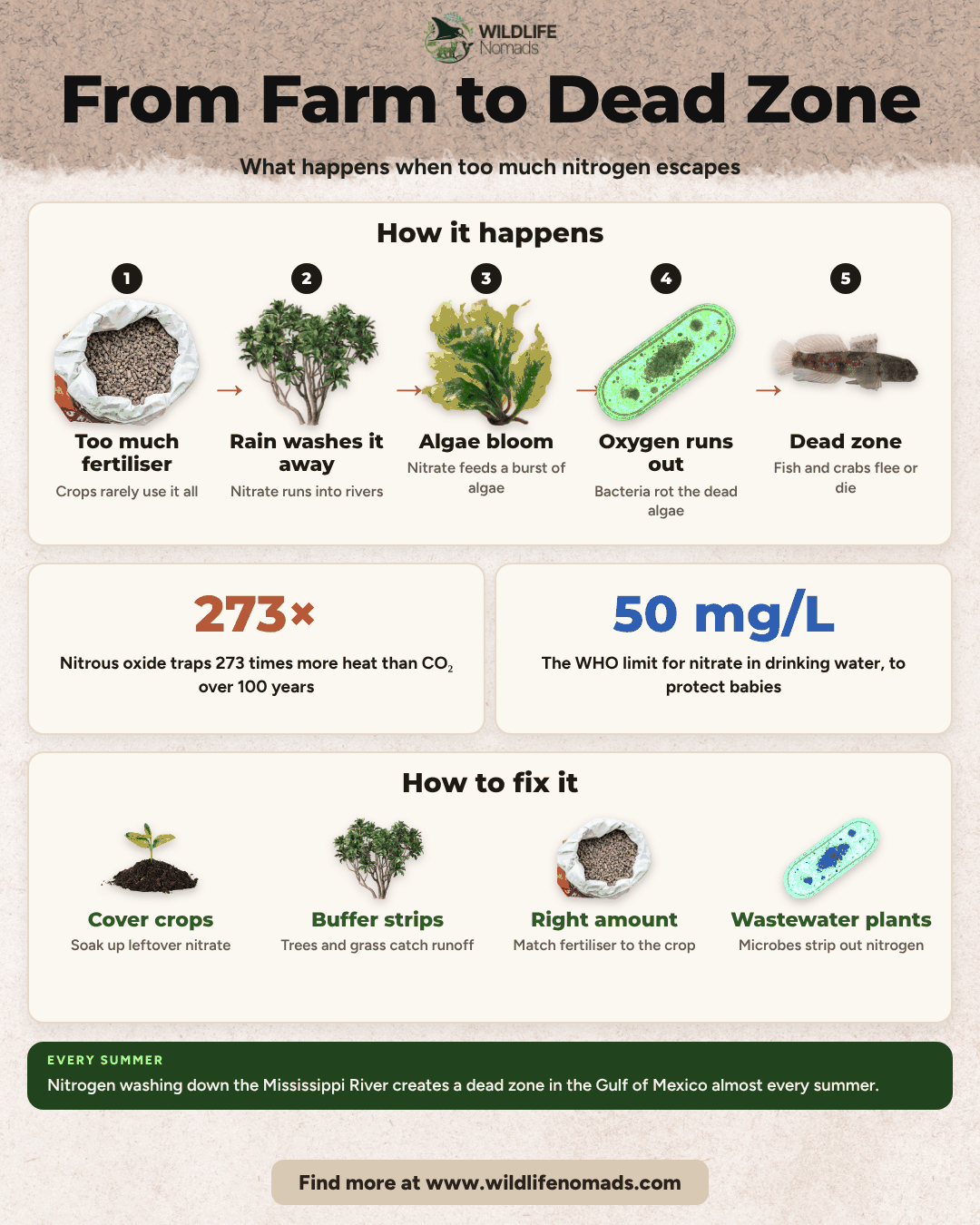
Crops rarely use all the fertiliser farmers apply. So rain washes extra nitrate into rivers, lakes and seas, where it feeds algal blooms.
When the algae die, bacteria decompose them and use up the oxygen. Consequently, fish and crabs flee or die. The Gulf of Mexico gets a dead zone like this almost every summer.
Some blooms are toxic, too. Read about the tiny swimmers behind many of them in my dinoflagellate facts. You can also see how nutrient runoff hurts sea life in how ocean pollution affects sea animals.
Nitrous oxide, climate and the ozone layer
Nitrous oxide traps 273 times more heat than carbon dioxide over 100 years. Besides that, it is the biggest ozone-depleting emission from human activity today. Fertilised soils release much of it.
Nitrate in drinking water
High nitrate in drinking water can cause adverse health effects in bottle-fed babies. For this reason, the WHO sets a guideline of 50 milligrams of nitrate per litre. That protects infants from blue baby syndrome.
How to keep nitrogen where it belongs
- Right amount, right time: farmers can match fertiliser to what the crop needs.
- Cover crops: during winter, these plants soak up leftover nitrate before rain washes it away.
- Buffer strips: trees and grass along rivers catch runoff. Wetlands also host denitrifying bacteria.
- Better wastewater treatment: nitrification, denitrification and anammox remove nitrogen before water reaches rivers.
- Cleaner engines: catalytic converters cut nitrogen oxides from car exhaust.
First, try the buffer strip and cover crop in stop 5 of the lab. Then see how nitrogen moves through whole communities in the Ecosystem Lab and the Food Web Game.
Try it: break the triple bond three ways in stop 2, then staff the microbe crew in stop 3.
Free mini guide
Take the nitrogen cycle with you
All four infographics in one printable PDF: the 5 steps, the microbe crew, who fixes nitrogen and the dead zone story, plus a quick quiz.
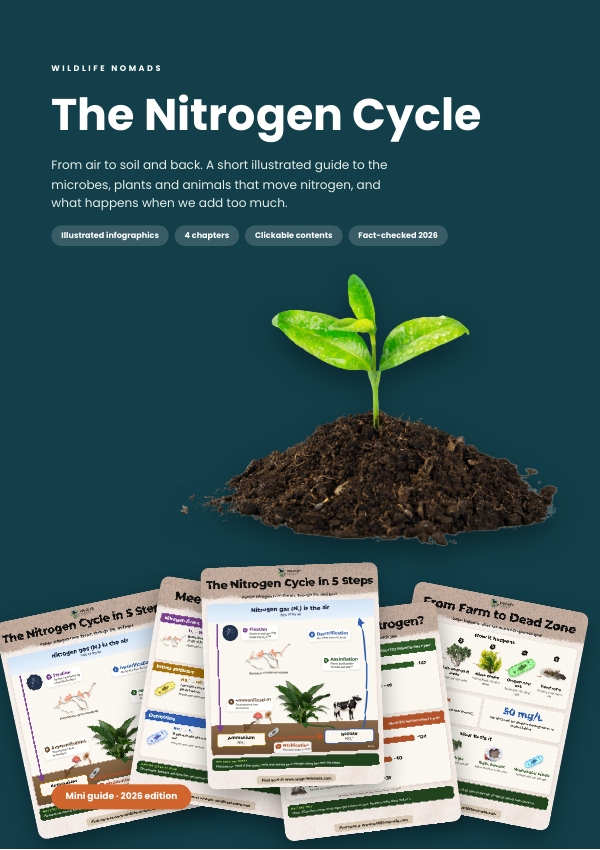 Free PDF · 14 pagesNitrogen Cycle Mini GuideMicrobes, plants, cows and lightning, ready to print for home or class.Download free →
Nitrogen Cycle FAQ
The nitrogen cycle is the movement of nitrogen between the air, soil, water and living things. Bacteria turn nitrogen gas into forms plants can use. Plants and animals pass it along. Other bacteria then return it to the air.
The five main steps are nitrogen fixation, nitrification, assimilation, ammonification and denitrification. Fixation turns nitrogen gas into ammonia. Nitrification makes nitrate. Plants assimilate both. Decomposers release ammonium, and denitrification returns nitrogen gas to the air.
The nitrogen cycle is a biogeochemical cycle run mostly by microbes. They move nitrogen between unusable nitrogen gas and usable forms such as ammonium and nitrate. Plants, animals and decomposers pass it along in between.
Yes. We get nitrogen from the proteins in our food and return it in urine and waste. People also add fixed nitrogen through fertiliser, legume crops and burning fossil fuels. Today we fix about as much as natural biological fixation.
Nitrogen moves in a loop. Bacteria pull it from the air into the soil. Plants take it up, animals eat the plants, and decomposers return it to the soil. Other bacteria send it back into the air.
Here are three examples. Air is about 78% nitrogen gas. Beans and peas add nitrogen to the soil. Farmers spread nitrogen fertiliser to help crops grow.
References
Microbes and the nitrogen cycle
Daims, H., Lebedeva, E. V., Pjevac, P., Han, P., Herbold, C., Albertsen, M., Jehmlich, N., Palatinszky, M., Vierheilig, J., Bulaev, A., Kirkegaard, R. H., von Bergen, M., Rattei, T., Bendinger, B., Nielsen, P. H., & Wagner, M. (2015). Complete nitrification by Nitrospira bacteria. Nature, 528(7583), 504–509. https://doi.org/10.1038/nature16461
Könneke, M., Bernhard, A. E., de la Torre, J. R., Walker, C. B., Waterbury, J. B., & Stahl, D. A. (2005). Isolation of an autotrophic ammonia-oxidizing marine archaeon. Nature, 437(7058), 543–546. https://doi.org/10.1038/nature03911
Kuypers, M. M. M., Marchant, H. K., & Kartal, B. (2018). The microbial nitrogen-cycling network. Nature Reviews Microbiology, 16(5), 263–276. https://doi.org/10.1038/nrmicro.2018.9
Mulder, A., van de Graaf, A. A., Robertson, L. A., & Kuenen, J. G. (1995). Anaerobic ammonium oxidation discovered in a denitrifying fluidized bed reactor. FEMS Microbiology Ecology, 16(3), 177–184. https://doi.org/10.1111/j.1574-6941.1995.tb00281.x
van Kessel, M. A. H. J., Speth, D. R., Albertsen, M., Nielsen, P. H., Op den Camp, H. J. M., Kartal, B., Jetten, M. S. M., & Lücker, S. (2015). Complete nitrification by a single microorganism. Nature, 528(7583), 555–559. https://doi.org/10.1038/nature16459
The global nitrogen cycle
Erisman, J. W., Sutton, M. A., Galloway, J., Klimont, Z., & Winiwarter, W. (2008). How a century of ammonia synthesis changed the world. Nature Geoscience, 1(10), 636–639. https://doi.org/10.1038/ngeo325
Fowler, D., Coyle, M., Skiba, U., Sutton, M. A., Cape, J. N., Reis, S., Sheppard, L. J., Jenkins, A., Grizzetti, B., Galloway, J. N., Vitousek, P., Leach, A., Bouwman, A. F., Butterbach-Bahl, K., Dentener, F., Stevenson, D., Amann, M., & Voss, M. (2013). The global nitrogen cycle in the twenty-first century. Philosophical Transactions of the Royal Society B, 368(1621), 20130164. https://doi.org/10.1098/rstb.2013.0164
Fowler, D., Steadman, C. E., Stevenson, D., Coyle, M., Rees, R. M., Skiba, U. M., Sutton, M. A., Cape, J. N., Dore, A. J., Vieno, M., Simpson, D., Zaehle, S., Stocker, B. D., Rinaldi, M., Facchini, M. C., Flechard, C. R., Nemitz, E., Twigg, M., Erisman, J. W., … Galloway, J. N. (2015). Effects of global change during the 21st century on the nitrogen cycle. Atmospheric Chemistry and Physics, 15(24), 13849–13893. https://doi.org/10.5194/acp-15-13849-2015
Houlton, B. Z., Morford, S. L., & Dahlgren, R. A. (2018). Convergent evidence for widespread rock nitrogen sources in Earth’s surface environment. Science, 360(6384), 58–62. https://doi.org/10.1126/science.aan4399
Morford, S. L., Houlton, B. Z., & Dahlgren, R. A. (2011). Increased forest ecosystem carbon and nitrogen storage from nitrogen rich bedrock. Nature, 477(7362), 78–81. https://doi.org/10.1038/nature10415
Climate, pollution and health
Forster, P., Storelvmo, T., Armour, K., Collins, W., Dufresne, J.-L., Frame, D., Lunt, D. J., Mauritsen, T., Palmer, M. D., Watanabe, M., Wild, M., & Zhang, H. (2021). The Earth’s energy budget, climate feedbacks, and climate sensitivity. In Climate change 2021: The physical science basis. Contribution of Working Group I to the Sixth Assessment Report of the Intergovernmental Panel on Climate Change (pp. 923–1054). Cambridge University Press. https://doi.org/10.1017/9781009157896.009
Rabalais, N. N., Turner, R. E., & Wiseman, W. J., Jr. (2002). Gulf of Mexico hypoxia, a.k.a. “The dead zone.” Annual Review of Ecology and Systematics, 33, 235–263. https://doi.org/10.1146/annurev.ecolsys.33.010802.150513
Ravishankara, A. R., Daniel, J. S., & Portmann, R. W. (2009). Nitrous oxide (N2O): The dominant ozone-depleting substance emitted in the 21st century. Science, 326(5949), 123–125. https://doi.org/10.1126/science.1176985
World Health Organization. (2022). Guidelines for drinking-water quality: Fourth edition incorporating the first and second addenda. World Health Organization. https://www.who.int/publications/i/item/9789240045064



