Two years ago, one of our Wildlife Nomads team members was deep inside Tortuguero National Park in Costa Rica. She wasn’t even looking for sloths that morning. The group had come for the birds, binoculars trained on the canopy, necks craned skyward.
Then she noticed something odd on the trail ahead. A shape was moving across the open ground, impossibly slow, dragging itself forward on long curved claws. It was a two-toed sloth on the forest floor, a rare sight. Everyone froze. As they followed its gaze upward, the team spotted a second one high in the same tree, just laying there, a shaggy lump against the leaves.
That single hour taught me more about two-toed sloths than any textbook. These animals are strange in the best way, built for a life lived upside down, hidden in plain sight. Here are ten things you truly need to know about them.
1. “Two-Toed” Is a Bit of a Lie… They’re Really Two-Fingered
Here’s one of my favourite facts. Two-toed sloths have two claws on their front limbs, but three toes on each hind foot. The name describes only their forelimbs, which is why scientists increasingly call them two-fingered sloths.
That anatomical difference goes deep. Two-toed sloths (Choloepus) and three-toed sloths (Bradypus) aren’t close relatives, they are a classic example of convergent evolution. Millions of years ago, two entirely separate mammalian lineages independently moved into the trees and adapted to life upside down.
So when you hear “2 toed sloth,” “two fingered sloth,” or “2 finger sloth,” they all point to the same creature. The confusion is baked into the common name itself.
2. There Are Only Two Species of Two-Toed Sloths
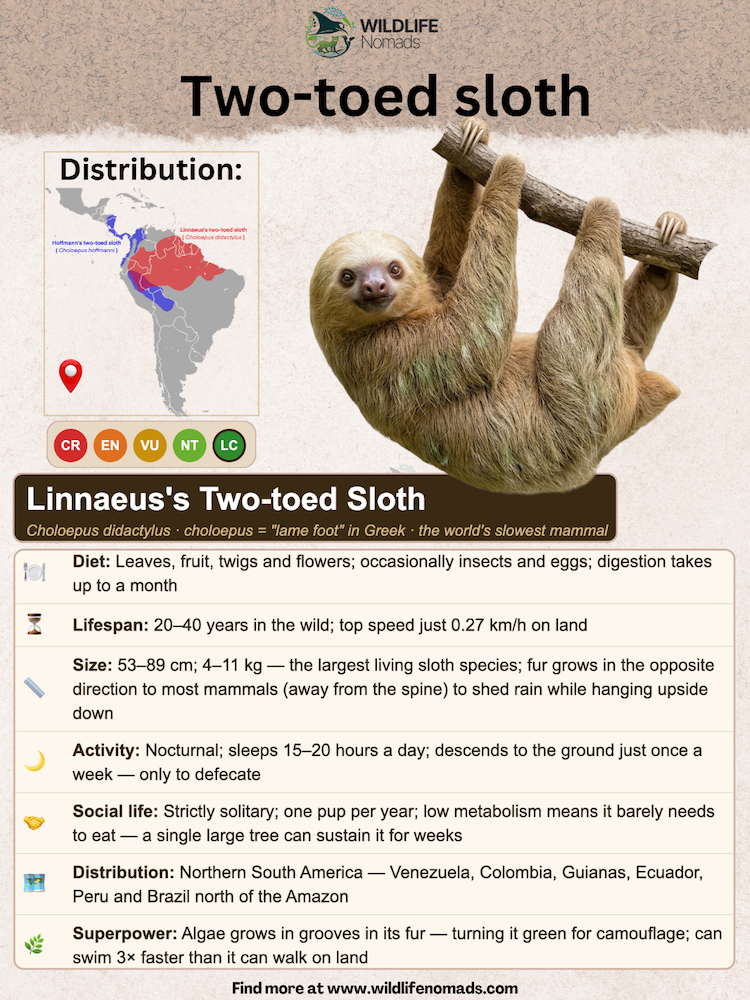
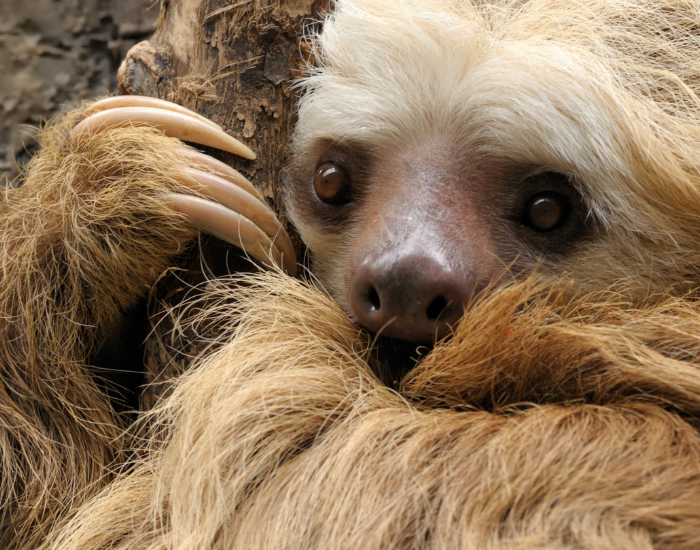
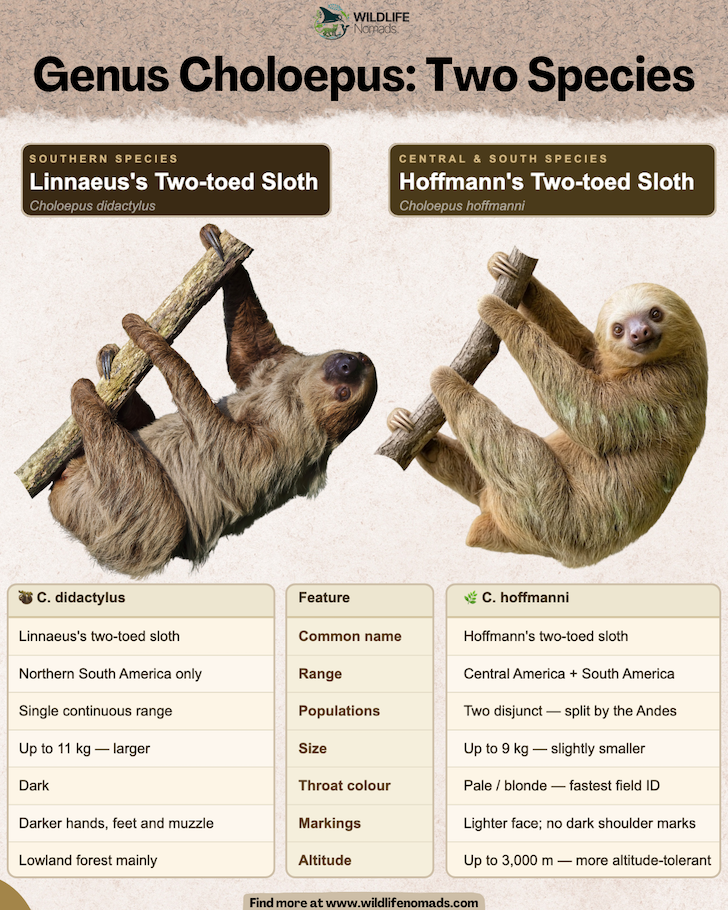
The world holds just two living species in the genus Choloepus. Linnaeus’s two-toed sloth (Choloepus didactylus) roams the northern reaches of South America. Hoffmann’s two-toed sloth (Choloepus hoffmanni) ranges across Central America and beyond.
These two species look nearly identical to the casual eye. They differ mainly in range, skull structure, and the number of neck vertebrae. Both are slow-moving, strictly arboreal mammals with the same shaggy fur, prominent snout, and rudimentary ears tucked deep in that long hair.
The three-toed side of the family is far more crowded. It includes the pygmy three-toed sloth (Bradypus pygmaeus), the maned sloth (Bradypus torquatus), the pale-throated sloth, and the widespread brown-throated sloth. Between the two genera, six sloth species survive today.
3. They Live Their Whole Lives Upside Down in the Canopy
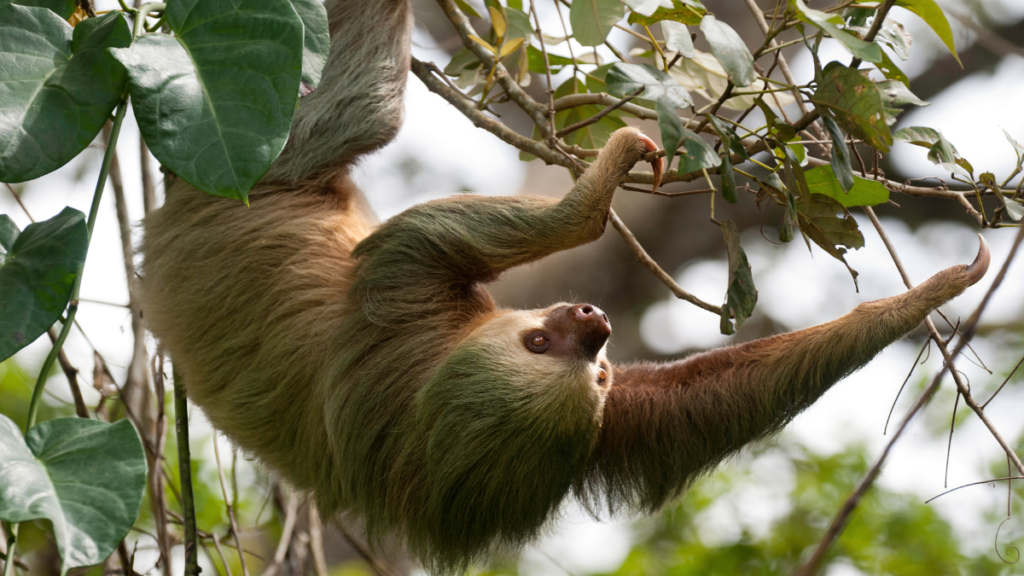
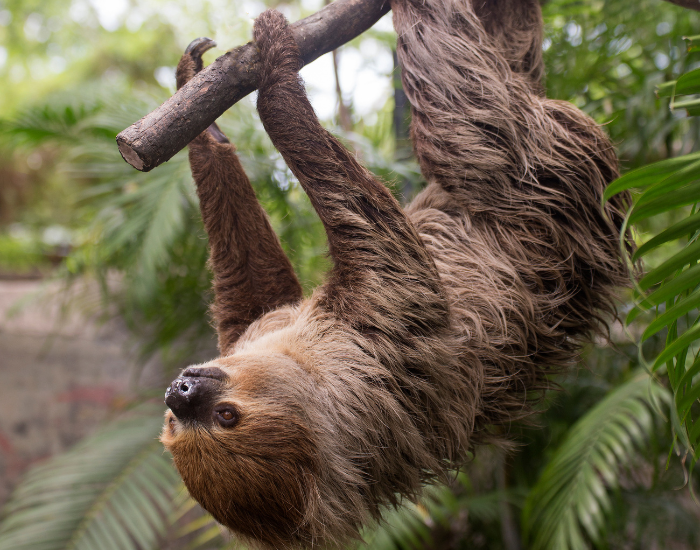
Two-toed sloths are arboreal mammals native to Central and South America. They spend almost their entire lives hanging upside down in trees, gripping branches with those long curved claws. The forest floor is dangerous territory, so they descend only when they must.
Their preferred home is dense, humid, and green. These sloths favor tropical rainforests and cloud forests, living high in the tree canopy where food and cover are plentiful. They avoid open pastures and gravitate toward shaded, unbroken forest instead.
Even their fur is built for the upside-down life. Unlike most mammals, a sloth’s hair parts along the belly and curves in the opposite direction, so rain runs off cleanly while the animal hangs. Small design choices like this reveal millions of years of arboreal fine-tuning.
4. They Run the Lowest, Most Variable Body Temperature of Any Mammal
Most mammals hold a steady internal thermostat. Two-toed sloths do the opposite. They have a lower and far more variable body temperature than other mammals, drifting roughly from 74°F to 92°F depending on their surroundings.
This variable body temperature ties directly to an extraordinarily slow metabolism. To conserve energy, sloths let their core temperature rise and fall with the day, almost like a reptile basking. Research by Cliffe and colleagues showed that a sloth’s metabolic rate climbs and falls in step with ambient temperature.
The tradeoff is real. A cold, wet spell can leave a sloth too chilled to digest its food, even on a full stomach. Their slow metabolism is a survival strategy, but it walks a fine line.
5. They Have More Ribs Than Any Other Mammal
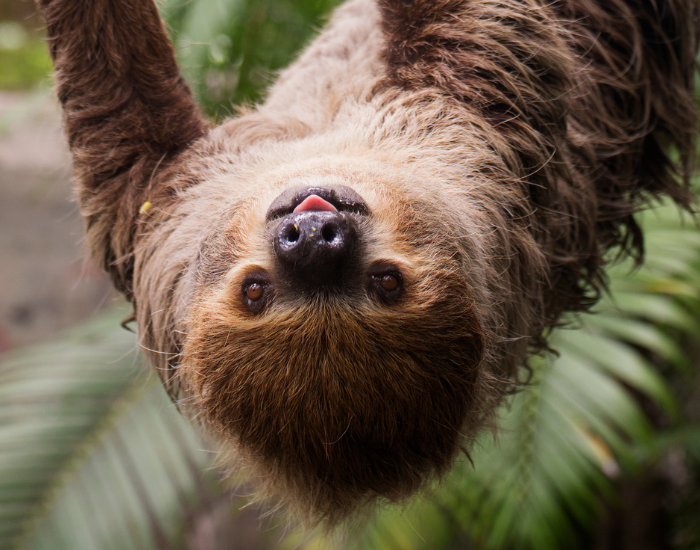
Open up a two-toed sloth’s anatomy and you’ll find something remarkable. They possess up to 24 pairs of ribs (48 total), the highest rib count of any mammal. Most mammals, including us, make do with far fewer.
Those extra ribs aren’t random. They help brace the sloth’s large digestive organs while it hangs upside down for hours. The ribs are also unusually flexible, which makes them hard to break during a fall from the canopy.
6. Digesting a Single Meal Can Take a Month
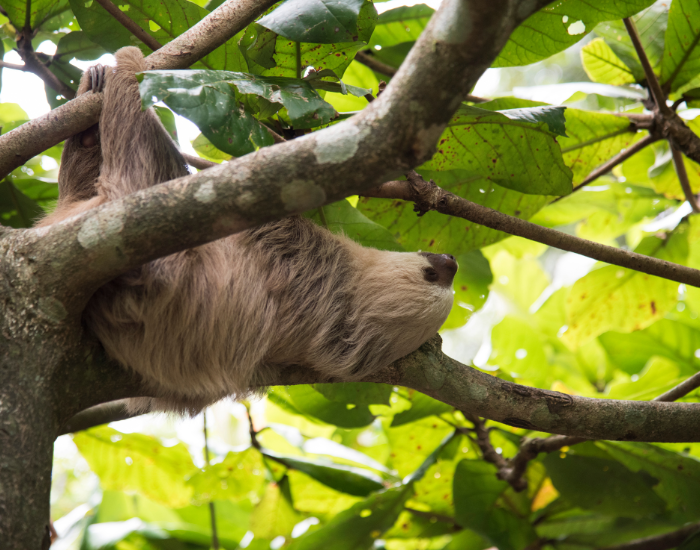
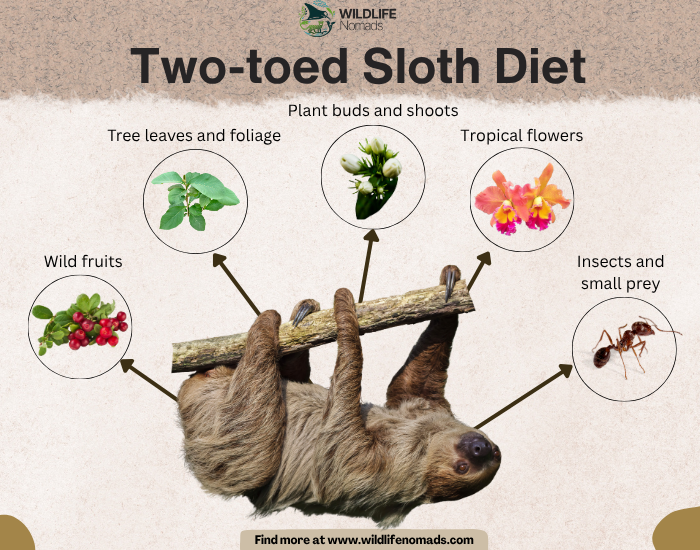
Two-toed sloths primarily eat leaves, fruits, and nuts, supplementing that plant matter with the occasional insect or small vertebrate. This makes them slightly more omnivorous than their strictly leaf-eating three-toed cousins.
Whatever they eat, digestion crawls. Sloths can take days or weeks to break down a meal, and a full cycle can take up to a month to complete. To manage it, they rely on a large, multi-chambered stomach where gut microbes slowly ferment tough plant fibers.
The result is a belly that stays remarkably full. At any moment, food and digesta can account for up to 37% of a sloth’s body mass. When I first learned that figure, I finally understood why these animals never seem to be in a hurry.
7. They Grow Their Own Camouflage
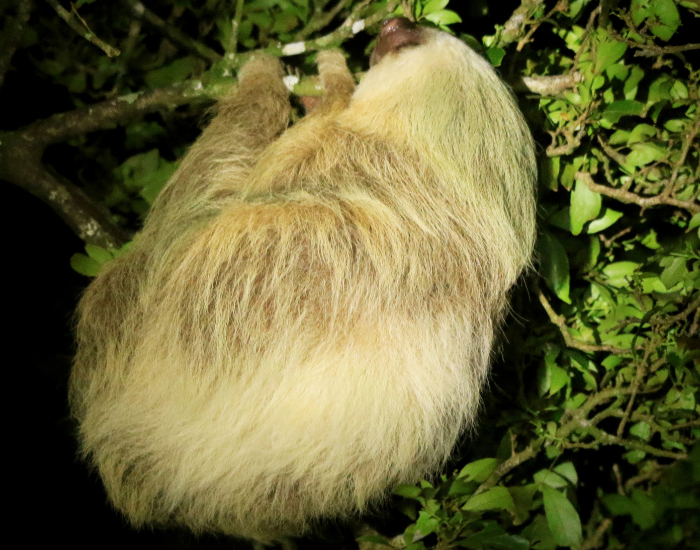
Look closely at a wild sloth and you may notice a greenish tint to its fur. That color is alive. Greenish algae grow within the grooved, moisture-holding hairs, giving the animal a subtle green wash that blends into the leaves.
This living coat pulls double duty. The algae provide camouflage among the foliage, hiding sloths from sharp-eyed predators above and below. Some sloths even lick or nibble the algae growing on their fur, gaining extra nutrients from their own body garden.
It’s one of nature’s quietest partnerships. The sloth offers shelter and moisture, and the algae repay it with cover and a snack. Few mammals turn their own hair into an ecosystem.
8. They Are Surprisingly Good Swimmers
On land, a two-toed sloth is almost helpless. Its limbs are built for hanging, not walking, so it drags itself clumsily across open ground. That awkwardness on the forest floor is exactly what our team witnessed in Tortuguero.
Water tells a different story. Sloths can swim surprisingly well, moving through flooded forest and rivers far faster than they ever move on land. They use a slow breaststroke and can hold their breath for impressively long stretches.
In flooded regions of the Amazon, swimming lets sloths change trees without ever touching the dangerous ground. What looks like a design flaw on land becomes a genuine advantage in the water.
9. They’re Night Owls Who Sleep Most of the Day
Two-toed sloths are predominantly nocturnal animals. They sleep for around 15 hours a day in captivity ((~10 hours in the wild) and become most active after dark, when cover is thicker and many predators are less effective. This is another reason they can be so hard to spot on a daytime tour.
By contrast, three-toed sloths tend to be active during daylight hours. That difference in schedule is one of the easiest behavioral clues for telling the two genera apart in the wild.
Their nocturnal habits also fit their energy budget. Moving at night, staying still, and conserving energy all serve the same goal, doing more with astonishingly little fuel.
10. A Single Baby Clings to Its Mother for Months
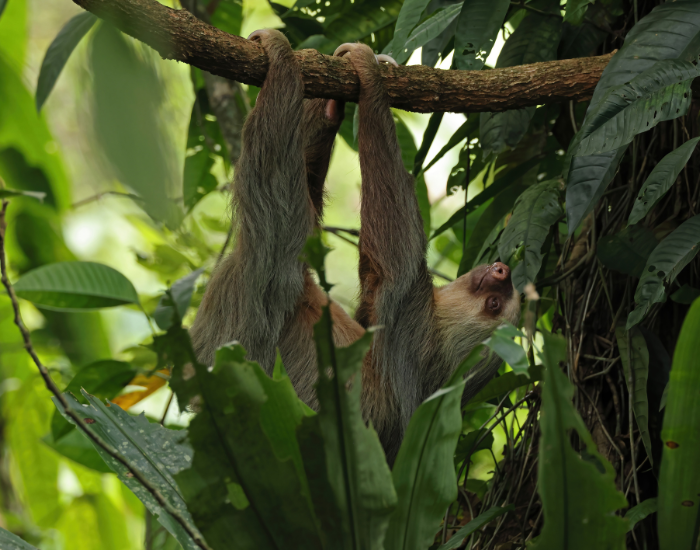
Reproduction in two-toed sloths is slow and deeply hands-on. Females give birth to a single young, and that baby immediately grips its mother’s belly. There it rides, nurses, and learns for roughly nine months.
During this long stretch, the infant shares its mother’s home range and even samples the same leaves she eats. That overlap teaches the youngster which food sources are safe within a very specific patch of forest. In human care, sloths can live for decades, though median life expectancy in the wild is shorter and harder to measure.
This slow pace of life has a cost. When habitat is lost, sloths simply cannot reproduce quickly enough to bounce back, which brings us to their biggest challenge.
Two-Toed Sloths vs. Three-Toed Sloths: The Key Differences
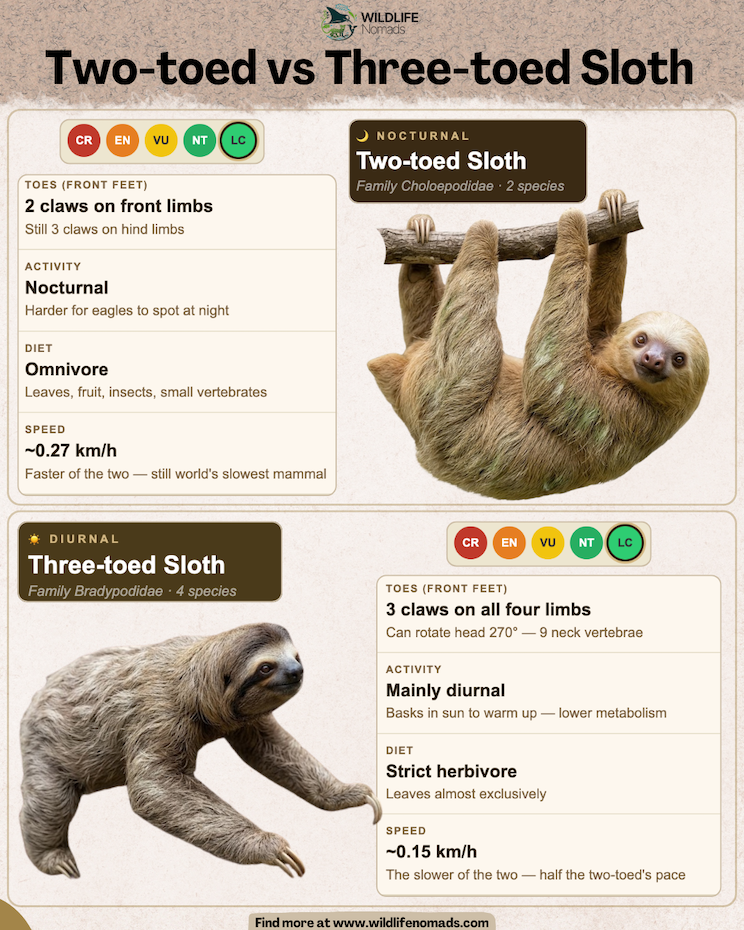
People often lump all sloths together, but the two types differ in meaningful ways. Two-toed sloths are larger than three-toed sloths, with a body length of roughly 58 to 70 cm. They’re also more active and noticeably faster than their three-toed counterparts.
Beyond size and speed, the tells are clear. Two-toed sloths have two claws on their forelimbs and a snub, pig-like nose; three-toed sloths carry three digits on every limb and a rounder face. Despite sharing the canopy, the two genera aren’t closely related. In fact, genomic studies show that two-toed sloths are more closely related to extinct giant ground sloths like Megalonyx than to three-toed sloths. Their similar appearance is purely the result of parallel evolutionary pressure.
Threats: Why Two-Toed Sloths Need Our Attention
Both species of two-toed sloth are currently listed as Least Concern by the IUCN, thanks to wide ranges and large populations. That status, however, hides real and growing pressure. Two-toed sloths are highly vulnerable to deforestation, and habitat loss increasingly threatens sloth populations in countries like Colombia and Brazil.
The dangers don’t stop at the chainsaw. Illegal wildlife trade poses a serious risk, as juveniles are stolen from the wild for the exotic pet market. As a result, some sloth subpopulations are already declining due to habitat degradation and fragmentation.
In the wild, sloths also face natural predators that hunt the canopy and the ground. Jaguars take them when they descend, and harpy eagles pluck them straight from the branches. Supporting forest protection and responsible conservation and ecotourism is the surest way to keep these slow, strange mammals hanging on.
Frequently Asked Questions
There are two species of two-toed sloths, both in the genus Choloepus. They are Linnaeus’s two-toed sloth (Choloepus didactylus) and Hoffmann’s two-toed sloth (Choloepus hoffmanni). Together they make up the entire two-fingered branch of the sloth family.
Two-toed sloths are most closely related to three-toed sloths, and both belong to the superorder Xenarthra alongside anteaters and armadillos. Their extinct relatives include the giant ground sloths that once roamed the Americas. These extinct ground sloths grew to elephant size before vanishing around 10,000 years ago.
Two-toed sloths live in the tropical rainforests and cloud forests of Central and South America. Linnaeus’s two-toed sloth occupies northern South America, while Hoffmann’s two-toed sloth spans Central America and parts of the northwest. Both stay high in the canopy and rarely touch the ground.
Two-toed sloths mainly eat leaves, fruits, and nuts, plus occasional insects or small vertebrates. This varied plant matter, fermented slowly in a large multi-chambered stomach, sets them apart from strictly leaf-eating three-toed sloths.
Why Two-Toed Sloths Are Worth a Second Look
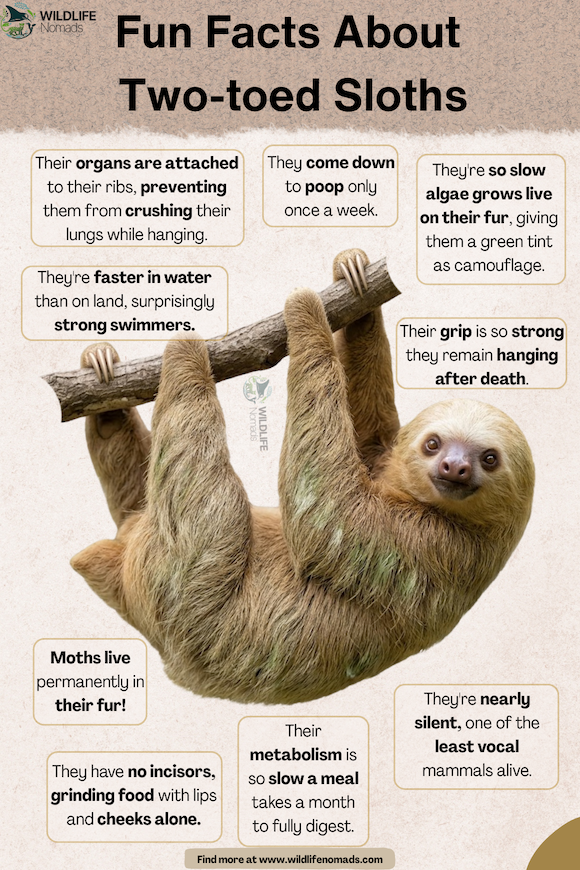
Everything strange about two-toed sloths, the upside-down life, the month-long digestion, the algae-green fur, turns out to be a finely tuned strategy for surviving on almost no energy. Slow is not lazy. Slow is how these animals have quietly outlasted their giant ground-sloth ancestors.
I still think about that pair in Tortuguero, one on the trail and one in the tree. If you ever get the chance to watch a sloth in the wild, take it. Drop a comment and tell me about your own sloth sighting, or keep exploring the incredible animals of Costa Rica and the mischievous monkeys that share their forest.
Two-Toed Sloths: Fact or Fiction? 🦥
Twelve statements about the canopy’s slowest resident — six true, six myths. Can you tell them apart?
Fact or Fiction?
Find Incredible Experiences with Sloths!
This blog is reader-supported. When you buy experiences through links listed on this site, we may earn an affiliate commission.
References:
Cliffe, R. N., Haupt, R. J., Avey-Arroyo, J. A., & Wilson, R. P. (2015). Sloths like it hot: ambient temperature modulates food intake in the brown-throated sloth (Bradypus variegatus). PeerJ, 3, e875. https://doi.org/10.7717/peerj.875
Cliffe, R. N., Scantlebury, D. M., Kennedy, S. J., Avey-Arroyo, J., Mindich, D., & Wilson, R. P. (2018). The metabolic response of the Bradypus sloth to temperature. PeerJ, 6, e5600. https://doi.org/10.7717/peerj.5600
Gilmore, D. P., Da Costa, C. P., & Duarte, D. P. F. (2000). An update on the physiology of two- and three-toed sloths. Brazilian Journal of Medical and Biological Research, 33(2), 129–146. https://doi.org/10.1590/S0100-879X2000000200001
Gilmore, D. P., Duarte, D. P. F., & Da Costa, C. P. (2001). Sloth biology: an update on their physiological ecology, behavior and role as vectors of arthropods and arboviruses. Brazilian Journal of Medical and Biological Research, 34(1), 9–25. https://doi.org/10.1590/S0100-879X2001000100002
Delsuc, F., Kuch, M., Gibb, G. C., Karpinski, E., Hackenberger, D., Szpak, P., Poinar, H. N. (2019). Ancient mitogenomes reveal the evolutionary history and biogeography of sloths. Current Biology, 29(12), 2031–2042. https://doi.org/10.1016/j.cub.2019.05.043