If you’ve ever watched a snake throw itself dramatically onto its back, stick out its tongue, and play dead – you’ve just met a hognose snake (also known as the blow snake in some regions). These chunky, upward-nosed reptiles are among the most charismatic species in North America, and they’ve earned every bit of their reputation.
Whether you’re a wildlife enthusiast who spotted one in the grasslands, a keeper researching your first snake, or a biologist wanting the full picture — this guide covers every main hognose snake species. We break down their range, diet, defence behaviour and the animal behaviour that makes them so unique, conservation status, and what makes each one genuinely unique.
Understanding the different hognose snake species also matters for homeowners. These harmless, beneficial snakes control insect and amphibian populations. They are not a threat to humans, despite their impressive bluffing. In fact, a hognose snake would rather die — or at least pretend to, than bite you.
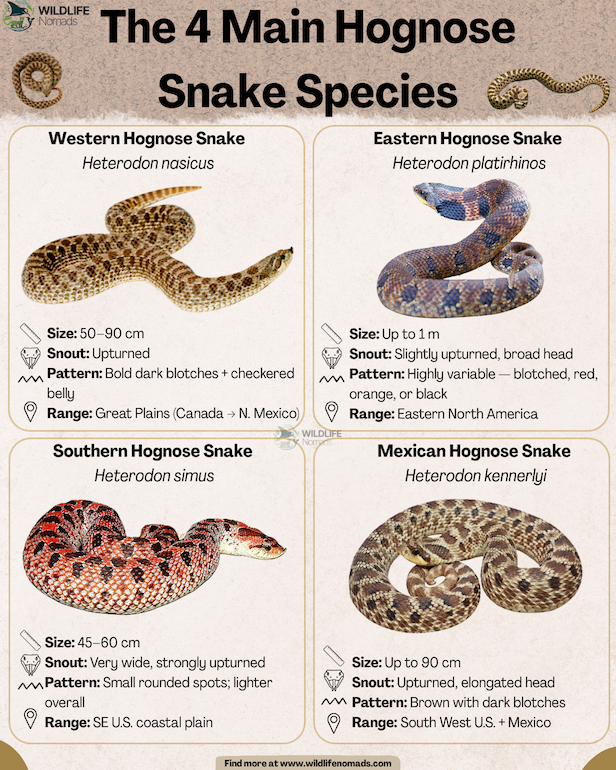
The 4 Main Hognose Snake Species
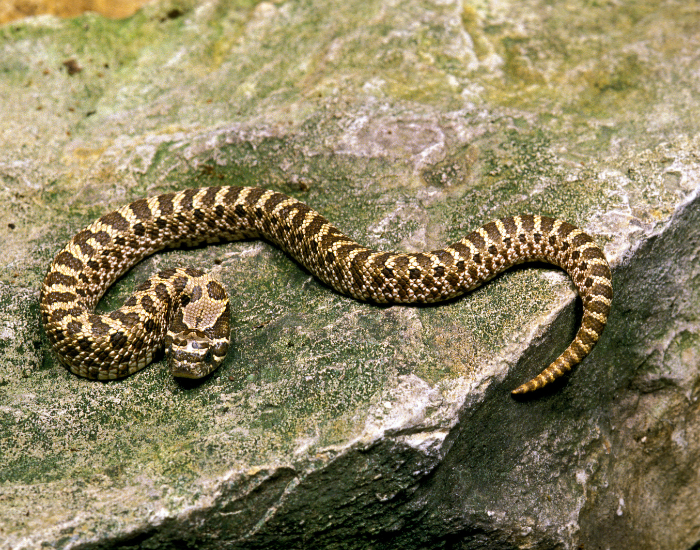
1. Western Hognose Snake (Heterodon nasicus)
Size: Females 60–90 cm | Males up to 50 cm
Range: Great Plains — southern Canada to northern Mexico
Habitat: Grasslands, prairies, sandy scrublands
Diet: Toads, frogs, lizards, small rodents
Status: Least Concern (IUCN)
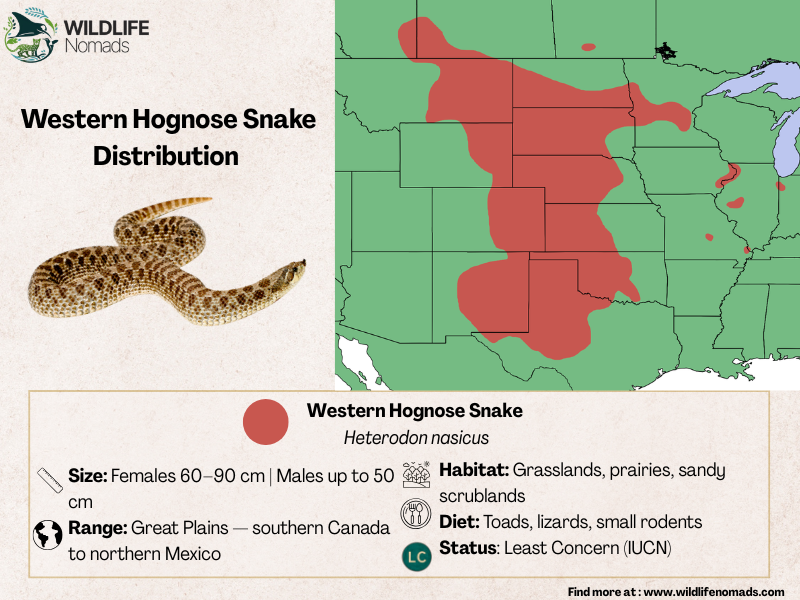
The western hognose snake (also called the western hog nosed snake or blow snake) is the undisputed star of the hognose world — and the most popular hognose kept as a pet. It’s easy to see why. This species packs enormous personality into a compact, manageable body, eats readily in captivity, and never stops being entertaining.
In the wild, you’ll find western hognose snakes across open grasslands and prairies stretching through the Great Plains. Their range extends from southern Canada through states like South Dakota and Illinois, down into northern Mexico. They strongly prefer sandy, loose soils — ideal for digging and burrowing with that specialised upturned snout.
Their diet in the wild includes toads, frogs, lizards, and occasionally small rodents or birds’ eggs. However, in captivity, most western hognose snakes readily accept frozen-thawed mice. This flexibility makes them one of the easiest species to feed, and a top recommendation for beginner snake keepers.
When threatened by predators, the western hognose runs a two-act performance. First, it spreads and flattens its neck like a cobra — earning it the nickname ‘puff adder’ — while hissing loudly. If the bluff fails, it rolls onto its back, opens its mouth, and plays dead with total commitment. Flip it right-side up and it immediately rolls back over, apparently convinced that dead snakes must lie upside down.
Mating occurs in spring after winter dormancy. Females lay clutches of 4–23 eggs in early summer, with eggs hatching after roughly 60 days. Neonate hognose snakes are fully independent from the moment they hatch.
2. Eastern Hognose Snake (Heterodon platirhinos)
Size: 50 cm to over 1 metre; females larger
Range: Eastern North America — southern Canada to Florida
Habitat: Sandy soils, open woodlands, coastal plains
Diet: Toads — highly specialised
Status: Least Concern (IUCN)
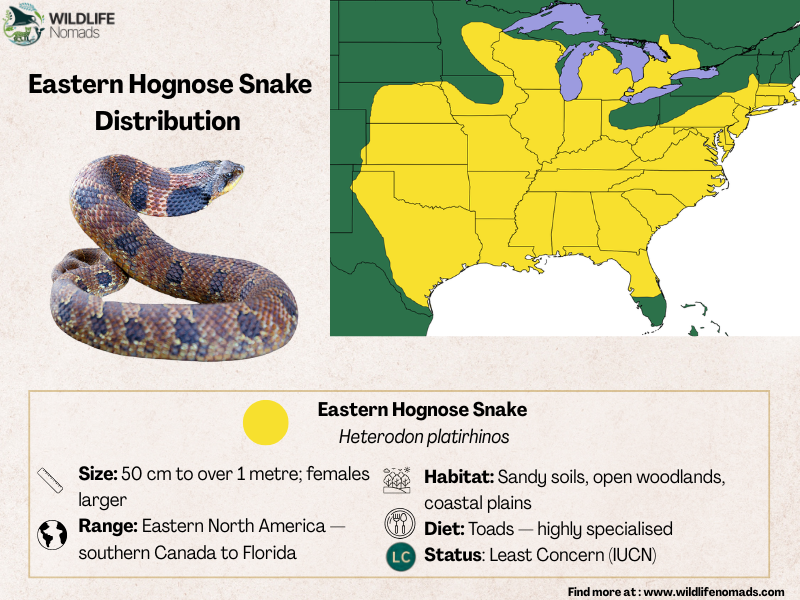
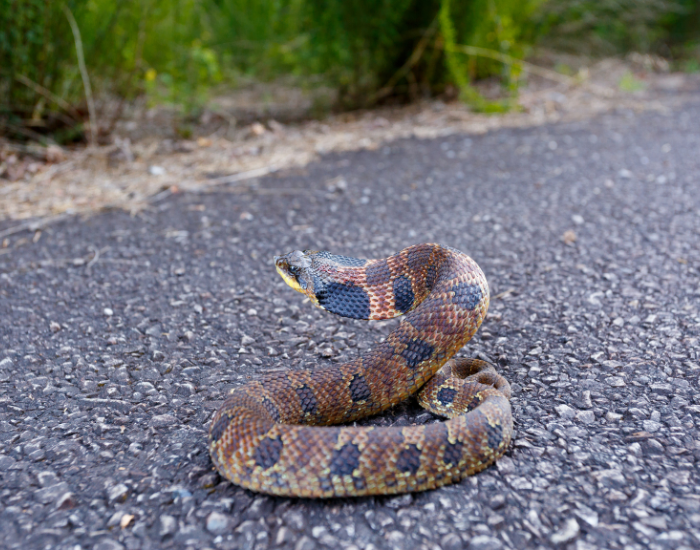
The eastern hognose snake is the true artist of the genus. It outperforms the western in dramatic flair, grows larger, and comes in a wider range of natural colour forms than almost any other North American snake species.
Eastern hognose snakes show remarkable colour variation. Some individuals are completely jet black (melanistic). Others display vivid oranges, reds, yellows, or complex grey-brown patterns. Two snakes of the same species can look entirely unrelated. Adults are noticeably larger than western hognose snakes, with large females occasionally exceeding 115 cm.
Their range covers eastern North America broadly — from southern Canada down through the eastern United States to Florida. They prefer sandy soils and open woodland edges, particularly areas where toads are abundant. This habitat preference links directly to their diet.
Eastern hognose snakes are toad specialists. Their saliva contains compounds that appear to help neutralise toad toxins, giving them access to prey that most snakes cannot safely eat. This is a remarkable dietary adaptation — but it creates real challenges in captivity. Many eastern hognose snakes refuse to eat anything other than toads, making them significantly harder to keep than western hognose snakes.
In terms of defence, the eastern hognose takes death feigning further than any other species. When threatened, it may flatten its entire body (not just the neck), writhe dramatically, then go completely rigid with its mouth open and tongue lolling out. It also releases a foul musk to complete the illusion. The performance is genuinely impressive.
3. Southern Hognose Snake (Heterodon simus)
Size: Adults typically 45–60 cm
Range: Southeastern United States — coastal plain states
Habitat: Sandy, well-drained soils, longleaf pine habitats
Diet: Toads, frogs, small lizards
Status: Vulnerable — populations in significant decline
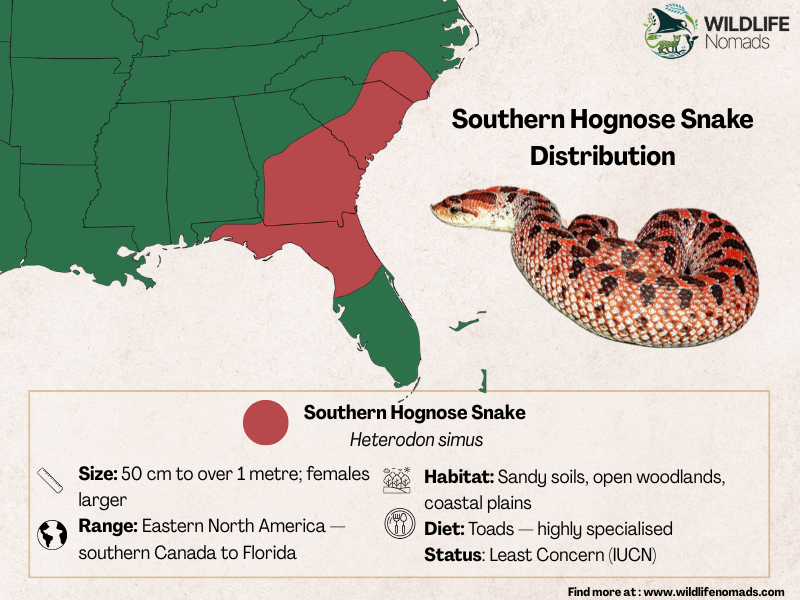
The southern hognose snake deserves far more attention than it receives. It is the smallest, most secretive, and most conservation-sensitive of all North American hognose species — and its future is genuinely uncertain.
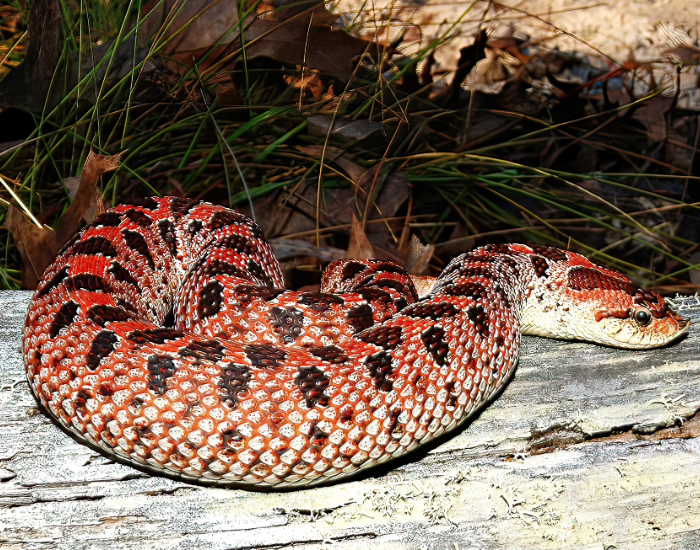
This species has a notably wider, flatter nose than its relatives — the most extreme upturned rostral scale of any hognose. Colouration tends toward tan, grey, or reddish-brown with darker blotches. Adults rarely exceed 60 cm, making the southern hognose noticeably more compact than both the western and eastern species.
Historically, the southern hognose ranged across the coastal plain of the southeastern United States — from North Carolina down through Florida and across to Louisiana. Today, populations have disappeared from large parts of that range. In many states, the species is now considered rare or threatened.
Like the eastern hognose, the southern hognose strongly prefers toads and amphibians as prey. This dietary specialisation, combined with its secretive burrowing behaviour, makes it one of the least-studied snake species in its range. Researchers often go entire field seasons without recording a single individual.
4. Mexican Hognose Snake (Heterodon kennerlyi)
Size: Females up to 90 cm | Males smaller
Range: Southern New Mexico, west Texas, into Mexico
Habitat: Arid grasslands, desert scrub
Diet: Toads, lizards, small rodents
Status: Least Concern (IUCN)
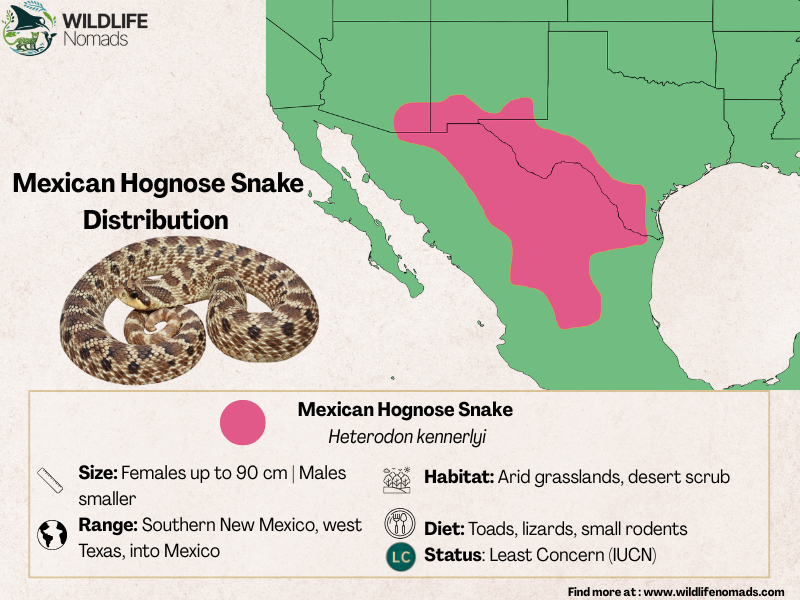
The Mexican hognose snake was long considered a subspecies of the western hognose. However, researchers now recognise it as a distinct species based on genetic and morphological differences. In the United States, this species occurs in southern New Mexico and the western tip of Texas, extending into northern and central Mexico.
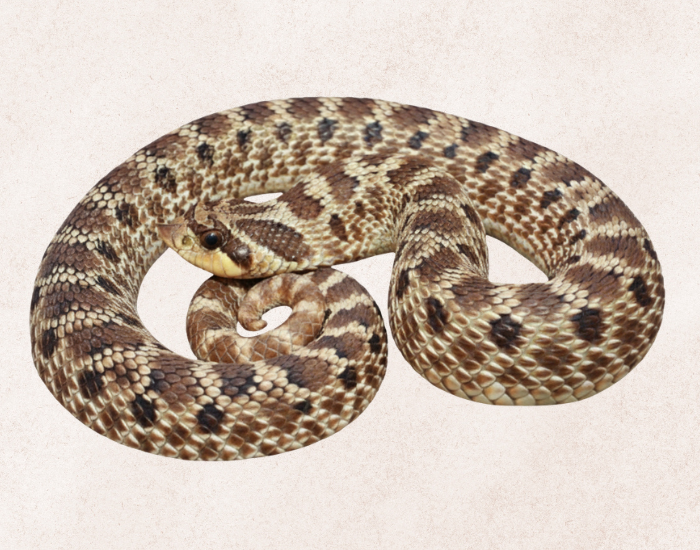
In appearance, the Mexican hognose closely resembles the western hognose — dusty brown or tan with darker blotches and a boldly patterned belly. It occupies arid grasslands and desert scrub habitat, using its upturned snout to dig through sandy soils in search of toads, lizards, and small rodents.
This species shares the same dramatic defence behaviours as its relatives. When threatened by predators, it flattens its neck, hisses, and — when all else fails — rolls onto its back and plays dead. The Mexican hognose has also attracted interest from reptile keepers and, in captivity, generally adapts to a rodent-based diet similarly to the western hognose.
As a relatively recently separated species, the Mexican hognose is still being studied. Its range in the United States is limited, and encounters with the species in the wild are less common than with the western hognose. However, it plays the same ecological role — controlling toad and small rodent populations across arid grassland habitats.
Western Hognose Snake Morphs
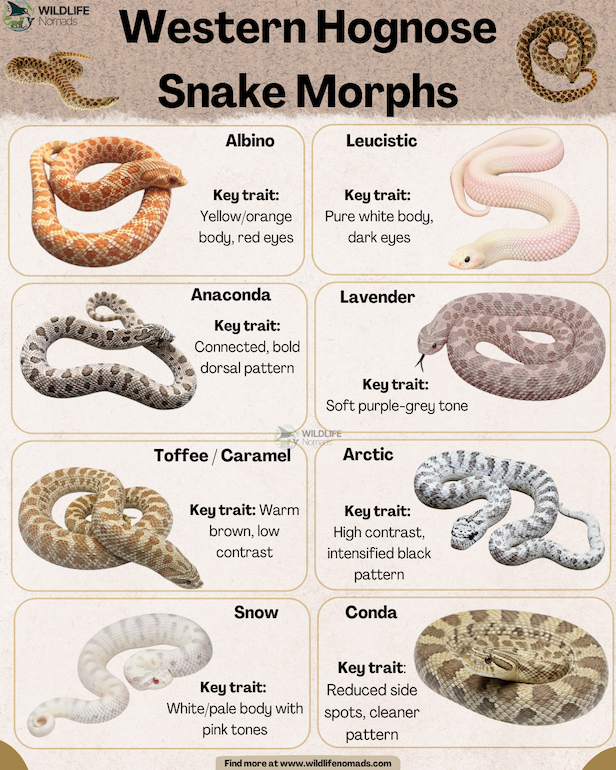
Captive breeding has produced extraordinary colour variation in Heterodon nasicus. The natural dusty tan wild-type is just the starting point. Today, breeders work with dozens of morph combinations. Here are the most popular:
Albino — Bright yellows and oranges with red eyes. The most classic hognose morph, and usually the most affordable entry point into the hobby.
Anaconda — Reduced, connected dorsal pattern inspired by the banding of a green anaconda. Popular for its clean, striking look.
Leucistic — Pure white body with dark eyes. Extremely rare and highly sought after — considered by many breeders to be the holy grail morph.
Lavender — A soft purplish-grey hue across the entire body. Subtle, elegant, and increasingly popular in the high-end market.
Axanthic — Removes all yellow and red pigmentation, leaving a high-contrast black, grey, and white snake. Bold and dramatic.
Breeders regularly combine these base morphs — an albino anaconda or a lavender axanthic, for example — pushing the visual variety even further each season.
Habitat and Distribution of Hognose Snakes
All hognose snake species share one habitat requirement above all others: sandy, loose, well-drained soil. That upturned snout is not decorative — it is a functional digging tool, and without soil suitable for burrowing, hognose snakes cannot thrive.
The western hognose occupies open grasslands and prairies across the Great Plains. The eastern hognose favours sandy woodland edges and coastal plain habitats. The southern hognose is most closely tied to longleaf pine savanna with open sandy ground — one of the most threatened ecosystems in the United States. The Mexican hognose occupies arid desert grassland and scrub in the southwest.
FAQs About Hognose Snakes
Technically, yes — but not in any way that threatens humans. Hognose snakes are rear-fanged venomous, with mild saliva adapted for subduing toads. Bites are rare and typically cause only minor swelling and itching, similar to a bee sting.
Death feigning (thanatosis) is a last-resort defence mechanism. If threatening displays — neck flattening, hissing, mock strikes — fail to drive away a predator, the hognose rolls onto its back and plays dead. Most predators lose interest in apparently dead prey.
No — they are defensive, not aggressive. Every dramatic display is an attempt to avoid contact. In all the time herpetologists have spent studying these species, a western hognose snake biting out of aggression is essentially unheard of.
Western hognose snakes typically live 15–18 years in captivity with proper care. Wild individuals generally have shorter lifespans due to predation and environmental pressures.
The southern hognose snake (Heterodon simus) is the rarest and most conservation-sensitive hognose in North America. Wild encounters are uncommon even within its remaining range, and populations continue to decline across the southeast.
The Drama, Adaptation & Survival of Hognose Snakes
These four hognose snake species represent one of the most fascinating groups of reptiles in North America. From the grassland-dwelling western hognose to the increasingly rare southern hognose clinging to shrinking longleaf pine habitat, each species tells a different story about adaptation, survival, and the pressures facing wildlife today.
Whether you’re spotting a western hognose doing its cobra impression in the prairie, watching an eastern hognose’s colour-change artistry, or reading a research report on southern hognose conservation — these snakes are worth your attention. Keep your distance in the field, choose captive-bred if you’re a keeper, and let these drama queens do what they do best: quietly controlling toad populations while putting on the most theatrical show in the reptile world.