What Makes an Animal Smart?
When we think about intelligence, humans naturally come to mind first. But here’s the thing, we’re definitely not alone in the brains department. The animal kingdom overflows with creatures that showcase jaw-dropping problem-solving skills, emotional intelligence, and clever behavior.
Measuring animal intelligence is a complex challenge, as it involves evaluating a range of cognitive skills and behaviors rather than relying on a single test or metric.
So what exactly makes the smartest animals on our planet so special? It’s not just about being able to solve puzzles (though that’s pretty cool). We’re talking about creatures that can use tools, recognize themselves in mirrors, show empathy, plan for the future, and even deceive others when it serves their purpose. Some of these intelligent animals demonstrate an impressive ability and cognitive abilities that rival those of human children.
Intelligence comes in so many different forms. A dolphin’s social intelligence might be off the charts, while an octopus excels at problem-solving in ways that seem almost alien to us. That’s what makes studying these most intelligent creatures so fascinating, each species has evolved their own unique brand of smarts.
In this deep dive, we’ll explore the top 12 world’s smartest animals, looking at what makes each one special and how researchers measure animal intelligence.

How Do We Measure Animal Intelligence?
Before we jump into our list, let’s talk about how scientists actually figure out which animals are the smartest. It’s not like we can give them an IQ test and call it a day (though researchers have tried some pretty creative approaches).
Instead, measuring animal intelligence involves a variety of tests and observations designed to assess different aspects of cognition. Dutch primatologist Frans de Waal explores this very question in his book “Are We Smart Enough to Know How Smart Animals Are?”, challenging the idea that we can even accurately measure animal intelligence using human standards.

Animal intelligence is typically measured through several key indicators:
- Communication Skills: Some animals have incredibly sophisticated communication systems that go way beyond basic survival needs.
- Problem-Solving Abilities: Can the animal figure out complex puzzles to get food or escape from situations? The best examples involve multi-step processes that require planning and memory.
- Tool Use: Using objects as tools is a big deal in the intelligence world. We’re not just talking about picking up a stick, we mean actually modifying objects for specific purposes.
- Self-Recognition: The mirror test is a classic. If an animal can recognize itself in a mirror (not think it’s another animal), that shows self-awareness, a pretty advanced cognitive ability.
- Social Intelligence: How well does the animal navigate complex social relationships? Can they show empathy, cooperation, or even deception?
- Learning and Memory: How quickly can they learn new behaviors
Evaluating animal intellect is complex, as comparing it to human intelligence involves many challenges due to differences in behavior, cognition, and the ways intelligence manifests across species.
According to scientific research, measuring intelligence across species is challenging because different animals have evolved different types of cognitive abilities based on their environmental needs. A study by the University of Cambridge found that comparing animal intelligence requires looking at multiple cognitive domains rather than trying to rank them on a single scale.

The Top 12 Smartest Animals on Earth
1. Orcas
It is a personal belief that Orcas have secret underwater societies. Just looking at how samrt they are, how could you not believe that? But Okay, jokes aside, as the ocean’s apex predator, Orcas (Killer Whales) demonstrate a level of cognitive and social sophistication rarely seen outside of primates. They live in stable, highly complex, and often matrilineal societies where daughters and sons typically remain with their mothers for life.
This tight-knit structure facilitates extraordinary cultural transmission, resulting in different pods developing unique, specialized hunting strategies, such as wave-washing seals off ice floes in the Antarctic, or the highly coordinated, intentional beaching of individuals to snatch seals off shores in Argentina.
These strategies, along with distinct vocal dialects that vary by clan, are learned and passed down across generations, proving that Orcas possess a non-human culture. Their problem-solving abilities, strategic planning, and emotional intelligence—including displays of empathy and play—secure their place among the world’s most intelligent creatures.
2. Dolphins: The Ocean’s Geniuses
Bottlenose dolphins consistently rank as one of the most intelligent creatures in the world, and spending any time watching them makes it obvious why. These marine mammals have brains that are not only large relative to their body size but also incredibly complex.
Dolphins are one of the few animals that can pass the mirror self-recognition test, showing they are self aware. They’ve been observed using tools, like holding sponges in their mouths to protect their noses while foraging on the seafloor. This behavior is learned culturally and passed down from mothers to daughters.
Their social intelligence is off the charts. Dolphins live in complex societies, have individual signature whistles (basically their names), and engage in complex social interactions, including cooperation in complex hunting strategies and teaching their young specific techniques. Research published in The Royal Society shows that dolphins have distinct personalities and can form alliances that last for decades.
Both dolphins are used in research and military applications, highlighting their intelligence and versatility. Killer whales, another highly intelligent marine mammal, also display advanced social behaviors and cultural learning.
Perhaps most impressively, dolphins seem to have a sense of humor and play. They’ve been observed surfing waves for fun, playing catch with seaweed, and even teasing other animals. That kind of playful intelligence suggests a level of cognitive complexity that’s truly remarkable.

3. Elephants: Memory Masters with Hearts of Gold
When people ask “what animal has the highest IQ?”, elephants definitely deserve to be in the conversation. These gentle giants have the largest brains of any land animal, and they know how to use them.
Elephants are famous for their impressive memory, the phrase “an elephant never forgets” isn’t just a saying. They can remember the locations of water sources during droughts that happen decades apart, recognize hundreds of individuals in their community, and even remember the bones of deceased family members.
Their emotional intelligence is extraordinary, and they display complex behaviors such as mourning their dead, standing vigil over the bodies of family members, and even returning to visit the bones of relatives years later. They show empathy by comforting distressed members of their herd and have been known to help other species in trouble.
Researchers discovered that elephants can work together to solve problems that require coordination. In one study from the University of Cambridge, two elephants had to pull on opposite ends of a rope simultaneously to get food, and they figured it out quickly and remembered the lesson.
Elephants also pass the mirror test, use tools (they’ll strip bark from trees to use as flyswatters), and have been observed apparently painting with brushes when given the opportunity in captivity.

4. Octopuses: The Alien Intelligence
They represent a completely different branch of intelligence evolution, their last common ancestor with vertebrates lived about 600 million years ago, yet they’ve independently evolved remarkable cognitive abilities. A key factor is their unique nervous system, which is highly distributed, with large neural centers not only in the brain but also in their arms, allowing for complex and adaptive behavior.
What makes octopuses so special? For starters, they’re incredible problem solvers. They can navigate complex mazes, open jars from the inside, and figure out puzzles that would stump many vertebrates. Octopuses have been observed solving intricate tasks to access food, such as manipulating objects or opening containers. In experiments, researchers often use a food reward to test their learning and memory, demonstrating how octopuses can adapt their strategies to obtain desirable incentives. The famous octopus Inky escaped from the National Aquarium of New Zealand by unscrewing his tank lid, crawling across the floor, and squeezing down a drainpipe to the ocean.
Studies show that octopuses have both short-term and long-term memory, can learn through observation, and even show individual personalities. Some are bold and exploratory, while others are shy and cautious.
Perhaps most impressively, octopuses appear to play and show curiosity. They’ve been observed repeatedly shooting jets of water at floating objects for no apparent reason other than entertainment, a sign of intelligence that goes beyond mere survival.

5. Crows and Ravens: Feathered Einsteins
Corvids (the crow family) are often called “feathered apes” because of their incredible intelligence. These birds have relatively large brains for their size and cognitive abilities that rival many mammals, challenging the outdated ‘bird brain’ stereotype and proving that birds can be remarkably intelligent.
Crows and ravens are exceptional tool users. They can bend wire into hooks to extract food, use multiple tools in sequence to solve complex problems, and even make tools by combining different materials. New Caledonian crows are particularly famous for their tool-making abilities, creating hooks and spears from twigs and leaves. Their intelligence is further demonstrated by their talent for solving puzzles, which requires advanced reasoning and adaptability.
These birds have excellent memories and can hold grudges, literally. Research from the University of Washington found that crows can remember human faces for years and will teach their offspring to recognize and distrust people who have wronged them.
Ravens show advanced planning abilities. In laboratory tests, they can select and save tools for future use, even when the need for those tools is hours away. They also demonstrate insight learning, solving problems through sudden understanding rather than trial and error.
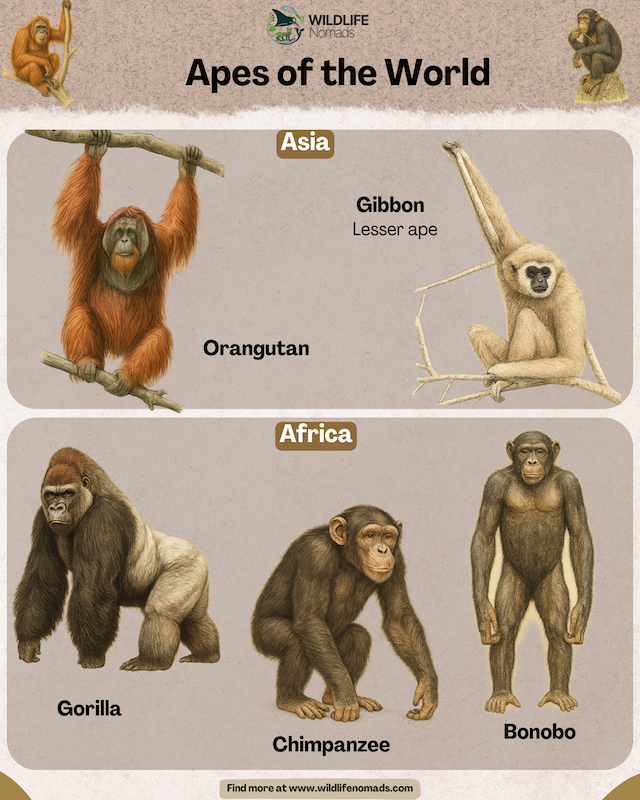
6. Great Apes: Gorillas, Orangutans, and Bonobos
All great apes, chimpanzees, gorillas, orangutans, and bonobos, each deserve recognition as some of the smartest animals in their own right, often displaying intelligence that rivals or exceeds that of other animal species.
Chimpanzees: Our Closest Intelligent Relatives
Let’s start with the obvious choice: many consider chimpanzees among the smartest animals on the planet, and for good reason. These incredible apes share about 98.8% of their DNA with humans, and it shows in their cognitive abilities, which in some areas rival those of a human toddler.
Observers have watched chimpanzees use tools in ways that would make any engineer proud, showing advanced problem-solving skills. They strip leaves from twigs to create termite-fishing tools, use stones as hammers and anvils to crack nuts, and even make spears for hunting. What’s really impressive is that different chimp communities have different tool-using cultures that they pass down through generations, a clear example of social learning.
Jane Goodall’s groundbreaking research at Gombe Stream revealed that chimps have complex social relationships, show empathy, and can even engage in warfare between groups. Human trainers taught chimpanzees sign language (including the famous Washoe), and the apes went on to solve multi-step problems and even recognize themselves in mirrors.
Researchers reported that recent studies from the Max Planck Institute for Evolutionary Anthropology show that chimpanzees can plan for future events and even save tools for later use, a level of foresight that was once thought to be uniquely human. In one experiment, chimpanzees were observed cooperating to solve tasks, further highlighting their sophisticated communication and social cognition as nonhuman animals.
Gorillas
They might look intimidating, but they’re incredibly gentle and intelligent, demonstrating advanced problem solving skills. Human trainers taught the famous gorilla Koko sign language, and she learned over 1,000 signs in American Sign Language, combining them to create new concepts. Gorillas show empathy, grief, and even a sense of humor. They use tools in the wild, like using sticks to test water depth before crossing streams. Social learning is also evident in gorilla groups, as younger individuals often learn behaviors by observing older members.
Orangutans
These primates are the escape artists of the ape world. They’re incredibly good at solving mechanical problems and have been observed making tools for specific tasks. In captivity, orangutans regularly figure out how to pick locks, unscrew bolts, and escape from enclosures that were supposedly “ape-proof.”
Bonobos
They are perhaps the most emotionally intelligent of all apes. They have complex social structures based on cooperation rather than aggression, show remarkable empathy, and can learn to communicate using symbols. In one experiment, bonobos were observed engaging in cooperative behaviors such as sharing food and initiating joint activities, demonstrating their social cognition and communication skills. Research shows that bonobos can understand human speech better than chimpanzees and are more skilled at reading human gestures.
All great apes pass the mirror test, use tools, show emotional intelligence, and can learn human communication systems to some degree. Through social learning and advanced problem solving skills, they represent some of the closest intelligence to our own on the planet, often surpassing other animal species in cognitive abilities.

7. Pigs: Underestimated Geniuses
Here’s one that might surprise you, pigs are incredibly intelligent animals that often get overlooked. Pigs can learn complex tasks faster than dogs and even some primates. They have an impressive ability to navigate mazes, recognize their names, respond to commands, and solve puzzles. In fact, pigs consistently outperform dogs in cognitive tests, which is pretty impressive considering how smart we know dogs to be.
These animals have excellent long-term memories and can remember solutions to problems for years. They show empathy and emotional intelligence, comforting distressed pen-mates and showing excitement when reunited with friends. Pigs also display complex behaviors in their social and emotional lives, such as forming intricate social hierarchies and cooperating with others in group settings.
Pigs are also surprisingly good at video games. In research at Pennsylvania State University, pigs learned to play simple video games using joysticks, demonstrating an understanding of cause and effect that’s quite sophisticated.
They have complex social relationships and communication systems, with over 20 different vocalizations that convey different meanings. Mother pigs even sing to their piglets while nursing, a behavior that shows emotional complexity.

8. African Grey Parrots: The Talking Geniuses
In general, many types of parrots are very smart. In terms of communication, the african grey parrot has to be in the conversation. These remarkable birds don’t just mimic human speech, they actually understand and use language in meaningful ways.
The most famous African Grey was Alex, who worked with researcher Dr. Irene Pepperberg for over 30 years. Alex could identify objects, colors, shapes, and materials. He could count up to six, understood concepts like “bigger” and “smaller,” and could even express when he was bored or wanted to go somewhere else.
African gray parrots are known for their impressive memory, allowing them to recall words, faces, and even events over long periods. They excel at understanding concepts such as shapes, colors, numbers, and sizes, which demonstrates their advanced cognitive abilities and challenges traditional views on animal intelligence.
These parrots show problem-solving abilities, can learn through observation, and demonstrate emotional intelligence. They form strong bonds with their human companions and can become depressed if neglected. In the wild, they have complex social structures and communication systems.

9. Sea Otters: Tool-Using Ocean Engineers
These otters might look adorable, but they’re also remarkably intelligent animals. They’re one of the few mammals that routinely use tools, and they’re incredibly good at it.
They use rocks as hammers to crack open shellfish, and they’re particular about their tools, they often keep favorite rocks in their armpit pouches and reuse them. Some otters have been observed using multiple tools in sequence, like using one rock to dislodge prey and another to crack it open.
These marine mammals also show cultural learning. Different otter populations have different techniques for using tools, and mothers teach these methods to their pups. Young otters spend months learning the proper techniques from their mothers.
Sea otters demonstrate problem-solving abilities and can adapt their behavior to new situations. They’ve been observed figuring out how to open containers, navigate complex environments, and even using teamwork to accomplish goals.

10. Border Collies: The Canine Einsteins
While all dogs are intelligent in their own ways, Border Collies stand out as exceptionally smart. They consistently rank as the most intelligent dog breed and show cognitive abilities that rival some primates.
The most famous Border Collie was probably Chaser, who learned the names of over 1,000 different toys and could retrieve specific ones on command. She could also learn new words through inference, if you asked for a toy she’d never heard of before, she could figure out which one you meant by process of elimination.
Border Collies excel at reading human body language and understanding complex commands. They can learn intricate sequences of behaviors, solve multi-step problems, and show remarkable memory for learned tasks.
These dogs also demonstrate emotional intelligence and can adapt their behavior based on human emotions. They’re incredibly good at their original job of herding sheep because they can anticipate the movements of the flock and make decisions independently.

11. Bees: Tiny Brains, Big Intelligence
This might seem like an odd choice, but honeybees demonstrate remarkable intelligence despite having brains smaller than sesame seeds. When we talk about the smartest creatures on earth, we shouldn’t ignore these tiny geniuses.
Bees can learn to navigate complex routes, remember the locations of flowers, and communicate this information to other bees through their famous “waggle dance.” This dance conveys not just the direction and distance to food sources, but also the quality of the nectar.
In experiments, bees are often given a food reward to test their learning abilities. They can solve problems and perform specific behaviors to access food sources, demonstrating advanced problem-solving skills. Research has shown that bees can learn to recognize human faces, count up to four, understand the concept of zero, and even solve simple mathematical problems. They can learn to associate symbols with rewards and show they understand abstract concepts, often applying implicit category based generalization to transfer learned patterns to new situations.
Bees also demonstrate cultural learning, different hives can develop different foraging strategies that get passed down through generations. They show decision-making abilities when choosing between different food sources and can adapt their behavior based on changing conditions.

12. Rats: Underrated Problem Solvers
Last but definitely not least, rats are an animal species renowned for their intelligence that often get overlooked. These rodents are exceptional problem solvers with impressive memory and social intelligence.
Rats can navigate complex mazes, learn intricate routes, and remember solutions for months. Their adaptability in urban environments further demonstrates their intelligence, as they develop advanced problem-solving skills to thrive alongside humans. They show empathy, in experiments, rats will free trapped companions even when there’s no benefit to themselves. They also show regret, actually appearing to second-guess their decisions when they make mistakes.
These animals have complex social structures and communication systems. They can learn their names, come when called, and even learn tricks. Rats show play behavior and can be taught to play games like hide-and-seek with humans. Their cognitive abilities include implicit category based generalization, allowing them to apply learned patterns to new situations, and understanding concepts such as patterns and categories.
Research has shown that rats dream in ways similar to humans, replaying the day’s events during sleep. They also show metacognition, they seem to know when they don’t know something, which is a pretty advanced cognitive ability.
What Makes These Animals So Smart?
So what do all these intelligent animals in the world have in common? When examining animal intellect, several key factors seem to contribute to high intelligence across species, especially among the most intelligent species compared to other animal species.
Social Complexity: Many of the smartest animals live in complex social groups where they need to navigate relationships, cooperate, compete, and communicate. This social pressure seems to drive the evolution of higher intelligence and highly developed cognitive abilities, often resulting in complex behaviors such as problem-solving, planning, and social learning.
Environmental Challenges: Animals that face varied and unpredictable environments often develop better problem-solving abilities. They need to be flexible and adaptable to survive, which leads to highly developed mental faculties.
Tool Use Requirements: Species that benefit from using tools tend to develop the cognitive abilities needed to make, modify, and use tools effectively. These complex behaviors are often seen in the most intelligent species and can be compared to similar skills in other animal species.
Long Childhood: Animals with extended periods of learning and development often end up smarter. This gives them time to learn complex skills and behaviors from their parents and community, further enhancing their animal intellect.
Brain Structure: While brain size matters to some extent, the structure and organization of the brain is more important. The ratio of brain size to body size, and specifically the development of areas associated with higher-order thinking, correlates with intelligence and highly developed cognitive abilities.

Conservation of Intelligent Animals
The conservation of intelligent animals is more than just a matter of preserving rare species, it’s about safeguarding the very heart of the animal kingdom’s diversity and complexity. Many of the world’s most intelligent animals, including great apes, dolphins, elephants, and African grey parrots, are facing unprecedented threats to their survival. Habitat destruction, poaching, and the accelerating impacts of climate change are putting immense pressure on these highly intelligent beings.
What makes the conservation of these animals so vital is their remarkable cognitive abilities and complex social structures. Great apes, for example, live in intricate societies where cooperation, empathy, and advanced problem solving abilities are essential for daily life. Elephants form deep family bonds and exhibit emotional intelligence that rivals our own, while dolphins rely on sophisticated communication skills and teamwork to thrive in their ocean environments.
In the end, the survival of these intelligent animals is a reflection of our own ability to recognize and respect the complex minds that share our world. Their continued existence enriches our understanding of animal intelligence, and reminds us of the profound connections that link all living beings.
The Future of Animal Intelligence Research
Our understanding of animal intelligence is constantly evolving. Ongoing scientific research continues to expand our knowledge, with a wide variety of animal species being studied for their cognitive abilities. New research techniques, from brain imaging to sophisticated behavioral tests, are revealing cognitive abilities in animals that we never suspected.
One exciting area is comparative cognition, studying how different species solve similar problems in different ways. Recently, researchers discovered that certain bird species can use tools in ways previously thought unique to primates. In another study, researchers reported that raccoons can solve complex puzzles, demonstrating advanced problem-solving skills. This helps us understand not just which animals are smart, but how intelligence itself evolved.
Admiring Intelligence Across Species
These smartest animals on earth remind us that intelligence isn’t uniquely human. We share our planet with animal species that can solve problems, show emotions, use tools, and navigate complex social relationships in ways that continue to amaze researchers.
Understanding and appreciating animal intelligence isn’t just academically interesting, it has real implications for how we treat other animal species and manage our shared environment. The more we learn about the cognitive abilities of these remarkable creatures, the more responsibility we have to protect them.
References:
Carls-Diamante S. (2022). Where Is It Like to Be an Octopus?. Frontiers in systems neuroscience, 16, 840022. https://doi.org/10.3389/fnsys.2022.840022
Croney, C. C., & Boysen, S. T. (2021). Acquisition of a joystick-operated video task by pigs (Sus scrofa). Frontiers in Psychology, 12, Article 631755. https://doi.org/10.3389/fpsyg.2021.631755
Jacobs, I., & Osvath, M. (2023). Tool use and tooling in ravens (Corvus corax): A review and novel observations. Ethology, 129(3), 169–181. https://doi.org/10.1111/eth.13352
Haslam, M., Fujii, J., Espinosa, S., Mayer, K., Ralls, K., Tinker, M. T., & Uomini, N. (2019). Wild sea otter mussel pounding leaves archaeological traces. Scientific reports, 9(1), 4417. https://doi.org/10.1038/s41598-019-39902-y
Howard, S. R., Avarguès-Weber, A., Garcia, J. E., Greentree, A. D., & Dyer, A. G. (2018). Numerical ordering of zero in honey bees. Science, 360(6393), 1124–1126. https://doi.org/10.1126/science.aar4975
Matzel, L. D., & Sauce, B. (2017). Individual differences: Case studies of rodent and primate intelligence. Journal of experimental psychology. Animal learning and cognition, 43(4), 325–340. https://doi.org/10.1037/xan0000152
Plotnik J. M. (2024). Frans B. M. de Waal, 1948 to 2024: Primatologist and evolutionary cognition researcher who brought us closer to our nonhuman relatives. Proceedings of the National Academy of Sciences of the United States of America, 121(33), e2414195121. https://doi.org/10.1073/pnas.2414195121
Vinken, K., Vermaercke, B., & Op de Beeck, H. P. (2014). Visual categorization of natural movies by rats. The Journal of neuroscience : the official journal of the Society for Neuroscience, 34(32), 10645–10658. https://doi.org/10.1523/JNEUROSCI.3663-13.2014