
Raise a Sea Turtle: Adopt a Newborn Sea Turtle
Name your newborn sea turtle and guide it from the nest to the open ocean. Dodge ghost crabs, avoid plastic and help it find its way home.
How to raise your sea turtle
Name your newborn green turtle and play its first chapter. Each chapter is a short game based on a real moment in a sea turtle’s life. You get two chapters on day one, then one new chapter each day.
You have three hearts per chapter. Lose them all and you can try again. Finish all ten chapters to earn a certificate with your turtle’s name.
- The nestChoose where the eggs go
- Hatching dayCrack the egg and dig out
- Dash to the seaDodge the ghost crabs
- Swimming frenzyDive when birds appear
- Snack timeEat jellies, not plastic
- HideEscape a tiger shark
- SeagrassBecome a vegetarian
- BreatheSurface away from boats
- Ghost netsFind the gap
- HomeFollow the magnetic map
What does a newborn sea turtle do first?
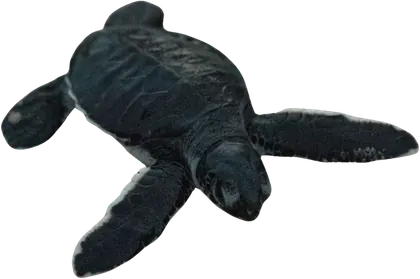
A newborn sea turtle breaks its shell with a caruncle. This temporary egg tooth sits on the tip of its snout. A green turtle hatchling is about 5 cm (2 in) long and weighs about 25 g (1 oz).
Brothers and sisters hatch at almost the same time. They dig up through the sand together, which saves each hatchling energy. The climb takes several days.
Most hatchlings wait just below the surface until the warm sand cools. Then the hatchlings emerge together, in the late afternoon or at night. No parent waits for them. Baby sea turtles look after themselves from the very first day.
How female sea turtles lay eggs
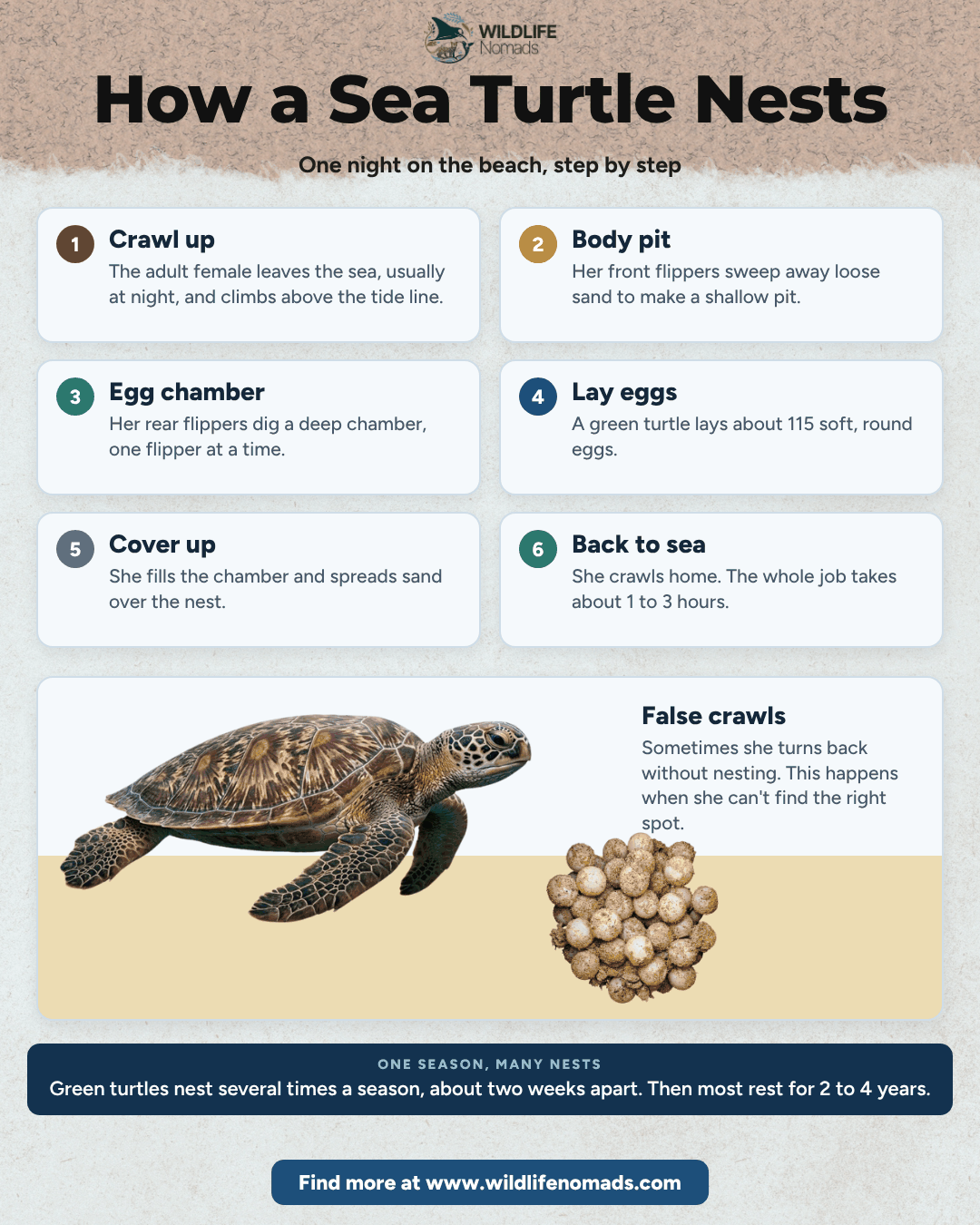
Males and females mate offshore during the mating season. Then the adult female crawls up the nesting beach, usually at night. First, she clears a shallow body pit with her front flippers.
Next, she digs a deep egg chamber with her rear flippers, one back flipper at a time. She lays her eggs, covers them and returns to the sea. The whole nesting process takes about one to three hours.
Sometimes a female turtle emerges, crawls up the beach and turns back without nesting. Turtle researchers call this a false crawl. It happens when she can’t find the right conditions.
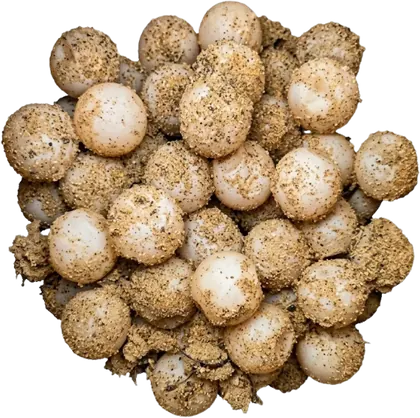
A green turtle lays about 115 eggs per nest. She nests several times in one nesting season, about two weeks apart. Most females then rest for two to four years before they nest again.
How long do turtle eggs take to hatch?
Green turtle eggs incubate in the sand for about two months. Across most sea turtle species, turtle eggs hatch after roughly 45 to 70 days. Warmer nests hatch faster than cooler ones.
Boy or girl? The pivotal temperature decides
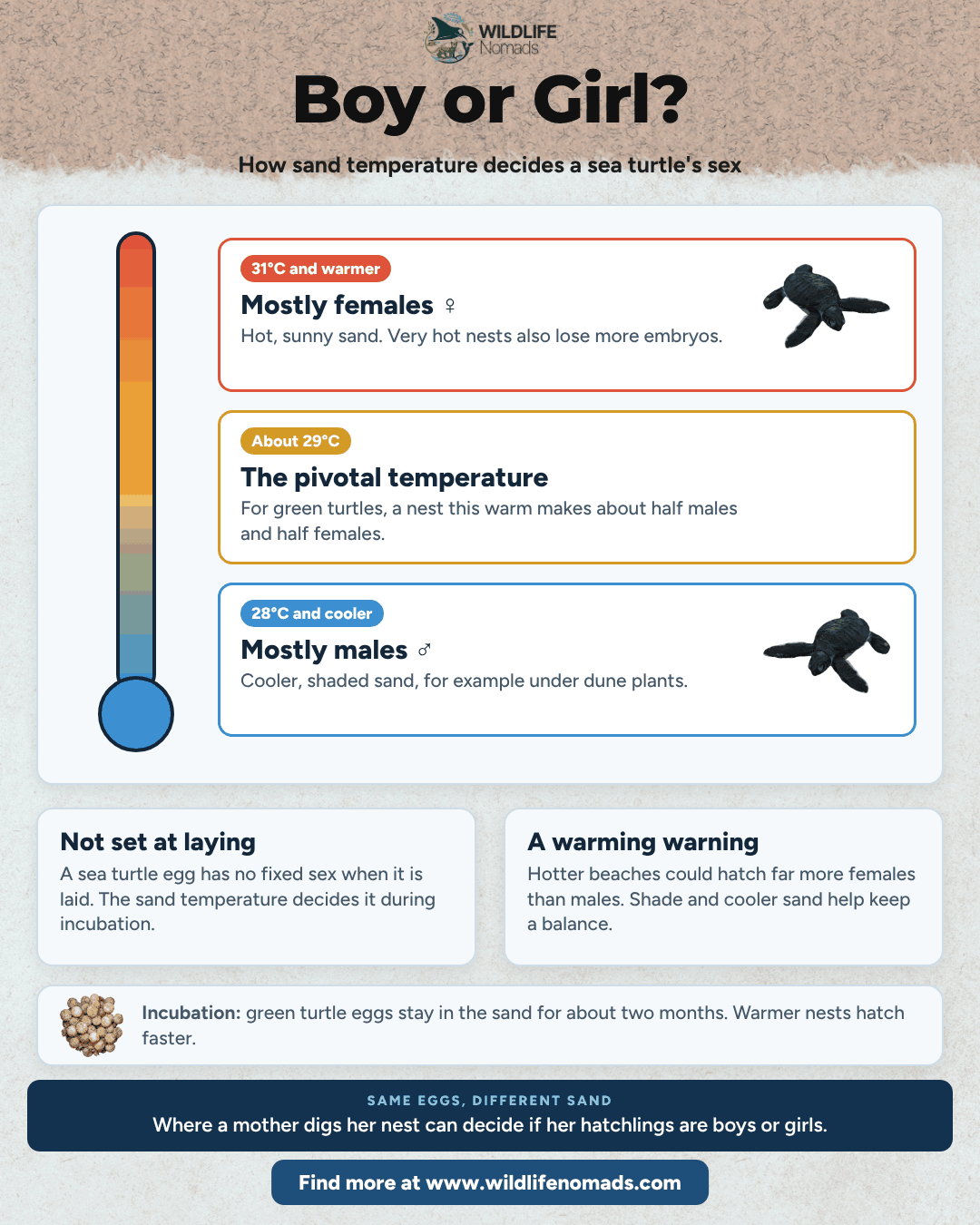
The nest temperature sets each hatchling’s sex. For green turtles, the pivotal temperature sits near 29°C. At that point, a nest makes about half males and half females.
Warmer nests produce mostly females. Cooler nests produce more males. Because of this, climate change worries turtle researchers. Hotter beaches could hatch far more female turtles than male turtles.
How do baby sea turtles find the ocean?
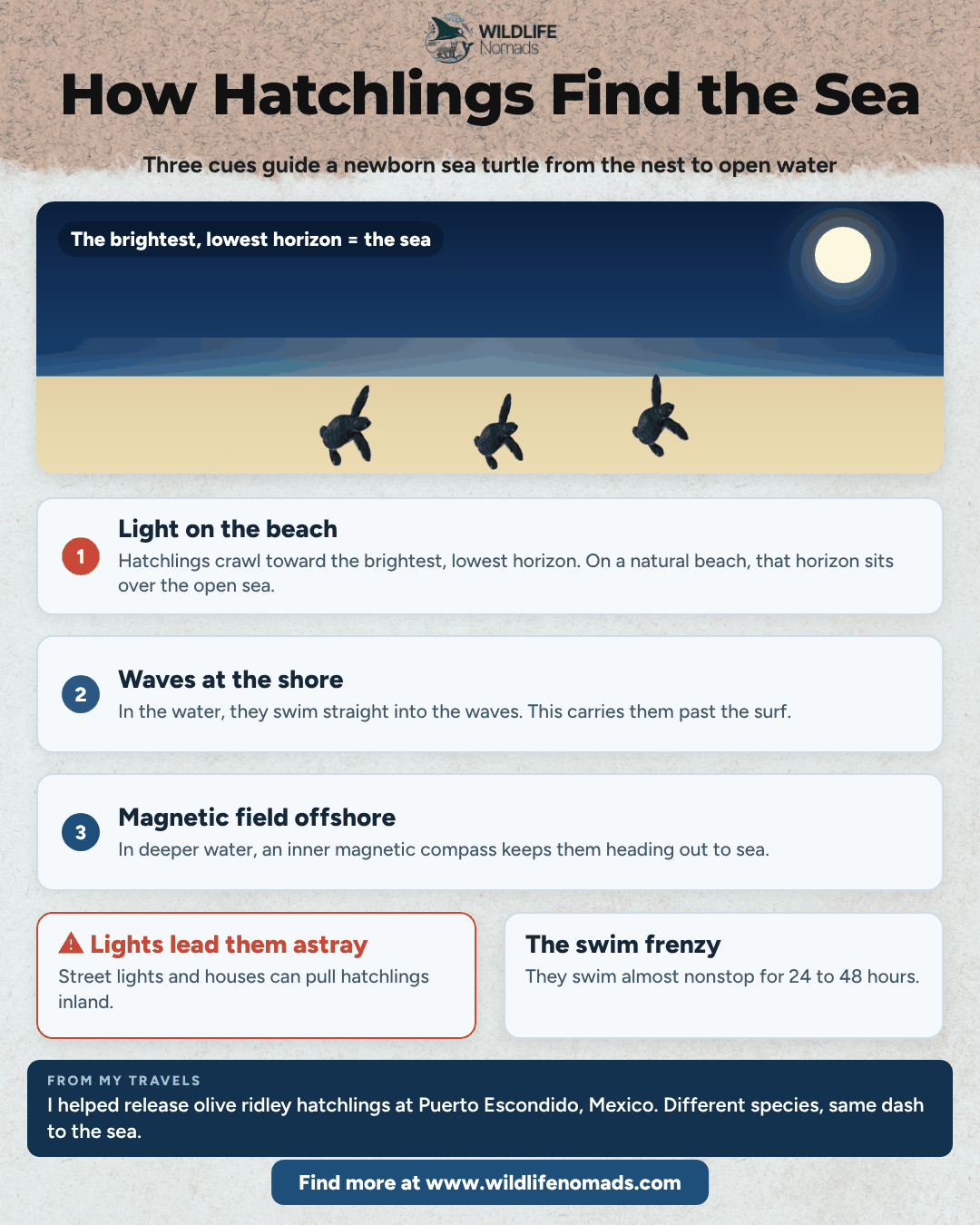
Scientists have tested several theories, and hatchlings seem to use a mix of cues. On the beach, they crawl toward the brightest, lowest horizon. On a natural beach, that horizon sits over the sea.
Once hatchlings enter the water, the swimming frenzy begins. They swim into the waves, almost nonstop for 24 to 48 hours. In deeper water, they steer by Earth’s magnetic fields.
Street lights, houses and other bright lights can pull hatchlings the wrong way. That is why human development near a nesting beach matters so much.
The lost years: juvenile sea turtles at sea
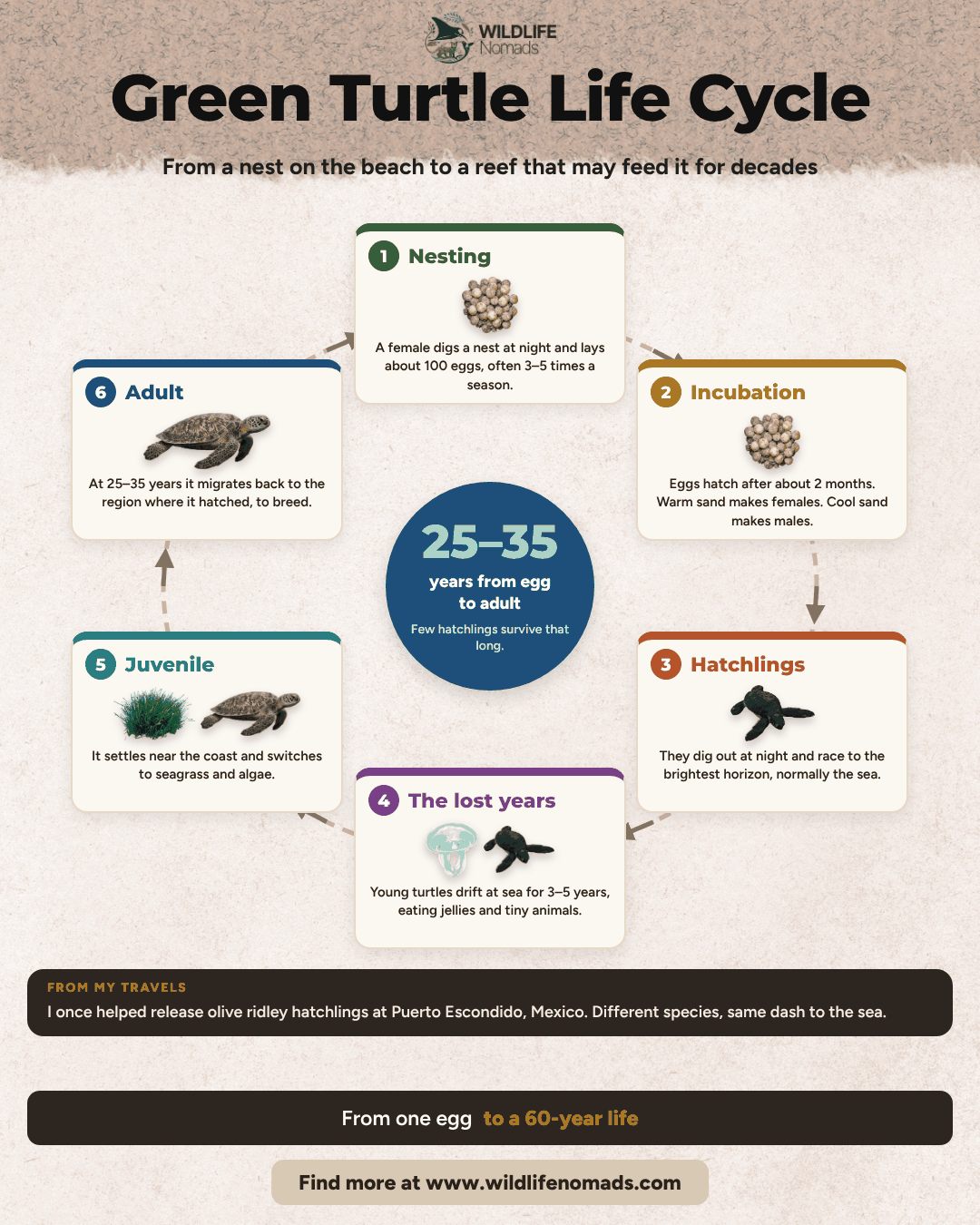
After the frenzy, young turtles drift in ocean currents for years. Scientists call these early years the lost years, because young turtles are so hard to track. Many shelter and feed in floating mats of sargassum seaweed.
Later, juvenile sea turtles move to coastal areas and feeding grounds. In Hawaii, green turtles leave the open ocean at about 35 cm long. That is a little bigger than a dinner plate.
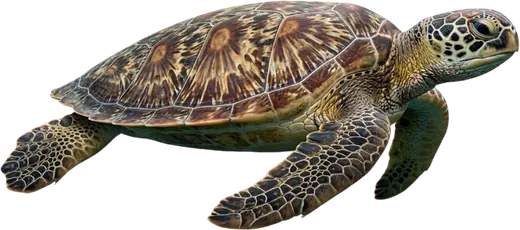
Green turtles then switch to a diet of seagrass and algae. Leatherbacks, the largest sea turtle species, spend most of their lives in the open ocean eating jellyfish.
Returning to the home beach
Scientists believe hatchlings imprint on the magnetic signature of their home beach. Decades later, adult females return to nest on or near the beach where they hatched. Green turtles take about 25 to 40 years to reach adulthood.
How many sea turtle hatchlings survive?
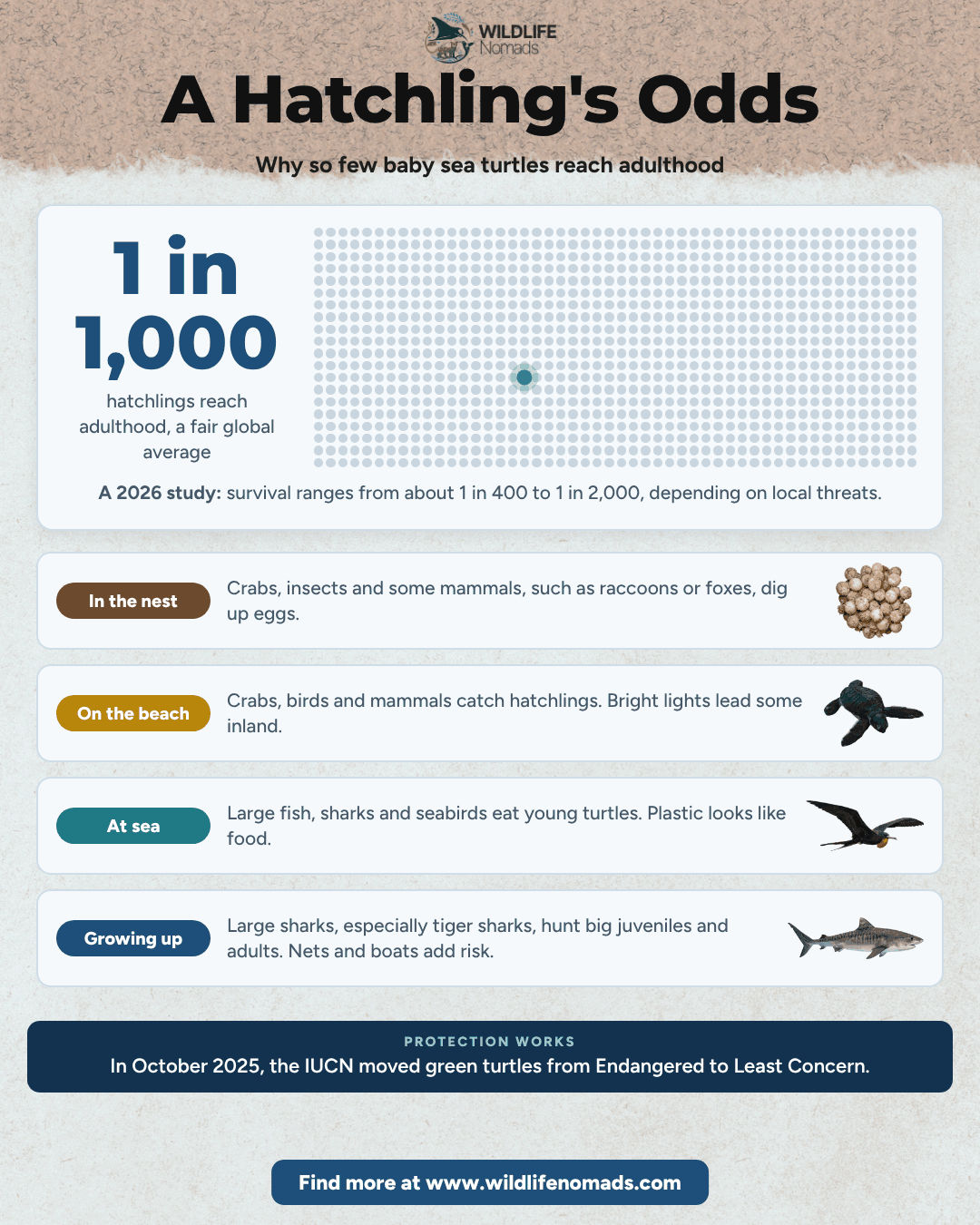
You often hear that about 1 in 1,000 hatchlings reaches adulthood. A 2026 study found this is a fair global average. Survival ranges from about 1 in 400 to 1 in 2,000.
Most hatchlings face many predators. Crabs and birds hunt them on the beach. Fish, seabirds and sharks take them at sea. People add more threats, such as bright lights, plastic, fishing nets and boat strikes.
Where to see nesting turtles on Australia’s east coast
Mon Repos, near Bundaberg in Queensland, has the largest group of nesting marine turtles on the eastern Australian mainland. It hosts the South Pacific’s most important loggerhead nesting population.
| Mon Repos season | Months |
|---|---|
| Nesting turtles | November to January |
| Hatchlings emerge | January to March |
| Main species | Loggerhead turtles, plus some flatbacks |
In the 2023/24 season, rangers there counted about 1,250 nests laid. Book a ranger-guided tour, because the beach closes to the public at night.
My own turtle moment. I helped release olive ridley hatchlings at Puerto Escondido, on the coast of Oaxaca in Mexico. I have also seen sea turtles in the wild from Southeast Asia to the Red Sea.
I built this game around those first steps, from the nest to the open sea.
How you can help newborn sea turtles
- Switch off or shield lights that face a nesting beach. Point outdoor lights down.
- Take beach chairs and gear home, so nothing blocks nesting turtles at night.
- Fill in holes and flatten sandcastles. Holes can trap turtles.
- Keep your distance, and never pick up a hatchling. Follow local rules and rangers.
- Avoid torches and flash photos near nesting turtles and hatchlings.
- Pick up plastic, and slow down when boating in turtle areas.
Where the facts come from
Every fact in the game comes from turtle researchers and government agencies. My sources include the Queensland Government, the US National Park Service and the IUCN Red List. In October 2025, the IUCN moved green turtles from Endangered to Least Concern. Some populations still struggle.
Want more? Read my green sea turtle guide and types of sea turtles. Then explore the Life Cycles Lab, the animals of seagrass meadows and the Coral Reef Explorer. For a quick daily challenge, try the Daily Animal Quiz.
FAQs you May Have
Yes. The game is free, needs no account and works on phones, tablets and computers. Your turtle is saved in your browser.
You get two chapters on your first day, then one new chapter each day. Finish all ten to earn a certificate.
A newborn sea turtle lives off its leftover yolk for its first days. Young green turtles then eat small animals, such as jellies.
Green turtle eggs hatch after about two months. Most sea turtle species take roughly 45 to 70 days, and warmer nests hatch faster.
Yes. Nests warmer than the pivotal temperature, about 29°C for green turtles, produce mostly females. Cooler nests produce more males.
Hatchlings crawl toward the brightest, lowest horizon, then swim into the waves. Bright beach and street lights can lead them inland.
At Mon Repos, near Bundaberg, turtles nest from November to January. Hatchlings emerge from January to March.
Yes. Adult females return to nest on or near their home beach. They seem to recognise its magnetic signature.
About 1 in 1,000 is a fair global average. A 2026 study puts survival between 1 in 400 and 1 in 2,000.
Nothing is lost. You simply replay that chapter. In the wild, hatchlings get no second chance.



