
Geologic time scale: ride the time elevator
Ride the geologic time scale through 4.6 billion years of Earth history, floor by floor. Squeeze it all into one day, rebuild a fossil cliff, survive the Big Five extinctions and find out where humans really fit.
By Cesar Medina, conservation biologist · 6 interactive stops
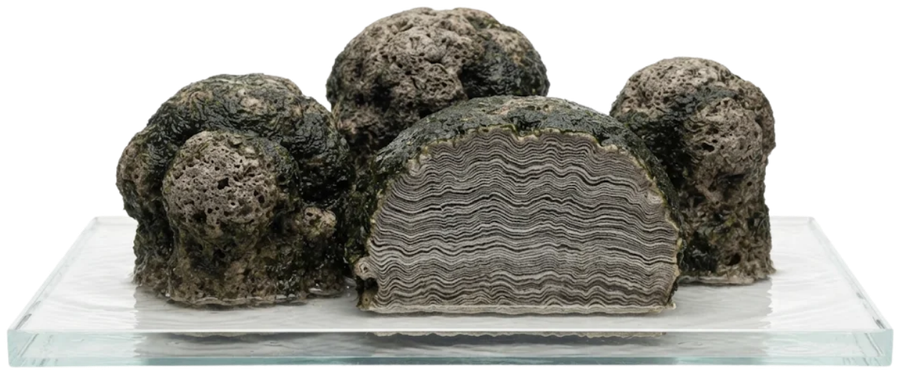 3.5 billion yrs
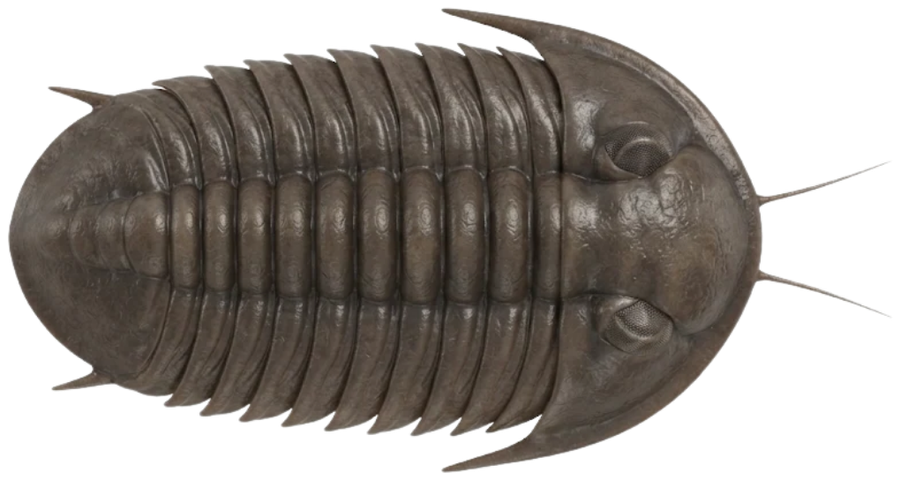 521 million
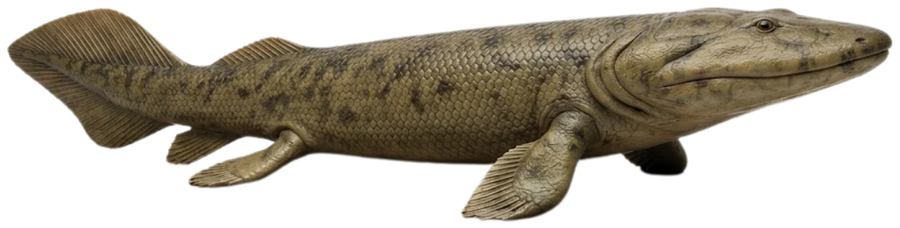 375 million
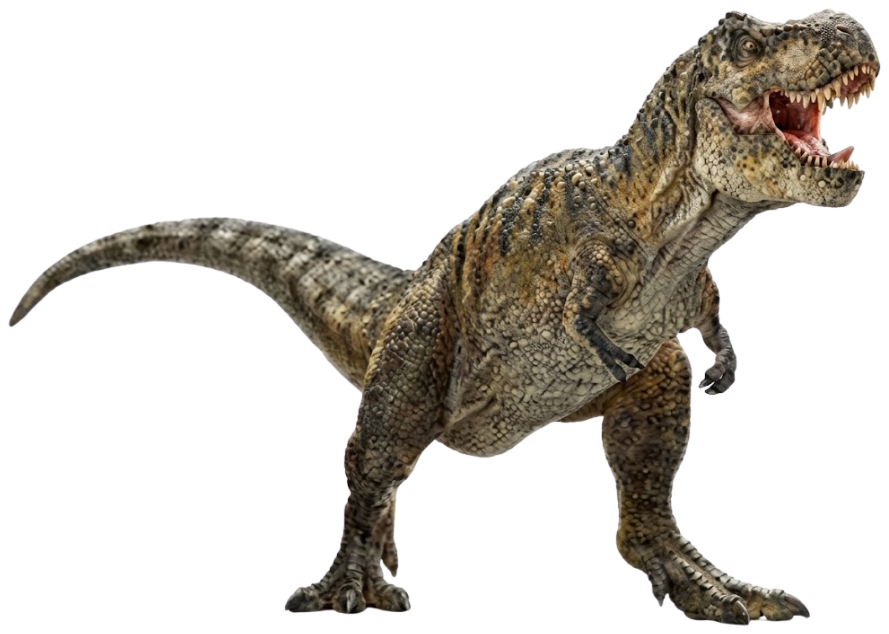 66 million
 Today
What is the geologic time scale?
The geologic time scale, or geological time scale, is the calendar of Earth’s history. Geologists split 4.567 billion years into eons, eras, periods, epochs and ages. Each boundary is defined by changes in rock layers and the fossils inside them.
Geologic time is the deep time of Earth’s history, counted in millions and billions of years. A student emailed me recently asking how humans came from monkeys. That question shaped this lab. I wanted a tool that shows where we really sit in deep time, and how short our story is.
I was born in Mexico. I have walked Chichén Itzá and dived with whale sharks off Holbox. Both sit on the Yucatán Peninsula. The buried Chicxulub crater, where the dinosaurs’ reign ended, lies beneath that same peninsula. Ride the time elevator above, then read on.
The geologic clock: Earth’s history in 24 hours
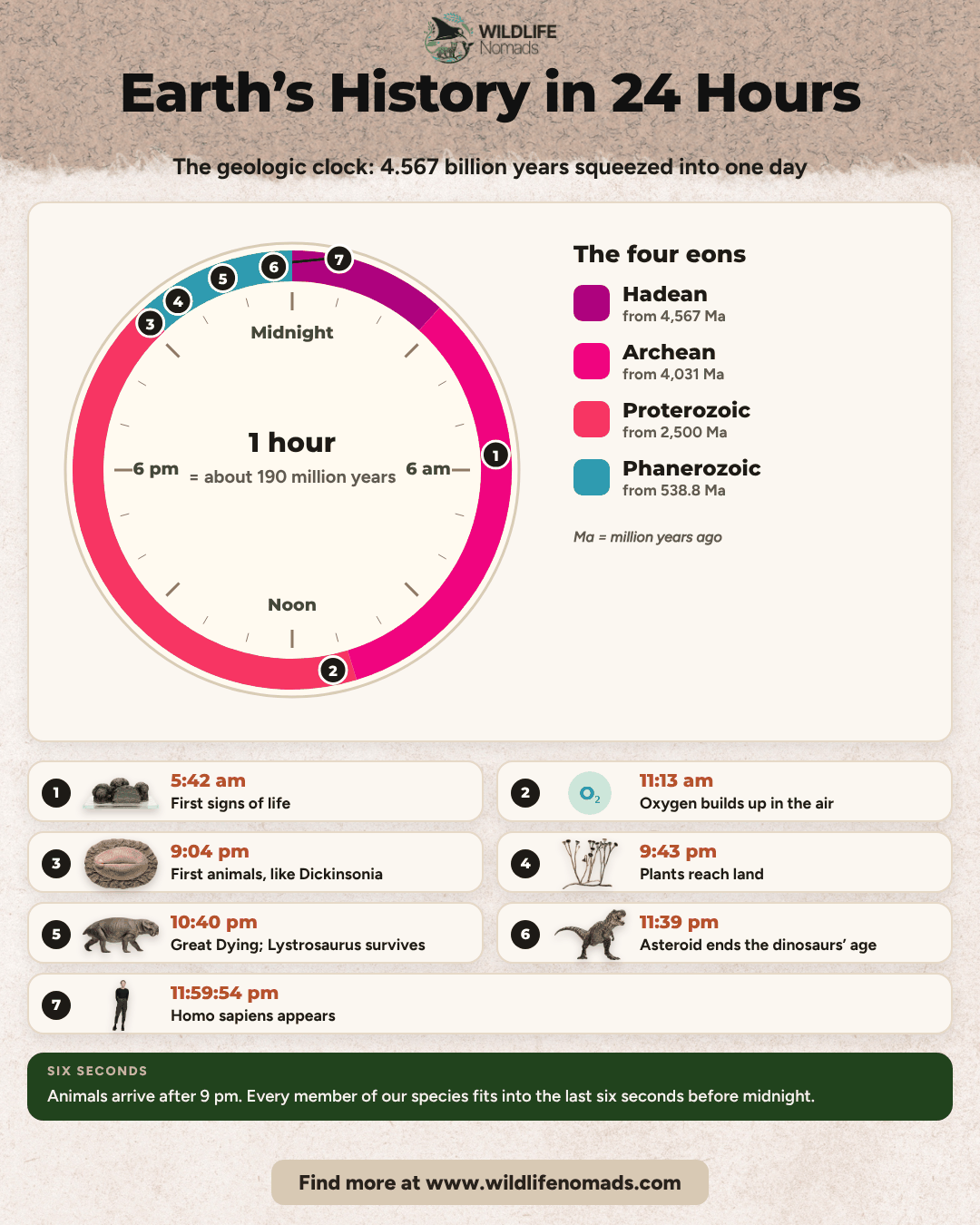
A geologic clock squeezes all of geologic time into one day. Midnight marks the start, 4.567 billion years ago. The next midnight is today. Each hour equals about 190 million years.
| Event | Years ago | Time on the clock |
|---|---|---|
| Earth starts forming | 4,567 million | 12:00:00 am |
| First signs of life (stromatolites) | 3,480 million | 5:42 am |
| Oxygen builds up in the air | 2,430 million | 11:13 am |
| First animals, like Dickinsonia | 558 million | 9:04 pm |
| The Cambrian explosion | 538.8 million | 9:10 pm |
| Plants reach land | 432 million | 9:43 pm |
| The Great Dying | 251.9 million | 10:40 pm |
| First dinosaurs | 230 million | 10:47 pm |
| The asteroid ends the age of dinosaurs | 66 million | 11:39 pm |
| Human and chimp lineages split | 8 to 6 million | About 11:57 to 11:58 pm |
| Homo sapiens appears | 300,000 | 11:59:54 pm |
| The Holocene Epoch begins | 11,700 | 0.2 seconds before midnight |
Life appears before breakfast, but animals only show up after 9 pm. The dinosaurs’ age ends at 11:39 pm. Every member of our species fits into the last six seconds. Try it yourself on the 24-hour geologic clock in Stop 2.
The geologic time scale chart
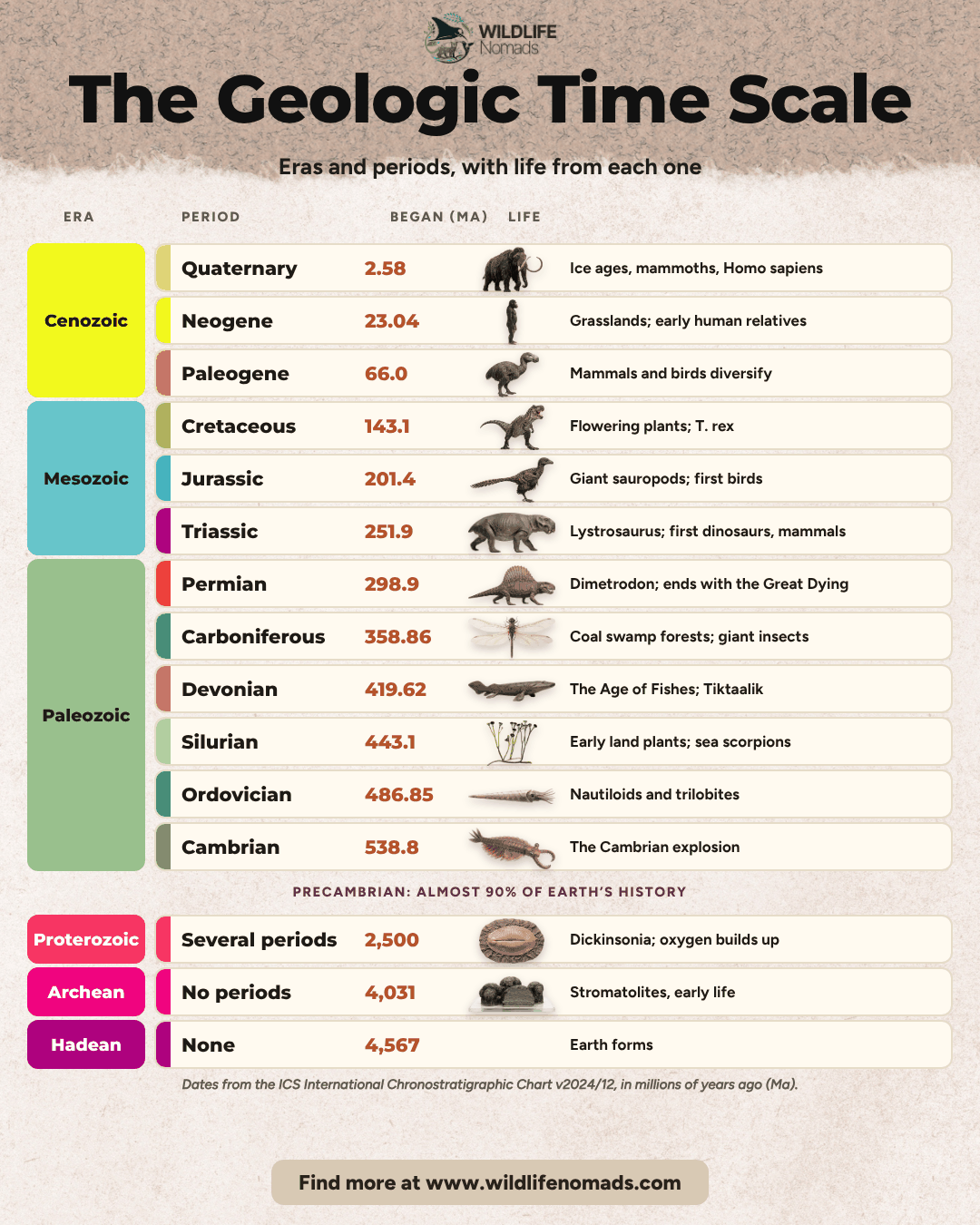
This geological timeline follows the International Commission on Stratigraphy (ICS) chart, version 2024/12. Dates show when each unit began, in millions of years ago. Colours are the official chart colours.
| Eon | Era | Period | Began (million years ago) | Life highlights |
|---|---|---|---|---|
| Phanerozoic | Cenozoic | Quaternary | 2.58 | Ice ages, woolly mammoths, Homo sapiens (from about 300,000 years ago) |
| Phanerozoic | Cenozoic | Neogene | 23.04 | Grasslands spread; the human and chimp lineages split 8 to 6 million years ago |
| Phanerozoic | Cenozoic | Paleogene | 66.0 | Mammals and birds diversify; early primates; whales with legs |
| Phanerozoic | Mesozoic | Cretaceous | 143.1 | Flowering plants spread; T. rex; ends with the asteroid |
| Phanerozoic | Mesozoic | Jurassic | 201.4 | Giant sauropods; Archaeopteryx and the first birds |
| Phanerozoic | Mesozoic | Triassic | 251.9 | Lystrosaurus; the first dinosaurs and early mammals |
| Phanerozoic | Paleozoic | Permian | 298.9 | Synapsids like Dimetrodon; ends with the Great Dying |
| Phanerozoic | Paleozoic | Carboniferous | 358.86 | Coal swamp forests; giant Meganeura and Arthropleura |
| Phanerozoic | Paleozoic | Devonian | 419.62 | The Age of Fishes; Dunkleosteus; Tiktaalik |
| Phanerozoic | Paleozoic | Silurian | 443.1 | Early vascular plants like Cooksonia; sea scorpions |
| Phanerozoic | Paleozoic | Ordovician | 486.85 | Nautiloids and trilobites fill the seas |
| Phanerozoic | Paleozoic | Cambrian | 538.8 | The Cambrian explosion; Anomalocaris; trilobites |
| Proterozoic | Neoproterozoic | Ediacaran (and older periods) | ~635 | Dickinsonia and other early animals |
| Proterozoic | Paleo- to Neoproterozoic | Several periods | 2,500 | The Great Oxidation Event, about 2.4 billion years ago |
| Archean | Four eras | No formal periods | 4,031 | Stromatolites, about 3.5 billion years ago |
| Hadean | None | None | 4,567 | The solar system’s first solids; Earth forms |
The Precambrian is an informal name for everything before the Cambrian. It covers almost 90% of Earth’s history. Most of its life was microscopic, so it left few fossils.
Earth’s eons, eras, periods and epochs
The time scale nests like a set of boxes. Eons are the biggest units. Eras divide eons, and periods divide eras. Epochs and ages split time even finer.
The largest unit. We live in the Phanerozoic Eon, the eon of visible animal life.
We live in the Cenozoic Era and the Quaternary Period. The Cenozoic began right after the asteroid.
We live in the Holocene Epoch. It began about 11,700 years ago, after the last ice age.
Many boundaries mark big changes in life. The Paleozoic, Mesozoic and Cenozoic eras are separated by two mass extinctions. Their names mean old life, middle life and new life.
How do scientists date rocks?
Geologists use two kinds of dating. Relative dating puts events in order. Absolute dating gives them numbers.
- Superposition. In undisturbed rocks, lower layers are older than the layers above them. You rebuild a cliff with this rule in Stop 3.
- Index fossils. Some species lived for a short time but spread widely. Finding them lets geologists match rock layers across continents.
- Radiometric dating. Radioactive elements decay at steady rates. Uranium in zircon crystals turns into lead, so the ratio works like a clock.
Zircons from the Jack Hills of Western Australia are about 4.4 billion years old. They are among the oldest known pieces of Earth.
The birth of Earth’s oceans, air and Moon
Earth’s early geologic history was violent. Rocks and dust collided to build the planet. Most scientists think the Moon formed when a Mars-sized body hit the young Earth.
The oceans came early. The 4.4-billion-year-old Jack Hills zircons hold chemical hints of liquid water at Earth’s surface.
The first atmosphere had almost no free oxygen. Cyanobacteria changed that through photosynthesis. Their oxygen began to build up in the air about 2.4 billion years ago. Geologists call this the Great Oxidation Event.
That oxygen changed the planet’s chemistry for good. It set the stage for oxygen-breathing life, from trilobites to us.
Lessons from Earth’s history for the future
Geologists often say the present is the key to the past. The reverse also helps: the past helps us read the present.
Ancient life left clues about past climates in rocks and fossils. Sea levels have risen and fallen many times. Before the end-Ordovician extinction, glaciers grew and the seas dropped, then rose again.
Today, rising sea levels and a warming climate worry scientists. Earth’s history shows how strongly environmental change can reshape life. Studying that record helps us prepare for the future.
Five crashes on the time scale
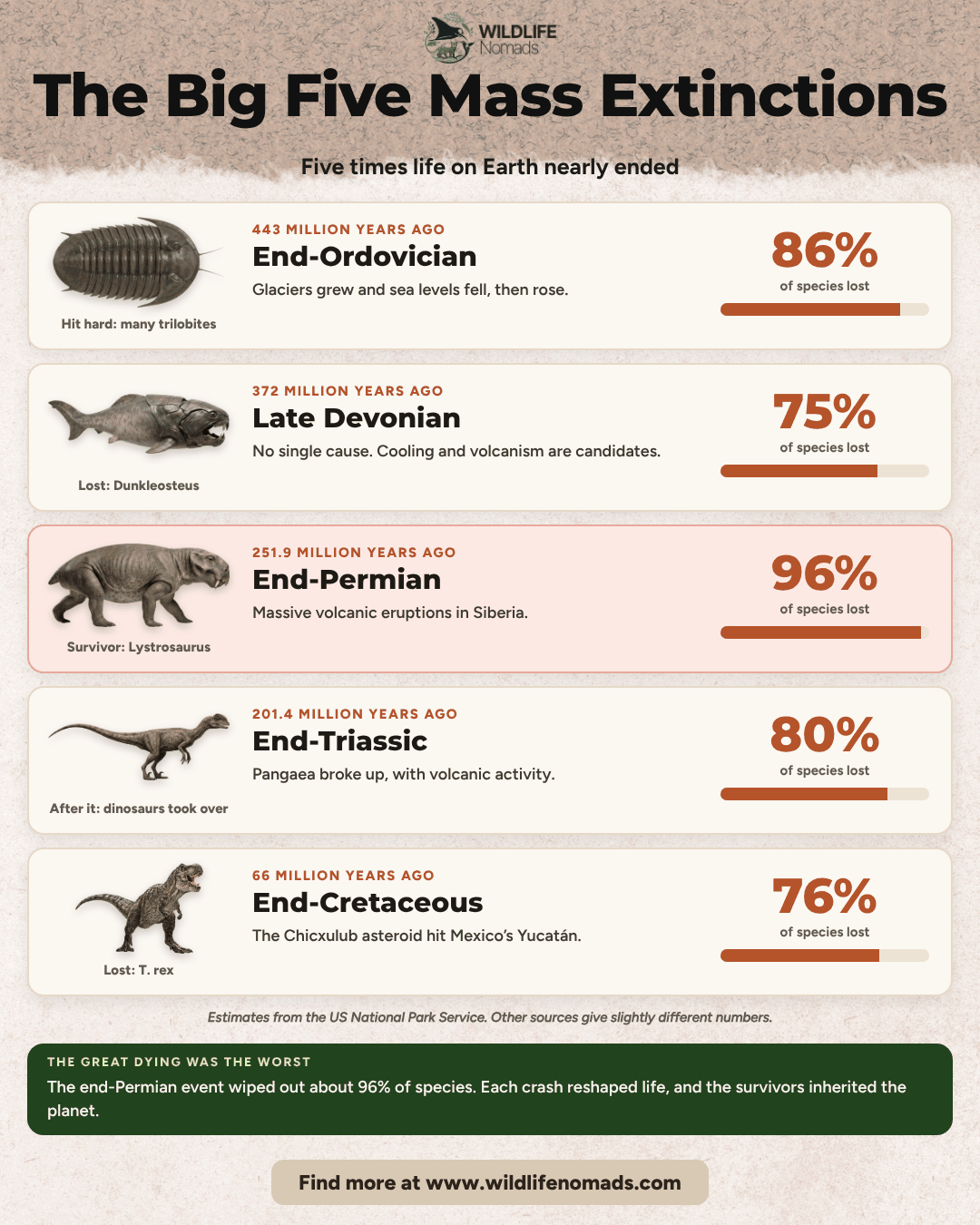
Five times, life on Earth lost most of its species in a geologically short time. Each crash reshaped the living world. The survivors inherited the planet.
| Extinction | Million years ago | Species lost | Likely cause |
|---|---|---|---|
| End-Ordovician | 443 | 86% | Glaciation on Gondwana; sea levels fell, then rose |
| Late Devonian | 372 | 75% | No single cause; cooling, volcanism, an impact and nutrient runoff are all candidates |
| End-Permian | 251.9 | 96% | Massive volcanic eruptions in Siberia |
| End-Triassic | 201.4 | 80% | Pangaea breaking up as the Atlantic opened, with volcanic activity |
| End-Cretaceous | 66 | 76% | The Chicxulub asteroid impact in Mexico’s Yucatán |
Species losses are estimates from the US National Park Service. Other sources give slightly different numbers. The end-Permian event, called the Great Dying, was the worst.
Did humans evolve from monkeys?
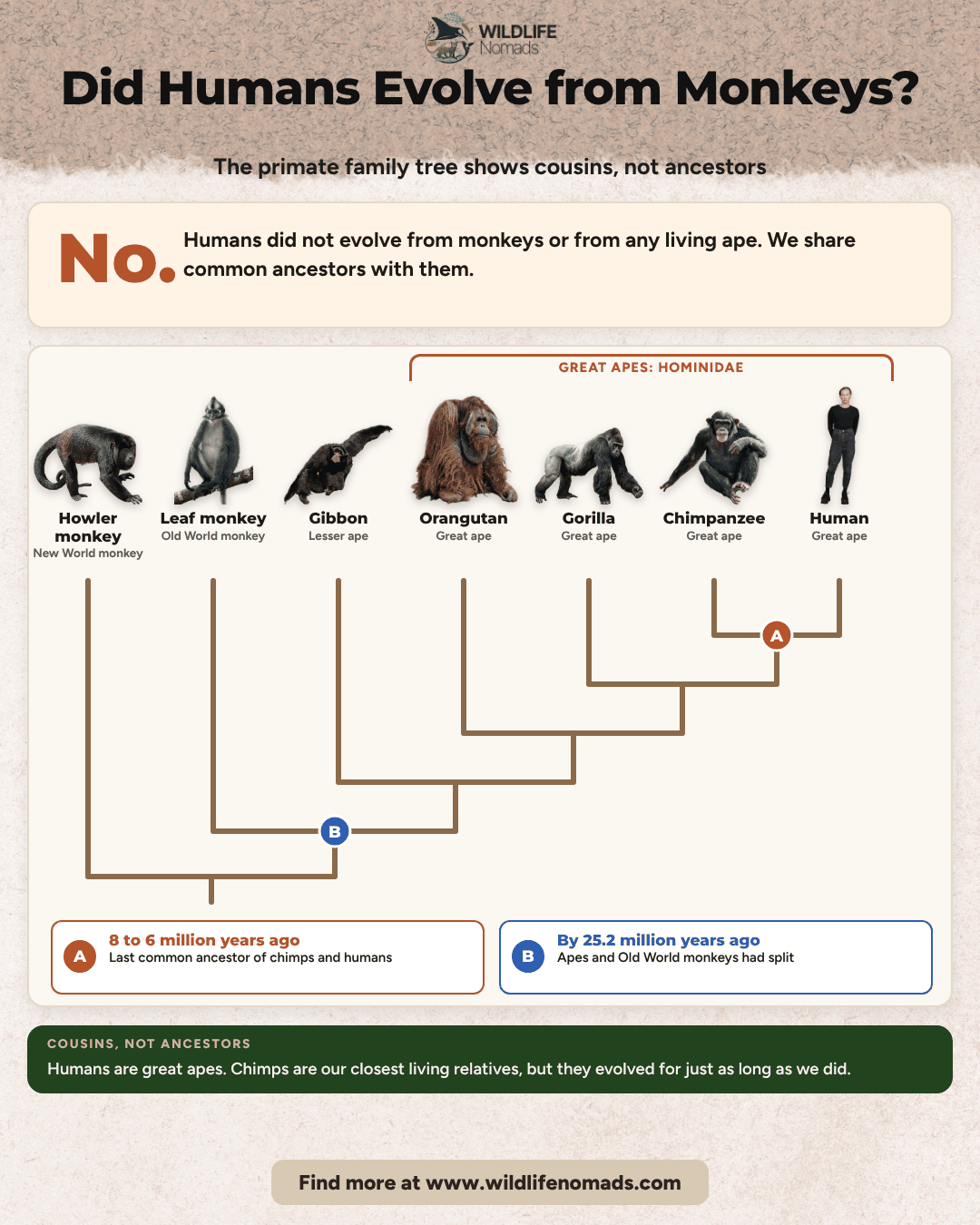
No. Humans did not evolve from monkeys or from any living ape. We share common ancestors with them. Our last common ancestor with chimpanzees lived about 8 to 6 million years ago.
Humans are apes. We belong to the great ape family, Hominidae, with orangutans, gorillas, chimpanzees and bonobos. Monkeys sit on separate branches of the primate tree. Fossils from Tanzania show apes and Old World monkeys had split by 25.2 million years ago.
In Bukit Lawang, Sumatra, I trekked into the jungle and saw gibbons, macaques and orangutans. I looked a mother orangutan and her baby in the eyes. They are our cousins, not our ancestors.
Human evolution is also a bush, not a ladder. Several hominin species often lived at the same time. Trace the branches yourself in Stop 5 of the lab.
Australia’s deep-time record
Australia holds some of the oldest clues to Earth’s history. Several of them star in this lab.
- Pilbara, Western Australia. Stromatolites about 3.5 billion years old are some of the earliest signs of life.
- Jack Hills, Western Australia. Zircon crystals about 4.4 billion years old.
- Ediacara Hills, South Australia. The Ediacaran Period is named after these hills, home to early animals like Dickinsonia.
- Emu Bay Shale, Kangaroo Island. Anomalocaris eyes with more than 16,000 lenses, over 500 million years old.
Explore more interactive labs
Free mini guide
Take deep time with you
All four infographics in one printable PDF: Earth’s history in 24 hours, the geologic time scale chart, the Big Five mass extinctions and the primate family tree, plus a quick quiz.
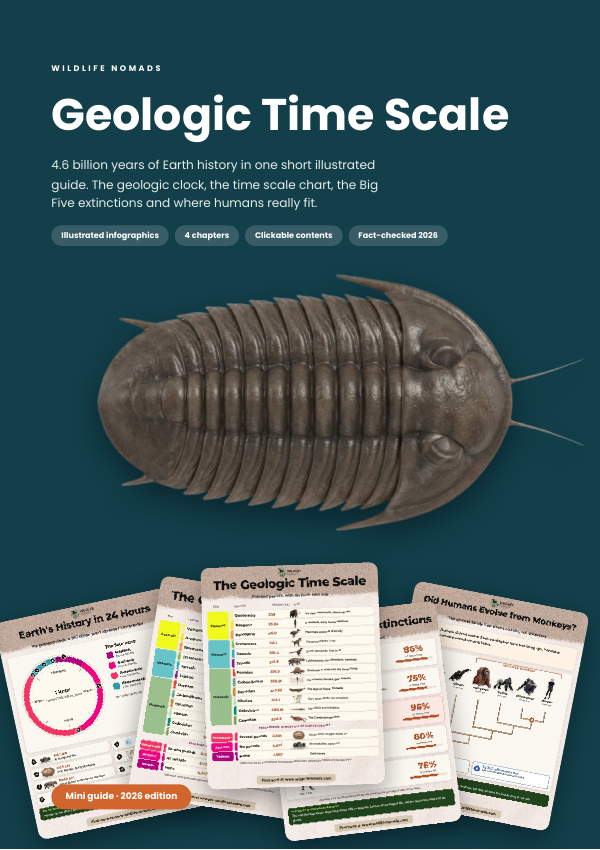 Free PDF · 14 pagesGeologic Time Scale Mini GuideTrilobites, dinosaurs, mass extinctions and our place in deep time, ready to print for home or class.Download free →
Geologic time scale FAQ
The geologic time scale is the calendar of Earth’s history. It divides 4.567 billion years into eons, eras, periods, epochs and ages. Geologists define each unit using rock layers and the fossils they contain.
The four eons are the Hadean (4,567 to 4,031 million years ago), the Archean (4,031 to 2,500 million years ago), the Proterozoic (2,500 to 538.8 million years ago) and the Phanerozoic (538.8 million years ago to today).
We live in the Phanerozoic Eon, the Cenozoic Era, the Quaternary Period and the Holocene Epoch. The Holocene began about 11,700 years ago, after the last ice age.
Earth is about 4.54 billion years old. The geologic time scale starts slightly earlier, 4.567 billion years ago, when the first solids formed in the solar system.
A geologic clock squeezes Earth’s history into 24 hours. Earth starts forming at midnight, animals appear after 9 pm, the dinosaurs’ age ends at 11:39 pm and Homo sapiens arrives about six seconds before midnight.
No. Humans did not evolve from monkeys or any living ape. Humans are great apes, and we share a common ancestor with chimpanzees that lived about 8 to 6 million years ago.
Scientists put rock layers in order with the law of superposition and index fossils. They get numerical ages from radiometric dating, which measures how radioactive elements like uranium decay into lead.
References
Angst, D., Lécuyer, C., Amiot, R., Buffetaut, E., Fourel, F., Martineau, F., Legendre, S., Abourachid, A., & Herrel, A. (2014). Isotopic and anatomical evidence of an herbivorous diet in the Early Tertiary giant bird Gastornis. Naturwissenschaften, 101(4), 313–322. https://doi.org/10.1007/s00114-014-1158-2
Australian Museum. (n.d.). Australopithecus afarensis. https://australian.museum/australopithecus-afarensis
Baumgartner, R. J., Van Kranendonk, M. J., Wacey, D., et al. (2019). Nano-porous pyrite and organic matter in 3.5-billion-year-old stromatolites record primordial life. Geology, 47(11), 1039–1043. https://doi.org/10.1130/G46365.1
Bobrovskiy, I., Hope, J. M., Ivantsov, A., Nettersheim, B. J., Hallmann, C., & Brocks, J. J. (2018). Ancient steroids establish the Ediacaran fossil Dickinsonia as one of the earliest animals. Science, 361(6408), 1246–1249. https://doi.org/10.1126/science.aat7228
Cohen, K. M., Finney, S. C., Gibbard, P. L., & Fan, J.-X. (2013; updated 2024). The ICS International Chronostratigraphic Chart (v2024/12). Episodes, 36, 199–204. https://stratigraphy.org/chart
Daeschler, E. B., Shubin, N. H., & Jenkins, F. A. (2006). A Devonian tetrapod-like fish and the evolution of the tetrapod body plan. Nature, 440(7085), 757–763. https://doi.org/10.1038/nature04639
Davies, N. S., Garwood, R. J., McMahon, W. J., Schneider, J. W., & Shillito, A. P. (2022). The largest arthropod in Earth history: Insights from newly discovered Arthropleura remains. Journal of the Geological Society, 179(3). https://doi.org/10.1144/jgs2021-115
Engelman, R. K. (2023). A Devonian fish tale: A new method of body length estimation suggests much smaller sizes for Dunkleosteus terrelli. Diversity, 15(3), 318. https://doi.org/10.3390/d15030318
Hublin, J.-J., Ben-Ncer, A., Bailey, S. E., et al. (2017). New fossils from Jebel Irhoud, Morocco and the pan-African origin of Homo sapiens. Nature, 546(7657), 289–292. https://doi.org/10.1038/nature22336
Massachusetts Institute of Technology. (2020, July 29). Study narrows the timing of when dinosaurs first appeared. MIT News. https://news.mit.edu/2020/study-timing-dinosaurs-evolution-0729
National Human Genome Research Institute. (2005). New genome comparison finds chimps, humans very similar at the DNA level. https://www.genome.gov/15515096/2005-release-new-genome-comparison-finds-chimps-humans-very-similar-at-dna-level
National Park Service. (n.d.). Mass extinctions through geologic time. https://home.nps.gov/subjects/fossils/mass-extinctions-through-geologic-time.htm
Natural History Museum. (n.d.). Homo erectus, our ancient ancestor. https://www.nhm.ac.uk/discover/homo-erectus-our-ancient-ancestor.html
Paterson, J. R., García-Bellido, D. C., Lee, M. S. Y., Brock, G. A., Jago, J. B., & Edgecombe, G. D. (2011). Acute vision in the giant Cambrian predator Anomalocaris and the origin of compound eyes. Nature, 480(7376), 237–240. https://doi.org/10.1038/nature10689
Smithsonian National Museum of Natural History. (n.d.). Human evolution: Frequently asked questions. https://humanorigins.si.edu/education/frequently-asked-questions
Smithsonian National Museum of Natural History. (n.d.). Homo erectus. https://humanorigins.si.edu/evidence/human-fossils/species/homo-erectus
Stevens, N. J., Seiffert, E. R., O’Connor, P. M., et al. (2013). Palaeontological evidence for an Oligocene divergence between Old World monkeys and apes. Nature, 497(7451), 611–614. https://doi.org/10.1038/nature12161
U.S. Geological Survey. (2007). Age of the Earth. https://pubs.usgs.gov/gip/geotime/age.html
University of Helsinki. (2019). The last mammoths died on a remote island. https://www.helsinki.fi/en/luomus/news/last-mammoths-died-remote-island
Wilde, S. A., Valley, J. W., Peck, W. H., & Graham, C. M. (2001). Evidence from detrital zircons for the existence of continental crust and oceans on the Earth 4.4 Gyr ago. Nature, 409(6817), 175–178. https://doi.org/10.1038/35051550
Wilson Mantilla, G. P., Chester, S. G. B., Clemens, W. A., et al. (2021). Earliest Palaeocene purgatoriids and the initial radiation of stem primates. Royal Society Open Science, 8(2), 210050. https://doi.org/10.1098/rsos.210050



