
Coral reef explorer: swim a 3D Great Barrier Reef and see coral bleaching happen
What is a coral reef?
A coral reef is a living structure built by millions of tiny animals called coral polyps. Each polyp is only a few millimetres wide. However, together they lay down skeletons of calcium carbonate, layer on layer, for thousands of years. As a result, one reef can grow into a ridge, a wall or a ring hundreds of kilometres long.
Corals are animals, yet most of their food comes from sunlight. Inside their tissue live microscopic algae called zooxanthellae. The algae photosynthesise and pass most of their sugars to the coral. In return, the coral gives them shelter, carbon dioxide and nutrients. The algae also give corals most of their colour. Because of this partnership, reef-building corals need clear, shallow and sunny water.
The first time I put my face in the water over a reef, it felt like landing on another planet, like a scene from Avatar. Everywhere I looked, juvenile fish hid between the branches and darted out again. That is why people call coral reefs the rainforests of the sea. So I built the dive above to give you the same feeling, even if you have never been underwater. Swim around, tap anything that moves, and then come back here for the science.
The four types of coral reef
Scientists sort reefs by where they grow in relation to land. Charles Darwin described the first three in 1842, and his idea of how atolls form still holds today. Here is how to tell them apart, with a simple diagram next to a real photo of each.
Fringing reefs
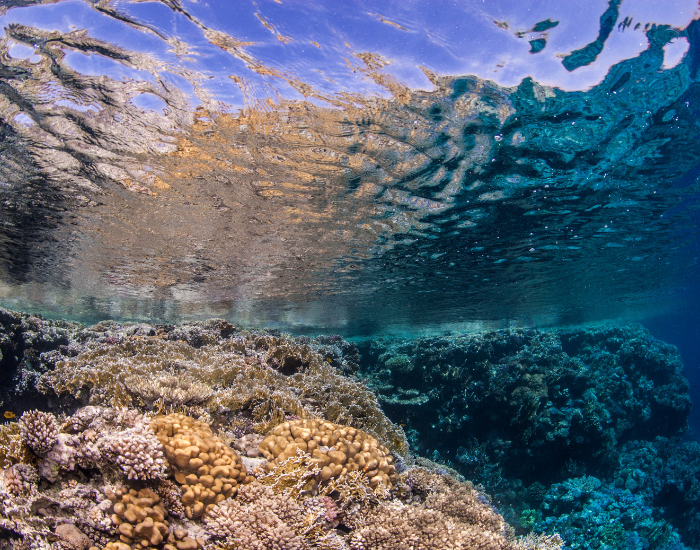
Fringing reefs grow right from the shore, so you can often swim straight onto them. They are the most common type of coral reef. Because they sit so close to land, they also take the full hit of runoff from farms, roads and towns. In Amed, on the east coast of Bali, I could swim to the reef from my accommodation. That closeness feels magical. Still, it means everything that washes off the land ends up on the coral.
Barrier reefs
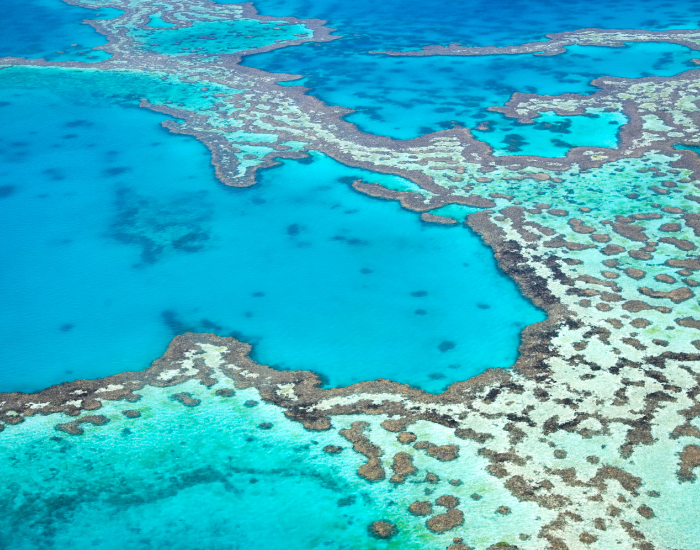
Barrier reefs also follow the coast, but further offshore, with a lagoon between them and the land. The Great Barrier Reef is the most famous example. On the other side of the world, the Mesoamerican Reef runs along Mexico, Belize, Guatemala and Honduras. I dived it around Cozumel, where I once watched two sea turtles fight a young nurse shark for the head of a dead fish.
Atolls
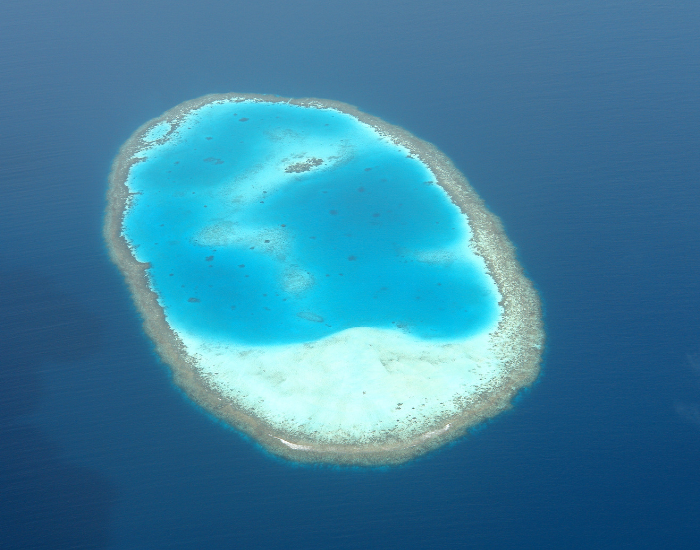
An atoll is a ring of coral around a lagoon. It starts life as a fringing reef around a volcanic island. Then, over millions of years, the volcano slowly sinks. Meanwhile, the coral keeps growing upward towards the light. In the end, only the ring of reef remains, often topped with sandy islands. The Maldives, for example, are built almost entirely on atolls.
Patch reefs
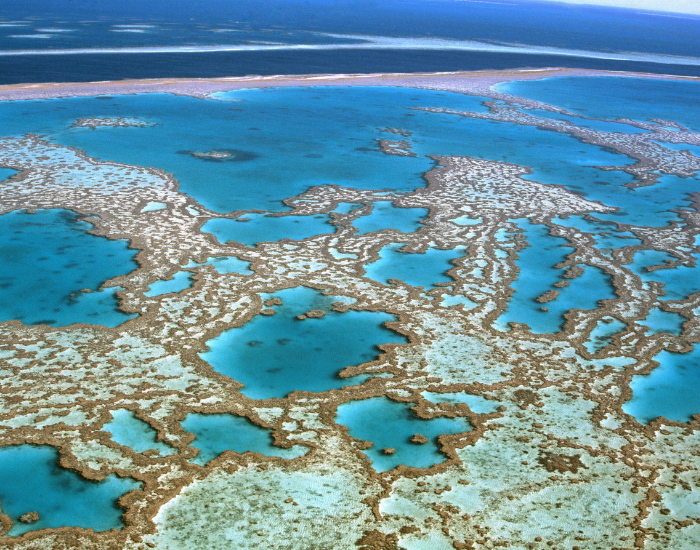
Patch reefs are small, isolated reefs. They grow on the floor of a lagoon or a shallow shelf, often between bigger reefs. The coral heads you swim between above work in a similar way. In Australia they are called bommies. Each one is a small island of life surrounded by sand.
Coral reef marine life: who lives on the reef?
Coral reefs cover less than 1% of the ocean floor. Even so, about a quarter of all marine species depend on them at some point in their lives. Fish are only the start. A reef also shelters sharks, manta rays, turtles, sea snakes, octopuses, sea stars, sea slugs, sponges and countless worms and crustaceans. Below are all 61 species from the 3D dive. Pick a group, then tap any card to open my full guide.
My favourite reef memories are all about these animals. In Coron, in the Philippines, I watched triggerfish and parrotfish over some of the most beautiful coral I have ever seen. Later, in Komodo, whitetip reef sharks swam very close to the shore, and baby sharks hid in the shallows. That showed me how much reefs work as nurseries. In Marsa Alam, on the Red Sea, I snorkelled from the shore among lionfish and rays. I also searched the seagrass for dugongs, although they never showed up.
The Great Barrier Reef
The Great Barrier Reef runs for about 2,300 km along the coast of Queensland, Australia. In fact, it is not one reef but more than 2,900 separate reefs and about 900 islands. Together they form the largest coral reef system on Earth, and it became a World Heritage Area in 1981. I saw my first clownfish there in 2019. On the same trip, I also saw coral bleaching for the first time: white branches right next to healthy ones. Since then, I have never looked at a reef in quite the same way.
Mass bleaching used to be rare. Now the reef has bleached five times since 2016: in 2016, 2017, 2020, 2022 and 2024. After the 2024 event, the Australian Institute of Marine Science recorded the largest one-year drop in coral cover in two of its three regions in 39 years of monitoring. Then, in 2026, monsoon clouds cooled the water and coral cover held steady. So the reef can bounce back. However, the gaps between heatwaves keep shrinking.
The problem is global, too. During the fourth global bleaching event, from 2023 to 2025, about 84% of the world’s reef area was exposed to heat strong enough to cause bleaching.
What is coral bleaching?
Coral bleaching happens when the water stays too warm for too long. Stressed corals expel their zooxanthellae, and the white skeleton shows through their clear tissue. A bleached coral is not dead yet. However, it has lost most of its food, so it starts to starve. If the water cools in time, the algae can return within weeks to months. If the heat lasts, the coral dies and turf algae cover its skeleton.
Sometimes corals glow neon pink, blue or yellow before they turn white. Bollati et al. (2020) found that these colours come from the coral’s own pigments. They work like a sunscreen, which may help the algae move back in after mild heat stress.
How hot is too hot? Degree heating weeks
NOAA Coral Reef Watch measures heat stress in degree heating weeks (DHW). First, it checks how far the water rises above a reef’s usual summer maximum. Only water at least 1 °C above that maximum counts. Then it adds up those hot spells over the last 12 weeks. At about 4 DHW, significant bleaching is likely. At 8 DHW or more, severe bleaching and widespread coral death are likely.
Hughes et al. (2017) showed why this matters so much. In 2016, the amount of bleaching on each reef followed the heat, while clean water and fishing rules gave little protection against it. In other words, local care cannot stop mass bleaching on its own. Cutting greenhouse gas emissions is the only long-term fix. You can watch the whole process in the Heatwave lab of the dive above.
The biggest threats to coral reefs
Heat is the biggest threat, but it is not the only one. Most reefs face several problems at once, and each one makes the others worse. I explain the wider picture in how climate change threatens animals.
Pollution, sediment and wastewater
Poor water quality is the threat you can see from the beach. Rain washes soil off cleared land, farms and dirt roads. The sediment then smothers corals and blocks their light. Fertilisers also feed seaweed that crowds young corals out. Meanwhile, untreated wastewater brings bacteria and nutrients that make coral disease more likely. For example, in Half Moon Bay on Roatán, Honduras, coral disease fell from 25% to zero between 2011 and 2016 as wastewater treatment improved.
In Bali I saw the other side. The reefs were full of life, yet plastic bags drifted between the corals. It felt daunting. My guide to how ocean pollution affects sea animals explains what that plastic does next.
Overfishing
Overfishing removes the fish that keep a reef in balance. Parrotfish and surgeonfish graze the seaweed that would otherwise cover young corals. Predators such as coral trout and reef sharks, in turn, keep the whole food web in check. When they are gone, a coral reef recovers far more slowly from every storm and heatwave. That is why apex predators matter on the reef too.
Crown-of-thorns starfish
On the Great Barrier Reef, crown-of-thorns starfish are one of the main causes of coral loss, along with cyclones and bleaching. They eat coral polyps. During an outbreak, they can strip whole reefs of living coral. Look for one on the bommies above: it is one of the six dive missions.
Coral restoration: can we help a reef recover?
Coral restoration means growing new corals and returning them to damaged reefs. Most projects start in a nursery. Divers take small fragments from healthy corals and grow them on ropes, frames or underwater trees. Once they are big enough, the team plants them on the reef. Some projects also collect coral spawn, raise the larvae and settle them onto damaged areas. In nature, coral larvae can drift long distances on currents, so healthy reefs also reseed damaged ones.
In 2025, Wildlife Nomads joined a coral restoration project in Pemuteran, in northern Bali, with the non-profit Metamorfosa Bali. We planted coral on the reef and met its co-founder, Ketut Totok. Between the coral frames I also found a long, slender seahorse. Of all my days on a reef, this is the one I am proudest of. It turned me from a visitor into a small part of that reef’s future.
Still, restoration is not a cure on its own. It stabilises damaged areas and speeds up recovery. Yet it works best when local threats are reduced first. Clean water, sustainable fishing and protection have to come together. Otherwise, the new corals simply die of the same causes as the old ones. Cabo Pulmo in Mexico shows what protection alone can do for fish populations.
How to get involved in saving coral reefs
You don’t need to be a marine biologist to help. Here are the ways I try to support reefs, at home and when I travel. Even one action a year adds up, especially when you share what you learn with friends.
Test yourself: three quick questions
Think of your answer, then tap to check. After that, the full 12-question reef quiz waits in the dive above.
Are corals plants or animals?
Animals. Each polyp is a tiny relative of jellyfish and sea anemones, although the algae inside it make most of its food.
Is a white, bleached coral already dead?
Not yet. It has lost its algae and is starving, so it can still recover if the water cools in time.
Which fish turn coral into white sand?
Parrotfish. They scrape algae off dead coral with their beaks, and the ground-up skeleton comes out as fine sand.
Coral reef FAQ
What kind of marine life can be found in coral reefs?
Almost every major group of sea animals lives on coral reefs. There are fish such as clownfish, parrotfish, wrasses and groupers, as well as blacktip and whitetip reef sharks. Reefs also hold sea turtles, octopuses, cuttlefish, sea stars, sea cucumbers, giant clams, nudibranchs and sponges. In addition, seagrass and algae grow around them.
What are 10 common marine fish species?
On a tropical reef, ten fish you are likely to meet are the clownfish, blue tang, moorish idol, butterflyfish, damselfish, parrotfish, cleaner wrasse, triggerfish, coral trout and lionfish. All ten swim in the dive above. For many more, see my guide to coral reef fish.
What is a reef in the ocean?
A reef is a ridge of rock, sand or living coral that rises from the seabed close to the surface. Coral reefs are the living kind. Others are rocky reefs, oyster reefs and artificial reefs such as shipwrecks.
What are the best marine reef fish?
It depends on what you want to see. For snorkellers, clownfish, parrotfish, moorish idols and butterflyfish are the easiest to spot and to love. For divers, groupers, turtles and reef sharks are often the highlight. If you mean aquarium fish, choose captive-bred ones, because many marine aquarium fish are still taken from wild reefs.
Can a bleached coral reef recover?
Yes, if the heat does not last too long. Bleached corals can regain their algae within weeks to months. Reefs where many corals died, however, need a decade or more of cool, clean water to grow back.
Where is the best coral reef to dive?
The Great Barrier Reef, Raja Ampat, the Red Sea and the Mesoamerican Reef are all world class. You can compare them in my guide to the best scuba diving destinations in the world.
If you enjoyed this dive, keep exploring the ocean with the deep sea species explorer and the shark size comparison.



