The Iconic Springbok Antelope
The springbok (Antidorcas marsupialis) stands as one of Africa’s most distinctive antelopes. As a quintessential animal of South Africa, the springbok is recognized for its ecological role in local ecosystems and its cultural importance as a national symbol. This medium-sized antelope is endemic to south and southwestern Africa, thriving across vast grasslands and semi-deserts. The animal has evolved into a masterpiece of adaptation, perfectly suited for a harsh and unpredictable environment.
Southern Africa celebrates the springbok as both wildlife icon and cultural symbol. South Africa’s national animal holds deep significance, representing the endurance and spirit of the region. The national rugby team proudly carries “The Springboks” nickname, cementing this antelope’s place in cultural heritage.
The Afrikaans word for springbok means “to show off,” referencing the animal’s unique leaping display. The name ‘springbok’ itself comes from the Afrikaans words ‘spring’ (to jump) and ‘bok’ (antelope or goat), highlighting both the animal’s jumping ability and its Afrikaans linguistic roots.

12 Springbok Facts
1: The Sole Living Member of Its Genus
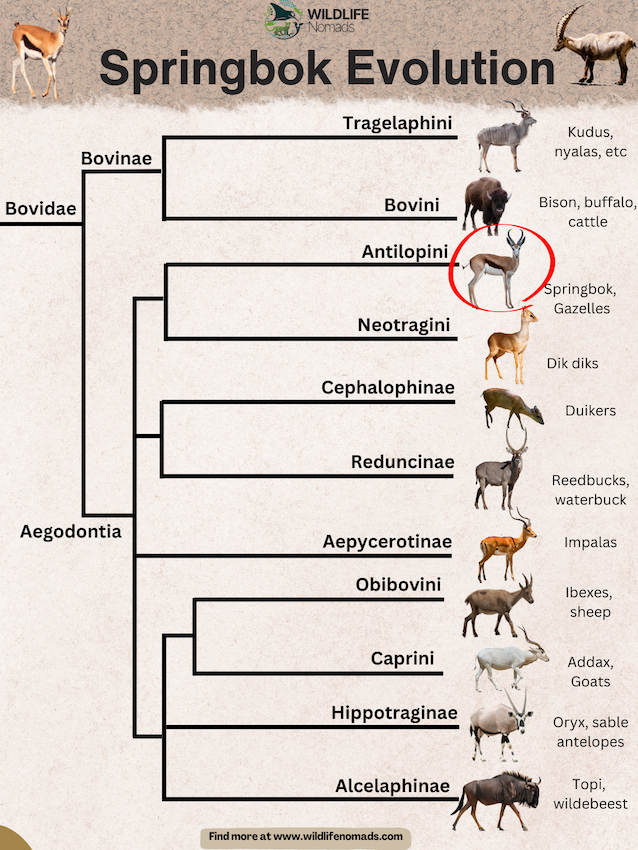
Scientists classify the springbok within the genus Antidorcas. Unlike most other antelopes and true gazelles, this species remains the only living member of its genus. This unique taxonomic position separates it from close relatives like the impala.
The fossil record reveals that Antidorcas has inhabited southern Africa for millions of years. The modern springbok evolved approximately 3 million years ago during the Pliocene. Two extinct species, A. bondi and A. australis, once roamed Africa but disappeared during the early Holocene around 7,000 years ago. In addition to these, a third species within the genus Antidorcas is recognized in the fossil record, providing important insight into the evolutionary history and ancestral lineage of the modern springbok.
While springbok are often visually mistaken for gazelles, distinct anatomical features set them apart. The pocket-like skin flap along their back represents one such unique characteristic. However, they share evolutionary connections with true gazelles through the subfamily Antilopinae.
2: South Africa’s National Animal
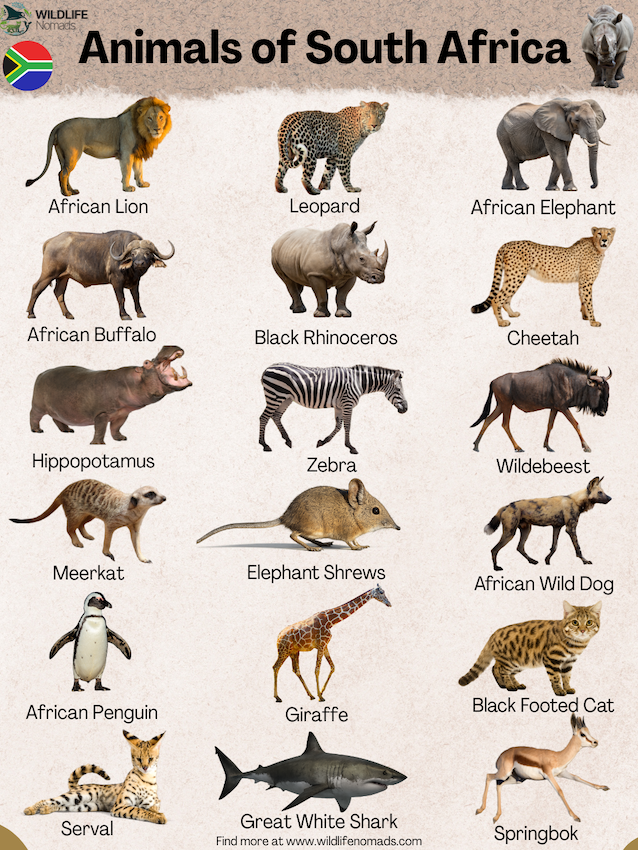
South Africa officially recognizes the springbok as its national animal. The springbok is widely recognized as the national animal of South Africa, and is often referred to as the national animal of South in various cultural and sporting contexts. This designation honors the species’ endurance, agility, and native status throughout the region. The symbolism extends prominently to sporting culture.
The South African national rugby team proudly embraces “The Springboks” nickname. This connection dates back over a century, linking athletic prowess with the antelope’s remarkable speed and agility. The emblem appears on jerseys, representing national pride.
Beyond sports, the springbok features prominently in South African heritage. The animal symbolizes the country’s natural wealth and biodiversity. Conservation efforts receive strong public support due to this cultural significance.
3: The Spectacular Pronk Leap
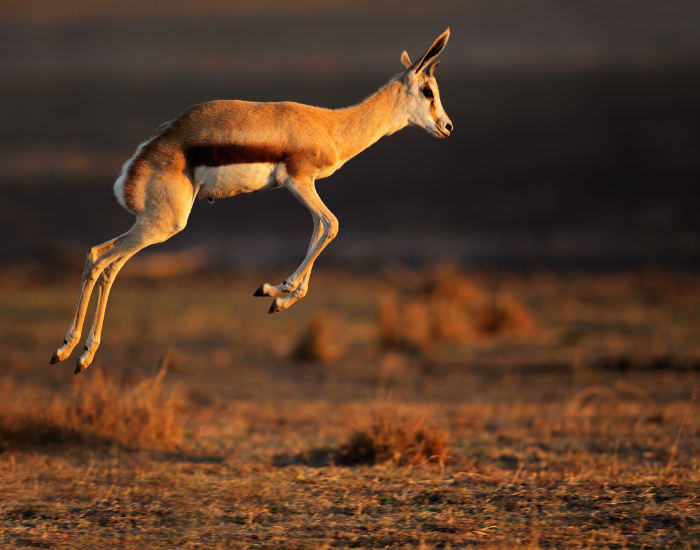
The springbok performs one of nature’s most remarkable behaviors: pronking. This high-arching leap derives its name from the Afrikaans word meaning “to show off.” During pronking, the animal exhibits extraordinary athleticism.
The antelope runs with stiff legs before leaping up to two meters into the air, with its hooves bunched together during the jump. It arches its back dramatically while airborne, creating a distinctive silhouette. Springboks often perform repeated high leaps during pronking. Multiple theories explain this behavior’s purpose.
Scientists widely believe pronking signals fitness to predators like cheetahs and hyenas. The display communicates that pursuit would prove futile, potentially saving energy for both predator and prey. Additionally, pronking may help springbok gain better views of concealed threats. This behavior can also distract predators by confusing or startling them, increasing the springbok’s chances of escape.
The behavior also serves social functions within large herds. Males perform elaborate pronking displays during mating rituals to attract females. Young springbok engage in pronking playfully, possibly practicing escape techniques.
4: The Unique Dorsal Skin Flap
A distinctive pocket-like skin flap runs along the springbok’s back from mid-spine to tail. This anatomical feature, which inspired the scientific name marsupialis (Latin for “pocket”), distinguishes springbok from true gazelles.
When the animal pronks, back muscles stretch and open this flap. The action exposes a crest of long white hairs hidden inside. This sudden flash of white hairs creates a highly visible signal across the savanna.
The white crest may serve multiple functions beyond visual communication. Scientists theorize it aids thermal regulation in harsh desert environments. The flap contains sebaceous scent glands that release distinctive odors during displays.
This mechanism proves particularly effective in large herds numbering thousands. The synchronized flashing of white crests across a herd creates a spectacular visual phenomenon. Such displays may confuse or deter predators attempting to single out individuals.

5: Built for Speed and Arid Survival
The springbok inhabits open treeless savanna and dry grasslands throughout southwestern Africa. The range of the springbok stretched across dry regions, deserts, and savanna zones in southwestern Africa. As creatures adapted to these harsh environments, they possess incredible speed and agility. Springbok can reach speeds up to 88 km/h (55 mph), making them among the fastest antelopes in Africa and one of the fastest animals on land.
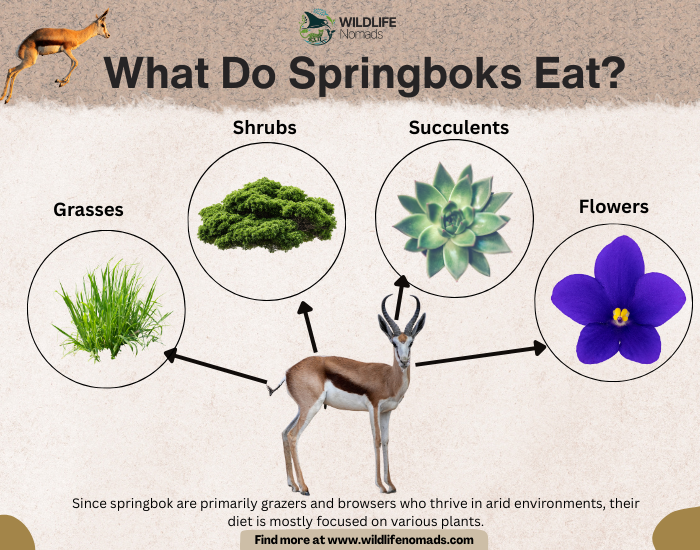
Their physiology shows remarkable adaptations to the arid Kalahari Desert region. Springbok survive for long periods without drinking water, obtaining necessary moisture from vegetation. During the dry season, they rely heavily on succulent plants and moisture-rich flowers.
These antelopes possess specialized muscle adaptations enabling their speed. Their muscles contain 58% glycolytic fast-twitch muscle fibers, along with lactate dehydrogenase activity four times higher than humans. Additionally, their muscles are rich in iron, supporting oxygen transport.
The Kalahari Desert presents extreme temperature fluctuations and scarce water resources. Springbok have evolved a specialized network of blood vessels in their heads for cooling. This adaptation allows them to thrive where many large mammals cannot survive.
6: Distinctive Markings and Horns
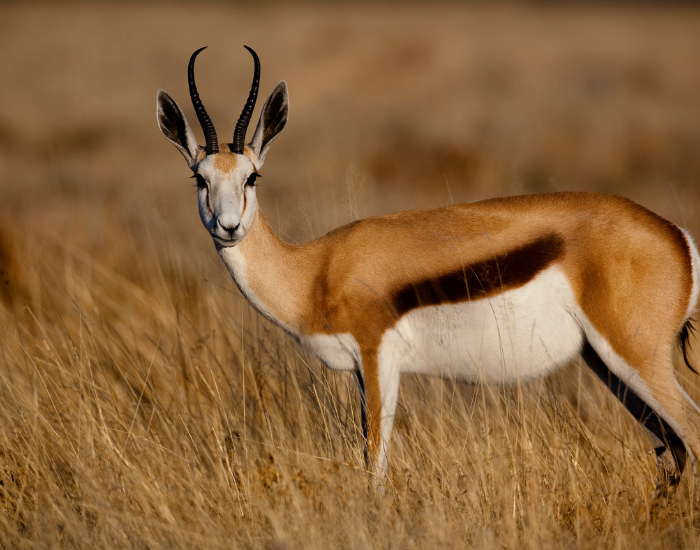
The springbok displays striking coloration that aids recognition across southern Africa. As a medium-sized antelope, it is considered one of the most agile and visually striking medium sized antelopes in Africa. Their beautiful tan-colored coat covers the upper body, creating warm tones. A crisp white underbelly provides sharp contrast with the darker upper parts.
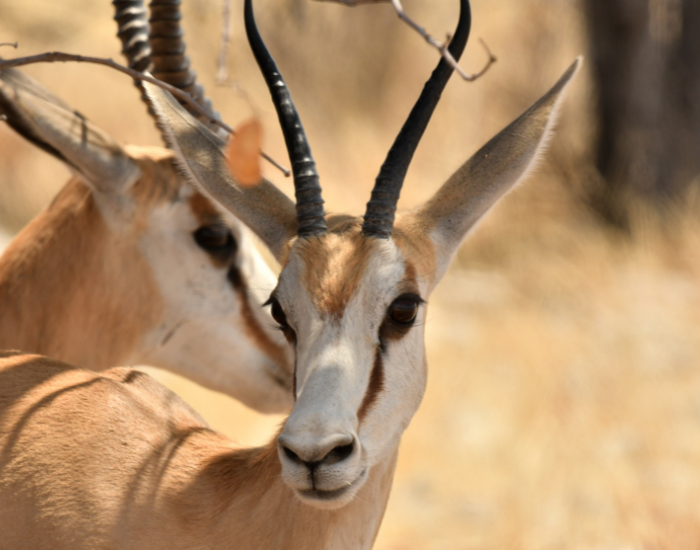
A prominent dark reddish-brown band runs horizontally along each flank. This stripe stretches from the forelegs to the hindquarters, creating a distinctive pattern. In addition, a dark brown stripe running along the sides of the springbok acts as a key identification marker. Along the flank, a dark stripe further highlights the animal’s appearance.
A fine dark brown stripe runs from each eye to the mouth, completing their facial markings. These dark stripes contrast sharply with the white face, serving as distinctive features that aid in identification.
Both males and females possess curved, ringed black horns. These distinctive ringed horns are a prominent feature of the springbok. However, dominant males typically develop thicker and longer horns. Male horns can reach 35-50 cm (14-20 inches) in length. Female horns appear slimmer and shorter than their male counterparts.
7: Complex Social Structures
Springbok are highly social animals living in large herds across southern Africa. Their social organization changes seasonally based on environmental conditions and reproductive cycles. Three main herd types characterize springbok society.
Breeding herds consist of females, young animals, and one territorial male. These herds form the core social unit during mating season. The dominant male defends his territory vigorously, attempting to keep competing males away from females.
Bachelor herds group together non-breeding or young males. These all-male groups remain separate from breeding herds until individuals mature sufficiently to challenge for territories. Young males join bachelor herds after leaving their mothers.
Female herds often consist of adult springbok females and their offspring. Adult springbok females live in these herds with their young, providing care and protection. Females live in these herds for most of their lives, offering stability and passing on knowledge of migration routes and feeding areas to younger members. Within these herds, adult springbok interact with other springboks, engaging in social behaviors and survival strategies essential for the group’s success.

8: Generally Quiet Animals
Despite the dramatic nature of pronking, springbok communicate primarily through visual signals. Body language and displays convey most information between herd members. Vocalizations occur infrequently compared to many other antelope species.
Springbok emit occasional low-pitched bellows when alarmed by predators. Males produce louder grunts during mating season territorial disputes. However, these sounds remain relatively quiet compared to other African mammals.
The emphasis on visual communication suits their open habitat perfectly. In the vast grasslands and treeless savanna, visual signals travel farther than sounds. The white dorsal crest provides an especially effective long-distance signal.
Olfactory communication also plays important roles in springbok society. Males mark territories with urine and dung piles in ritualized displays. The sebaceous glands in their dorsal flaps release scents during pronking.
9: Mating and Territoriality
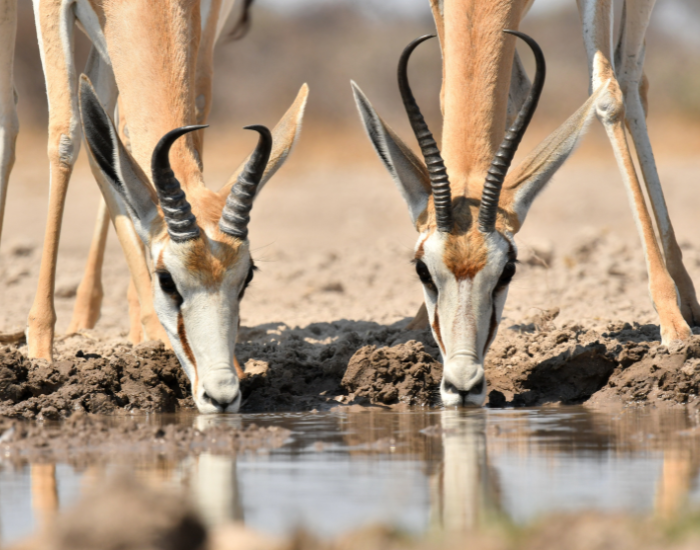
The mating season peaks after the rainy season when resources become most abundant. However, springbok can breed year-round under favorable conditions. They do not have a fixed breeding season; instead, the timing of the breeding season depends on environmental conditions. This reproductive flexibility allows populations to respond to environmental variability.
Males establish territories ranging from 25-70 hectares (62-173 acres) during the rut. They defend these areas vigorously against rival males through horn-to-horn combat. Territorial displays include grunting, vegetation thrashing, and creating large dung middens.
After a gestation period of approximately five to six months, females give birth to single calves. Most births occur during October and November, coinciding with the start of the wet season. This timing ensures abundant food for lactating mothers.
Newborn calves remain hidden in tall grass or bushes for their first few days. Mothers return periodically to nurse their young. After about one week, calves join nursery herds with other mothers and offspring.
Females can conceive as early as six to seven months of age. Under optimal conditions, they may produce two offspring per year. Males require approximately two years to reach sexual maturity and establish territories.

10: Extensive Fossil Record
The genus Antidorcas has been part of the southern Africa ecosystem for millions of years. Fossil evidence from the Pliocene epoch documents this long history. The modern springbok species evolved approximately 3 million years ago.
This evolutionary timeline reveals remarkable adaptation to changing climates. Southern Africa experienced significant environmental shifts during the Pleistocene. Springbok survived these changes while related species became extinct. During its evolutionary history, the springbok migrated sporadically across its range in response to environmental changes.
Antidorcas recki, likely a direct ancestor to modern springbok, existed around 100,000 years ago. This species showed similar adaptations to arid environments. Two other extinct species, A. bondi and A. australis, once ranged widely across Africa.
The fossil record helps scientists understand how springbok developed their unique characteristics. Their speed, water conservation abilities, and social behaviors evolved over millennia. These adaptations enabled survival in increasingly arid southern African environments.
11: Formerly Formed Mega Herds
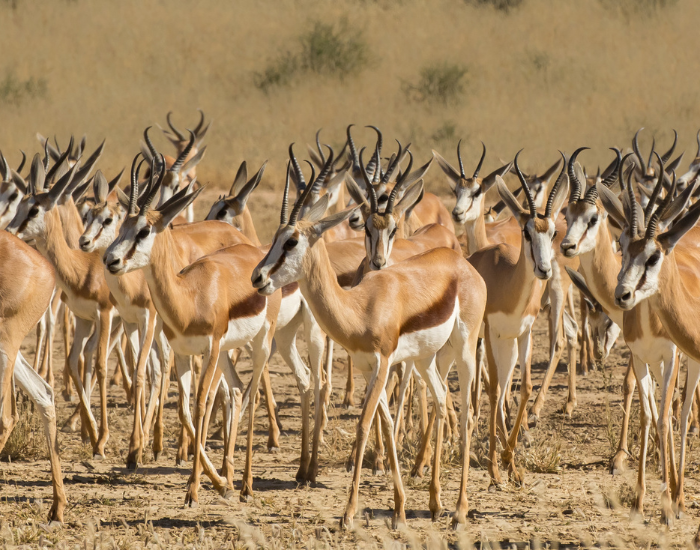
Historically, springbok formed massive migrations known as “trekbokken” in Afrikaans. These legendary movements involved hundreds of thousands, possibly millions, of animals. During these migrations, springbok used to form very large herds, sometimes numbering over a million individuals. Observers reported herds stretching hundreds of kilometers, taking days to pass a single location.
European settlers in the 1800s documented these spectacular migrations across the Kalahari Desert and Karoo regions. The treks occurred during prolonged drought periods when springbok searched for fresh grazing. Animals could efficiently retrace migration routes after traveling long distances.
Habitat fragmentation and fencing dramatically reduced these migrations. Modern agricultural development subdivided the vast grasslands into farms and ranches. Today, trekbokken occur only occasionally in remote areas of Botswana and Angola.
While large-scale migrations have ceased, the instinct remains. Springbok still form substantial herds numbering in the thousands during favorable seasons. Game reserves in Namibia, South Africa, and Botswana support these smaller congregations.
12: Classified as Least Concern
The IUCN Red List currently classifies the springbok as Least Concern (LC). This conservation status reflects stable, robust population trends across their range, with current estimates suggesting between 2 and 2.5 million springbok inhabit southern Africa today.
Effective conservation management contributes significantly to this success story. Numerous national parks and game reserves protect large populations. The species thrives particularly well in the arid, short-grass habitats of the Kalahari Desert region (such as the Kgalagadi Transfrontier Park) and Etosha National Park in Namibia.
Private farms also play a crucial role in springbok conservation. Landowners value the species for eco-tourism and sustainable hunting, creating an economic incentive that encourages habitat preservation and population management. No major threats to the springbok’s long-term survival exist currently, making it one of the few African antelope species with expanding populations.

Conservation and Habitat
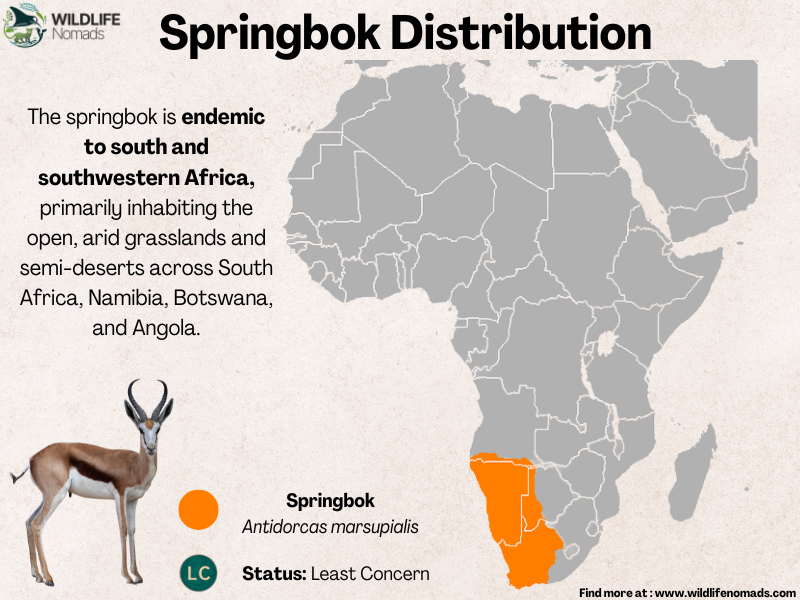
Springbok inhabit dry areas of south and southwestern Africa. Their range extends from northwestern South Africa through the Kalahari Desert into Namibia and Botswana. They also occur in southwestern Angola and parts of the Free State.
The species thrives in game reserves and private farms throughout this range. Preferred habitats include treeless savanna, short grasslands, and semi-desert scrublands. Springbok avoid areas with tall grass, preferring open terrain for predator detection.
On private farms, springbok contribute significantly to the local economy. Springbok meat is a valuable game meat exported from Namibia and South Africa, playing an important role in the hunting industry and local cuisine. It is used in various culinary preparations and is a key product of wildlife hunting and trade.
Climate change presents potential future challenges for springbok populations. Shifting rainfall patterns may alter vegetation in their habitats. However, their adaptability to arid conditions provides resilience against environmental changes.
Sustainable wildlife management ensures continued population health. Regulated hunting generates revenue for conservation programs. Eco-tourism centered on springbok and other wildlife provides additional economic benefits.
FAQs you May Have
Springbok reach speeds up to 88 km/h (55 mph) in short bursts. This remarkable speed makes them among the fastest antelopes in Africa. They can maintain speeds of 50 km/h for up to six kilometers.
Pronking describes the springbok’s distinctive stiff-legged jumping behavior. The term comes from Afrikaans meaning “to show off.” Springbok leap up to two meters high while arching their backs.
Female springbok carry their young for approximately five to six months. Most calves are born during October and November. Females can produce two offspring per year under optimal conditions.
Springbok inhabit southern and southwestern Africa, particularly in Namibia, Botswana, South Africa, and Angola. They prefer open treeless savanna, dry grasslands, and the Kalahari Desert region.
The Fastest Animal on Erth
The springbok antelope remains a charismatic and enduring icon of southern Africa. From its unique position as the sole living member of genus Antidorcas to the spectacular pronking ritual, this animal perfectly embodies the wild spirit of the region.
Its distinctive features, including the dorsal skin flap, striking tan and white coloration, and remarkable speed, make identification easy across the dry grasslands. The ability to thrive in the harsh, arid Kalahari Desert demonstrates evolutionary excellence.
Strong, stable population status testifies to successful conservation efforts across southern Africa. National parks, game reserves, and private farms all contribute to springbok protection. This ensures that future generations will witness these magnificent creatures leaping across African plains.
The springbok’s cultural importance in South Africa extends far beyond wildlife conservation. As the national animal and namesake of the beloved rugby team, it holds a special place in the nation’s heart. This deep connection strengthens conservation commitment.
Recommended Tours to see a Springbok in the Wild:
This blog is reader-supported. When you buy experiences through links listed on this site, we may earn an affiliate commission.