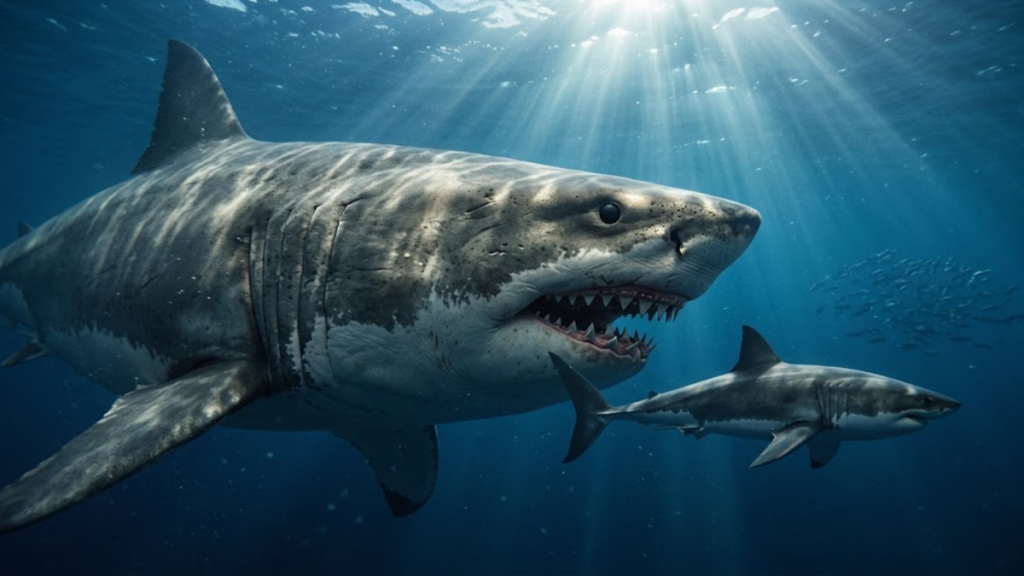
In July 2026, I walked into the Natural History Museum in London for the first time. Hope, the blue whale skeleton, hung over Hintze Hall like a frozen wave. I took a photo with a giant ground sloth. Then I spent hours among small dinosaurs and ice age animals.
Two exhibits stopped me in my tracks, though: a giant crocodile and the megalodon. As a kid in Mexico, I called it megalodón and watched animated prehistoric sea monsters on giant IMAX screens. Standing in front of the real thing, my biologist brain and my inner kid finally agreed.
Today, everyone argues about great white sharks and orcas as the ocean’s apex predators. Millions of years ago, that title belonged to megalodon, the largest shark that ever lived. These are the 12 facts I brought home from that visit, checked against the latest research.
1. Megalodon Means “Big Tooth,” and One Tooth Can Cover Your Palm
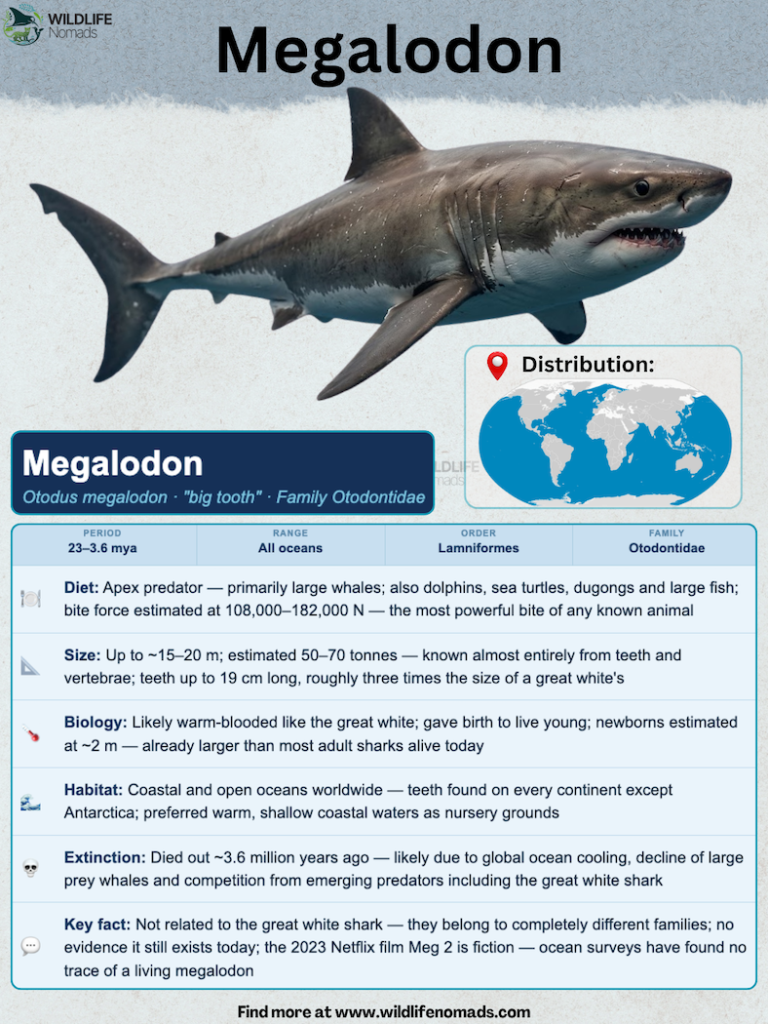
The name comes from Greek: mega means big, and odon means tooth. Swiss naturalist Louis Agassiz named the species in the 1830s using nothing but fossil teeth. Honestly, no animal has ever had a more fitting name.
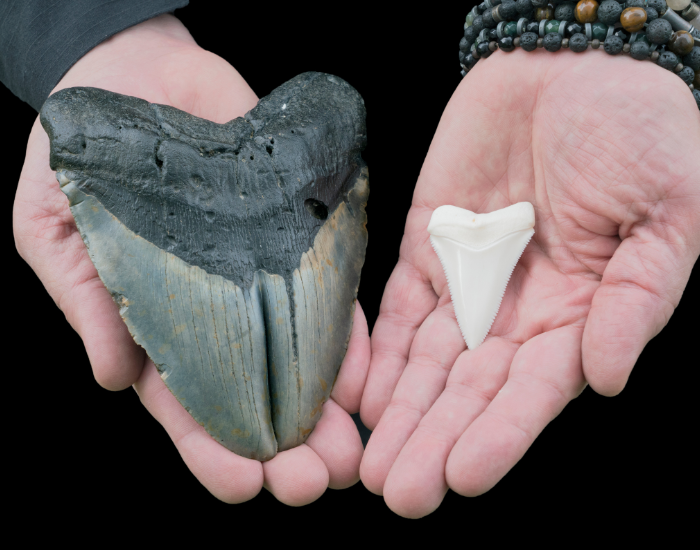
The largest megalodon tooth specimens measure over 18 centimetres along the slanted edge. Hold one up and it covers your whole palm. Each giant tooth is a thick triangle with fine serrations down both edges, made for cutting and tearing flesh.
For centuries, nobody knew what these objects were. Europeans called them “tongue stones” and believed they grew inside rocks or fell from the sky. In 1667, Danish scientist Nicolas Steno compared them with a modern shark’s head and identified them correctly.
2. Almost Everything We Know Comes From Teeth and a Few Vertebrae
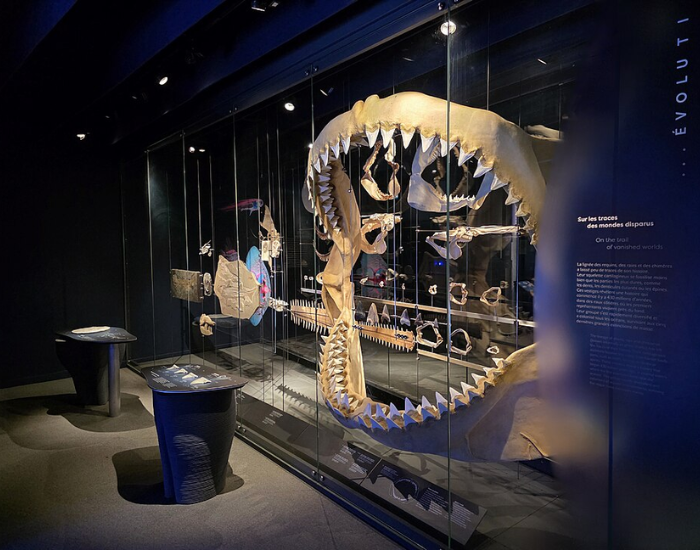
Sharks build their skeletons from cartilage, not bone. Cartilage rarely fossilises, so nobody has ever found a complete megalodon skeleton. Instead, the fossil record consists mainly of teeth, rare megalodon vertebrae and a few scales.
The teeth survive because sharks lose them constantly. Like modern sharks, megalodon grew rows of replacement teeth that moved forward like a conveyor belt. Shed teeth sank to the sea floor, and today collectors pull them from riverbeds and sea cliffs.
The vertebrae tell us even more. One partial spinal column from Belgium stretches more than 11 metres on its own. That single specimen forced researchers to rethink the whole size debate.
3. It Was Not a Giant Great White
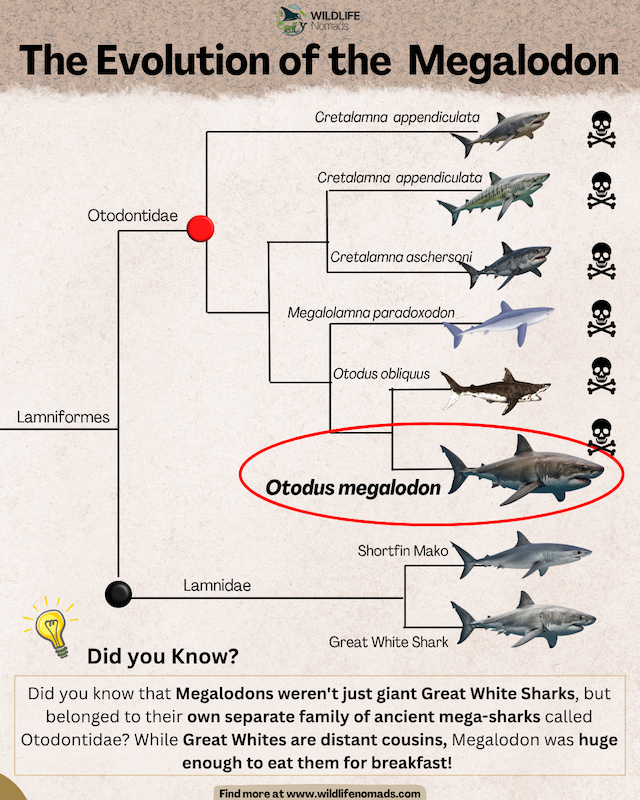
Early researchers noticed a strong dental similarity with the modern great white shark, Carcharodon carcharias. So they placed the fossil in the same genus, as Carcharodon megalodon. Later, many experts moved it to the genus Carcharocles, which is why older books say Carcharocles megalodon.
Today, most paleontologists call it Otodus megalodon. It belongs to the megatooth sharks, an extinct family whose teeth grew bigger over tens of millions of years. Megalodon was the last member of that lineage, and the biggest.
Its closest living relatives are the extant lamniform sharks, including makos, porbeagles and the white shark. However, the great white resemblance reflects a similar hunting lifestyle, not direct ancestry. Most sources date megalodon from about 23 to 3.6 million years ago, although some earlier studies had proposed alternative extinction timelines.
4. Megalodon’s Size Is Still Hotly Debated
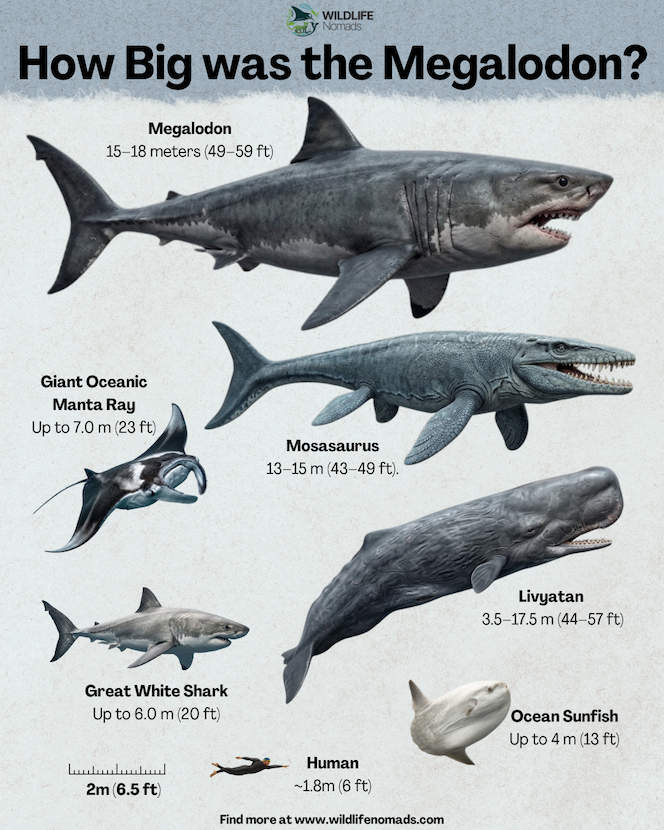
Without a complete skeleton, every size estimate scales up from teeth or vertebrae. That’s why numbers vary so wildly online. A 2015 study of hundreds of teeth calculated an average body length of about 10.5 metres across populations.
Other estimates suggest adults commonly reached 14 to 15 metres, with maximum length estimates of 15 to 20 metres. In 2025, paleobiologist Kenshu Shimada and 28 colleagues pushed further. Using the Belgian spine and body dimensions scaled from living sharks, their model calculated an absolute maximum theoretical upper ceiling of up to 24.3 metres for extreme outliers. A shark of that maximum scale could weigh around 94 tonnes. For comparison, the whale shark is today’s largest fish, at up to about 18 metres. My honest read of the research: treat 24.3 metres as an absolute theoretical ceiling, while typical adults ranged closer to 15 to 18 metres.
A shark that size could weigh around 94 tonnes. For comparison, the whale shark is today’s largest fish, at up to about 18 metres. My honest read of the research: treat 24.3 metres as a ceiling for megalodon’s size, not a typical adult.
5. Its Body Was Probably Slimmer Than the Movies Show
Films draw megalodon as a bloated great white. Older reconstructions also gave it a robust, stocky body, long pectoral fins and a tall dorsal fin. That shape works for a six-metre shark, but the physics gets awkward at twenty.
The 2025 study argues that a stout body at that scale would create too much drag. Instead, the team suggests a slimmer build, closer to a lemon shark. They also estimated a cruising speed of just 2.1 to 3.5 kilometres per hour.
That slow pace makes sense to me. Most of the crocodiles I fed at the zoo stayed placid for hours, saving energy between meals. Giant predators rarely waste fuel on constant speed.
6. Megalodon Jaws and Bite Force Were in a League of Their Own
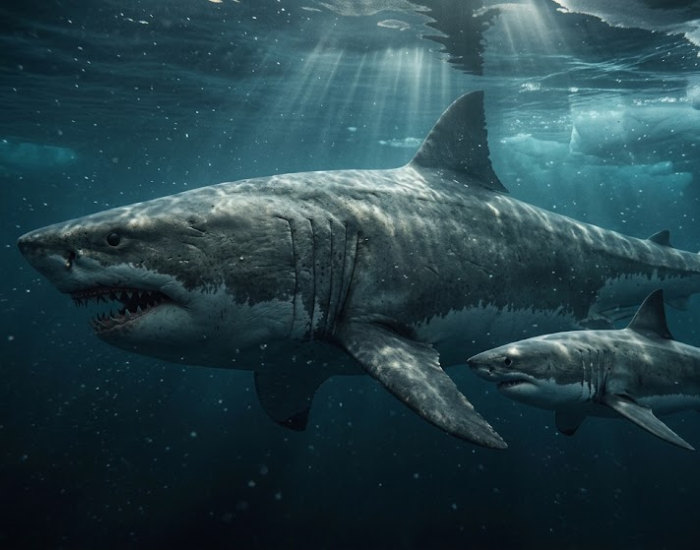
Reconstructions of megalodon jaws suggest an opening of roughly 2.7 by 3.4 metres. An adult person could stand inside that gape. The robust teeth lining it formed a cutting edge unlike anything alive today.
A 2008 computer modelling study estimated megalodon’s bite force at 108,514 to 182,201 Newtons. By contrast, saltwater crocodiles hold today’s record for a measured bite, topping out at roughly 16,400 Newtons. Even Cretaceous giants like Deinosuchus, the terror crocodile that hunted dinosaurs, topped out at an estimated 100,000 Newtons. I spent part of my childhood in Villahermosa, beside a river where crocodiles were part of daily life, but picturing a shark with nearly double the crushing power of the ultimate prehistoric crocodilian feels almost unreal.
7. What Did Megalodon Eat? Mostly Whales
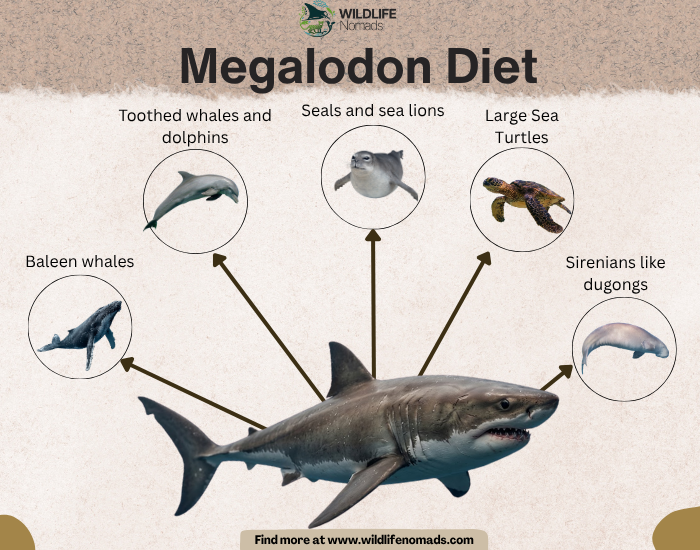
Megalodon’s prey list reads like a marine mammal field guide. It hunted large marine mammals, especially baleen whales and small whales, plus dolphins, seals and sea turtles. Younger sharks likely added bony fish and other shark species too.
The best evidence comes from megalodon bite marks on whale bones. Paleontologists have found deep, serrated gouges on fossil ribs, vertebrae and flipper bones. Some researchers read bites on flippers and tails as a strategy to disable large prey first.
This fact feels personal. In the Baja California lagoons, a gray whale mother once eased her calf to our boat, within arm’s reach. I’ve also released olive ridley hatchlings (Lepidochelys olivacea) at Puerto Escondido. Picturing megalodon hunting animals like these gives its menu a face.
8. It Sat Higher in the Food Chain Than Any Living Predator
Chemistry, not just teeth, reveals where megalodon sat in the food chain. In 2022, researchers measured nitrogen isotopes preserved inside fossil shark teeth. Their results placed megatooth sharks above every living marine apex predator.
That means megalodon likely ate other predators, not only whales. Adult sharks of other species and predatory whales probably ended up on its menu. Few living sharks hunt that high up the ladder.
So when people debate whether great whites or orcas rule the ocean, I smile. In a Miocene sea, both would have looked like middle management.
9. Megalodon Ran Warmer Than the Water Around It
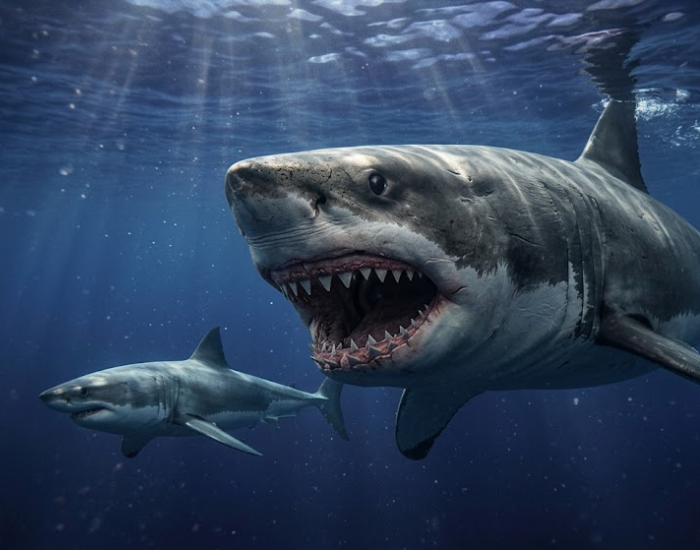
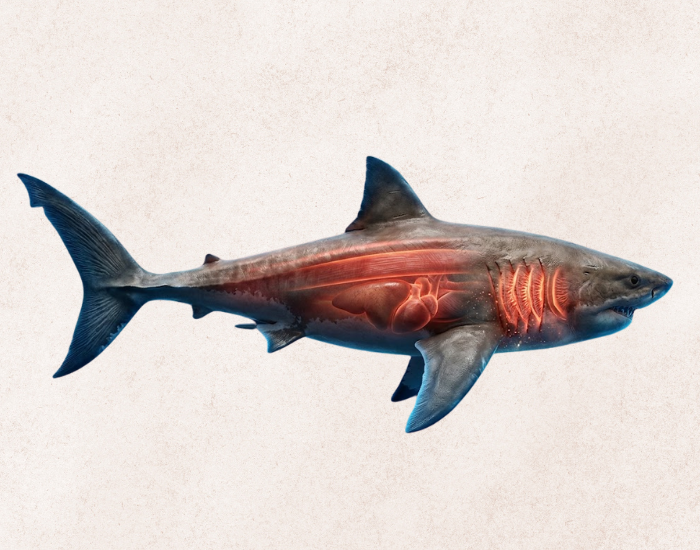
Most fish match the temperature of the surrounding sea. However, a 2023 study found that megalodon was regionally endothermic (similar to the living salmon shark and mako shark), meaning partly warm-blooded. Researchers read its body temperature from chemical signatures in fossil tooth enamel.
Their results suggest megalodon ran about 7°C warmer than the surrounding water. Lamnid sharks like makos and great whites do something similar today. That extra heat helped megalodon hunt in colder waters and travel long distances.
There’s a catch, though. Warm bodies burn more fuel. A giant shark with a huge energy bill needs a steady supply of fat-rich whales, which matters in fact 12.
10. Where Did Megalodon Live? Almost Everywhere
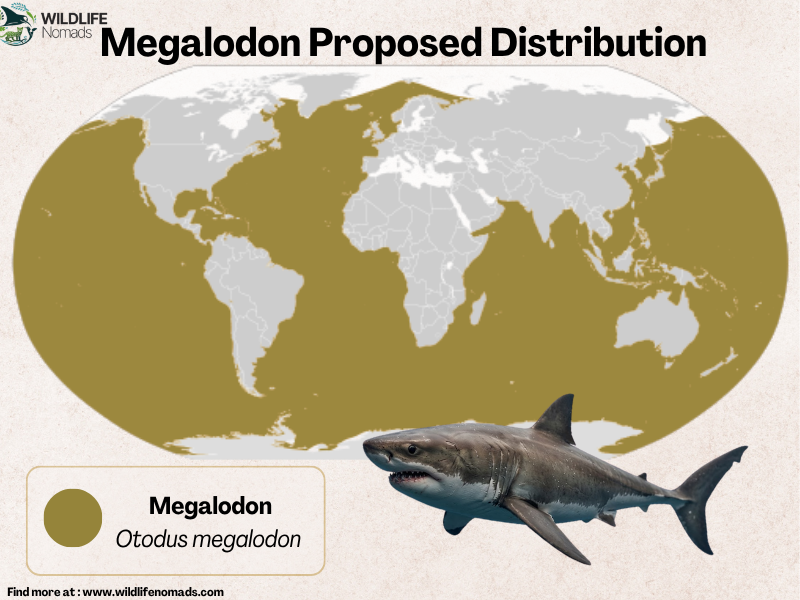
Megalodon remains turn up on every continent except Antarctica. Fossils come from Europe, Africa, Asia, Australia, North America and South America. Scientists call this a cosmopolitan distribution across the world’s marine environments.
It favoured warm tropical and subtropical waters, yet it also reached temperate seas. A 2016 study found its geographic range contracted during the Pliocene, before it disappeared. Some papers cite a tooth from Svalbard at 78°N, but that record is controversial.
Australia has its own megalodon chapter. Fossil teeth wash out of the cliffs at Beaumaris, near Melbourne. Whenever I watch sharks from a Queensland headland, I remember that megalodon once patrolled these same coasts.
11. Juvenile Megalodon Started Life as Giants
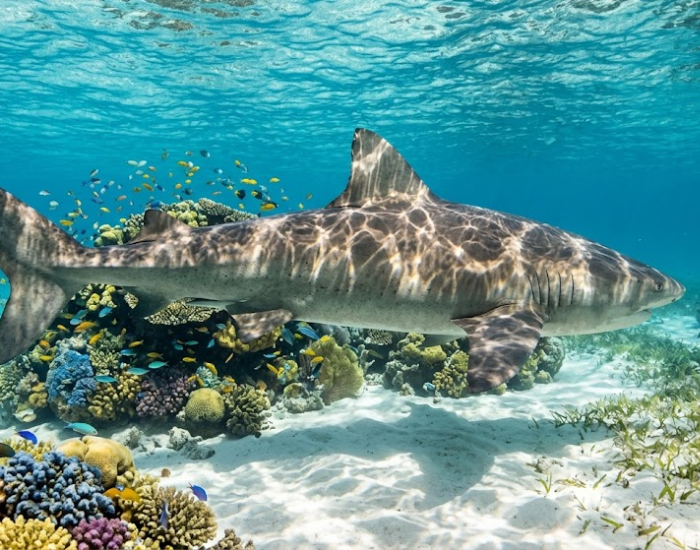
Megalodon pups arrived enormous. A 2025 reanalysis of vertebral growth bands suggests newborns measured roughly 3.6 to 3.9 metres. That’s longer than most adult sharks alive today.
Like many lamniforms, megalodon probably gave birth to live young. Inside the mother, embryos likely fed on unfertilised eggs to grow that big. Earlier work in Panama found many juvenile teeth in shallow coastal waters, which researchers interpreted as a nursery.
The 2025 team questions whether giant newborns needed nurseries at all. I think both ideas can coexist. Even a four-metre baby benefits from warm, food-rich bays with fewer large predators.
12. What Killed Megalodon? A Slow Squeeze, Not One Disaster
Megalodon’s extinction happened around 3.6 million years ago, in the early Pliocene. Earlier studies placed it closer to 2.6 million years ago. Either way, no single catastrophe wiped it out.
First, the climate cooled and sea levels fell, shrinking the warm coastal habitats it relied on for reproduction. Second, many smaller whale species disappeared, while others shifted toward colder polar feeding grounds. As a result, megalodon faced a decline in prey during the Pliocene.
Third, the modern great white shark became a competitor. A 2022 zinc-isotope study found the two species overlapped in diet in some regions. A smaller, more flexible hunter coped better as food ran short. Add megalodon’s high energy needs, and climate change plus competition tipped the balance.
Megalodon FAQ
Megalodon means “big tooth” in Ancient Greek. Swiss naturalist Louis Agassiz formally described and named the species Carcharodon megalodon in 1843 because scientists knew the animal almost entirely from its enormous fossil teeth. The largest recorded teeth exceed 18 centimetres.
No. Megalodon was a cartilaginous fish, while dinosaurs were land-dwelling reptiles. It also appeared more than 40 million years after the non-avian dinosaurs died out. The two never met.
The Shark That Outgrew Its Ocean
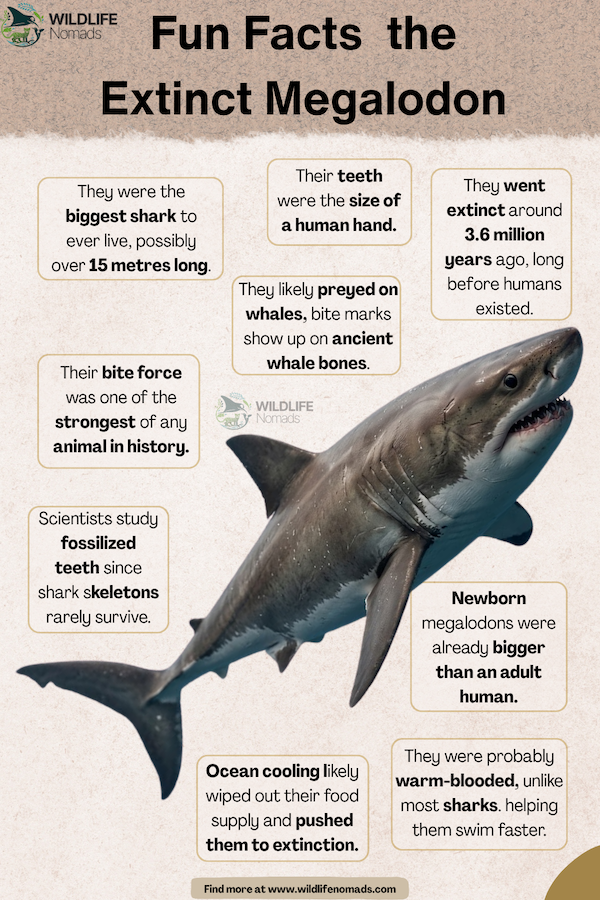
Standing in that London hall, I realised megalodon isn’t just a monster from my childhood IMAX memories. It proves that oceans once fed predators far beyond anything alive today, and that climate and prey loss can topple even the biggest.
That lesson still applies to the sharks we share the sea with. If megalodon has you hooked, read the article about the great white sharks and compare the champion with its modern cousin. Then test your prehistoric knowledge with my guess the dinosaur quiz. And tell me in the comments: which megalodon fact surprised you most?
Megalodon Science & Prehistoric Quiz
Ten fun study questions covering fossil tooth history, massive bite forces, warm-blooded adaptations, giant newborn pups, and extinction causes. Test your retention!
Multiple Choice
References:
Boessenecker, R. W., Ehret, D. J., Long, D. J., Churchill, M., Martin, E., & Boessenecker, S. J. (2019). The Early Pliocene extinction of the mega-toothed shark Otodus megalodon: A view from the eastern North Pacific. PeerJ, 7, e6088. https://doi.org/10.7717/peerj.6088
Griffiths, M. L., Eagle, R. A., Kim, S. L., Flores, R. J., Becker, M. A., Maisch, H. M., IV, Trayler, R. B., Chan, R. L., McCormack, J., Akhtar, A. A., Tripati, A. K., & Shimada, K. (2023). Endothermic physiology of extinct megatooth sharks. Proceedings of the National Academy of Sciences, 120(27), e2218153120. https://doi.org/10.1073/pnas.2218153120
McCormack, J., Griffiths, M. L., Kim, S. L., Shimada, K., Karnes, M., Maisch, H., Pederzani, S., Bourgon, N., Jaouen, K., Becker, M. A., Jöns, N., Sisma-Ventura, G., Straube, N., Pollerspöck, J., Hublin, J.-J., Eagle, R. A., & Tütken, T. (2022). Trophic position of Otodus megalodon and great white sharks through time revealed by zinc isotopes. Nature Communications, 13, 2980. https://doi.org/10.1038/s41467-022-30528-9
Pimiento, C., MacFadden, B. J., Clements, C. F., Varela, S., Jaramillo, C., Velez-Juarbe, J., & Silliman, B. R. (2016). Geographical distribution patterns of Carcharocles megalodon over time reveal clues about extinction mechanisms. Journal of Biogeography, 43(8), 1645–1655. https://doi.org/10.1111/jbi.12754
Shimada, K., et al., (2025). Reassessment of the possible size, form, weight, cruising speed, and growth parameters of the extinct megatooth shark, Otodus megalodon (Lamniformes: Otodontidae), and new evolutionary insights into its gigantism, life history strategies, ecology, and extinction. Palaeontologia Electronica, 28(1), a12. https://doi.org/10.26879/1502