White lions have such a stunning appearance and mysterious origins. Straight to the sad part, these majestic creatures face serious conservation challenges in the wild. Understanding the truth about white lions becomes essential for their protection!
In this article, you’ll discover twelve fascinating facts about these rare big cats. From their genetic makeup to their sacred cultural role, we’re diving deep into what makes white lions truly extraordinary.
1. White Lions Are Leucistic, Not Albino
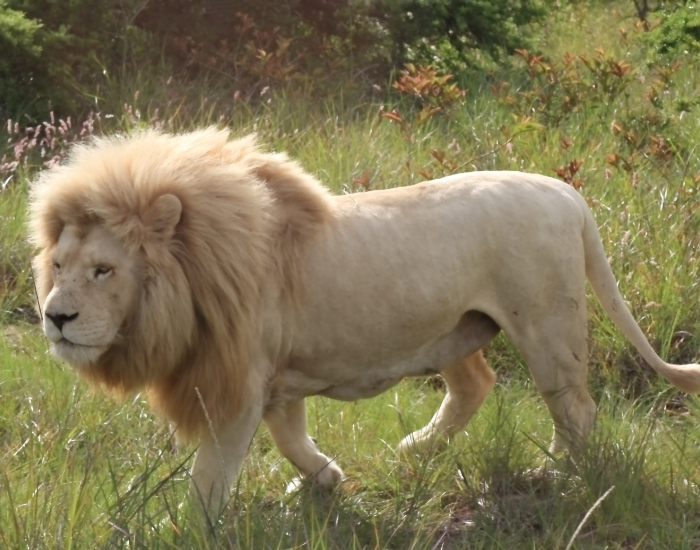
Many people assume white lions are albinos. In reality, they have a genetic condition called leucism. White lions are not albino lions; instead, they are leucistic, meaning their white fur is caused by a genetic mutation that reduces pigmentation in the coat but does not affect the eyes or skin. This distinguishes them from true albino lions, which lack all pigmentation.
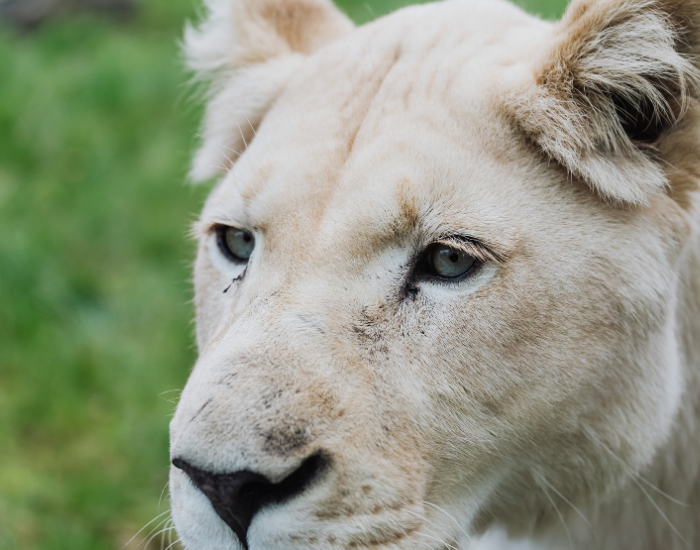
Leucism causes partial pigmentation loss, which results in their pale coats. Some white lions are ‘near white’, with pelage ranging from blonde to almost pure white. However, lions are not albinos, and white lions’ eyes retain their natural pigmentation, which can include normal hazel, golden, blue-gray, or green-gray. Their paw pads and noses also show normal pigmentation.
In contrast, albino lions would have pink eyes, pink noses, and pink paw pads. True albino lions are exceptionally rare. Moreover, no documented cases exist of albino lions surviving to adulthood in the wild.
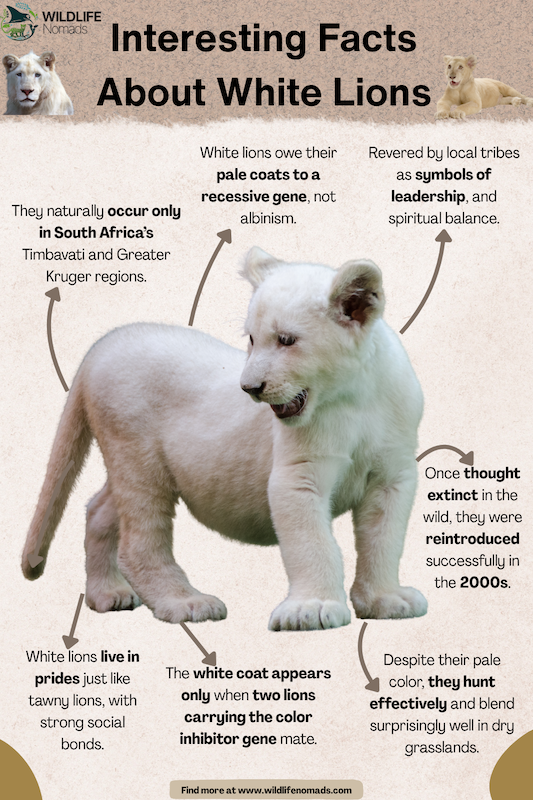
The white lion gene is a recessive allele of the tyrosinase gene. Therefore, both parents must carry this rare gene for white cubs to be born. The leucistic mutation is less severe than the severe mutation in the TYR gene that causes true albinism.
2. They Only Occur Naturally in One Place on Earth
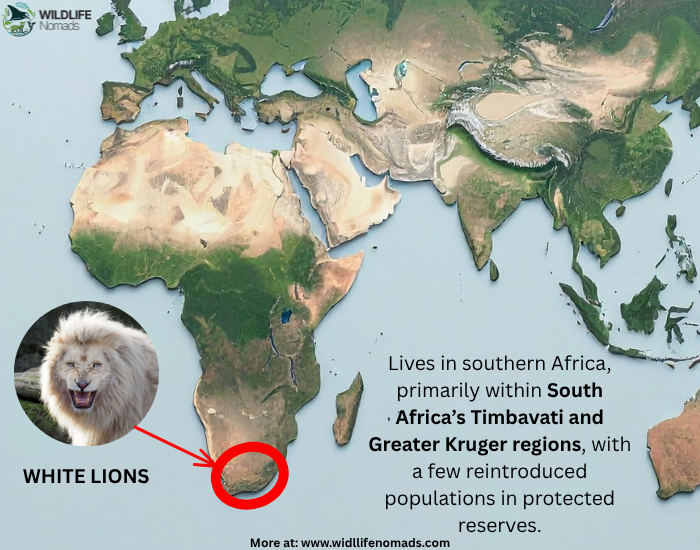
White lions are endemic to a specific region in South Africa. The Greater Timbavati region remains their only natural habitat, and the presence of white lions here is a natural occurrence, not just the result of captive breeding.
This area includes both public and private game reserves, such as the Timbavati Private Nature Reserve and central regions of Kruger National Park. These game reserves play a crucial role in protecting white lions and supporting their conservation efforts. The indigenous name “Tsimba-vaati” translates to “the place where star-lions came down from the heavens.”
The earliest recorded sighting by non-indigenous people occurred in 1938. However, African oral records document white lions living successfully in this region for centuries.
White lions are not a separate species. Instead, they represent a rare color variation of Panthera leo krugeri, the South African lion.
3. Fewer Than 20 Wild White Lions Exist Today
The wild population of white lions remains critically low, and they are considered critically endangered due to their extremely low numbers in the wild. Experts estimate fewer than 20 free-roaming individuals exist in their natural habitat, making them some of the rare white lions and rare white big cats in existence.
This staggering rarity stems from systematic removal during the 1970s onwards. White lions were hunted as trophies or captured for captive breeding programs. Consequently, white lions became technically extinct in the wild for over 12 years. At one point, only four white lions were known to survive in the wild, representing a unique group that symbolized the last of their kind and the urgent need for protection.
In contrast, hundreds—possibly thousands—of white lions live in captivity globally. Many are bred intentionally for commercial purposes, including zoos and the canned hunting industry.
The small wild population highlights why conservation efforts in Timbavati are absolutely vital. When you consider Africa’s vast savannas, confining these rare white lions to such a limited area underscores their vulnerability and the importance of protecting rare white lions to prevent their extinction.
4. Both Parents Must Carry the Recessive Gene
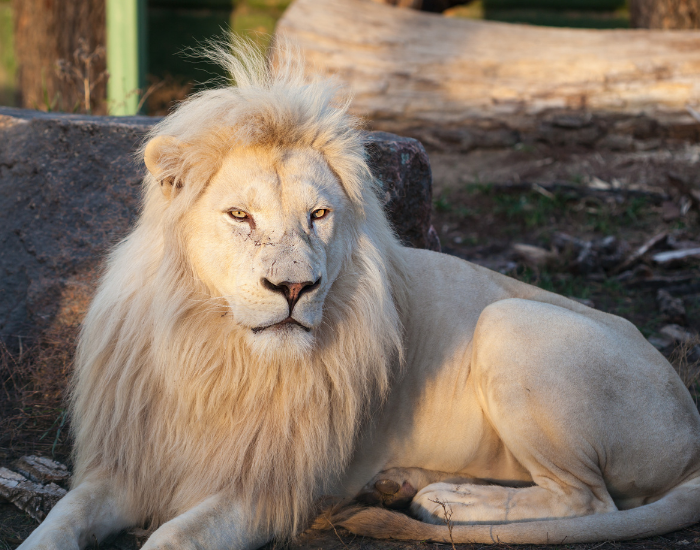
White lion genetics follow Mendelian inheritance patterns. The white coat results from a double recessive gene. White lions are not a separate subspecies, but rather a color mutation of the tawny African lion (Panthera leo krugeri).
Even if both parents appear tawny, they can produce white cubs. This happens when both carry the hidden recessive white gene. In some coalitions, such as the tawny brothers of the Shishangaan coalition, these tawny males can carry the recessive gene and, when paired with the right females, produce white lion births. In such cases, there’s a 25% chance of each cub being white.
This genetic rarity makes breeding programs complex. For example, conservation efforts must carefully track genetic lineages. Otherwise, inbreeding can lead to health problems and reduced genetic diversity. Tracking white lion births is especially important for conservation and genetic research, as each birth contributes valuable data to understanding and preserving the population.
The recessive white gene can remain hidden for generations. Therefore, tawny lions in Timbavati might carry this genetic marker without showing any white coloration.
5. White Lions Hold Sacred Cultural Significance
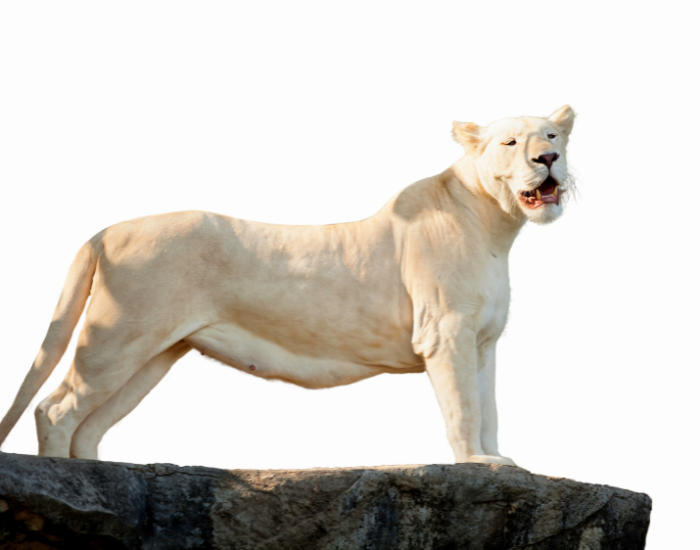
Local Tsonga and Sepedi communities revere white lions as sacred animals. They call them “Children of the Sun God” or “Star Lions.”
The appearance of a white lion carries immense spiritual significance. In addition, these communities view white lions as angelic guardians whose presence demands reverence and protection.
This cultural importance extends back centuries through oral traditions. However, modern exploitation nearly erased these sacred animals from their homeland.
Indigenous knowledge has proven crucial for conservation efforts. Therefore, combining traditional wisdom with scientific approaches offers the best path forward for white lion protection.

6. They Were Extinct in the Wild for Over a Decade
From the 1970s onwards, white lions faced systematic removal from their natural habitat. Their exotic appearance made them targets for trophy hunters and animal traders.
By the early 1990s, white lions had disappeared completely from the wild. This extinction lasted for more than 12 years, a devastating loss for biodiversity.
The Global White Lion Protection Trust (GWLPT), founded by conservationist Linda Tucker, spearheaded the reintroduction program. This world-first scientific initiative returned genetically pure white lions to their endemic homeland.
Reintroduction began in the early 2000s. Consequently, wild white lions now roam Timbavati again, though their population remains fragile. The first white lion introduced to Malaysia, at Bukit Gambang Safari Park, marked a significant milestone for conservation efforts in the region and highlighted the importance of white lions in both local and global biodiversity.
7. Their White Fur May Not Be a Major Disadvantage
A long-standing debate centers on whether white lions can survive in the wild. Critics argue their lack of camouflage puts them at a disadvantage during hunts.
However, research suggests this disadvantage may be overstated. Many prey species, including zebras and antelopes, are partially color-blind. These animals perceive their environment in muted tones.
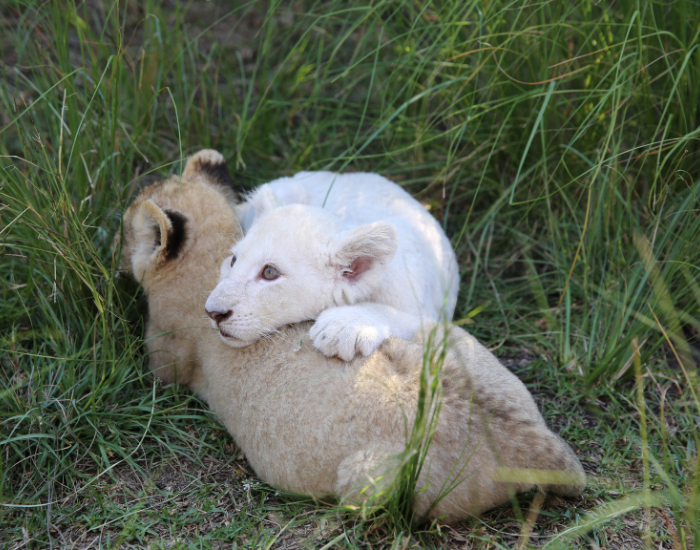
Therefore, a white lion may not appear dramatically different from tawny lions to prey animals. Field observations support this theory, wild white lions, including adult white lions, have been observed hunting successfully and thriving in their natural environment. Adult white lions display strong social behavior within their prides and possess the physical characteristics necessary for survival in the wild.
Some white lions, including blue eyed white lions, are selectively bred in captivity for their unique features. Blue eyes are a rare trait among white lions, resulting from specific genetic combinations.
The greater threats come from human activities rather than hunting difficulties. Habitat loss, human-wildlife conflict, and trophy hunting pose far more serious challenges.
8. Male Coalitions Pose a Natural Threat to Cubs
Infanticide represents a brutal but natural phenomenon in lion populations. When new dominant males, such as the Ross males, take over a pride, they often kill existing cubs, which can severely impact the survival of white lion cubs.
This behavior becomes particularly devastating for white lion populations. With so few white cubs born, losing even one to infanticide significantly impacts the gene pool.
A specific male lion, Xakubasa, has played a key role in establishing his own territory and contributing to the genetic propagation of white lions in the wild. Male white lions face additional challenges establishing territories. However, successful breeding by white males has occurred in recent years.
Conservation programs must account for these natural behaviors. Therefore, protecting breeding females, who are essential for passing on the white gene to their offspring, and young cubs becomes paramount for population recovery.
9. The Kimba Controversy Sparked Decades of Debate
“Kimba the White Lion” (Jungle Emperor Leo) premiered in the 1960s as a pioneering anime series. Created by Osamu Tezuka, it became one of the first successful color anime programs.
Fans noticed striking similarities between Kimba and Disney’s “The Lion King.” The names, characters, and overall themes share significant parallels.
Disney has always denied direct inspiration from Kimba. Nevertheless, the visual and narrative connections remain a popular debate among animation enthusiasts.
This controversy introduced white lions to global pop culture. However, it also risked creating misconceptions about these real animals.
10. “Mia and the White Lion” Used Real Lions Over Three Years
The 2018 film “Mia and the White Lion” tells a fictional story with a powerful conservation message. However, the production method was extraordinary.
Actress Daniah De Villiers formed a genuine bond with a white lion cub named Thor. Filming occurred over three years as Thor grew from cub to adult. Notably, the production featured three white cubs, emphasizing their rarity and the unique challenges of working with them in a film environment. The presence of three white lions in the production also highlighted the difficulties these animals face in the wild, such as threats from predators and environmental factors.
The production used real, non-sedated lions throughout. This risky approach aimed to highlight the plight of lions in captive breeding and canned hunting industries.
While the story is fictional, the relationship shown reflects real challenges facing captive white lions. Therefore, the film serves as both entertainment and conservation advocacy.
11. Captive Breeding Often Undermines Conservation
Hundreds of white lions exist in captivity worldwide. However, not all breeding programs serve conservation purposes.
Commercial operations deliberately inbreed white lions to guarantee white offspring. This practice reduces genetic diversity and creates health problems.
Many captive white lions end up in canned hunting operations. In these facilities, lions are bred for trophy hunters to kill in enclosed spaces.
Ethical breeding programs focus on genetic purity and reintroduction potential. Private game reserves, such as Pumba Private Game Reserve, play a crucial role in ethical breeding and conservation by providing safe environments for rare species and supporting science-based initiatives. For example, the GWLPT maintains strict genetic records and aims to return lions to the wild. In 2018, a litter of four cubs, including two rare white cubs, was born at a private game reserve—an exceptionally rare event that highlights the importance of these programs. The birth of a single white cub, such as the one born to the Birmingham Pride at Ngala Private Game Reserve, is significant for conservation efforts, as it demonstrates the success of maintaining genetic diversity in managed populations.
When visiting facilities with white lions, ask about their breeding program. Supporting ethical, science-based conservation initiatives ensures the long-term survival of wild populations.
12. Conservation Success Stories Offer Hope
Despite challenges, white lion conservation has achieved remarkable successes. The reintroduction program in Timbavati represents a breakthrough in wildlife management.
The GWLPT follows a meta-population management model. This approach establishes separate sub-populations before integrating them with resident tawny prides.
Recent years have seen wild births of white lion cubs in Timbavati. The Birmingham pride, located in the Timbavati and Kruger regions, is especially significant for its role in producing white lion cubs and supporting ongoing breeding and conservation efforts. For example, male white lions like “Casper,” born in Kruger National Park in 2014, have contributed to the gene pool.
These successes demonstrate that rare white lions can thrive in their natural habitat. However, continued support and dedicated efforts to protect rare white lions in the wild remain essential for long-term population recovery.
FAQs About White Lions
No, white lions are leucistic, not albino. They have a genetic condition causing partial pigmentation loss. However, they retain normal eye color and skin pigmentation, unlike true albinos. White lions are not albino lions; lions are not albinos because their eyes and skin still have pigmentation, which distinguishes them from true albino lions.
Fewer than 20 free-roaming white lions exist in their natural habitat in South Africa. In contrast, hundreds live in captivity globally.
White lions occur naturally only in the Greater Timbavati region of South Africa. This includes areas within Kruger National Park and surrounding reserves.
Yes, research shows white lions can hunt successfully in the wild. Many prey species are partially color-blind, reducing the camouflage disadvantage.
The white coat results from a recessive allele of the tyrosinase gene. Both parents must carry this gene for white cubs to be born.
While not classified as a separate species, the wild population is critically low. White lions are considered critically endangered due to their extremely small wild population. Conservation status remains precarious due to extremely small numbers
Supporting White Lion Conservation
White lions represent more than a genetic rarity. They embody the fragile beauty of our natural world.
Their reintroduction to Timbavati stands as one of modern conservation’s greatest success stories. However, the fight continues.
Support organizations dedicated to ethical, science-based conservation. Educate others about the difference between leucism and albinism. Most importantly, advocate against commercial exploitation threatening their genetic integrity.
These majestic “Children of the Sun God” deserve to roam free in their ancestral homeland. Therefore, our continued support ensures they’ll inspire future generations.
Further Reading
- Top 10 Facts You Need to Know About Black-Footed Cats
- Conservation Tourism: The Fight to Save South Africa’s Rhinos
- Top 5 Best Places to See Wildlife in South Africa
Safaris in South Africa
This blog is reader-supported. When you buy experiences through links listed on this site, we may earn an affiliate commission.