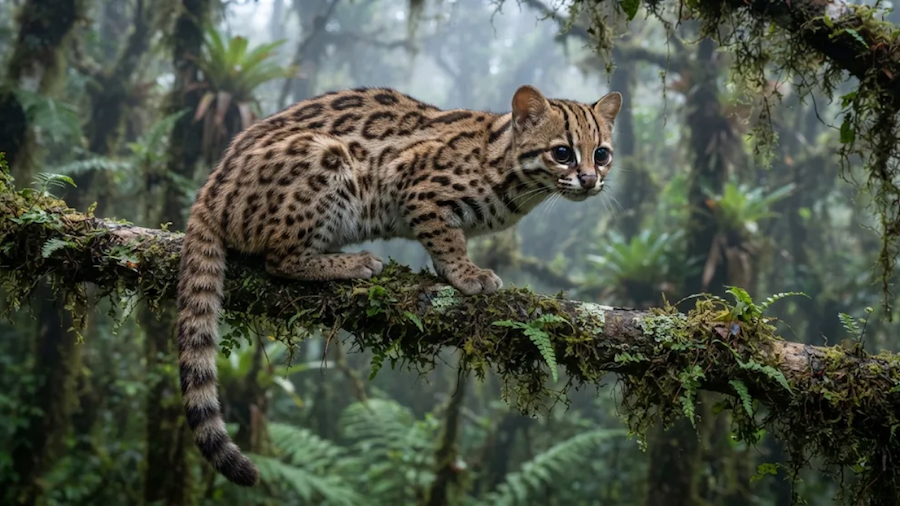
I have trekked the cloud forests and rainforests of Chiapas many times. I still have never seen a wild quetzal, a bright green bird the size of a pigeon. So I understand how a small spotted cat could hide from science for a very long time.
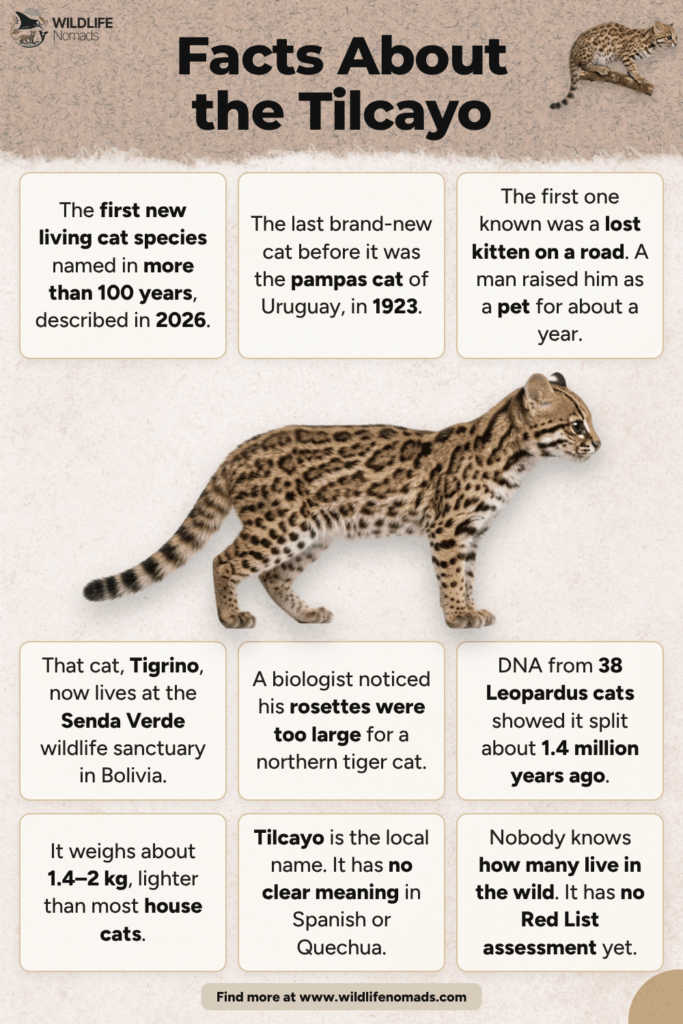
In September 2026, scientists announced the first new cat species described in more than 100 years. It is a tiny tiger cat from Bolivia’s Yungas cloud forest, now called Leopardus tilcayo. The last brand-new living cat named before it was the Uruguayan pampas cat, back in 1923.
The best part is how they found it. The cat that sparked it all was not caught in a trap deep in the jungle. He was a lost kitten on a road. A man raised him for a year, thinking he was a pet.
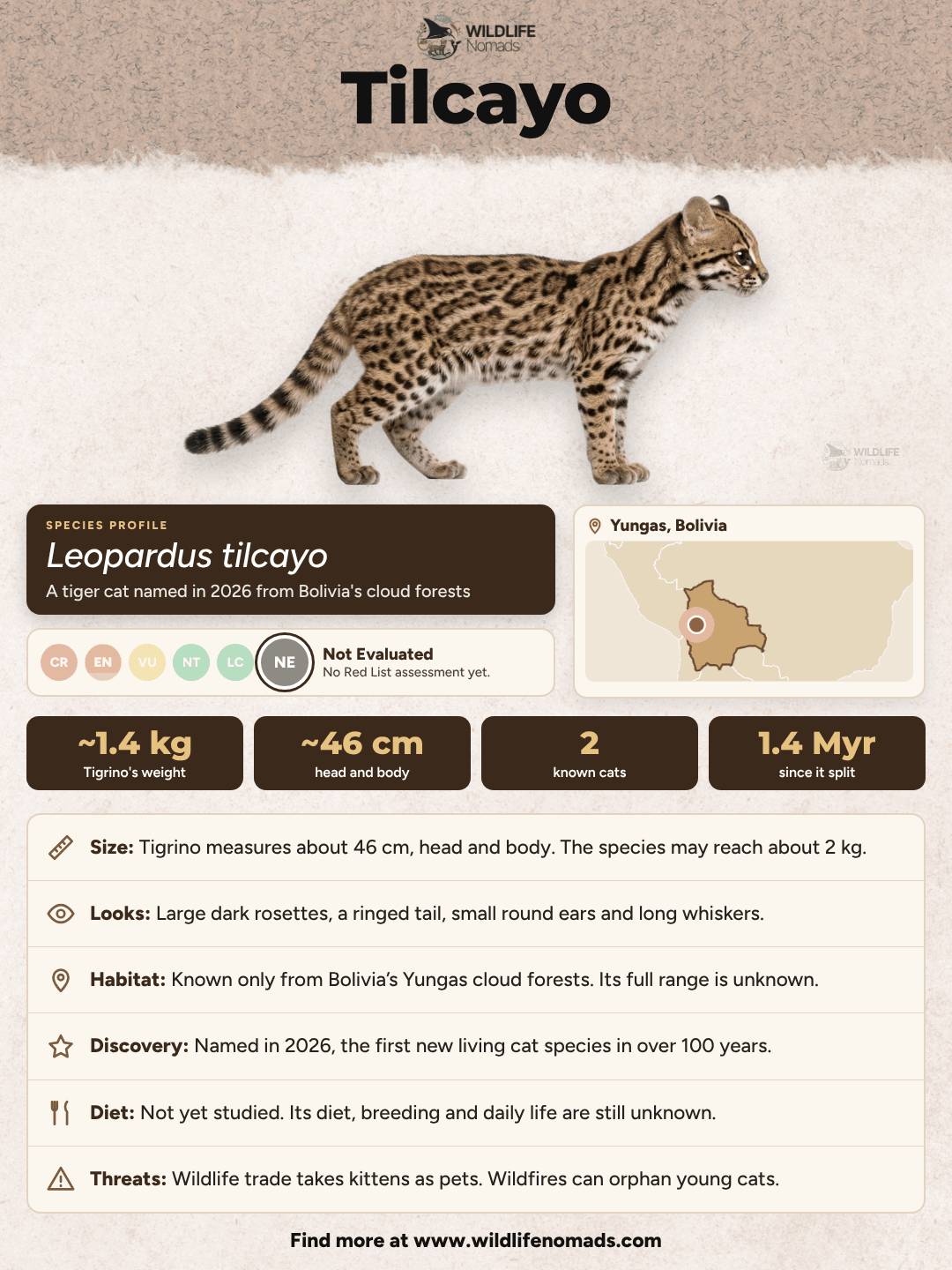
New Cat Species Discovered: The Short Version
- Name: Leopardus tilcayo, the tilcayo, from the local name for the cat.
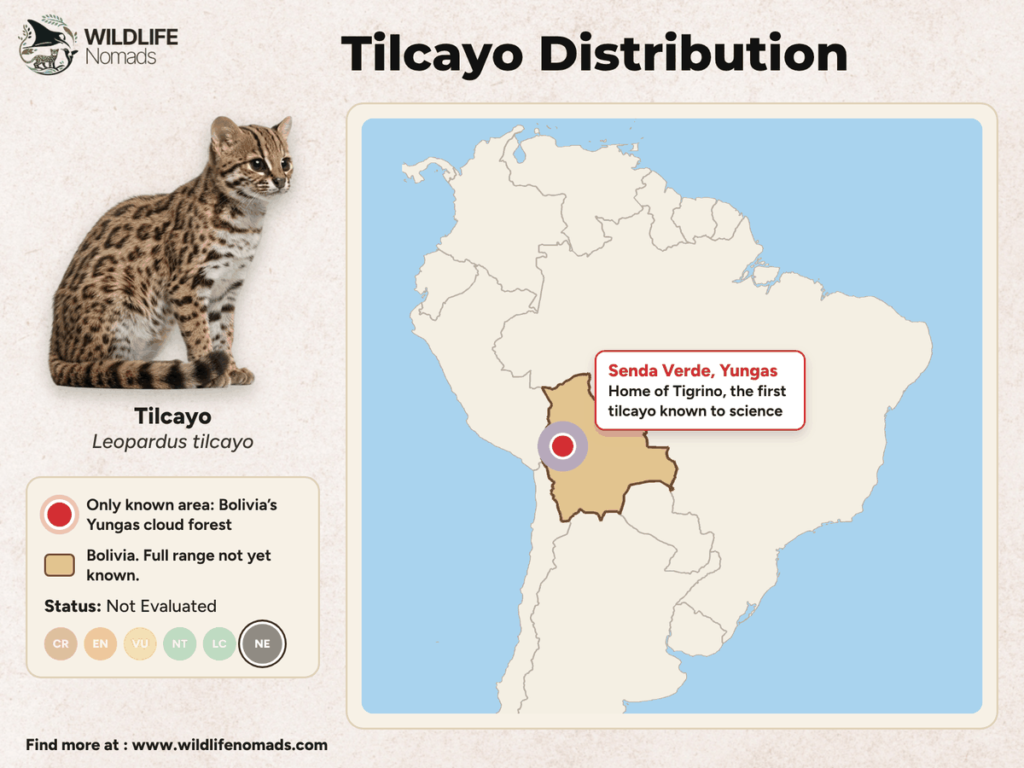
- Where: the Yungas cloud forests on the eastern slopes of the Andes in Bolivia.
- Size: about 46 cm long without the tail, based on Tigrino, and lighter than most house cats.
- How: complete genomes from 38 Leopardus cats, published in Current Biology on 17 September 2026.
- Big picture: the South American tiger cat is now split into five species.
A Kitten on the Road
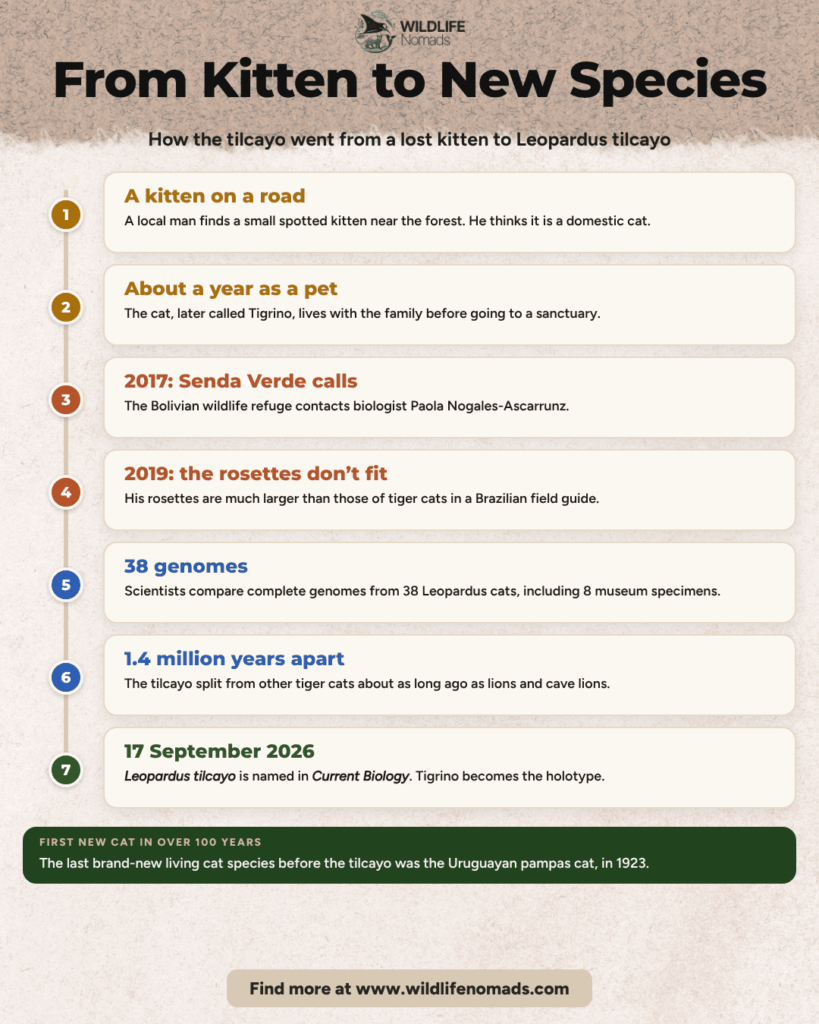
The story starts in 2017. A local man found a small spotted kitten on a road near the forest. He took it home, believing it was some kind of domestic breed.
About a year later, he decided the cat belonged in a sanctuary. It went to Senda Verde, a refuge in Bolivia’s Yungas that cares for trafficked wildlife. The cat became known as Tigrino, and the sanctuary contacted Bolivian biologist Paola Nogales-Ascarrunz.
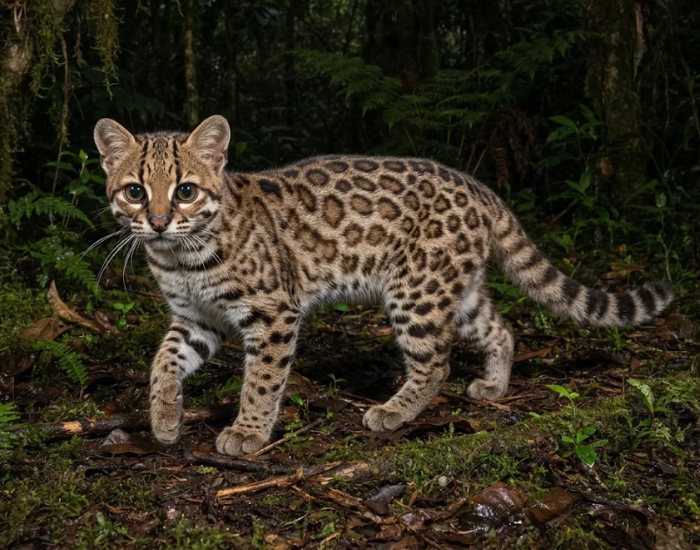
At first, she assumed Tigrino was a northern tiger cat, also called the oncilla. Then, in 2019, she compared her photos with a Brazilian field guide. Tigrino’s rosettes were much larger than those of the tiger cats in the book. He also seemed too small, and his tail looked different.
That is a lesson I love as a biologist. Big discoveries often start with a small detail that does not quite fit.
Why Nobody Noticed for So Long
Tiger cats are small, spotted, nocturnal and shy. Most people who see one get a glimpse at night, or a blurry camera trap photo. On top of that, several species look almost identical.
The original tiger cat, Leopardus tigrinus, has a strange history. Scientists described it in the 1700s from a single illustration of a cat from French Guiana. For centuries, almost every small spotted cat in South America ended up under that one name.
Elusive animals humble all of us. I still have not managed to find a wild platypus, despite days of searching rivers. Imagine trying to tell apart five lookalike cats that you almost never see.
How DNA Proved It Was a New Species
Nogales-Ascarrunz teamed up with geneticist Eduardo Eizirik in Brazil and Jonas Lescroart in Belgium. Together, they compared complete genomes from 38 cats across the genus Leopardus. They also pulled DNA from eight old museum specimens, including skull fragments from Guyana.
The results were clear. The tilcayo lineage split from its closest tiger cat relatives about 1.4 million years ago. The researchers compare that gap to the one between modern lions and extinct cave lions.
Tigrino became the holotype. That is the reference animal the new scientific name is formally attached to. Any scientist who wants to know what Leopardus tilcayo means can go back to him.
Meet the Tilcayo
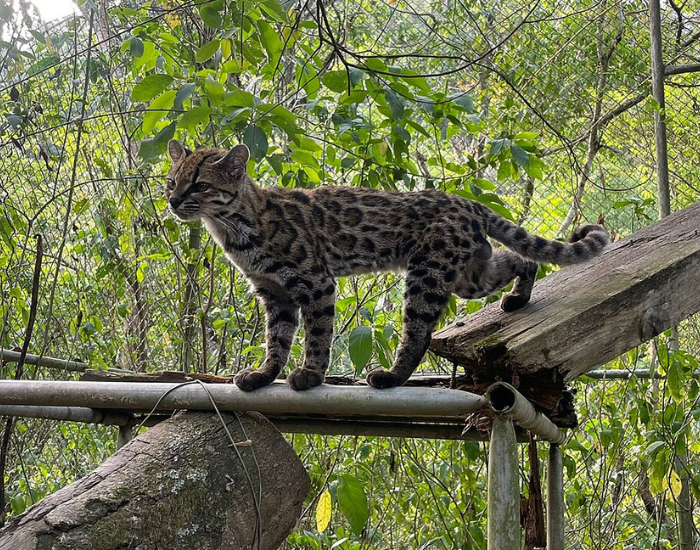
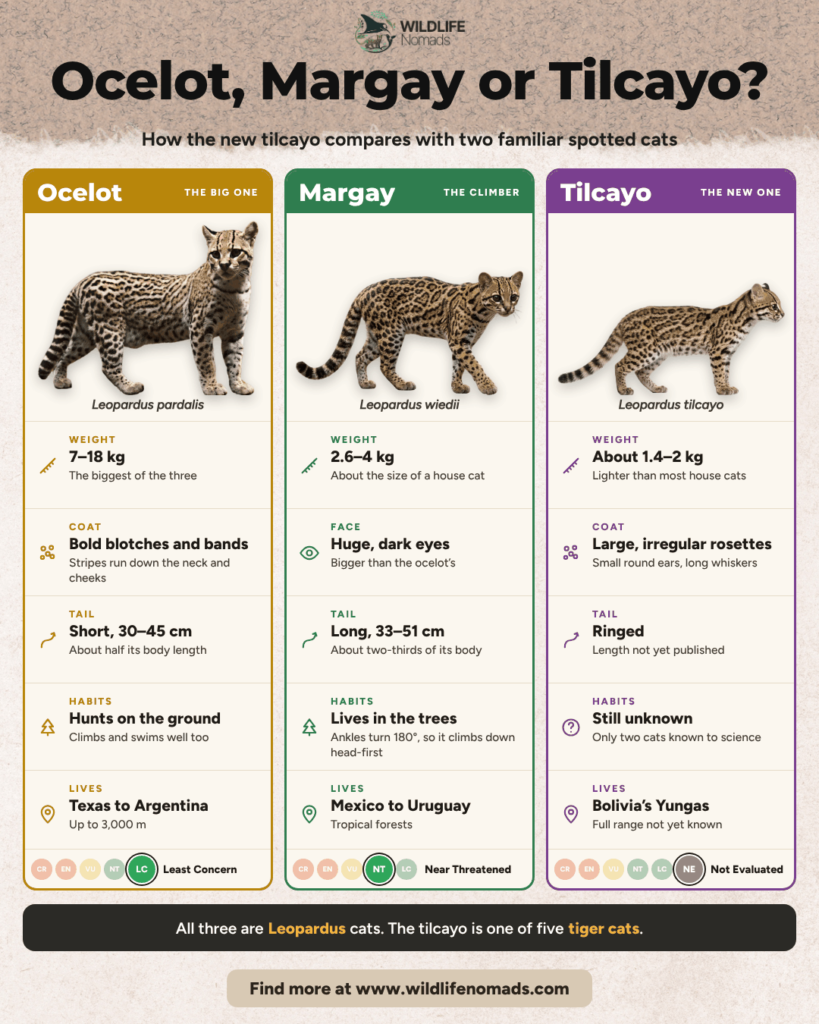
Tigrino is a 10-year-old male. He measures about 46 cm from head to the base of the tail and weighs roughly 1.4 kg. Published estimates for the species reach about 2 kg, still lighter than an average house cat.
The tilcayo has light brown fur, darker along the spine and paler towards the legs. Large, irregular dark rosettes cover its body, and its tail has rings. It also has a short face, small round ears and long whiskers.
So far, scientists know it only from the Yungas of Bolivia. These steep, humid forests sit on the eastern slopes of the Andes, often wrapped in cloud. Interestingly, the name tilcayo has no clear meaning in Spanish or Quechua. Local people simply have always called the cat that.
One Tiger Cat Becomes Five
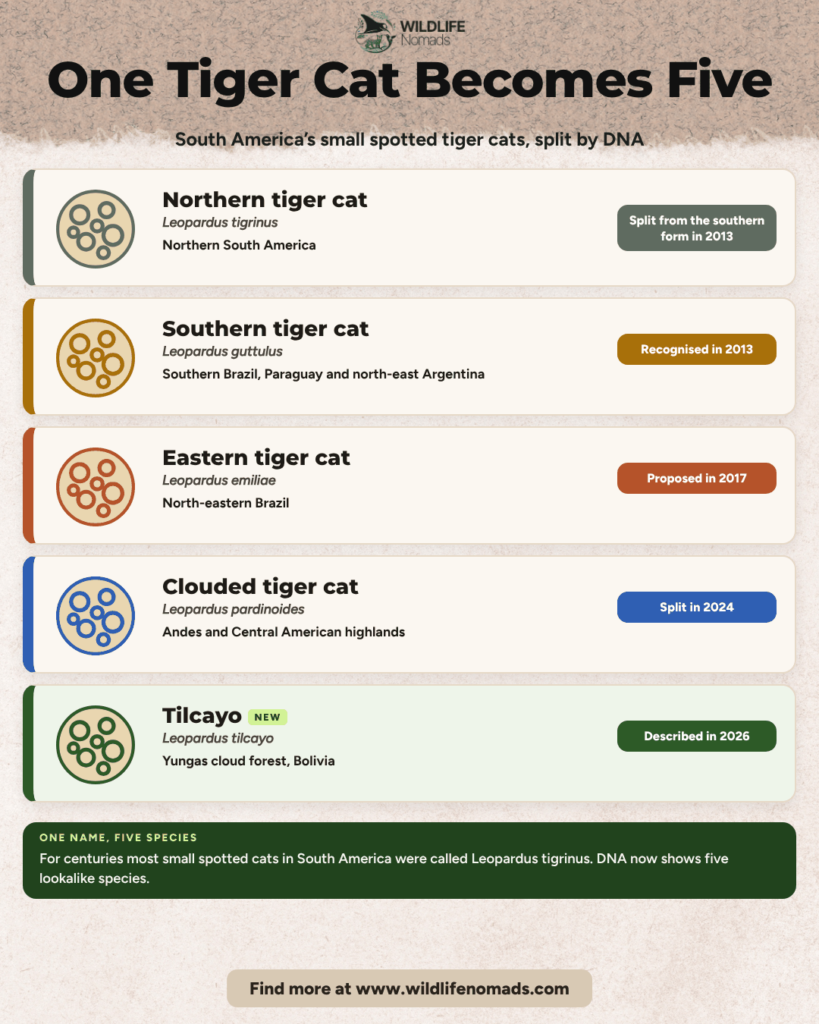
Twenty years ago, most field guides showed one tiger cat across Central and South America. Genetic studies have changed that picture step by step.
| Species | Common name | Recognised |
|---|---|---|
| Leopardus tigrinus | Northern tiger cat (oncilla) | Split from the southern form in 2013 |
| Leopardus guttulus | Southern tiger cat | 2013 |
| Leopardus emiliae | Eastern tiger cat | Proposed in 2017 |
| Leopardus pardinoides | Clouded tiger cat | Split in 2024 |
| Leopardus tilcayo | Tilcayo | Described in 2026 |
The same study also named a new tiger cat subspecies from Peru’s Yungas, Leopardus tigrinus antisuyo. Its name comes from Antisuyu, a region of the old Inca Empire.
Why a New Name Matters for Conservation
This is not just a change on paper. Conservation status is assessed species by species. One widespread cat can look safe, while five smaller species may each be in trouble.
Tiger cats already face deforestation, wildlife trafficking and diseases spread by domestic dogs. The northern and southern tiger cats are both listed as Vulnerable, with falling numbers. The tilcayo has no Red List assessment yet, and nobody knows how many live in the wild.
Tigrino’s own story shows another risk. Small wild cats look like kittens, so people take them home. Senda Verde exists because so many wild animals in Bolivia end up trafficked or kept as pets.
FAQs About the New Cat Species
It is Leopardus tilcayo, a small tiger cat from the Yungas cloud forests of Bolivia. Scientists described it in Current Biology in September 2026. It is the first new living cat species named in more than 100 years.
The last brand-new living cat species described before the tilcayo was the Uruguayan pampas cat, Leopardus fasciatus, in 1923. Other cats have since been split from existing species, but the tilcayo was entirely unnamed.
The tilcayo is smaller than most house cats. The reference animal, a male called Tigrino, measures about 46 cm without the tail and weighs roughly 1.4 kg.
They compared complete genomes from 38 Leopardus cats, plus DNA from eight museum specimens. The tilcayo lineage split from other tiger cats about 1.4 million years ago. That gap is similar to the one between lions and extinct cave lions.
Nobody knows yet. The species has not been assessed for the IUCN Red List, and its population size is unknown. Its close relatives, the northern and southern tiger cats, are both listed as Vulnerable.
Scientists now recognise five tiger cat species. They are the northern, southern, eastern and clouded tiger cats, plus the new tilcayo. All were once treated as a single species, Leopardus tigrinus.
There Are Still Cats Out There
A new cat species in 2026 sounds almost impossible, yet here it is. Experts now expect better genetic tools to reveal more small wild cats, in Africa and Asia too. As Nogales-Ascarrunz puts it, there are still undescribed things out there.
For me, the tilcayo is a reminder to stay curious about details. Look twice at the animal that does not quite match the field guide. Then take the quiz below and see how much of the tilcayo story stuck.
References:
Lescroart, J., Nogales-Ascarrunz, P., Cassatt-Johnstone, M., Bonilla-Sánchez, A., Sartor, C. C., Angulo, F., Ramirez, J. L., … Eizirik, E. (2026). Phylogenomics and museomics reveal five distinct species of tiger cats in South America. Current Biology. https://doi.org/10.1016/j.cub.2026.08.059
Trigo, T. C., Schneider, A., de Oliveira, T. G., Lehugeur, L. M., Silveira, L., Freitas, T. R. O., & Eizirik, E. (2013). Molecular data reveal complex hybridization and a cryptic species of Neotropical wild cat. Current Biology, 23(24), 2528–2533. https://doi.org/10.1016/j.cub.2013.10.046
National Geographic. (2026). Meet the first new cat species discovered in 100 years. nationalgeographic.com
Live Science. (2026). Scientists name a new cat species for the first time in over a century. livescience.com