
Wildlife Nomads · Play · Carbon Cycle Lab
What Is the Carbon Cycle? Follow One Carbon Atom Around the Earth
The carbon cycle is the movement of carbon between the air, living things, soil, oceans and rocks. Follow one carbon atom through a tree, a cow, the sea and a volcano. Then weigh Earth’s carbon stores and fill the carbon bathtub.
By Cesar Medina, conservation biologist · 6 interactive stops
What is the carbon cycle?
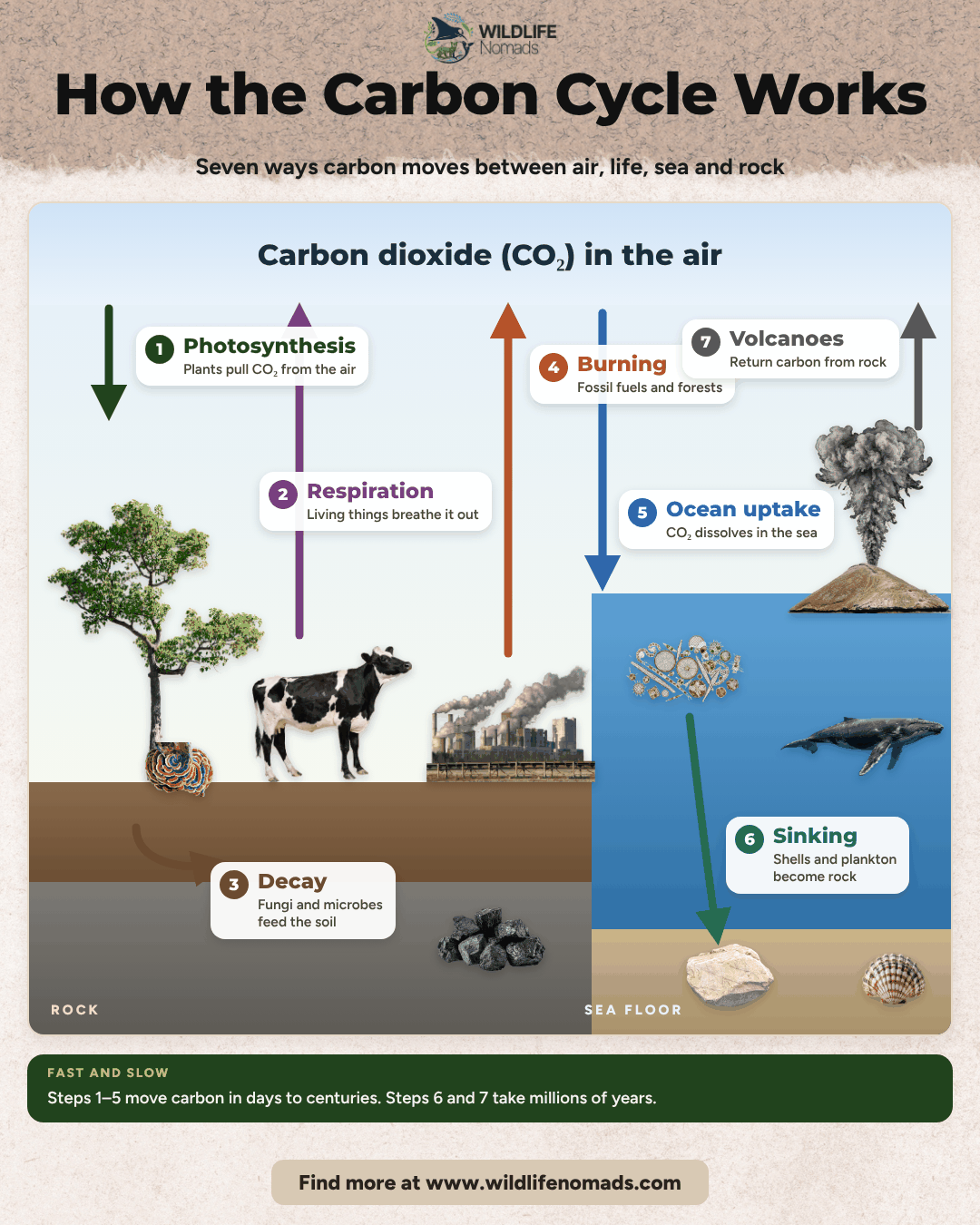
The carbon cycle is the movement of carbon atoms between the atmosphere, living things, soils, oceans and rocks. Plants pull carbon dioxide from the air. Respiration, decay, fire and volcanoes send it back. Some carbon stays locked away for millions of years.
Carbon exists in many forms. It floats in the air as carbon dioxide. It sits in every cell as sugar, fat, protein and DNA. It dissolves in seawater, hardens into shells and limestone, and hides underground as coal, oil and natural gas.
The carbon atom cycle links all these stores. Each step moves carbon from one reservoir to another. Follow a single atom through them in the Carbon Cycle Lab above.
Why carbon matters to life on Earth
Carbon is the chemical backbone of life. Each carbon atom can bond with up to four other atoms. That lets carbon build long chains and rings.
Those chains form organic compounds, such as sugars, fats, proteins and nucleic acids. Every living organism is built from them. Scientists call carbon in these molecules organic carbon.
Inorganic carbon is everything else. Carbon dioxide gas, bicarbonate in seawater and calcium carbonate in shells and limestone are all inorganic. The carbon cycle keeps turning one kind into the other.
Where carbon is stored: Earth’s carbon reservoirs
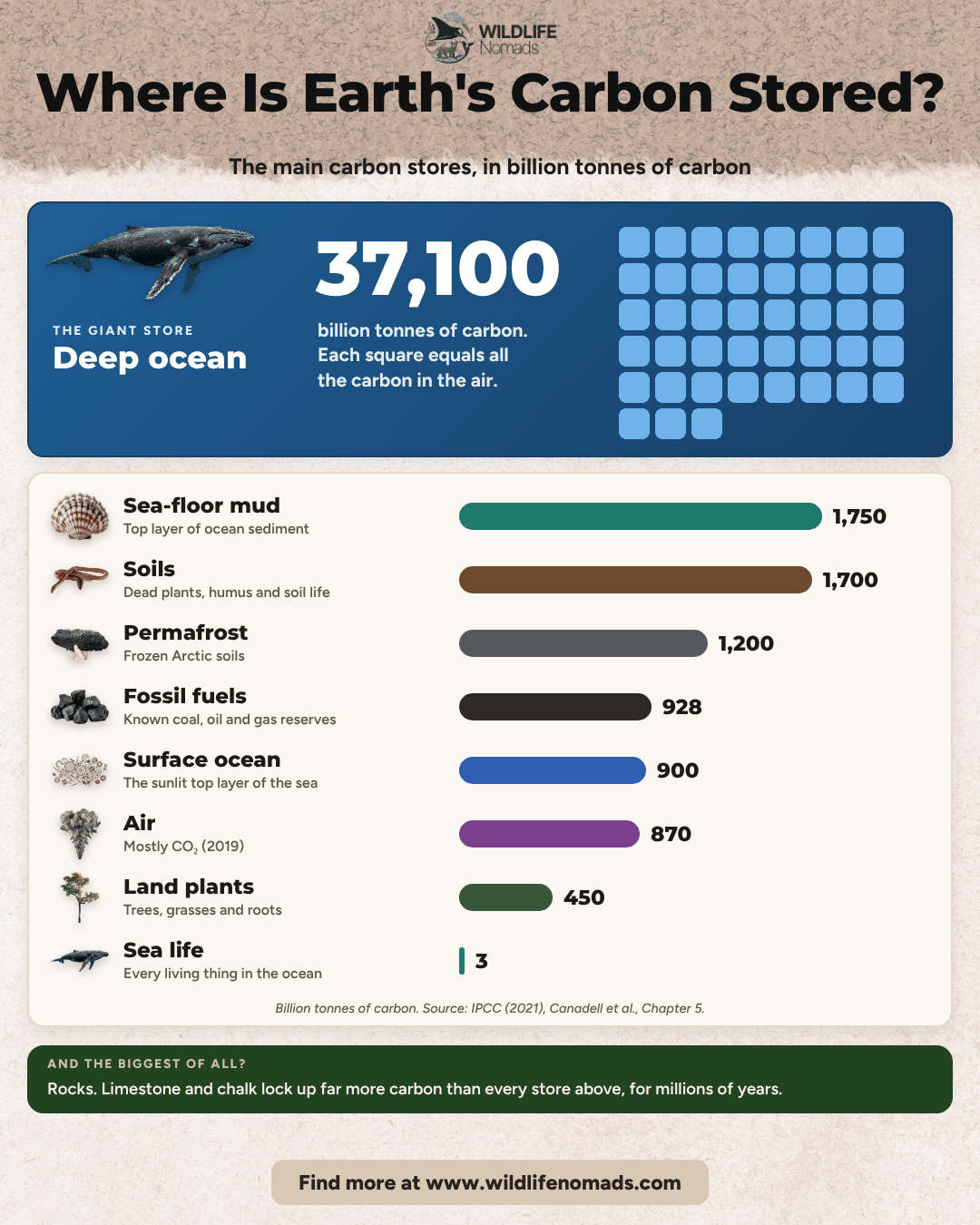
Scientists call each store a carbon reservoir. A reservoir that absorbs more carbon than it releases is a carbon sink. These are the main stores, using the latest IPCC estimates.
| Reservoir | Carbon stored | What it is |
|---|---|---|
| Rocks | Most of Earth’s carbon | Limestone, chalk and other sedimentary rocks (NASA) |
| Deep ocean | 37,100 billion t | Dissolved carbon in the intermediate and deep sea |
| Ocean floor sediment | 1,750 billion t | Carbon in the top layer of sea-floor mud |
| Soils | 1,700 billion t | Dead plant matter, humus and soil life |
| Permafrost | 1,200 billion t | Frozen soils in the Arctic |
| Fossil fuel reserves | 928 billion t | Coal 580, oil 230, natural gas 118 |
| Surface ocean | 900 billion t | The sunlit top layer of the sea |
| Atmosphere | 870 billion t | Mostly carbon dioxide, in 2019 |
| Plants on land | 450 billion t | Trees, grasses and roots |
| Marine life | 3 billion t | All living things in the sea |
Figures are billion tonnes of carbon, from IPCC (2021), Figure 5.12. Fossil fuel figures are known reserves. The deep ocean is the largest active store, but rocks hold far more over geological time.
Two numbers surprise most people. The air holds almost twice as much carbon as all land plants. Soils hold more than plants and air combined. Test yourself in Stop 2 of the lab.
The fast carbon cycle
The fast carbon cycle runs through living things. Carbon moves in days, years or a lifetime. NASA estimates it moves 1,000 to 100,000 million tonnes of carbon every year.
Photosynthesis and respiration
Photosynthesis is how carbon enters the living world. Plants, algae and some bacteria use sunlight to join carbon dioxide and water. The products are sugar molecules and oxygen.
6CO₂ + 6H₂O + sunlight → C₆H₁₂O₆ + 6O₂
Cellular respiration runs the same reaction backwards. Cells break sugar down to produce energy and release carbon dioxide. Plants, animals, fungi and microbes all respire.
On land, plants take in about 142 billion tonnes of carbon a year. Respiration and fire return almost the same amount. That near balance kept carbon dioxide levels steady for thousands of years before industry.
Decomposition and soil carbon
When plants and animals die, decomposers take over. Fungi, bacteria and earthworms break down the remains. Most of the carbon returns to the air, but some becomes soil organic matter.
In peat bogs and frozen soils, decay slows almost to a stop. Carbon builds up there for thousands of years. That is why draining a peat bog or thawing permafrost releases so much carbon.
The slow carbon cycle
The slow carbon cycle runs through rocks, sediments and volcanoes. One loop takes 100 to 200 million years. It moves only 10 to 100 million tonnes of carbon a year (NASA).
Carbon dioxide dissolves in rain and forms a weak acid. It slowly dissolves rock, and rivers carry the carbon to the sea.
Marine organisms build shells of calcium carbonate. Their remains pile up on the sea floor and become chalk and limestone.
Plates carry old sea floor into the hot mantle. Volcanoes release the carbon as carbon dioxide.
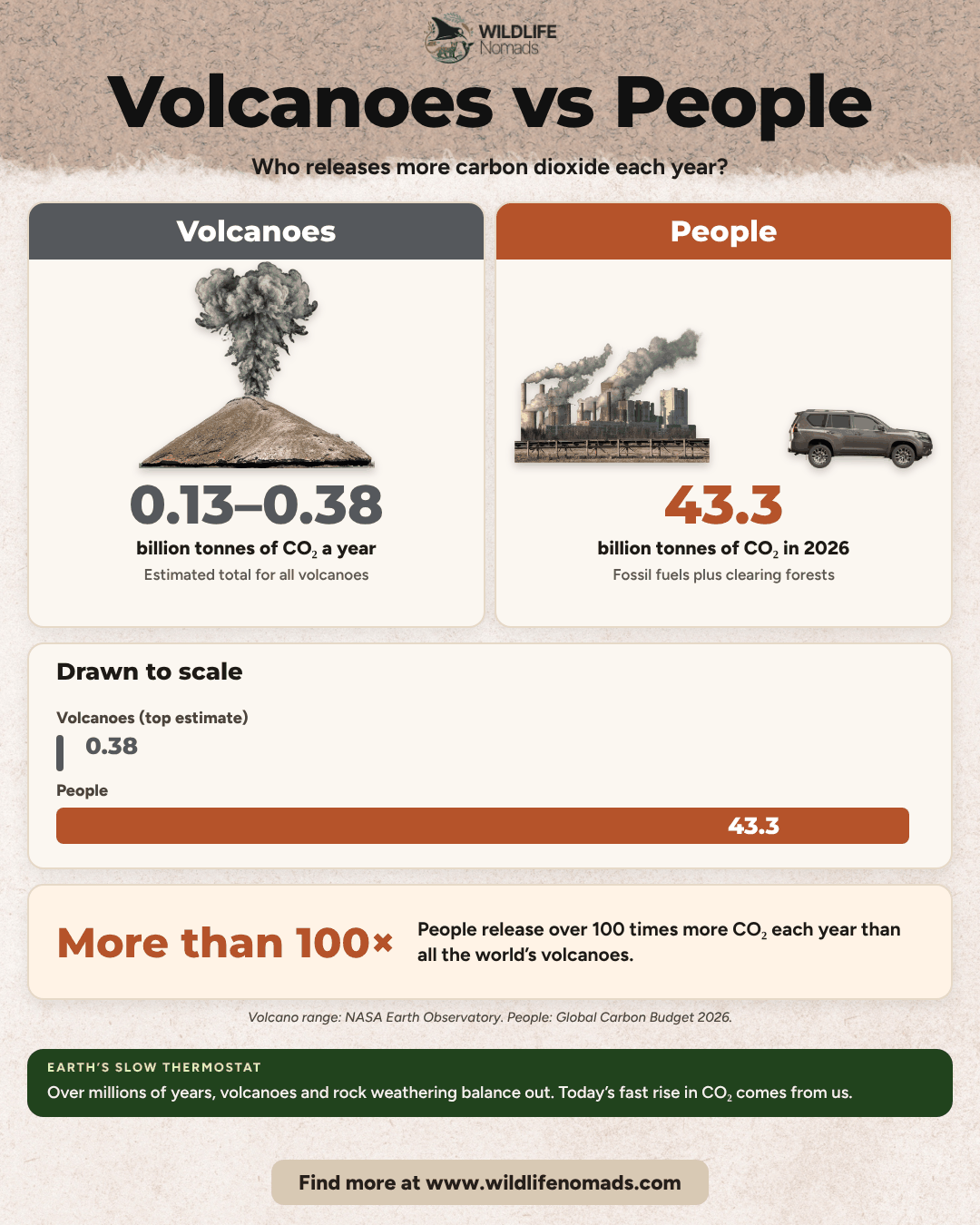
Volcanoes release about 130 to 380 million tonnes of carbon dioxide a year (NASA). People now release about 100 to 300 times more (NASA). Over millions of years, the slow cycle acts like a thermostat for Earth’s climate.
How fossil fuels form
Sometimes dead plants or plankton get buried before they rot. Heat and pressure work on them for millions of years. Ancient swamp forests became coal. Marine plankton mostly became oil and natural gas.
That buried carbon would normally stay out of the cycle for millions of years. Burning fossil fuels moves it back into the air in seconds.
The oceanic carbon cycle
The ocean holds over 40 times more carbon than the atmosphere, using the IPCC figures above. It exchanges carbon with the air every day.
Carbon dioxide dissolves at the sea surface. It reacts with water and mostly becomes bicarbonate. Cold water holds more dissolved gas than warm water. Ocean currents then sink this cold, carbon-rich water into the deep.
Ocean life adds a second route, the biological pump. Phytoplankton photosynthesise in sunlit water. Copepods and other grazers eat them, and their droppings sink. Dead plankton and even whale carcasses carry carbon down to the deep sea.
Coastal plants store carbon too. Mangroves, seagrass meadows and salt marshes lock it in their waterlogged soils. People call this blue carbon. I watched green sea turtles grazing seagrass while snorkelling from the shore at Marsa Alam, in Egypt. Those quiet meadows are carbon stores as well as turtle pastures.
Ocean acidification
The ocean pays a price for absorbing our carbon dioxide. The gas forms carbonic acid, so seawater becomes more acidic. Since the late 1980s, open-ocean surface pH has dropped by 0.017 to 0.027 units per decade (IPCC, 2021).
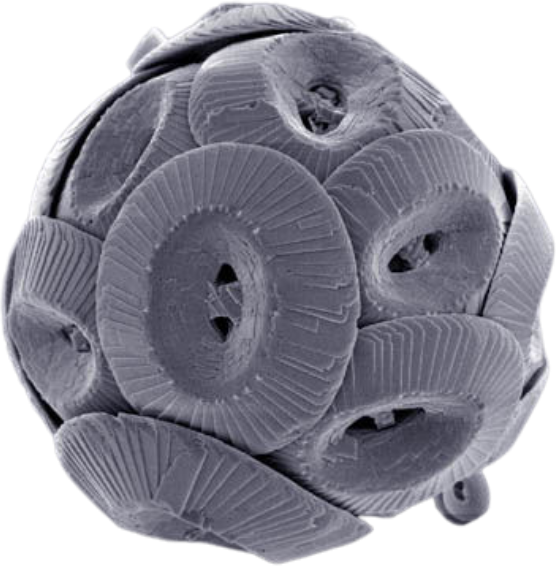
The extra acid uses up carbonate ions. Clams, corals and coccolithophores need those ions to build shells and skeletons. In 2025, Wildlife Nomads joined a coral restoration project with Metamorfosa Bali in Pemuteran. Planting coral there made the stakes feel very personal.
Heat is a separate threat. I saw coral bleaching for the first time on the Great Barrier Reef in 2019. Marine heatwaves cause bleaching, while acidification weakens the building blocks. Both come back to the same extra carbon. Try the Coral Reef Bleaching Simulator to see heat stress in action.
How human activity changes the carbon cycle
For thousands of years, carbon moved in and out of the atmosphere in near balance. Human activity broke that balance in two main ways.
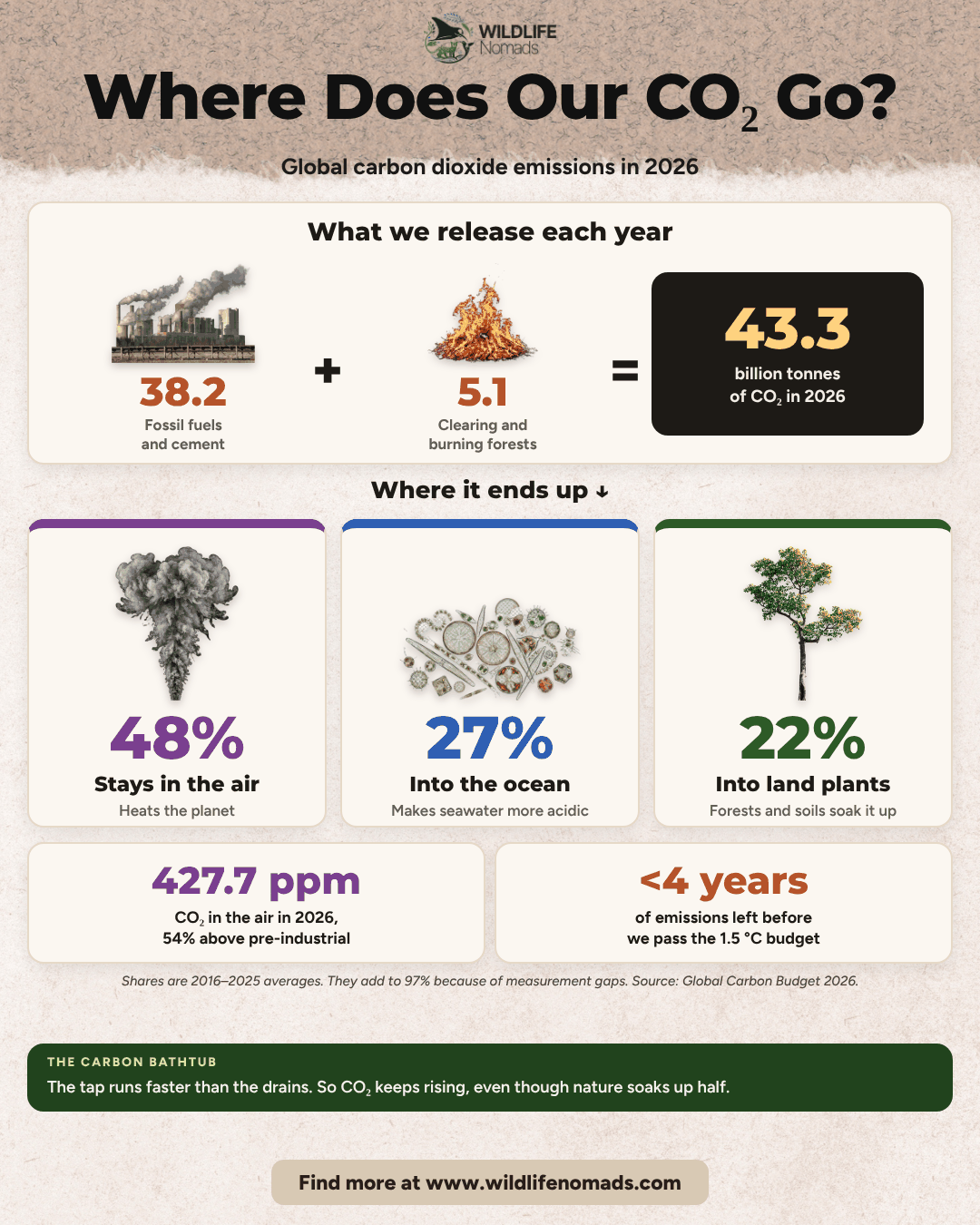
Burning fossil fuels is the biggest. The Global Carbon Budget 2026 projects 38.2 billion tonnes of fossil carbon dioxide this year. That is 0.4% lower than in 2025.
Land-use change is the second. Clearing forests and draining peat releases stored carbon. Land-use emissions are projected to rise to 5.1 billion tonnes in 2026. Peat fires and forest damage in Southeast Asia drove the increase. Explore this in the Deforestation Lab.
Together, people will release about 43.3 billion tonnes of carbon dioxide in 2026. From 1750 to 2019, people released about 700 billion tonnes of carbon. Less than half of it remains in the atmosphere today (IPCC, 2021).
Country trends in 2026: fossil emissions fall about 0.9% in China and 1.3% in the United States. They drop 1.5% in the European Union. India’s rise about 4.4% (Global Carbon Budget 2026).
Greenhouse gases and Earth’s temperature
Carbon dioxide and other greenhouse gases trap heat in the climate system. Without them, Earth would be far colder. With too much, global temperatures climb.
In 2019, carbon dioxide concentrations were higher than at any time in at least 2 million years (IPCC, 2021). Methane, another carbon gas, also reached a level unmatched in at least 800,000 years.
The IPCC compared future warming under different emissions paths. By 2081–2100, global surface temperature would very likely rise 1.0 to 1.8 °C above 1850–1900 levels under very low emissions. Under very high emissions, it would rise 3.3 to 5.7 °C.
Carbon sinks and carbon capture
Nature still cleans up about half our mess. Over the past decade, the ocean absorbed about 27% of human carbon dioxide emissions. Land plants and soils took about 22% (Global Carbon Budget 2026).
The sinks are not guaranteed. The Global Carbon Budget reports the ocean sink has barely grown since 2016. The land sink dipped during the 2023–24 El Niño and recovered in 2025.
Carbon capture technology tries to help. It collects carbon dioxide from smokestacks or straight from the air and stores it underground. Protecting forests, peatlands, mangroves and seagrass keeps natural stores intact.
Time is short. In 2026, the remaining budget for 1.5 °C of warming was about 150 billion tonnes of carbon dioxide. That is less than four years of current emissions. Play with this in the carbon bathtub, Stop 4 of the lab.
Is the carbon cycle a closed system?
For carbon, Earth is close to a closed system. Almost no carbon arrives from space or escapes into it. The same carbon atoms keep moving between reservoirs.
That is why the carbon cycle is so important. Carbon we take out of the ground does not disappear. It moves into the air, the ocean and living things, and it changes them.
Keep exploring
Want the bigger picture of how forests and other habitats disappear? Read my guide to habitat destruction. For coastal carbon stores, see why mangroves are so important.
Free mini guide
Take the carbon cycle with you
All four infographics in one printable PDF: how the cycle works, Earth’s carbon stores, where our CO₂ goes and volcanoes vs people, plus a quick quiz.
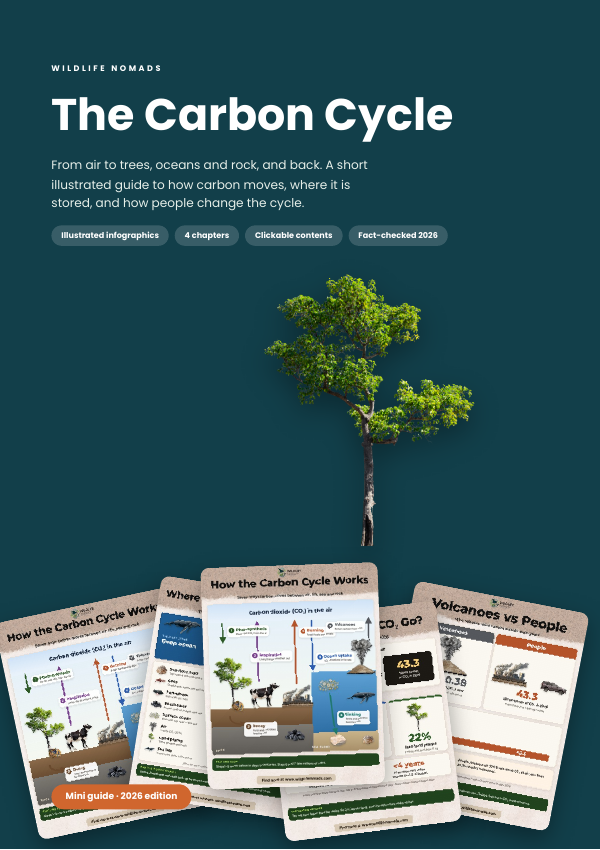 Free PDF · 14 pagesCarbon Cycle Mini GuideTrees, oceans, rocks and volcanoes, ready to print for home or class.Download free →
Carbon Cycle FAQ
The carbon cycle is how carbon moves around Earth. Plants take carbon dioxide from the air to make sugar. Animals eat the plants. Respiration, decay, fire and volcanoes send the carbon back to the air.
The main steps are photosynthesis, consumption, respiration, decomposition, ocean uptake, burial in sediments and release by volcanoes or burning. The first steps form the fast carbon cycle. Burial and volcanoes form the slow carbon cycle.
Rocks such as limestone hold most of Earth’s carbon. Among the active stores, the deep ocean is the largest, with about 37,100 billion tonnes of carbon. Soils, permafrost and the atmosphere follow (IPCC, 2021).
The fast carbon cycle moves carbon through living things in days to decades. The slow carbon cycle moves carbon through rocks and volcanoes. One slow loop takes 100 to 200 million years (NASA).
People burn fossil fuels and clear forests. That releases carbon that took millions of years to store. In 2026, these activities released about 43.3 billion tonnes of carbon dioxide (Global Carbon Budget 2026).
Carbon is the backbone of every living thing. The carbon cycle also controls how much carbon dioxide stays in the air. That gas traps heat, so the cycle helps set Earth’s temperature.
Carbon dioxide dissolves at the sea surface and mostly becomes bicarbonate. Phytoplankton also take it up by photosynthesis, and sinking plankton carry it deep. The extra gas makes seawater more acidic.
References
Canadell, J. G., Monteiro, P. M. S., Costa, M. H., Cotrim da Cunha, L., Cox, P. M., Eliseev, A. V., Henson, S., Ishii, M., Jaccard, S., Koven, C., Lohila, A., Patra, P. K., Piao, S., Rogelj, J., Syampungani, S., Zaehle, S., & Zickfeld, K. (2021). Global carbon and other biogeochemical cycles and feedbacks. In Climate change 2021: The physical science basis. Contribution of Working Group I to the Sixth Assessment Report of the Intergovernmental Panel on Climate Change (pp. 673–816). Cambridge University Press. https://doi.org/10.1017/9781009157896.007
Friedlingstein, P., O’Sullivan, M., et al. (2026). Global Carbon Budget 2026 [Preprint]. Earth System Science Data Discussions. https://essd.copernicus.org/preprints/essd-2026-895/
Integrated Carbon Observation System. (2026, November). Fossil CO₂ emissions decrease in 2026, according to the Global Carbon Budget. https://www.icos-cp.eu/news-and-events/news/fossil-co2-emissions-decrease-2026-according-global-carbon-budget
IPCC. (2021). Summary for policymakers. In Climate change 2021: The physical science basis. Contribution of Working Group I to the Sixth Assessment Report of the Intergovernmental Panel on Climate Change (pp. 3–32). Cambridge University Press. https://doi.org/10.1017/9781009157896.001
Riebeek, H. (2011). The carbon cycle. NASA Earth Observatory. https://science.nasa.gov/earth/earth-observatory/the-carbon-cycle/
U.S. Geological Survey. (2009, December 17). Volcano Watch: Volcanoes are not responsible for global warming. https://www.usgs.gov/observatories/hvo/news/volcano-watch-volcanoes-are-not-responsible-global-warming



