The first time a reddish bird truly stopped me, I was at my university town, in Mexico Puebla. A male Pyrocephalus rubinus, the Vermilion Flycatcher, dropped onto a mesquite snag like a lit match. I forgot my field notes entirely.
I’ve spent my career chasing animals across continents. Yet the older I get, the more I notice something. My friends who aren’t biologists keep falling for birds too. They text me blurry photos on hikes. They ask the same question you probably have: what is that little red bird?
That red is rarely an accident. Often it’s a signal, a male flashing bright feathers to attract females and rivals alike. This guide covers the most iconic and most probable red birds you’ll actually meet. You’ll learn to tell a cardinal from its many copycats, why females look duller, and what diet paints these birds red.
Why Are Birds Red in the First Place?
Before the checklist, one idea ties every species together. Reddish plumage in birds usually comes from carotenoid pigments in their diet, not from the birds themselves. They eat yellow carotenoids in fruit and insects, then convert them into red feathers through their own metabolism.
Males of many red bird species wear brighter feathers than females. That brightness is honest advertising. A rich red coat signals a well-fed, healthy male, so females often prefer him. By contrast, females of many species stay duller for camouflage while nesting on exposed ground or in open branches.
Interestingly, not every species uses the same chemistry. Research shows house finches build red from a different enzymatic pathway than cardinals do. Same color, different recipe. Keep that in mind as we move through these 15 red birds.
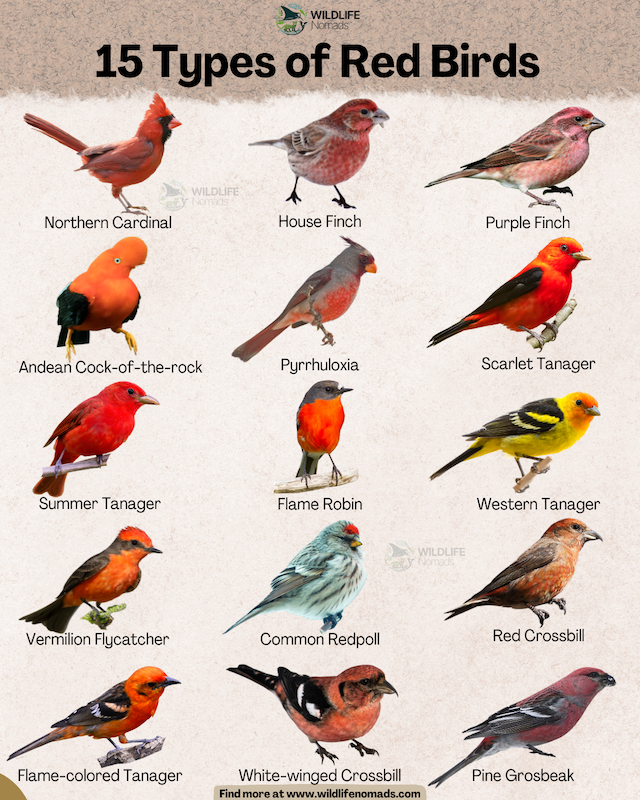
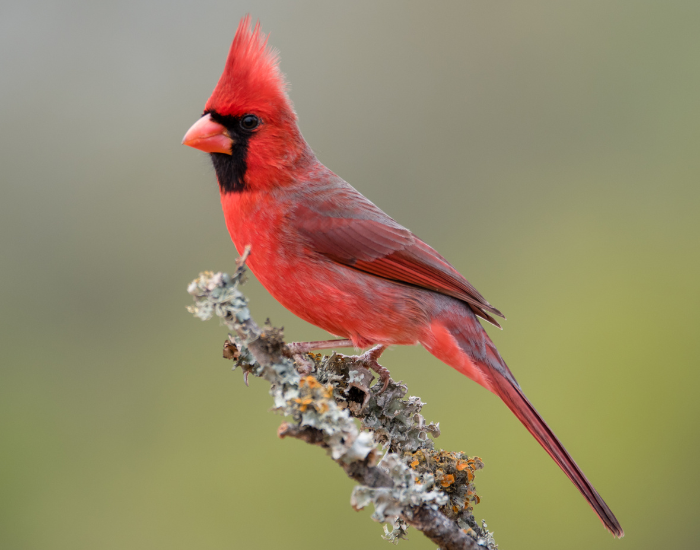
1. Northern Cardinal
If one bird defines “red bird” for most people, it’s this one. The Northern Cardinal has bright red plumage, a black mask, and an unmistakable pointed crest. Males glow crimson; females wear warm tan with red highlights on the wings, tail, and that same jaunty crest.
Cardinals are the ultimate backyard birds. You’ll find them in woodlands and parks year round, and they rarely leave home. They love feeders stocked with sunflower seeds. I’ve watched pairs stay together through winter, the male passing seeds to the female beak to beak, a genuine courtship gift.
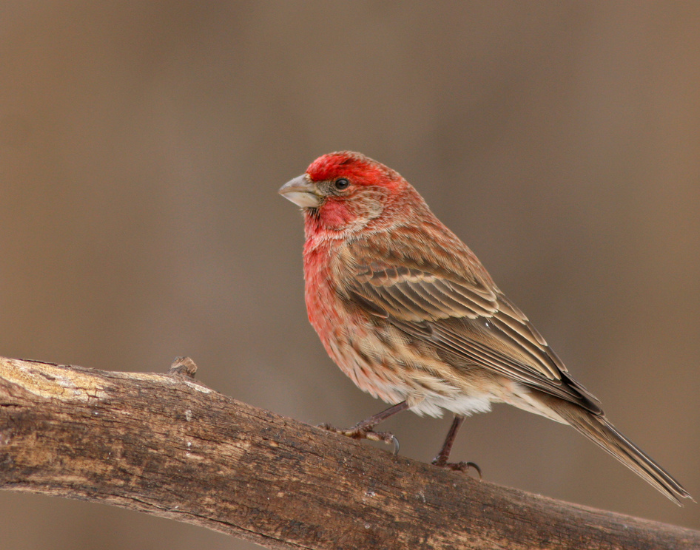
2. House Finch
Here’s the answer to a question I get constantly: the bird that looks like a red sparrow is almost always a House Finch. Males show a rosy red head and chest over streaky brown flanks. That combination, a red bird with brown wings and streaks, fools people daily.
House Finches are year round residents across the continental United States. Originally a western species, they now thrive in eastern backyards, cities, and suburbs. Females lack red entirely and look like plain brown, streaky sparrows. If you see a small reddish bird mobbing your feeder in a noisy flock, start here.
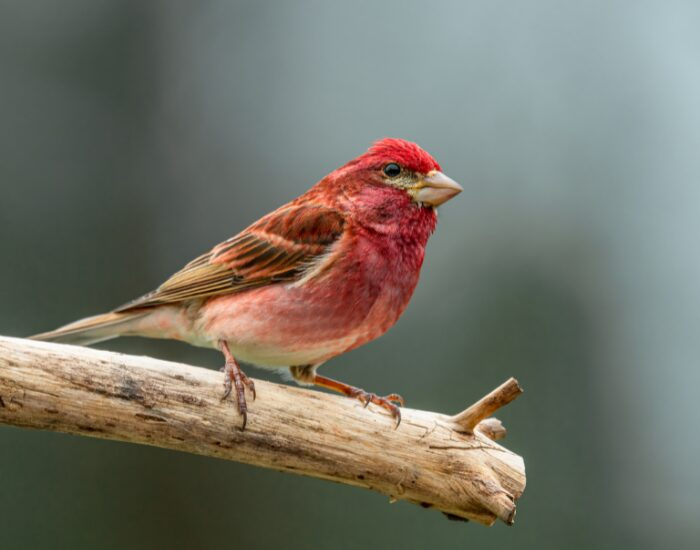
3. Purple Finch
The Purple Finch looks like a House Finch that got dunked in raspberry juice. Males are washed in rosy red across the head, back, and breast, deeper and more even than a House Finch’s. The name misleads everyone; there’s no purple, only a rich wine red.
Purple Finches are winter visitors across much of the northern and eastern United States, breeding farther north in cool conifer and mixed forests. They favor seeds and will visit feeders during cold months. Telling them from House Finches is a rite of passage for new birders, so don’t feel bad if you mix them up.
4. Pyrrhuloxia
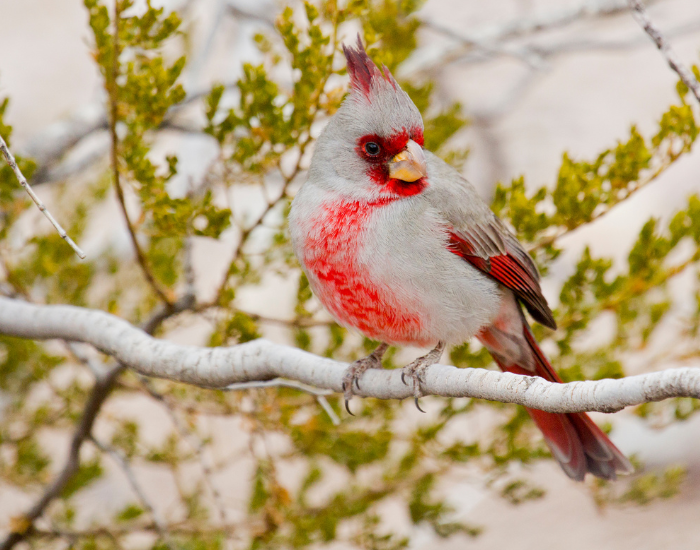
Want a small red bird that’s not a cardinal but looks like one? Meet the Pyrrhuloxia, sometimes called the desert cardinal. It shares the crest and shape but wears mostly gray with red accents down the face, breast, and crest, plus a stubby yellow bill.
I’ve tracked these birds through mesquite scrub in southern Arizona and Texas. They’re desert specialists, tough little songbirds that thrive where water is scarce. If a “faded cardinal” shows up in the arid Southwest, you’ve likely found a Pyrrhuloxia, one of the red birds most often mistaken for cardinals.
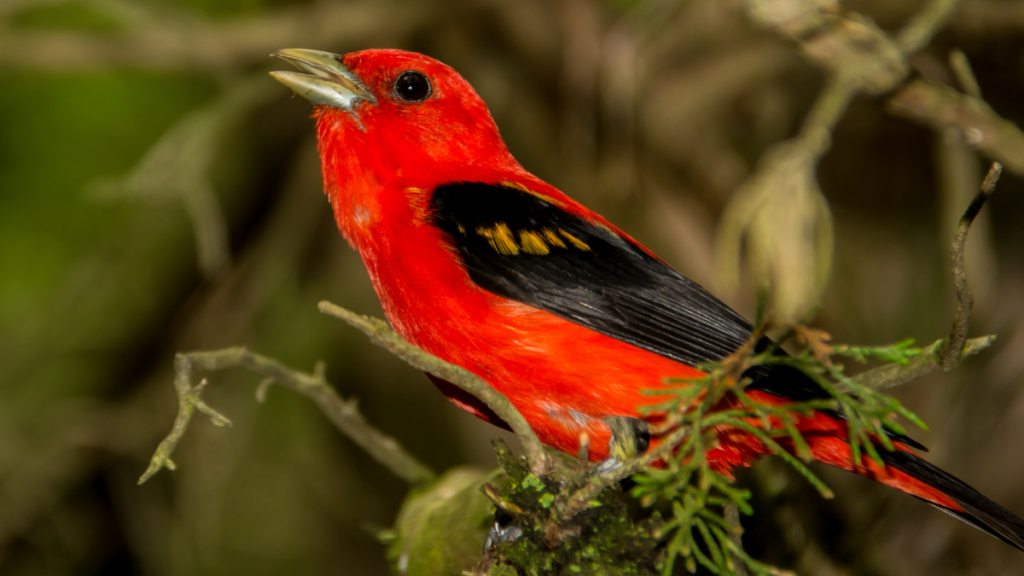
5. Scarlet Tanager
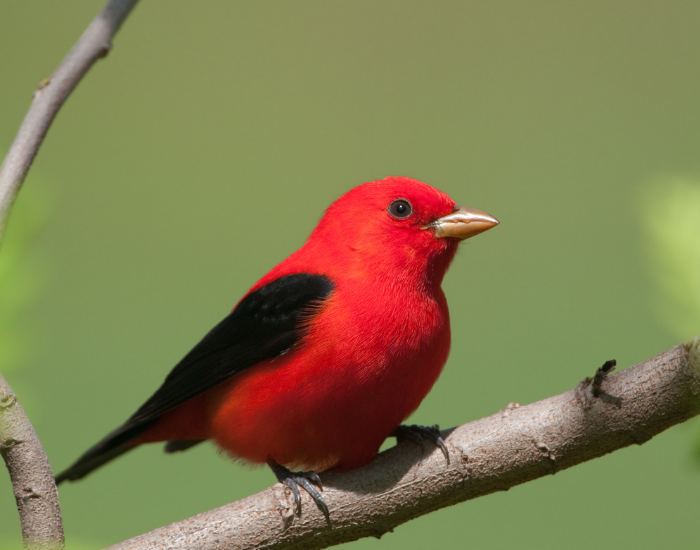
Few sights match a male Scarlet Tanager in spring. The Scarlet Tanager has bold black wings and searing red plumage, a contrast so sharp it looks painted. Females, by contrast, are olive-yellow and easy to overlook in the canopy.
Scarlet Tanagers are neotropical migrants. They breed in the mature forests of eastern North America, then travel to South America for winter. You’ll rarely see one at a feeder. Instead, listen for their burry, robin-like song high in the treetops, then scan for that flash of red among green leaves.
6. Summer Tanager
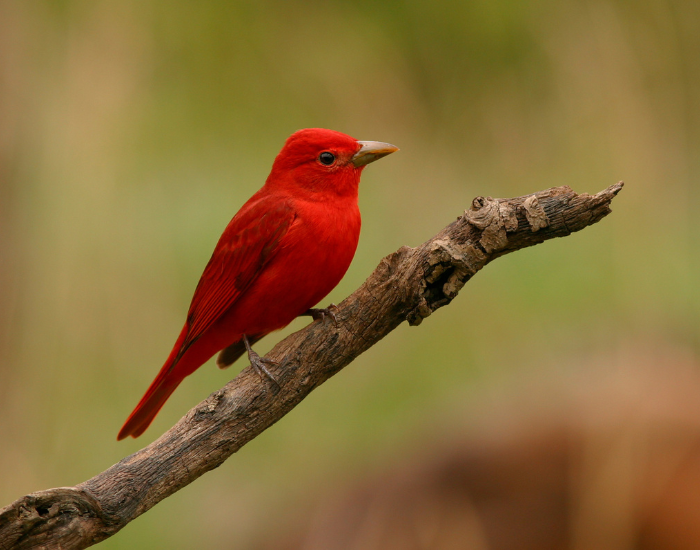
The Summer Tanager holds a special title: it’s the only all-red bird in North America. Males are rosy red from head to tail, with no black wings and no crest, a clean ruby glow. Females are a soft mustard yellow.
These birds are bee and wasp specialists. I’ve watched one catch a wasp midair, then wipe the stinger off on a branch before swallowing, a party trick that never gets old. Summer Tanagers migrate north to breed in southern and eastern states, favoring open woodlands. They spend our winter in Central and South America.
7. Western Tanager
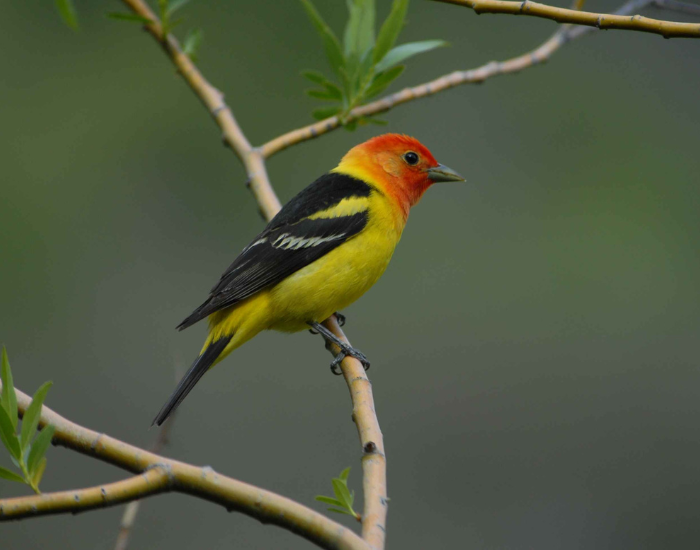
Out West, the tanager story changes color. The male Western Tanager pairs a fiery red-orange head with a bright yellow body and black wings, like a sunset with feathers. It’s one of the prettiest red birds in the mountain West.
That red head comes from a pigment the bird can’t make itself. Western Tanagers get it through their diet of insects and fruit, likely from their prey. They breed in western conifer and mixed forests, then head to Mexico and Central America for winter. Catch one at a spring stopover and you won’t forget it.
8. Vermilion Flycatcher
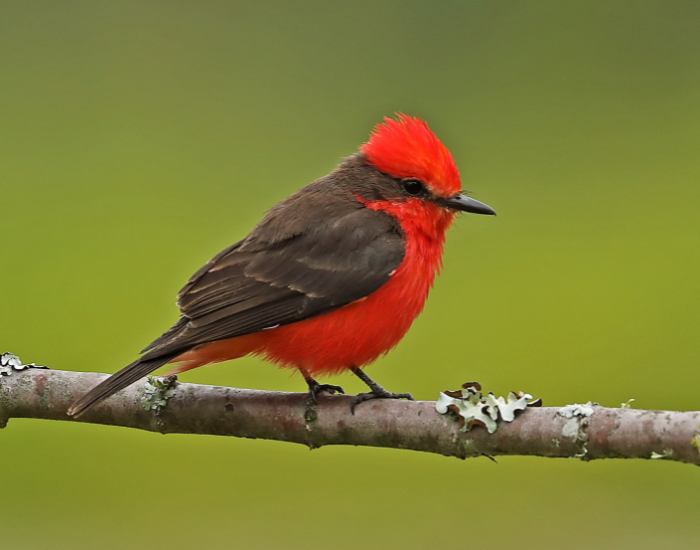
This is my Álamos bird, the one that started this whole obsession. The male Vermilion Flycatcher is a tiny red bird with a brilliant scarlet crown and underparts set against a dark brown mask and back. Females wear peachy salmon tones instead.
You’ll find Vermilion Flycatchers near water in the Southwest, along desert streams, ponds, and irrigated fields. They hunt from low perches, sallying out to catch flying insects, then returning to the same twig. Few cute red birds are as photogenic. When one performs its fluttering courtship flight, stop and watch.
9. Common Redpoll
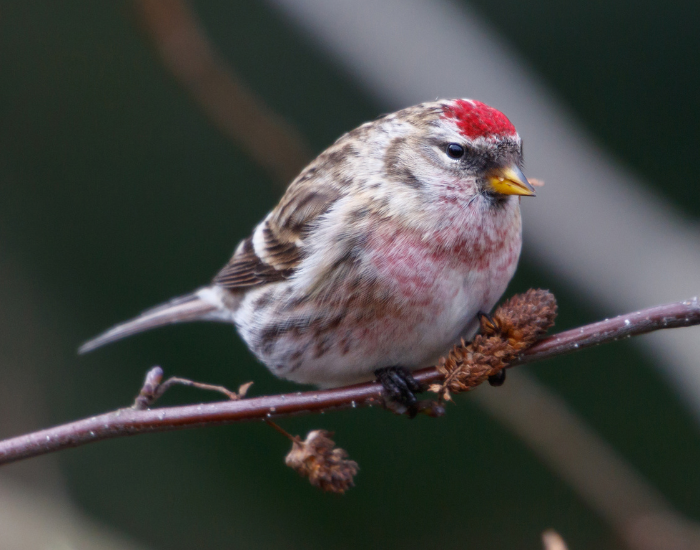
If you’re hunting for the tiny little red birds that appear in winter flocks, the Common Redpoll delivers. It’s a small, streaky finch with a bright red cap on the forehead and, in males, a rosy blush across the chest. Think sparrow-sized, energetic, and always in motion.
Redpolls breed in the far Arctic and irrupt south in cold years, sometimes flooding feeders in huge flocks. They love nyjer and small seeds and can survive brutal cold by storing food in a throat pouch. Spot a little red bird clinging upside down to a birch catkin and you’ve likely found one.
10. Red Crossbill
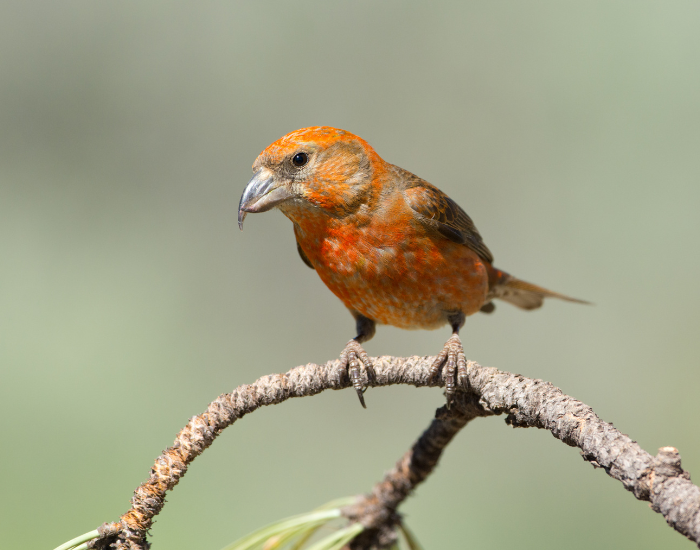
The Red Crossbill is a bird built like a tool. Males are brick red with dark wings, but the real marvel is the bill. The Red Crossbill uses its crossed mandibles to pry apart conifer cones and extract seeds no other finch can reach.
That specialization runs deep. Different populations, called call types, carry slightly different bill shapes matched to their key conifers, a living example of coevolution between birds and trees. You’ll find them wandering conifer forests wherever cone crops are good. Their movements are unpredictable, so seeing one always feels like luck.
11. White-winged Crossbill
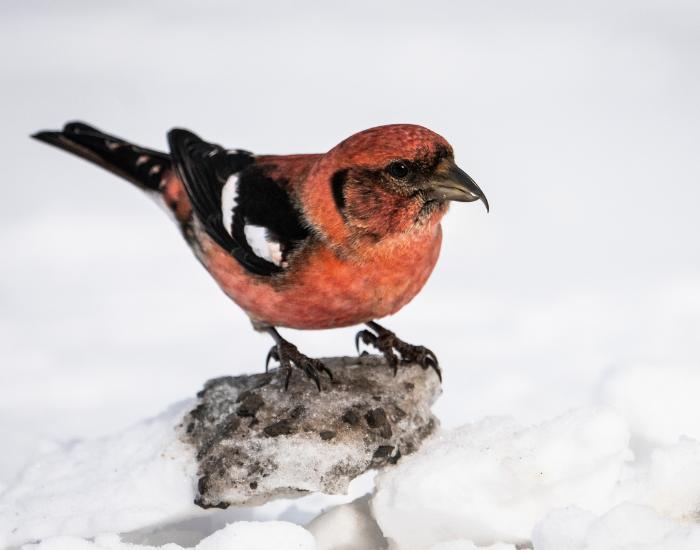
Its cousin adds two bold white wing bars to the formula. The male White-winged Crossbill is pinkish red with jet black wings crossed by those white slashes, a striking combination in a snowy spruce. Females trade red for a mossy yellow-green.
These are the two species of crossbill you’ll meet in North America, and both live and die by conifer seeds. White-winged Crossbills specialize in spruce and tamarack, wandering huge distances to track cone crops. I once found a flock stripping tamaracks in a bog at dawn, their soft chatter the only sound for miles.
12. Pine Grosbeak
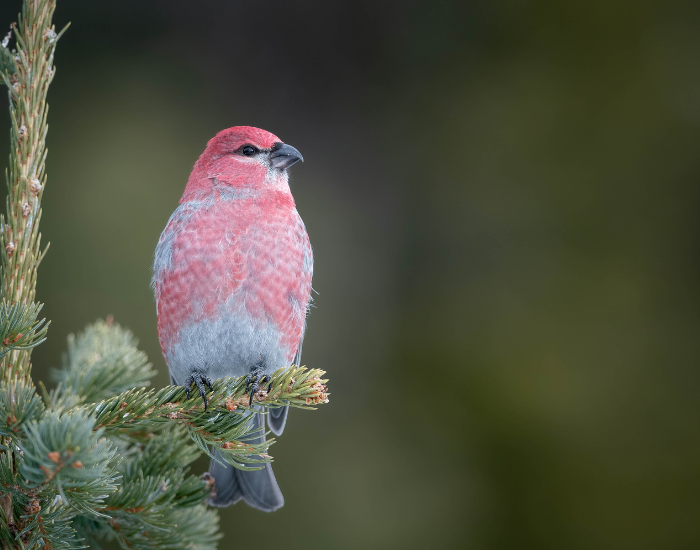
The Pine Grosbeak is the gentle giant of the red finches, plump and slow-moving with a stubby dark bill. Males are a soft rose red washed over gray; females and young birds show warm yellow or russet on the head instead. Everything about them reads unhurried.
Pine Grosbeaks are seen in northern conifer forests year round, drifting south into the northern states only in hard winters. They feed on buds, seeds, and fruit, often letting you walk right up to them. Among red feathered birds, few are as approachable or as quietly beautiful.
13. Red-winged Blackbird
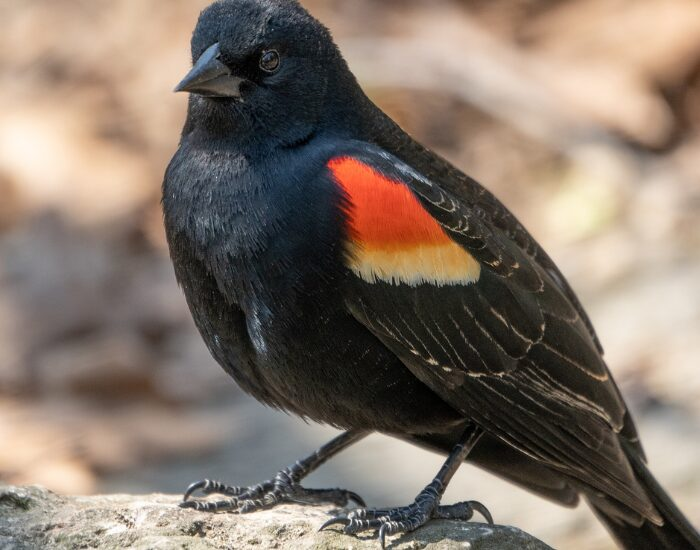
Not every red bird is red all over. The male Red-winged Blackbird is glossy black with brilliant red-and-yellow shoulder patches he flares to defend his turf. Those epaulets are pure signal, hidden or displayed depending on mood. Females look like large, dark-streaked sparrows.
Red-winged Blackbirds prefer marshy areas in spring, where males sing from cattails at dawn to claim territory. I’ve been dive-bombed by protective males more times than I can count. They’re among the most abundant birds in North America, so a wetland edge almost guarantees a sighting.
14. Ruby-throated Hummingbird
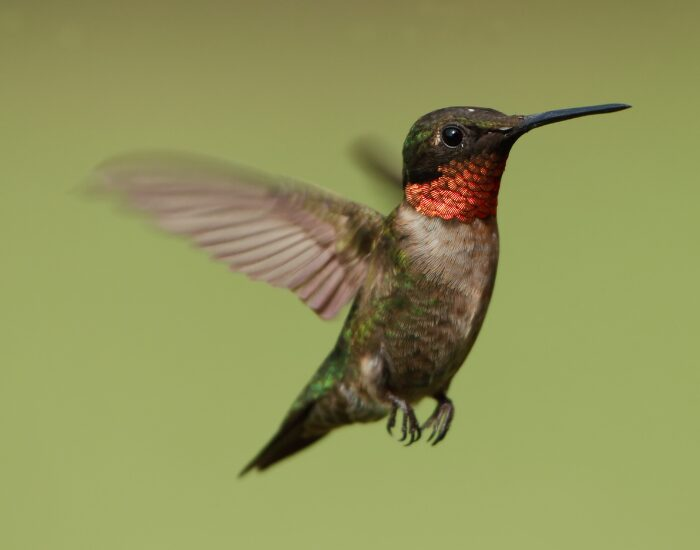
The smallest red flash in the eastern yard belongs to a hummingbird. The male Ruby-throated Hummingbird has a brilliant red gorget, a throat patch that blazes crimson in sunlight and goes black in shade. It’s structural shimmer, not pigment, so the color flickers as he turns.
These birds are neotropical migrants too, crossing the Gulf of Mexico twice a year. They defend flowers and feeders fiercely despite weighing less than a nickel. Hang a nectar feeder and you’ll host them all summer. Watch the male’s gorget catch the light and you’ll understand why red gets attention. Another hummingbird worth seeing is the Rufous Hummingbird is the rufous hummingbirds, but it may belong better to our list of orange birds, but still worth noting it!
15. Scarlet Ibis
For the boldest red of all, we leave the backyard. The Scarlet Ibis is a type of ibis of northern South America that glows an almost unreal fire red, from its long curved bill to its wingtips. It’s the pretty red bird that looks impossible when a flock lifts off a mangrove at sunset.
Here’s the twist. Scarlet Ibis coloration derives from astaxanthin pigments in their crustacean diet, especially red crabs and shrimp in their wetland habitat. Chicks hatch drab gray-brown and turn red only as they eat. Stop feeding on those crustaceans and the fire fades, proof that in the bird world, you truly are what you eat.

Frequently Asked Questions
It’s almost always a male House Finch. It has a red head and chest over brown, streaky, sparrow-like sides. This red bird with brown wings is common at feeders across the country. Females lack red and look like plain brown sparrows, which adds to the confusion.
The top look-alikes are the Pyrrhuloxia, Summer Tanager, Scarlet Tanager, and Vermilion Flycatcher. The Pyrrhuloxia is the classic small red bird that’s not a cardinal, sharing the crest but wearing mostly gray. Tanagers lack the cardinal’s crest, and the flycatcher is far smaller with a dark mask.
House Finches and Purple Finches both look like sparrows with red added to the head and chest. Common Redpolls fit too, with their small red cap and streaky bodies. Check where the red sits and how streaky the flanks are to tell these little red birds apart.
Both sexes exist, but females are usually far duller. Duller colors help camouflage females during nesting, when sitting still on eggs matters more than showing off. Female house finches, tanagers, and cardinals all trade bright red for browns, olives, and grays.
Ready to Name the Next One?
Red in birds is a story about diet, honesty, and survival, written in feathers you can read from your porch. Learn a few of these 15 species and the mystery reddish bird on your next walk becomes an old friend with a name.
So go look. Fill a feeder, watch the treetops, and check the marsh edge at dawn. When you spot your first Pyrrhuloxia or Summer Tanager, come tell me in the comments. If you want more backyard detective work, wander through my other bird guides on species like wrens, sparrows, and finches, then head outside and see what red bird finds you.
Can You Name That Red Bird? ❤️
A 15-photo identification challenge — the wrong answers are deliberately tricky look-alikes (the cardinal copycats will test you). Go back and change any answer before you score.
Which red bird is this?
References:
Benkman, C. W. (2010). Diversifying coevolution between crossbills and conifers. Evolution: Education and Outreach, 3(1), 47–53. https://doi.org/10.1007/s12052-009-0190-8
Simons, M. J. P., Cohen, A. A., & Verhulst, S. (2012). What does carotenoid-dependent coloration tell? Plasma carotenoid level signals immunocompetence and oxidative stress state in birds—A meta-analysis. PLOS ONE, 7(8), e43088. https://doi.org/10.1371/journal.pone.0043088
Weaver, R. J., Santos, E. S. A., Tucker, A. M., Wilson, A. E., & Hill, G. E. (2018). Carotenoid metabolism strengthens the link between feather coloration and individual quality. Nature Communications, 9, 73. https://doi.org/10.1038/s41467-017-02649-z
Koch, R. E., Truong, C. N., Reeb, H. R., Joski, B. H., Hill, G. E., Zhang, Y., & Toomey, M. B. (2025). Multiple pathways to red carotenoid coloration: House finches (Haemorhous mexicanus) do not use CYP2J19 to produce red plumage. Molecular Ecology. https://doi.org/10.1111/mec.17744
Centanni, C., Robinson, W. D., & Young, M. A. (2024). Is resource specialization the key? Some, but not all Red Crossbill call types associate with their key conifers in a diverse North American landscape. Frontiers in Bird Science, 3, 1321583. https://doi.org/10.3389/fbirs.2024.1321583